
Keeping track of trailers with EYE Bluetooth beacons
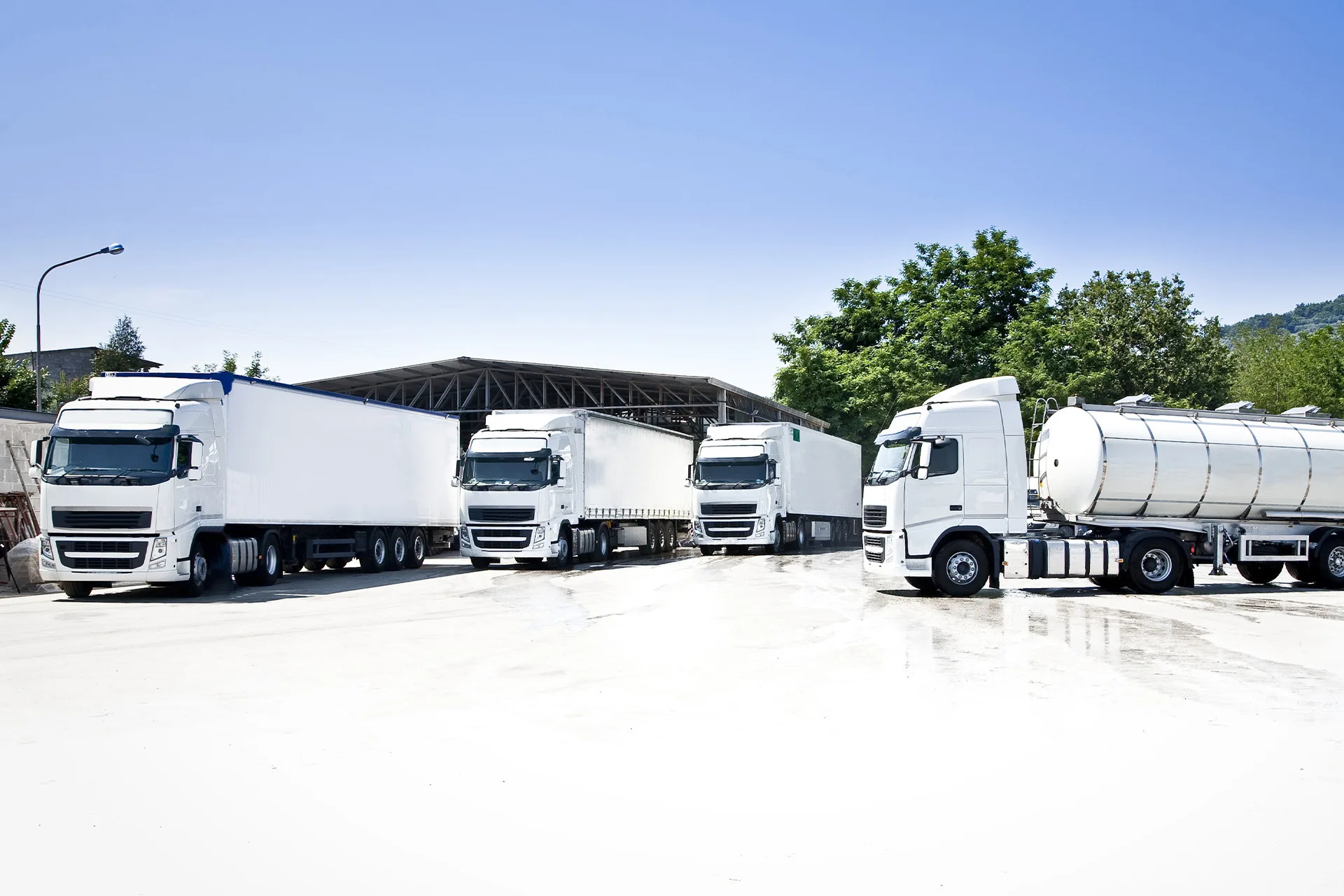
A logistics company finds out which trailer is coupled to which tractor unit and where it has been left from an EYE Beacon on the trailer, whose signal is picked up by a Teltonika tracker in the cab.
A logistics company finds out which trailer is coupled to which tractor unit and where it has been left from an EYE Beacon on the trailer, whose signal is picked up by a Teltonika tracker in the cab. The tractor units in a fleet usually have trackers already; the trailers do not. And there are fewer tractor units than trailers, drivers change them over several times a week, and a month later nobody can say for certain which trailer is standing where and how much work it has actually done. In this Teltonika scenario a small wireless Bluetooth beacon is hung on each trailer. The tractor unit's tracker recognises the beacon when the trailer is nearby and sends that to the server along with its coordinates. There is no need to fit a second tracker on the trailer.
What this scenario solves
The dispatcher does not know which trailer is in service and which is standing idle.
A driver can set off with the wrong trailer, and it only surfaces at the customer's premises.
Without a record of a trailer's working hours there is no way of telling whether it pays for itself.
Paper coupling logs tell lies and lag behind reality.
The dispatcher does not know which trailer is in service and which is standing idle. A driver can set off with the wrong trailer, and it only surfaces at the customer's premises. Without a record of a trailer's working hours there is no way of telling whether it pays for itself. Paper coupling logs tell lies and lag behind reality.
The market is large and growing. According to the Automobile Trailers Global Market report, the world market for road trailers was valued at 20.3 billion dollars in 2021. For a haulier, trailers and tankers are as valuable a part of the fleet as the tractor units, and they have to be managed with the same precision, whether the work is domestic or international.
Without control everything starts to unravel. Trailers get lost on other people's yards, are used without permission, are stolen. Deadlines slip, customers complain, orders fall away, and the money invested in the fleet does not earn its keep. Keeping track of trailers stopped being a nice-to-have long ago; without it a logistics company simply performs worse than its competitors.
The dispatcher and the manager have plenty of questions. Where each trailer is now and what its mileage is. Which driver is pulling it. Whether the load has been delivered or not, how many stops there were in a day or on a run, where the trailer was left to stand and which tractor unit is nearest to it now.
Another question concerns the return on the asset. How many hours a particular trailer worked over a shift, a week, a month, a quarter. Most companies keep some record of how heavily their plant and their people are used, and trailers are no exception: without those figures there is no way of deciding whether new trailers are needed or whether the existing ones are enough.
What Teltonika offers
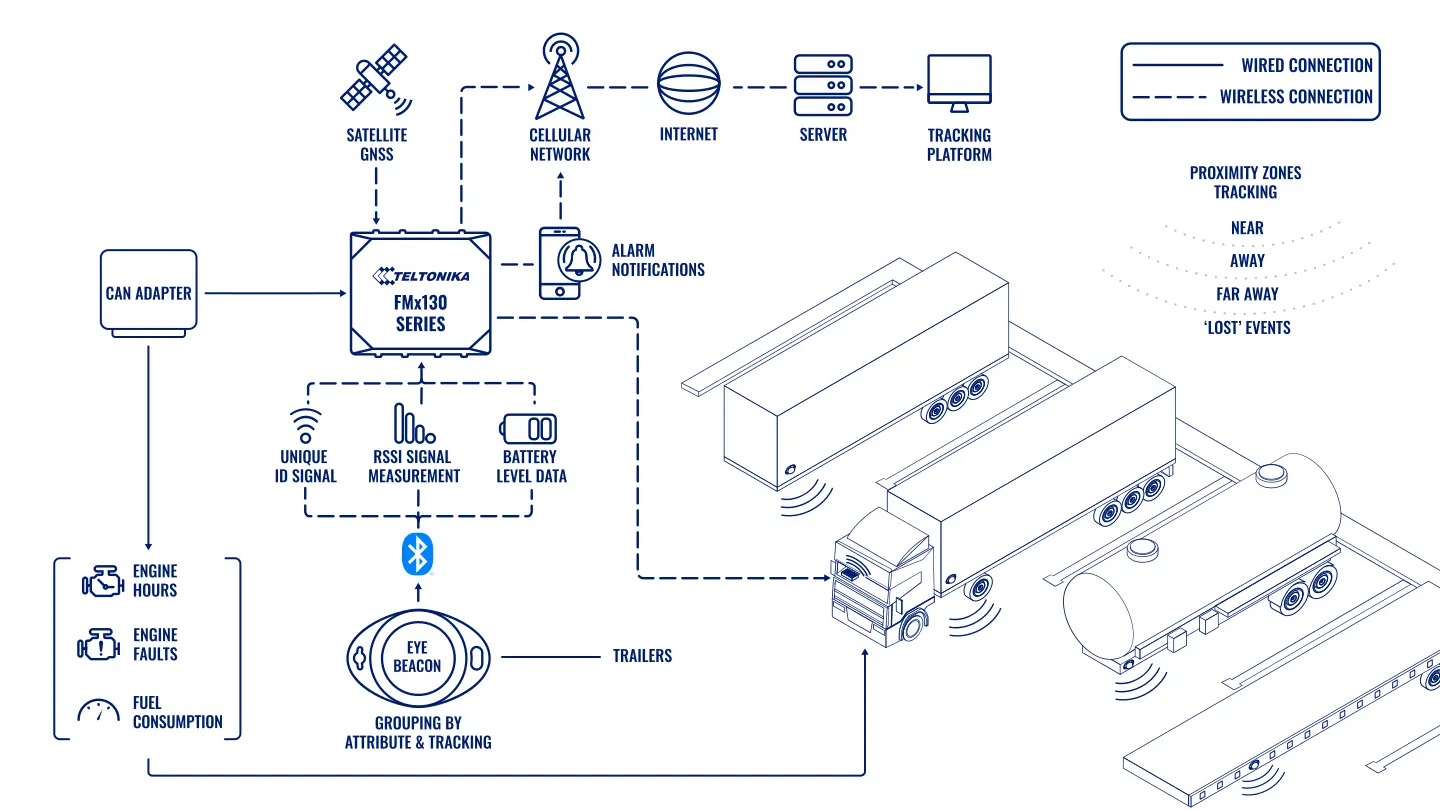
An EYE Beacon with its own identifier is fitted to the front of every trailer, and the Teltonika trackers on the tractor units recognise over Bluetooth which beacon is nearby and send that to the server along with their own coordinates.
Installation and setup
Fitting the device and configuring it for the fleet scenario at hand.
Data transfer
The device collects data and sends it to the monitoring platform; how often depends on the model and its settings.
Analysis and control
The person in charge gets reports and alerts and looks into what stands out.
The trackers. All Teltonika trackers on the FMB platform, together with the FMC130 and FMC650 models, support Bluetooth LE and work with beacons and sensors. The case study takes an FMC130 on a lorry as its example. If the tractor units are already equipped with trackers like these, the solution is added to them with no change of hardware.
The beacons. The EYE Beacon is light and small, and is fixed to the front of the trailer, nearer the tractor unit's cab. Almost any type suits: flatbed trailers and chassis, semi-trailers, box vans, refrigerated units, intermodal chassis and containers, general cargo trailers, tankers.
How it works. At a set interval the beacon transmits its identifier by radio, and each beacon's is its own. The tracker on the tractor unit hears it, recognises it and sends the data to the server in iBeacon or Eddystone format along with its own GNSS coordinates. The monitoring software shows the position of every beacon, and therefore of every trailer, by its proximity to a tracker, and helps keep a record of which beacon is linked to which trailer.
Trailers can be viewed from any device with an internet connection: a phone, a tablet, a laptop, the computer in the office. The manager sees the real picture and plans the work instead of establishing where everything is by telephone and from paper notes.
The proximity event. The tracker generates events based on the strength of the Bluetooth signal. Trailers within a set distance of the tractor unit are counted, and those further off are ignored. Two events can be configured: the tractor unit has come up to the trailer and entered the zone (event 1), and the tractor unit has driven off and left the zone (event 2). That shows the moment of coupling and uncoupling. Beacons can be divided between a Near and a Far zone.
Filtering by name. Beacons are grouped by whatever matters for the work, by trailer type for instance. Or the tracker sees only the beacons of its own fleet and does not react to others when another company's trailer is standing nearby. At large terminals that is particularly important.
What this looks like in service. A driver picks up a trailer from the yard by a warehouse. As soon as the tractor unit draws up, the tracker registers the beacon entering the zone and a coupling event. The dispatcher sees the trailer number next to the tractor unit number in the system. If the driver has coupled up the wrong trailer by mistake, it shows immediately, while the vehicle is still on the yard. When the trailer is uncoupled at the customer's premises, the tracker registers the beacon leaving the zone, and the point where the trailer was left stays in the system.
Why Bluetooth. The link is cheap, sparing with power and accurate enough for this job. A beacon is easy to fit and just as easy to replace if it is broken or torn off. Signal strength and transmission interval are set to suit a particular fleet, so the solution scales from a dozen trailers to hundreds.
What reports the manager gets. For each trailer it shows how many hours it was coupled up over a shift, a week or a month, which tractor units and drivers it worked with, how many kilometres it covered and where it stood idle. If half the trailers stand unused for months, that is an argument for redistributing what you have rather than buying new ones. If one trailer is constantly on the road, it is time to plan its servicing.
The rollout. First you check which trackers are fitted to the tractor units and whether they support Bluetooth, updating the firmware where necessary. Then the beacons are ordered or renamed to suit the fleet's filter, fixed to the trailers, and each beacon is linked in the system to a trailer number. The last step: set the signal threshold for the proximity event, so that the tracker does not confuse the trailer it is coupled to with the one next to it in the yard.
A check on the yard. The signal threshold for the proximity event is chosen on a real yard: you place a tractor unit with a coupled trailer and a neighbouring one beside it, look at the signal strength from both beacons and pick the value at which the tracker reliably tells its own trailer apart. A beacon's battery drains faster the more often it transmits, so the interval is set to suit how often the trailers are changed over. The report for each trailer carries the time and place it was last detected: that is the point where the tractor unit left it, not its current coordinates.
What you get
Every trailer on the map
The dispatcher and the manager can see where a trailer is, which tractor unit it is travelling with and where it was left, from any device.
Added to existing trackers
If the tractor units already have Teltonika trackers, all it takes is hanging beacons on the trailers and switching scanning on.
Coupling and uncoupling recorded automatically
The proximity event shows when the tractor unit took the trailer and when it left it.
Only your own beacons
Filtering by name cuts out other companies' trailers on shared yards and groups your own by type.
Cheap and wireless
A beacon goes on in minutes, needs no power from the trailer and is quickly replaced if it fails.
Why this solution
Teltonika trackers and EYE Beacon beacons are made by the same manufacturer and configured through the same configurator. The proximity event and filtering by name functions are already in the trackers' firmware, so keeping track of trailers needs no logic of your own to be written.
The solution suits companies whose tractor units are already equipped with FMB130, FMC130 or FMC650 trackers. The outlay comes down to the beacons and the configuration, and the data arrives in the same monitoring system the fleet already uses.
An honest limitation: a beacon has no GPS or mobile connection of its own. A trailer standing alone on a yard stays in the system at the last point where the tractor unit's tracker saw it. If a trailer is stolen without a tractor unit carrying a tracker, the beacon will not show it. For guarding trailers in a yard, a self-contained tracker with a battery is a better fit, while a beacon solves the job of recording couplings and utilisation.
How this works in Azerbaijan. The scenario gives most benefit to hauliers who have more trailers than tractor units and work by dropping a trailer for loading and picking up another. That means the logistics terminals and warehouses in Baku, Sumgait and Ganja, the yards by the port of Alat where trailers wait for the ferry, and the retail chains' distribution centres in Absheron. On large yards trailers belonging to different companies stand side by side, so filtering by name is essential — otherwise the tracker will pick up other people's beacons. In summer the metal of a trailer heats up badly in the sun, so a beacon is better fixed to the shaded front wall rather than the roof. GPS.az selects the EYE beacons, sets up the proximity events and the name filter on the Teltonika trackers and presents reports in Wialon on couplings, trailer stops and their utilisation.
Related case studies
Related rollouts and equipment

Questions about the “Keeping track of trailers with EYE Bluetooth beacons” scenario
Request a call
A specialist will call back and match a solution to your fleet and your task.