
Van door monitoring with an EYE Sensor
A Teltonika scenario for haulage firms and delivery services: a wireless EYE Sensor with a magnet reports every opening of the cargo door to the tracker, and the dispatcher sees where and when it happened.
A Teltonika scenario for haulage firms and delivery services: a wireless EYE Sensor with a magnet reports every opening of the cargo door to the tracker, and the dispatcher sees where and when it happened. On many vans and lorries the state of the rear door cannot be read from the CAN bus or from the on-board computer. Running a cable from a limit switch through the whole body is awkward and expensive, especially when the fleet is large and mixed. A Bluetooth sensor solves the problem without wiring: it is stuck inside the body, the magnet goes on the door, and half an hour later the vehicle is already reporting opening and closing events.
What this scenario solves
Most cargo theft happens in transit — industry figures put it at about 71% of all cases.
Tools are one of the most frequent targets, and they are almost never recovered: in the UK only about 1% of stolen tools are found.
Expensive cargo in a van with no door monitoring is easy prey.
The worst case is a vehicle where the state of the door is visible neither over CAN nor in the on-board data.
Most cargo theft happens in transit — industry figures put it at about 71% of all cases. Tools are one of the most frequent targets, and they are almost never recovered: in the UK only about 1% of stolen tools are found. Expensive cargo in a van with no door monitoring is easy prey. The worst case is a vehicle where the state of the door is visible neither over CAN nor in the on-board data.
A wired limit switch on such a vehicle means stripping the trim, a cable through the body and connectors that corrode over time from damp and vibration. Across a dozen vans of different makes it turns into a project of its own.
Door data is not only about security. The logistics manager needs to know when loading began, how long unloading took and exactly where the vehicle was opened. Without that it is hard to compare drivers, count time at drops and spot stops that should not be there.
Finally, the solution has to be inexpensive. A delivery service will not fit every van with cash-in-transit grade alarms; it needs simple, dependable protection for dozens of vehicles at once.
What Teltonika offers
Teltonika builds the solution from off-the-shelf components: an FMB130 or FMC130 tracker, an LV-CAN200 CAN adapter to read vehicle data, and a wireless EYE Sensor with a magnet that reacts to the door opening.
Installation and setup
Fitting the device and configuring it for the fleet scenario at hand.
Data transfer
The device collects data and sends it to the monitoring platform; how often depends on the model and its settings.
Analysis and control
The person in charge gets reports and alerts and looks into what stands out.
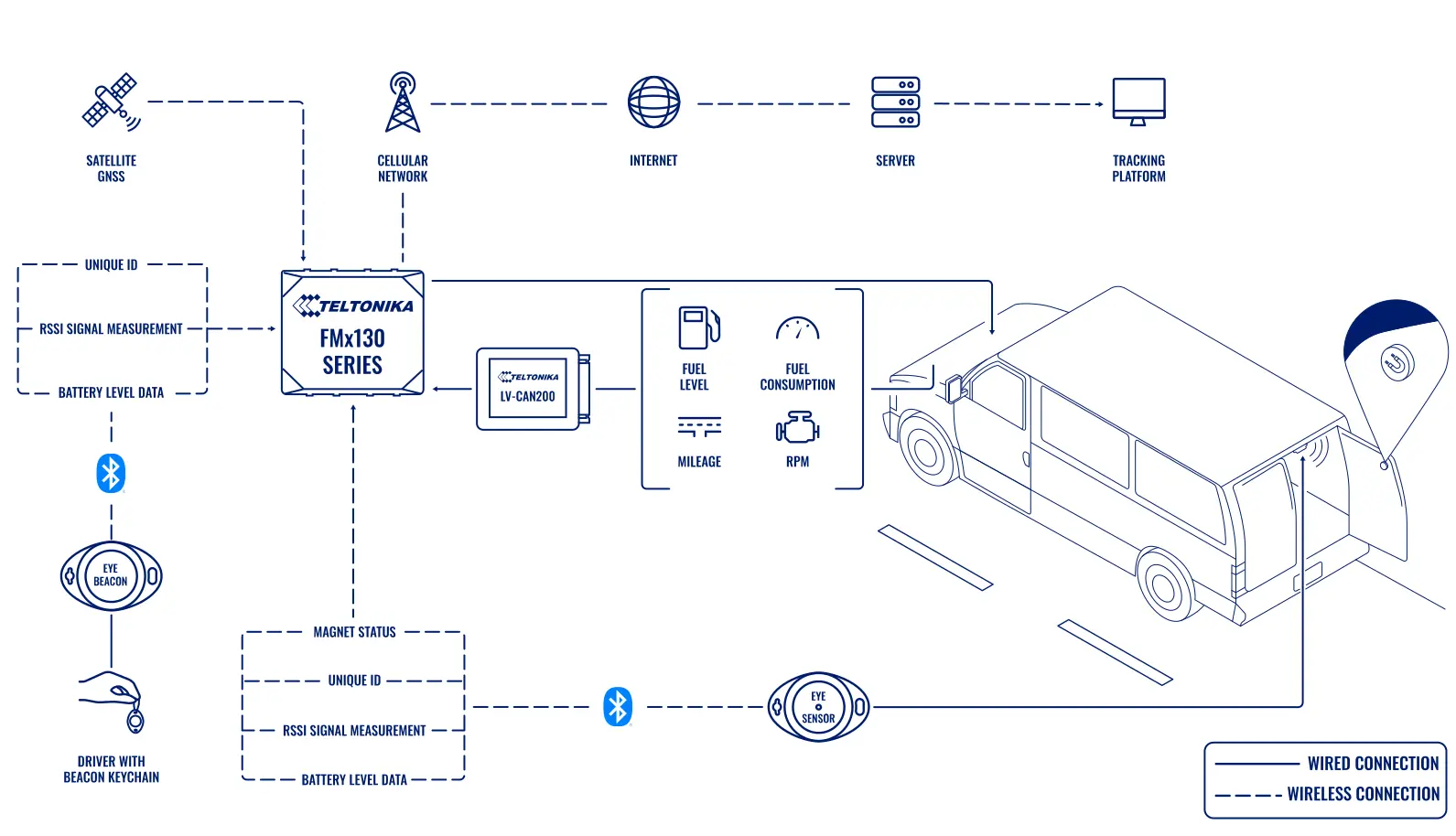
Inside the EYE Sensor there is a magnetometer. The sensor is fitted inside the body next to the opening, and a small magnet goes on the rear door leaf so that in the closed position it sits opposite the sensor. The door opens, the magnet leaves the detection zone, the sensor notices it and reports to the tracker over Bluetooth LE. The door closes, the magnet is back, and the tracker gets a new event. No wires between the body and the cab.
The tracker sends the events to the server over the mobile network together with coordinates and time. For the dispatcher they appear as marks on the track: here the vehicle is standing at the warehouse with the door open for 14 minutes, here it is closed and the vehicle moves off. If the door opens where it should not — on the road between two drops, say, or overnight in a car park — the system raises an alert immediately, to the dispatcher and, if required, to the driver.
Picture a van carrying power tools around building sites. The driver pulls into a filling station and goes inside to pay, and meanwhile somebody opens the rear door. A few seconds later a notification appears for the dispatcher with the address of the filling station. Ringing the driver takes less than a minute, and there is a real chance of catching the thief on the spot. Without the sensor the loss would only come to light at the next drop.
The LV-CAN200 adds the vehicle's own data: fuel consumption and level, engine RPM, mileage. It shows driving style and excess consumption, and it is used to watch for fuel drains and to have a word with drivers who keep the engine at high revs.
Wireless driver identification is easy to add. Then a door opening in the wrong place carries the name of whoever was behind the wheel at that moment. For the dispatcher all of this comes together in a single run report: the stops, the door openings at each of them and how long each lasted. The same report is used for comparison: unloading at a supermarket takes one driver 20 minutes and another 45, which is reason enough to find out why.
Companies that already run Bluetooth-capable Teltonika trackers do not need to change any hardware. The EYE Sensor pairs with any Teltonika vehicle tracker that has Bluetooth: fit the sensor in the body, send the tracker a new configuration, and the existing fleet gains the function.
What the report shows. For each vehicle, rows with the opening and closing time, the duration, the address and a flag for whether the opening happened inside an approved geofence. The arrangement suits vehicles where the door leaf is metal and the gap to the magnet is stable. On curtain-sided bodies and badly worn doors it is worth trying on one vehicle first.
What you get
Theft from the body shows up at once
A door opening in the wrong place or at an odd hour arrives as an alert with coordinates, while the vehicle can still be found.
Unauthorised access does not go unnoticed
The dispatcher and the driver learn of it at the same moment and have time to step in.
Loading and unloading time in figures
The opening and closing events give the duration of each drop and of the whole run.
No wiring through the body
An EYE Sensor is fitted in a few minutes and needs no cable run and no costly maintenance.
Configurable for the job
The signal strength and transmission interval of the Bluetooth sensor are adjusted to the particular body and scenario.
Why this solution
The solution runs on off-the-shelf components that Teltonika makes itself: the tracker, the CAN adapter and the Bluetooth sensor work together without adapters or third-party firmware. The sensors are configured from a mobile app for Android and iOS: standing at the vehicle you can check whether the sensor sees the magnet and look at signal strength and battery charge.
The EYE Sensor is versatile. The same sensor that watches the door today can also measure temperature, humidity and tilt, so a single type of accessory covers several jobs across the fleet.
An honest limitation: a magnetic sensor records the position of the door leaf, not the integrity of the body. If the load was taken out through a slashed curtain, the door stays closed as far as the system is concerned. Curtain-sided semi-trailers need a different approach, while for all-metal vans and refrigerated bodies the magnet arrangement works well.
The questions we hear most often. How long does the battery in the sensor last? Years rather than months, but it depends on the transmission interval: the more often the sensor goes on air, the sooner the cell runs down. What happens if the sensor comes unstuck? The tracker stops seeing it, and that too can be configured as an event, so a sensor quietly removed will be noticed. Can two sensors be fitted, one on the side door and one on the rear door? Yes, the tracker works with several Bluetooth sensors at once, and each door appears as a separate row in the report.
A word on false alerts. If unloading at a customer's warehouse is routine, a door opening inside the warehouse geofence should not wake the dispatcher. So the alert is normally tied to openings outside approved zones or outside working hours, while every other opening is simply written to the report.
How this works in Azerbaijan. The greatest need is among delivery services in Baku and Absheron, and distributors of household appliances, building materials and tools who run goods out to Sumgait, Ganja, Sheki and Lankaran. The typical situation is a van parked overnight outside the driver's house or in an unguarded car park, with a shortfall discovered in the morning. With a door sensor it is clear whether the vehicle was opened during the night and at what hour. When fitting we allow for the body getting very hot in summer: the sensor is stuck to metal inside, away from direct sun, and we check the gap to the magnet with the door closed, because on older vans the leaves sag over time. GPS.az selects the tracker to suit the fleet, fits the EYE Sensor and the magnet, connects CAN where it is needed, and configures door events, approved unloading geofences and Telegram notifications on the Wialon platform.
Related case studies
Related rollouts and equipment
Two trackers against the theft of leased vehicles
Car sharing and rental
Keyless car sharing on the FMB130 and CAN-CONTROL
Car sharing and rental
Keeping track of trailers with EYE Bluetooth beacons
Logistics and delivery
Questions about the “Van door monitoring with an EYE Sensor” scenario
Request a call
A specialist will call back and match a solution to your fleet and your task.