
Two trackers against the theft of leased vehicles
A Teltonika use case: a leased vehicle is protected by two trackers — a main FMB130 and a hidden backup, a TAT100 or an FMB920, which wakes up if the thief has removed the first one.
A Teltonika use case: a leased vehicle is protected by two trackers — a main FMB130 and a hidden backup, a TAT100 or an FMB920, which wakes up if the thief has removed the first one. A leased or rented vehicle formally belongs to one company while somebody else drives it. The lessor carries a double risk: the vehicle may be stolen from the client, and the client himself may stop paying and hide the car. In both cases the company needs to know exactly where its property is. An experienced thief finds and removes a single tracker in a few minutes. That is why Teltonika proposes a two-layer arrangement: the main tracker works openly and continuously, while the second one stays silent, stays hidden and comes on air only when the first has gone. The arrangement was devised for leasing and rental, but it works anywhere a vehicle is expensive, is driven by different people and does not spend the night in a guarded car park: car sharing, taxis, managers’ company cars, the commercial vehicles of a small business. Below is how both variants are built, how to configure them and what matters during fitting.
What this scenario solves
The leasing and rental market is growing, and vehicle theft is growing with it.
In the United Kingdom 74,769 vehicles were stolen in 2020, on average one every seven minutes.
In the United States 810,400 vehicles were stolen in the same year, and the damage reached 7.4 billion dollars.
An experienced thief knows where to look for a tracker and removes or jams it in the first few minutes.
The leasing and rental market is growing, and vehicle theft is growing with it. In the United Kingdom 74,769 vehicles were stolen in 2020, on average one every seven minutes. In the United States 810,400 vehicles were stolen in the same year, and the damage reached 7.4 billion dollars. An experienced thief knows where to look for a tracker and removes or jams it in the first few minutes.
Leasing and rental companies need to see where vehicles are and receive alerts about suspicious movement or interference with equipment. That helps them investigate an incident promptly and document the response.
What happens to stolen vehicles. The FBI statistics for 2020 are the highest level of vehicle theft in the United States since 2008. Far from every vehicle comes back, and those that are found have often already been stripped, damaged, or have had the numbers on their major components altered. For a leasing company that is a direct loss: insurance does not cover everything, court cases drag on, and the client whose vehicle was stolen is unhappy too.
Why one tracker is not enough. A tracker in a vehicle long ago stopped being a secret to professional thieves. They check the usual fitting places — under the dashboard, by the fuse box, behind the head unit — and use radio signal scanners and GSM and GPS jammers. If there is only one tracker, the vehicle disappears from the map once it is removed, and the search from then on is blind.
A scenario of its own is the lessee who does not play fair. He knows there is a tracker in the vehicle and can ask an electrician he knows to disconnect it. In this case the company needs a way of learning about the interference at once, rather than a month later when the payment fails to arrive.
What Teltonika offers
The Teltonika arrangement is simple in principle: the thief has to spend more time and run into a surprise. The main tracker protects the vehicle actively, while the second, the backup, stays invisible until the moment the first is put out of action.
Installation and setup
Fitting the device and configuring it for the fleet scenario at hand.
Data transfer
The device collects data and sends it to the monitoring platform; how often depends on the model and its settings.
Analysis and control
The person in charge gets reports and alerts and looks into what stands out.
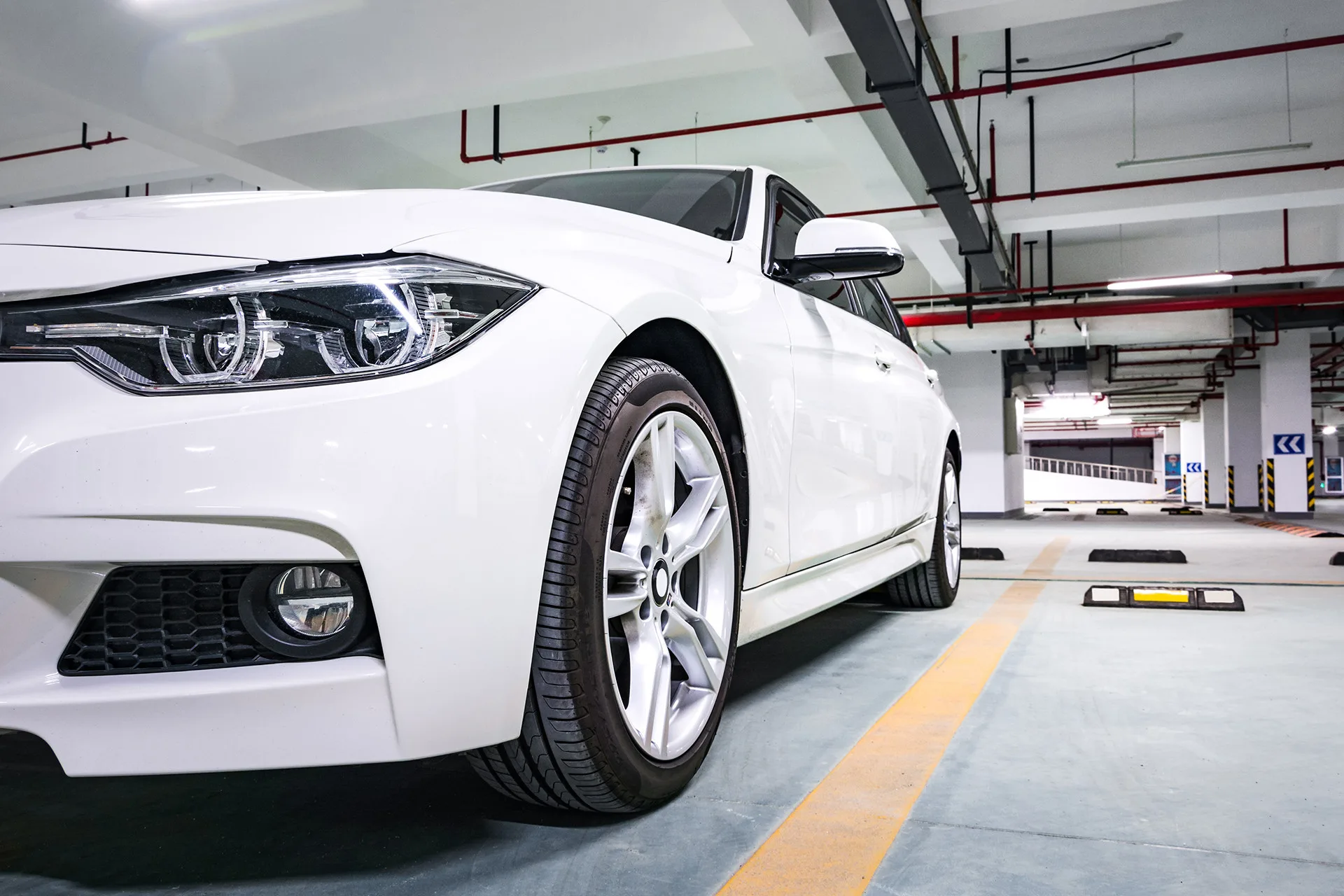
The main tracker is the FMB130. It is an ADVANCED series tracker with a 2G network, flexible inputs and outputs and support for CAN adapters, which means it suits most cars and commercial vehicles. Like other Teltonika vehicle trackers, it can spot GSM signal jamming, towing, disconnection from power and departure from an automatic geofence. A response can be assigned to such events: switching on the factory alarm, immobilising the starter or locking the doors through a tracker output.
But if the main tracker has been found and removed, a second level is needed. Teltonika describes two variants of backup device.
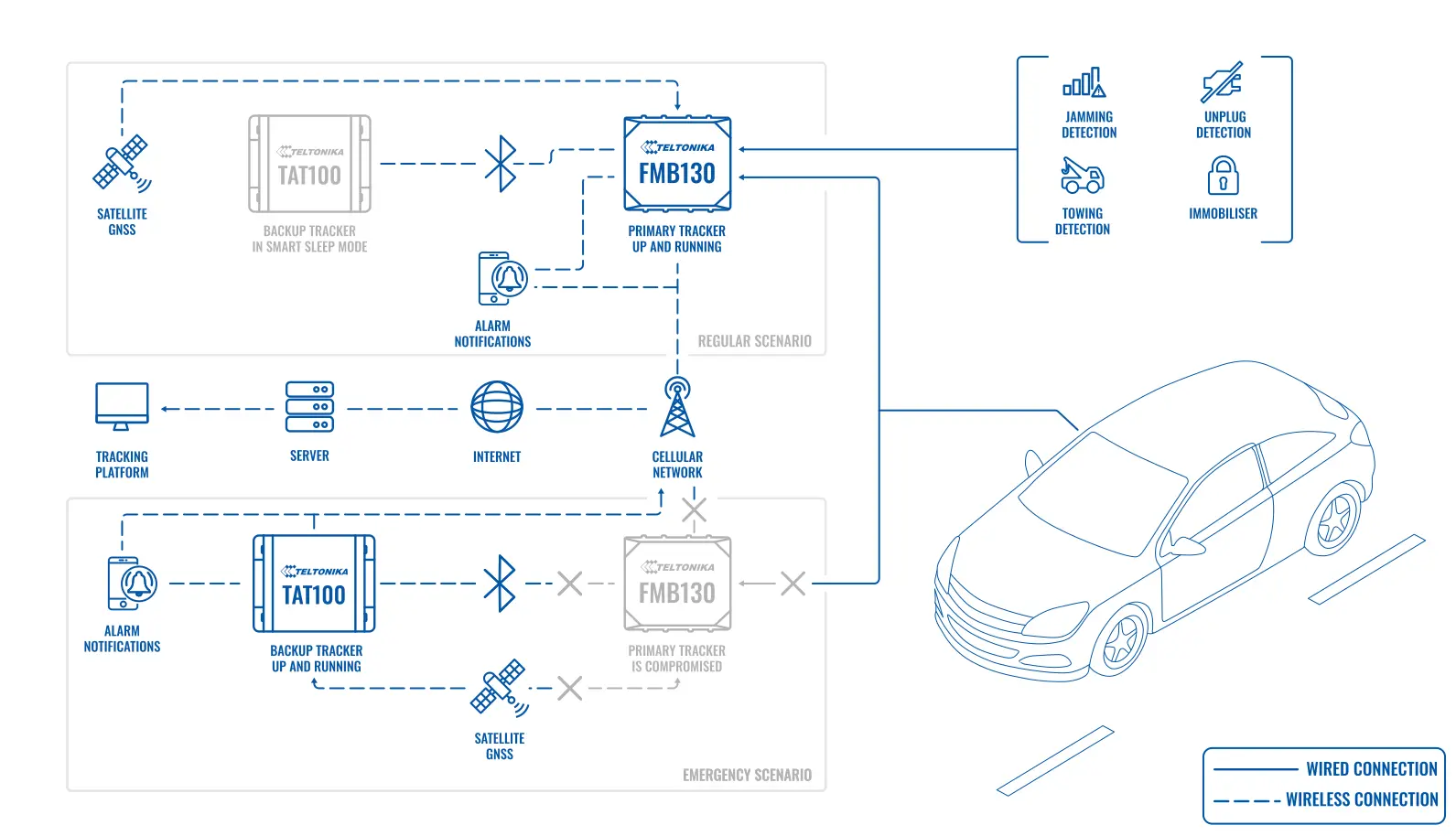
Variant 1. The standalone backup tracker TAT100. This is a compact tracker on its own battery with Bluetooth LE, and it needs no wiring. It is hidden somewhere else in the vehicle, away from the main one.
• The main tracker (FMB130 or FMC130) works all the time, transmitting coordinates and events.
• The TAT100 sleeps most of the time and periodically checks over Bluetooth that the main tracker is in place and working.
• If the Bluetooth link has gone — the main tracker has been switched off, pulled out or smashed — the TAT100 wakes up, turns on GNSS and the cellular connection and starts transmitting coordinates.
• At the same time an alert goes out: to the fleet manager, to the staff responsible, to the driver, and if necessary to a security firm.
The Teltonika range also has other standalone trackers, the TAT140 for example, if a different battery capacity or form factor is needed.
Variant 2. The wired backup tracker FMB920. This is Teltonika’s most popular compact 2G tracker for basic tracking. Here both devices are powered from the vehicle’s electrical system, and the FMB920 is fitted somewhere unusual, in the boot or inside the trim, for instance.
• The FMB130 acts as the main device and transmits packets over Bluetooth.
• The FMB920 acts as the backup: it periodically scans for those packets and transmits nothing over the cellular network, so that a radio scanner does not pick it up.
• To save energy the FMB920 can be put into one of the sleep modes with Bluetooth active: GPS Sleep, Deep Sleep or Online Deep Sleep.
• A delay timeout is set in the configurator: how long the backup device waits after the main one disappears before it starts sending data.
Why the delay is needed. After removing the first tracker, a competent thief often goes over the vehicle with a scanner once more. If the backup tracker starts transmitting straight away, it will be found by its radio signal. If it waits the time set, until the vehicle has been driven off and is no longer being checked, its chances of staying unnoticed are far better. The record of the alarm event is created immediately, and it is sent once the delay is over.
Immobilising through the backup tracker. If a jamming detection or immobiliser scenario is configured, the FMB920 can cut the fuel pump through its digital output. The vehicle will not start again after it stops, even if the main tracker has already been removed.
What a theft looks like from the dispatcher’s side. At night the FMB130 on the client’s vehicle records a loss of power and disappears. The duty officer receives an alert but sees only the last point. After the time set, the backup tracker comes on air and reports new coordinates: the vehicle has already been moved to another district. The leasing company passes the coordinates to the police and, if needed, sends the command to cut the pump. The chances of getting the vehicle back intact within a few hours are considerably higher in this arrangement than with a single tracker.
What the main tracker transmits in ordinary life. Besides protection, the FMB130 works as an ordinary telematics tracker: mileage, speed, stops, ignition, CAN data, geofences. For a leasing company that is useful even without any theft — it shows how the vehicle is used, where it spends the night, and whether it leaves the permitted region.
The scenario with a client who stops paying. The lessee stops making payments and takes the vehicle to a private garage, having first asked a mechanic to disconnect the tracker. The main tracker records the loss of power, and the leasing company is left with the exact time and place in its event log. The backup device meanwhile keeps working: the company knows where the vehicle is and can act within the contract and the law, rather than looking for it among the client’s acquaintances.
How to choose the delay and the sleep mode. Too short a delay gives the backup tracker away to anyone who checks the vehicle with a scanner right after the theft. Too long a delay gives thieves time to take the vehicle far away. The value is usually chosen to match the typical pattern of thefts in the region: where vehicles are hidden, how long the drive takes. The sleep mode for the FMB920 is chosen according to how important a quick reaction is and how long the vehicle may stand without moving before it drains the battery. For the TAT100, the interval at which it checks the main tracker determines how many years the battery will last.
What to consider during fitting. The two trackers must not be placed next to each other: if a thief has found one, he will look carefully at the places nearby. The backup tracker’s wiring is run so that it does not follow the route of the factory harnesses and does not catch the eye. The fitting locations are recorded in an internal document with restricted access, not in the general handover report the client receives. Once a season it is worth checking that the pairing works: disconnect the main tracker on a test vehicle and make sure the backup comes on air with the delay expected.
The response procedure matters more than the hardware. Trackers give the signal, but it is people who get the vehicle back. Before launch it has to be decided who receives the alert at night and at weekends, who takes the decision to immobilise the engine, at what point the client is called and at what point the police are called straight away. Cutting the pump is better allowed only on a stationary vehicle or on a confirmed event, so that a car is not stopped in the middle of a junction. If these questions are not settled in advance, the valuable first half hour after the alert goes on getting approvals, and in that time the thief manages to change vehicles or get it into a closed lock-up.
Who may send a command, and where that is visible. Rights to send immobilisation commands in the monitoring platform are granted to individual members of the security team, not to every user with access to the map. Every command sent stays in the object’s history with the time and the user name, so if there is a dispute with the client it is clear who sent the command and when, and what state the vehicle was in at that moment.
Where the arrangement has its limit. A tracker reports where the vehicle is, but does not bring it back itself. In an underground car park or a closed metal lock-up the satellite signal disappears, and the last known point is all that remains in the system. Coordinates are grounds for going to the police or acting under the leasing contract, not a reason to seize the vehicle yourself.
An important limitation. Pairing a main and a backup device over Bluetooth works only between Teltonika trackers. Mixing one manufacturer’s tracker with another’s backup beacon is not possible in this arrangement.
Servicing at a distance. The firmware and configurations of all the trackers are updated remotely through FOTA WEB, so protection scenarios or the delay can be changed without calling the vehicle in for service.
What you get
A second line of defence
If the main tracker has been removed or smashed, the backup carries on watching the vehicle, and it does not disappear from the map.
Resistance to jammers
Jamming of the main tracker becomes a reason for an alert, and a backup tracker that stays silent until the moment it is needed is harder to suppress in advance.
Invisible to scanners
In normal operation the backup device transmits nothing over the cellular network, and after an alert it waits the configured time before coming on air.
Smaller losses
A quick alert and fresh coordinates sharply increase the chance of getting the vehicle back whole rather than in pieces, and save time for the leasing company and the police.
Full telematics on ordinary days
The main tracker transmits mileage, stops, CAN data and events, and they show how the client is using the vehicle.
Remote servicing
The configurations and firmware of every tracker in the fleet are updated through FOTA WEB, with no trips to the workshop.
Why this solution
The two-layer arrangement rests on two things: both trackers have to be able to talk over Bluetooth and to understand the roles of main and backup device. With Teltonika that is built into the firmware and set up through the configurator, with no third-party modules. So any pair can be assembled from a single range: an FMB130 or FMC130 as the main device, an FMB920 or a standalone TAT100 as the backup.
The choice between the variants usually depends on the vehicle and the budget. A standalone TAT100 is easier to hide, because no wiring gives its position away, but its battery charge is limited and the sleep mode has to be matched to the term the vehicle goes out on lease for. A wired FMB920 does not depend on a battery and can cut the fuel pump, but it needs careful fitting so that the wiring is not found by the traces left in the interior.
Two trackers cost more than one, and that has to be acknowledged. But for a leasing company the cost of the second device is a small part of the price of the vehicle, and a single theft prevented pays for the protection on many vehicles to come. For cheap vehicles and short rental terms, one tracker with sensible fitting is often enough.
Whatever the arrangement, the fitting is what matters most. A tracker placed in the usual spot by the same crew to the same template is found quickly by thieves. The fitting locations have to be varied from vehicle to vehicle and not written down in documents anyone can see.
How this works in Azerbaijan. Double protection is in demand with leasing companies and banks offering car loans, with rental companies in Baku and at Heydar Aliyev airport, and with car sharing and taxi services where vehicles are driven by different people. For rental vehicles in Azerbaijan there is one more risk — being taken across the border through the crossing points on the M-1, M-2 and M-3; a geofence along the border with an alert on leaving it helps to notice this in good time. When rolling this out it is worth allowing for the fact that in the mountain districts beyond Guba and Sheki and in the Greater Caucasus the connection is unreliable: the tracker will keep points in memory and send them when it returns to Azercell, Bakcell or Nar coverage. GPS.az, as a Teltonika GOLD partner in Azerbaijan, selects a pair of trackers for the vehicle model, fits them out of sight, configures the alert and immobilisation scenarios and brings the data onto the Wialon platform, where the leasing company’s security team sees it.
Equipment used
Full specifications are in the catalogue.
Full specifications are in the catalogue.
Full specifications are in the catalogue.
Full specifications are in the catalogue.
Full specifications are in the catalogue.
Related case studies
Related rollouts and equipment
Keyless car sharing on the FMB130 and CAN-CONTROL
Car sharing and rental
Hire equipment protected by the TAT240
Assets and workforce
Keeping track of trailers with EYE Bluetooth beacons
Logistics and delivery
Questions about the “Two trackers against the theft of leased vehicles” scenario
Request a call
A specialist will call back and match a solution to your fleet and your task.