
Keyless car sharing on the FMB130 and CAN-CONTROL
For car sharing Teltonika offers the FMB130 tracker (or the FMC130 with LTE) paired with the CAN-CONTROL adapter: the customer unlocks the car from a smartphone, while the operator sees its location, mileage, fuel and door status.
For car sharing Teltonika offers the FMB130 tracker (or the FMC130 with LTE) paired with the CAN-CONTROL adapter: the customer unlocks the car from a smartphone, while the operator sees its location, mileage, fuel and door status. Very different people use car sharing. A city dweller takes a car for an hour to drive to IKEA. A company keeps a shared pool of cars for its staff instead of assigning company cars. A public body covers business trips without running a garage of its own. One thing unites them all: the car has to be picked up without meeting a manager and without handing over keys, while insurance, tyres, washing and servicing stay with the operator. Below is what the equipment has to be capable of and how the Teltonika solution is put together.
What this scenario solves
The central requirement of car sharing is to lock and unlock the car remotely, with no physical key.
A failure here is unacceptable: the customer is left standing at a locked car in the rain or, worse, the car stays unlocked overnight.
Every make and model has its own commands on the CAN bus, and the database of those commands has to keep growing.
The operator needs data on the car in real time, otherwise the fleet is running blind.
The central requirement of car sharing is to lock and unlock the car remotely, with no physical key. A failure here is unacceptable: the customer is left standing at a locked car in the rain or, worse, the car stays unlocked overnight. Every make and model has its own commands on the CAN bus, and the database of those commands has to keep growing. The operator needs data on the car in real time, otherwise the fleet is running blind.
Locks are more complicated than they look. For a tracker to be able to operate the central locking, it has to speak the car's own language. A new model in the fleet means a new set of commands. If the equipment supplier cannot keep up with the market, the operator cannot buy a popular car.
The second problem is visibility. Where the car is now, how much fuel is in it, whether the doors are locked, whether the lights have been left on, how the customer drove — without that data you can neither work out the charge, nor issue a penalty for a breach, nor plan refuelling and washing.
And all of it has to work together: the hardware, the firmware and the operator's software. One weak link and the customer goes to a competitor.
What Teltonika offers
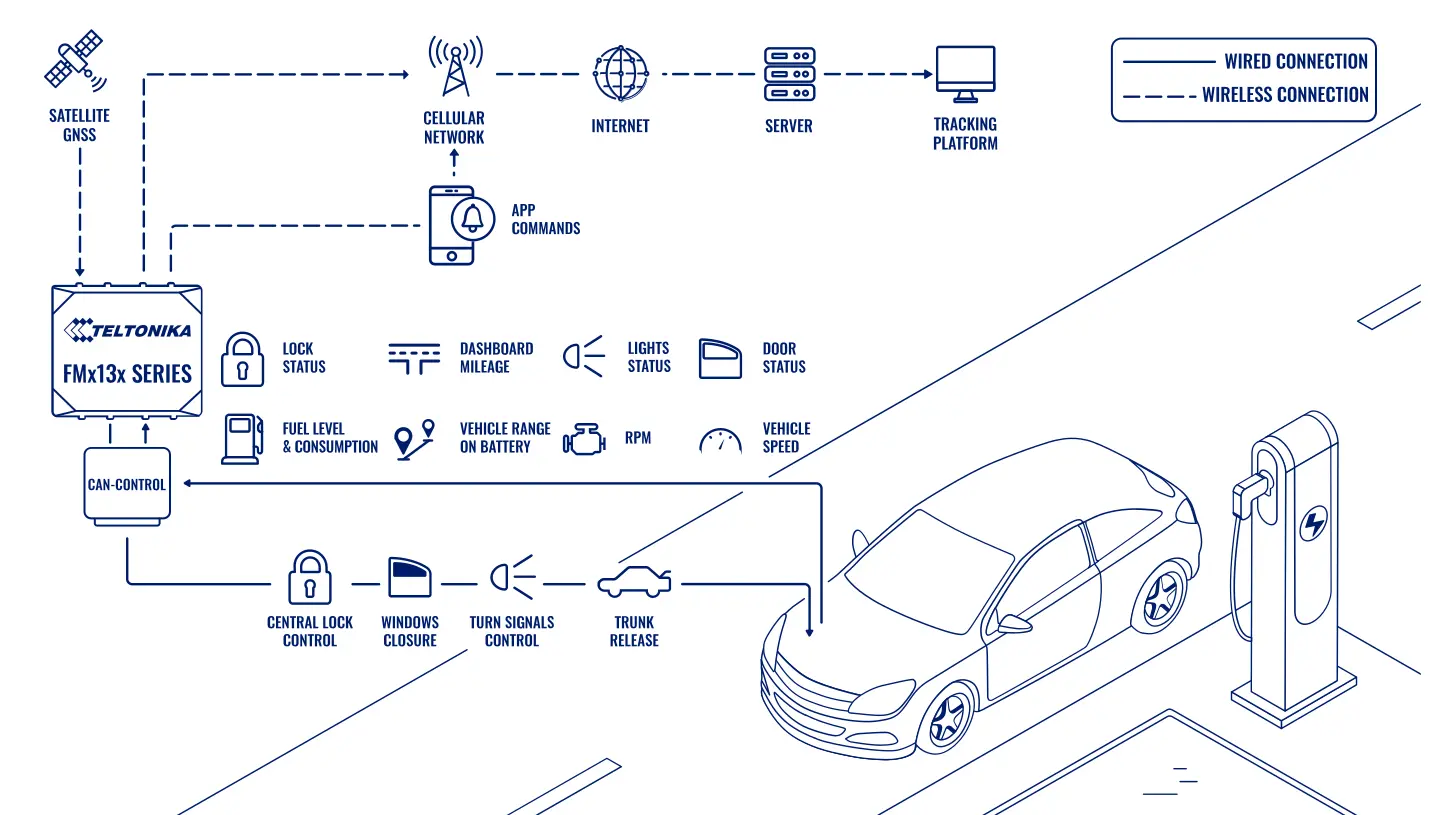
The Teltonika solution is an FMB130 or FMC130 tracker plus the CAN-CONTROL adapter, which connects to the car's CAN bus and takes on the locks, windows, lights and data reading.
Installation and setup
Fitting the device and configuring it for the fleet scenario at hand.
Data transfer
The device collects data and sends it to the monitoring platform; how often depends on the model and its settings.
Analysis and control
The person in charge gets reports and alerts and looks into what stands out.
What the adapter can do. Over the CAN bus it reads more than 300 parameters and operates the car's factory systems:
• locks and unlocks the central locking;
• closes the windows;
• switches the hazard lights and indicators on and off — handy for helping the customer find the car in a car park;
• opens the boot.
Alongside that it reports statuses: whether the doors are locked, whether the parking brake is applied, whether the lights are on. From the live data — engine revolutions, speed, fuel level from the instrument panel. From the fuel figure the operator sees at once how many kilometres the car still has in it, and sends it for refuelling before the next customer is left with an empty tank.
Electric cars are supported too. For them the adapter reads the battery state of charge, the charging status, whether the cable is connected and the range on the current charge.
How a hire goes. The customer books a car in the app. The operator's server sends a command to the tracker, and the tracker unlocks the car through CAN-CONTROL. After the trip the customer presses the finish button, the system checks that the doors are closed, the headlights are off and the car is on the handbrake, and only then closes the hire. If something is not right, the app says what to put right.
The track of the trip stays on the server. The operator uses it to deal with camera fines, speeding and disputed cases: the customer says the scratch was already there, and the data shows where and when the car braked hard. For a corporate pool the data feeds reports: which employees drove how much, in working hours or not, on business or not. The tracker can also block engine starting if no hire has been set up — that is protection against theft, when somebody tries to drive off in a car with no booking.
Safe conditions for commands. Locking and unlocking are carried out only against a valid booking, and start blocking is applied with the ignition off, never on the move. Rights to send remote commands from the platform are given to named members of the operator's staff, and every command stays in the unit's history, so an argument about who unlocked the car is settled with an export.
The Teltonika database currently holds more than 1300 car models, and the list is regularly extended with new cars from popular makes. For car sharing that matters: fleets usually consist of recent cars no more than three years old, and they are replaced often.
A limitation: on older cars with no proper CAN bus, or on models that are not yet in the supported list, the adapter will not work. The car model is checked against the list before the equipment is bought, not afterwards.
What you get
Handover with no member of staff
The customer locks and unlocks the car from the app, and no keys are needed.
Support for more than 1300 models
From mass-market city cars to electric vehicles, with the list kept up to date.
Data for charging and control
Mileage, fuel, speed, door and light status arrive in real time.
Fewer disputes at drop-off
The system will not let a hire be closed with a door open or the headlights on.
Configuration without visiting the car
The Configurator for initial setup and FOTA WEB for over-the-air firmware updates.
Why this solution
Teltonika partners have already launched car sharing services on this equipment in several countries, and the manufacturer refines the firmware and extends the list of cars on the strength of their feedback. You can see it in the trend: the database of supported models grows steadily.
The second point is convenience for the integrator. The tracker and the adapter are configured in the free Teltonika Configurator, and firmware updates go out through FOTA WEB with no need to connect to the car. When a fleet runs to several hundred cars, the difference between updating over the air and driving round every car with a laptop amounts to weeks of work.
The FMB130 works on the 2G network, the FMC130 on LTE Cat 1 with a fallback to 2G. For new projects the FMC130 makes more sense: operators are gradually shutting down the older networks.
How this works in Azerbaijan. Car sharing in Baku is only gathering pace, but the demand for hiring a car without meeting a manager is there: tourists flying into Heydar Aliyev airport, people on business trips to Baku and Sumgait, companies with a shared pool of company cars. Hire companies have a similar problem when they let cars out for trips to Gabala, Sheki or Guba and want to see where the car is and how hard it is being driven on the M-1 and M-4. When rolling this out, the first thing we do is check the fleet's models against the CAN-CONTROL list: the Toyota, Hyundai and Kia models popular here are mostly on it, but we check the particular year and specification. In the underground car parks of shopping centres there is often no GSM signal, so the unlocking scenario there is thought through separately. GPS.az installs the trackers and adapters and feeds the data into Wialon, and lock control can be tied to the operator's app through the platform API.
Related case studies
Related rollouts and equipment
Questions about the “Keyless car sharing on the FMB130 and CAN-CONTROL” scenario
Request a call
A specialist will call back and match a solution to your fleet and your task.