
Hire equipment protected by the TAT240
A hire company puts the TAT240, a self-contained magnet-mounted tracker, on generators, compressors, medical and stage equipment; it reports any attempt to remove it and helps find what has been stolen.
A hire company puts the TAT240, a self-contained magnet-mounted tracker, on generators, compressors, medical and stage equipment; it reports any attempt to remove it and helps find what has been stolen. Equipment out on hire goes off to people the company knows only from a contract. It travels a long way, gets left on open ground, and is sometimes hired on somebody else's documents precisely so that it is never returned. The search afterwards falls to the company itself, and the odds are not good. Teltonika offers the TAT240 tracker for this, with a magnetic tamper sensor. It runs on a battery, needs no connection to the equipment's power supply and goes on in a minute, so it suits almost any item in a hire fleet.
What this scenario solves
Hired plant is stolen more often than a company's own, because it spends longer in transit and is less well guarded.
Fraudsters hire equipment on somebody else's documents and do not bring it back.
A hirer looks after someone else's property less carefully than their own.
Stolen equipment is rarely recovered, and the losses fall on the hire company.
Hired plant is stolen more often than a company's own, because it spends longer in transit and is less well guarded. Fraudsters hire equipment on somebody else's documents and do not bring it back. A hirer looks after someone else's property less carefully than their own. Stolen equipment is rarely recovered, and the losses fall on the hire company.
The scale of the losses is noticeable. According to figures quoted by Teltonika, the average value of a piece of stolen construction plant in the United States is about 29,000 dollars, and only 21% of what is stolen is found.
The bulk of hire activity is in construction. Here it is generators, concrete pumps, skips, tippers, portable toilets and everything else a site cannot work without that goes missing. But the problem is wider. In healthcare, adjustable beds, patient hoists, oxygen concentrators and ventilators are hired out. In the events industry it is amplifiers, lighting and speakers that disappear.
Theft hits a hire business several times over. The item itself is gone, the next bookings for it fall through, customers get their equipment late, and the reputation suffers. If a contract or a customer's project collapses because of the loss, the bill grows larger still.
An ordinary vehicle tracker is no good here. You cannot run wiring to a generator or a ventilator, and a device that is easy to remove unnoticed will not protect anything from theft.
What Teltonika offers
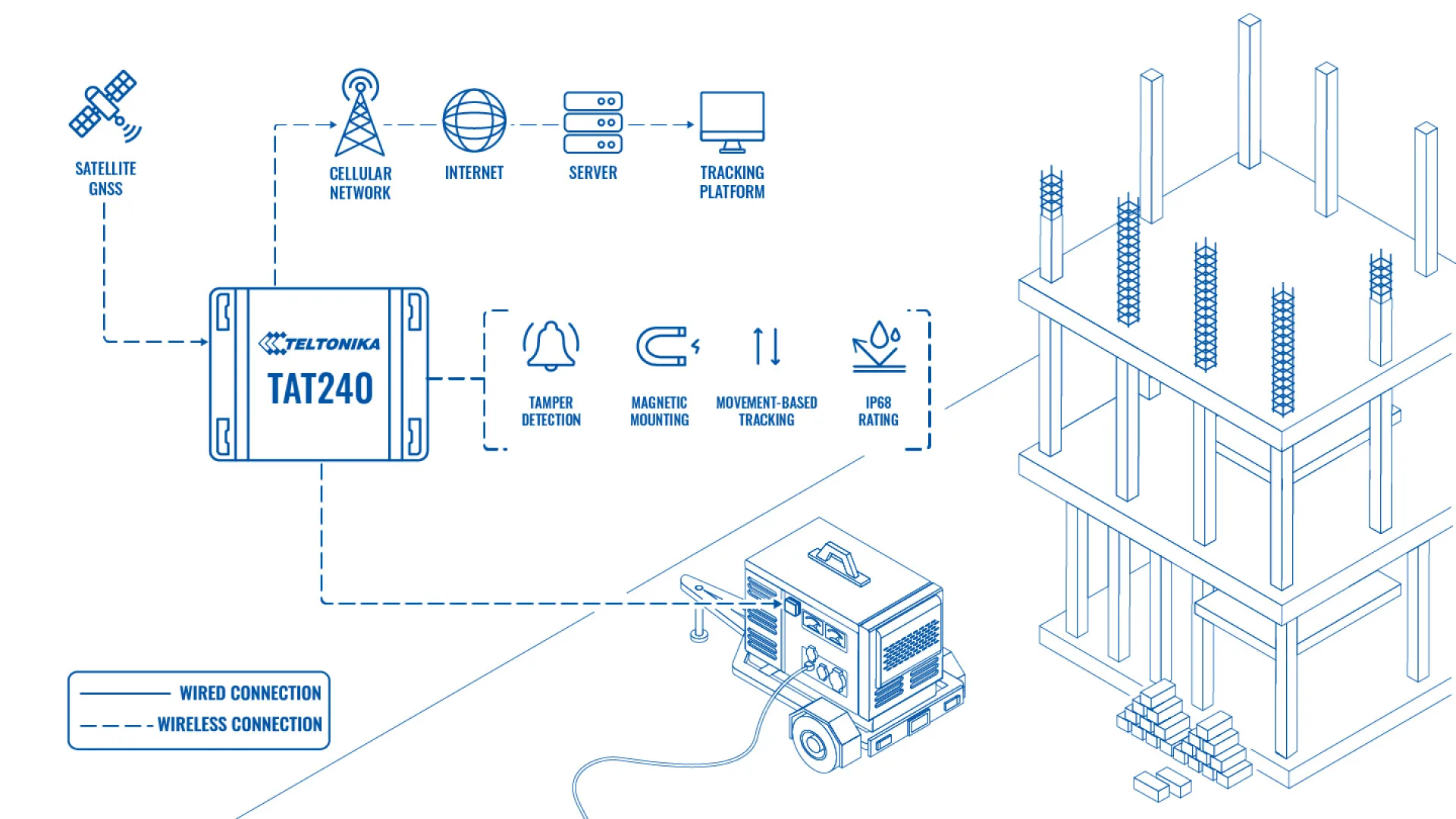
The TAT240 attaches by magnet to the metal body of a piece of equipment, sends coordinates on movement or on a schedule, and the moment anyone tries to remove it, raises an alert and switches to a search mode with frequent position reports.
Installation and setup
Fitting the device and configuring it for the fleet scenario at hand.
Data transfer
The device collects data and sends it to the monitoring platform; how often depends on the model and its settings.
Analysis and control
The person in charge gets reports and alerts and looks into what stands out.
Fitting. Magnetic mounting comes in the box; the tracker is simply placed on a metal surface of a generator, an air compressor, a medical device or a flight case of equipment. There is no wiring — the TAT240 runs on its own battery.
Transmission modes. The owner chooses how the tracker sends data: on movement, at set intervals or on a weekly schedule. If the equipment is sitting in the store waiting for the next customer, the tracker keeps quiet and saves its battery. Movement start and end events show when the item left and when it stopped.
Protection against removal. The main difference between the TAT240 and its predecessors is the magnetic tamper sensor. If a thief has found the tracker and tries to detach it, the device immediately sends an alert together with the coordinates of the place where it happened. Even if the tracker is then thrown away, the owner knows the point to start searching from and the time of the event.
Search mode. Where theft is suspected, the recovery mode scenario is switched on: the tracker starts sending coordinates frequently, and the track shows where the equipment is being taken, so the data can be passed to the police.
Indoors. The TAT240 has Bluetooth LE. It works with EYE Sensor tags and can determine that a tag has disappeared from range. That is useful where GPS does not reach: in a store, in a hospital, in a concert hall. The tracker might sit on the case with the mixing desk, for instance, with tags on the speakers, and if one of the speakers goes off on its own a notification arrives.
What the hire manager sees. The map shows all the equipment currently with customers and everything standing in the store. The movement history makes it clear whether the equipment was used as the contract says or was moved somewhere else. Once it is back, it is easy to check whether the generator has been out to another site that the contract says nothing about.
What this can look like. A diesel generator is hired out for a month to a site out of town. In the early hours of Saturday the manager receives a tamper notification: the tracker has been detached from the body. The coordinates point to the customer's site, the time about two in the morning. The manager rings the site's security and the customer, and the generator is found already loaded into somebody else's vehicle by the gate. Without the alert the loss would not have been discovered until Monday.
What you get
A signal the moment anyone tries to remove the tracker
The magnetic tamper sensor sends an alert with the place and time while the thief is still nearby.
Searching for stolen items on a frequent track
In recovery mode the tracker sends coordinates often, and equipment can be followed to where it ends up.
Battery conserved in the store
Transmission on movement or on a schedule uses no charge while an item waits for its next hire.
Bluetooth cover indoors
EYE Sensor tags and detection of their loss work where there is no satellite signal.
Equipment in place on time
It is clear where every unit is, and it can be made ready for the next booking in good time.
Why this solution
The TAT240 grew out of the proven TAT100 and TAT140 asset trackers that Teltonika has been making for a long time. From them it has inherited self-contained battery operation, a rugged housing and simple fitting, and it adds a magnetic tamper detection system. That is why it can go on hire equipment, on cargo and on trailers alike.
For a hire company what matters is that the device does not have to be wired into the equipment. The same tracker can be taken off one item and put on another as the hire fleet changes. All three models, the TAT100, TAT140 and TAT240, work in the same monitoring system, so a fleet of trackers can be assembled to fit the budget and the job.
An honest limitation: frequent position reports in search mode use the battery up faster. The modes are worth setting so that in ordinary life the tracker runs economically and frequent reporting comes on only with an alert. And the tracker should sit somewhere inconspicuous — the magnetic sensor will warn you of removal, but it is better if the thief simply does not find it.
How this works in Azerbaijan. Hire of construction plant and equipment is growing here along with the building work in Baku, in Absheron and in Karabakh, where generators, compressors, formwork and portable toilets stand on sites for weeks with no security. There is event hire in Baku too, moving lighting and sound to concerts, exhibitions and weddings all over the country, as well as hire of medical equipment for care at home. In the mountain districts beyond Guba and Sheki the signal can be weak, and the tracker sends the points it has stored once an Azercell, Bakcell or Nar network appears. Metal bodies heating up in the summer sun are worth allowing for when choosing where to mount it. GPS.az selects a model from the TAT range, sets up the transmission modes and tamper notifications in Wialon and shows how to check an item's usage history once it comes back.
Who responds to an alert, and how. Before the rollout you appoint who receives the tracker removal notification by day and by night and who has the right to switch on search mode: frequent transmission uses the battery up quickly, so switching it on just in case is not a good idea. The history of alerts and of the mode being switched on stays in the system and will come in useful in a discussion with the customer or the insurer. The tracker shows where the equipment is, but recovering it yourself, bypassing the police, is not something we recommend.
Related case studies
Related rollouts and equipment

Two trackers against the theft of leased vehicles
Car sharing and rental

The self-powered TAT100 tracker for cargo and equipment
Assets and workforce

Monitoring semi-trailers with the TAT100 tracker
Assets and workforce
Questions about the “Hire equipment protected by the TAT240” scenario
Request a call
A specialist will call back and match a solution to your fleet and your task.