
Recording farm machinery and implements with the FMB140
For farms Teltonika offers a combination of an FMB140 tracker on the tractor or the combine and Bluetooth beacons on the mounted and trailed implements: the system records by itself which machine worked with which implement, where and for how long, with no paper logs.
For farms Teltonika offers a combination of an FMB140 tracker on the tractor or the combine and Bluetooth beacons on the mounted and trailed implements: the system records by itself which machine worked with which implement, where and for how long, with no paper logs. For quad bikes and light utility vehicles on the same farm, the compact FMB920 tracker is used. The case is addressed to agricultural holdings, farmers and service companies with a large fleet of machines and implements, where a plough, a seed drill or a baler is constantly moved from one tractor to another. We look at which problems this closes, how the beacons identify the implement they belong to, what the tractor's CAN bus adds and where a solution like this runs into its limits.
What this scenario solves
A farm has dozens of machines and implements, and the record of their work is still often kept on paper.
A plough, a seed drill or a sprayer has no power supply of its own, and an ordinary tracker cannot be fitted to it.
Without data it is hard to tell which field has been worked, with which implement, and how much fuel went into it.
A poor harvest, or simply a badly organised year, hits a farm's finances for a long time.
A farm has dozens of machines and implements, and the record of their work is still often kept on paper. A plough, a seed drill or a sprayer has no power supply of its own, and an ordinary tracker cannot be fitted to it. Without data it is hard to tell which field has been worked, with which implement, and how much fuel went into it. A poor harvest, or simply a badly organised year, hits a farm's finances for a long time.
The demand for food grows along with the population: on the figures in the case, it adds about 83 million people a year and has risen from 1 billion in 1800 to 7.8 billion in 2020. Agriculture has to grow more while spending less time, fuel and labour.
At the same time farmers are under pressure from many directions at once: the weather and climate change, the economy, the environment, politics, swings in supply and demand. A farm can do almost nothing about any of these. What it can do is bring order to what it does control — its machinery.
And here the main difficulty is variety. A single farm runs tractors, combines, loaders, balers and all-terrain vehicles. Hitched to them are ploughs, cultivators, harrows, seed drills, sprayers, mowers and trailers. One tractor can work with five different implements over a season, and who hitched what and when is known, at best, to the foreman.
Paper work sheets and printed field maps cope badly with that volume. Records get lost, get muddled, get filled in after the event. The result is that it is hard to work out the cost of working a particular field, and hard to find where the money goes.
The losses show up at industry scale too. The FAO report on the state of food and agriculture (SOFA) says that in 2019 food loss and waste exceeded 15% in North America and Europe and 20% in Central and Southern Asia. Part of that loss arises in the field — through harvesting at the wrong time and poorly organised machinery work.
What Teltonika offers
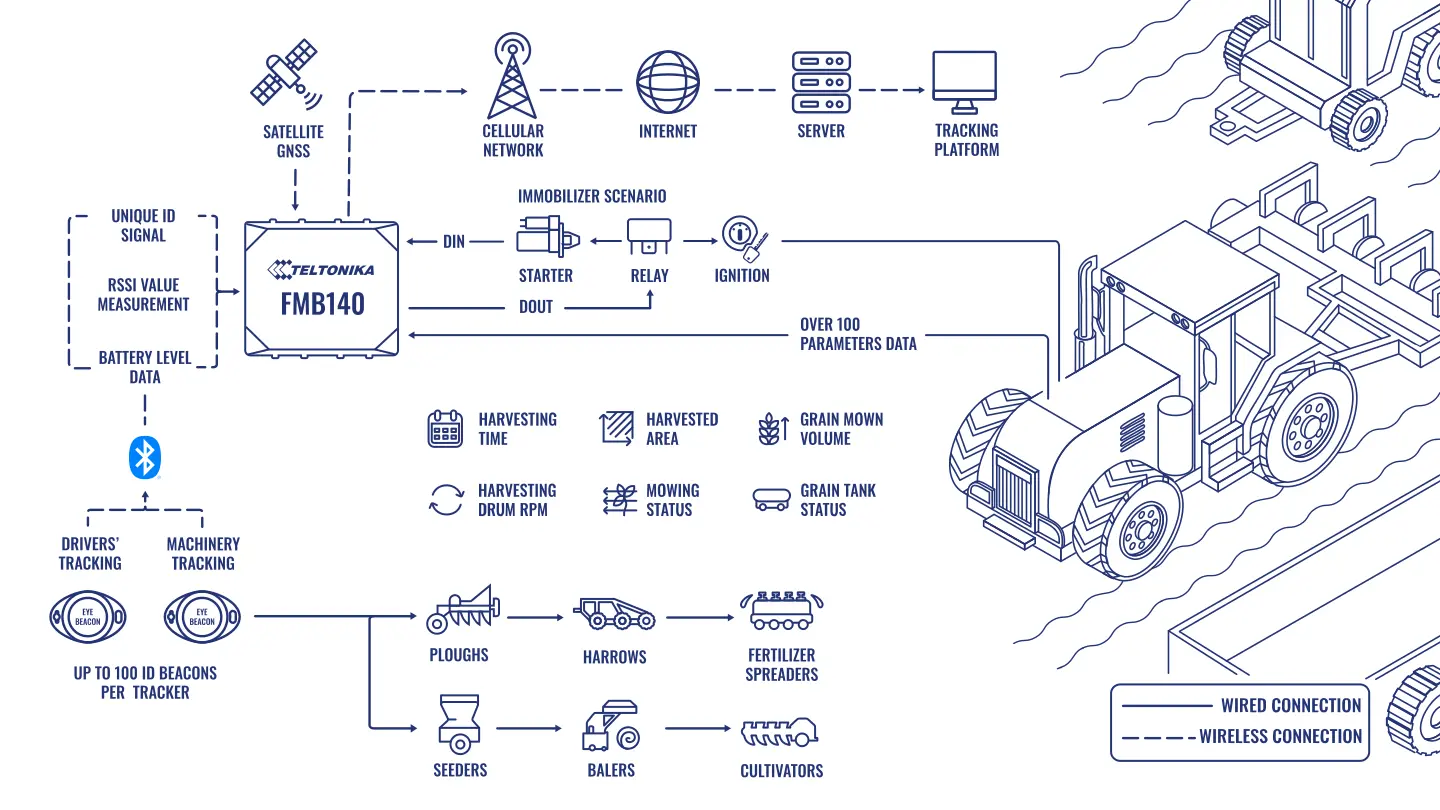
The Teltonika solution is built on three elements: the FMB140 GPS tracker with built-in CAN bus reading on the self-propelled machines, Bluetooth Low Energy beacons (ID beacons) on the mounted and trailed implements, and a platform that works out from the proximity of a beacon to a tractor which implement is working at any moment and where.
Installation and setup
Fitting the device and configuring it for the fleet scenario at hand.
Data transfer
The device collects data and sends it to the monitoring platform; how often depends on the model and its settings.
Analysis and control
The person in charge gets reports and alerts and looks into what stands out.
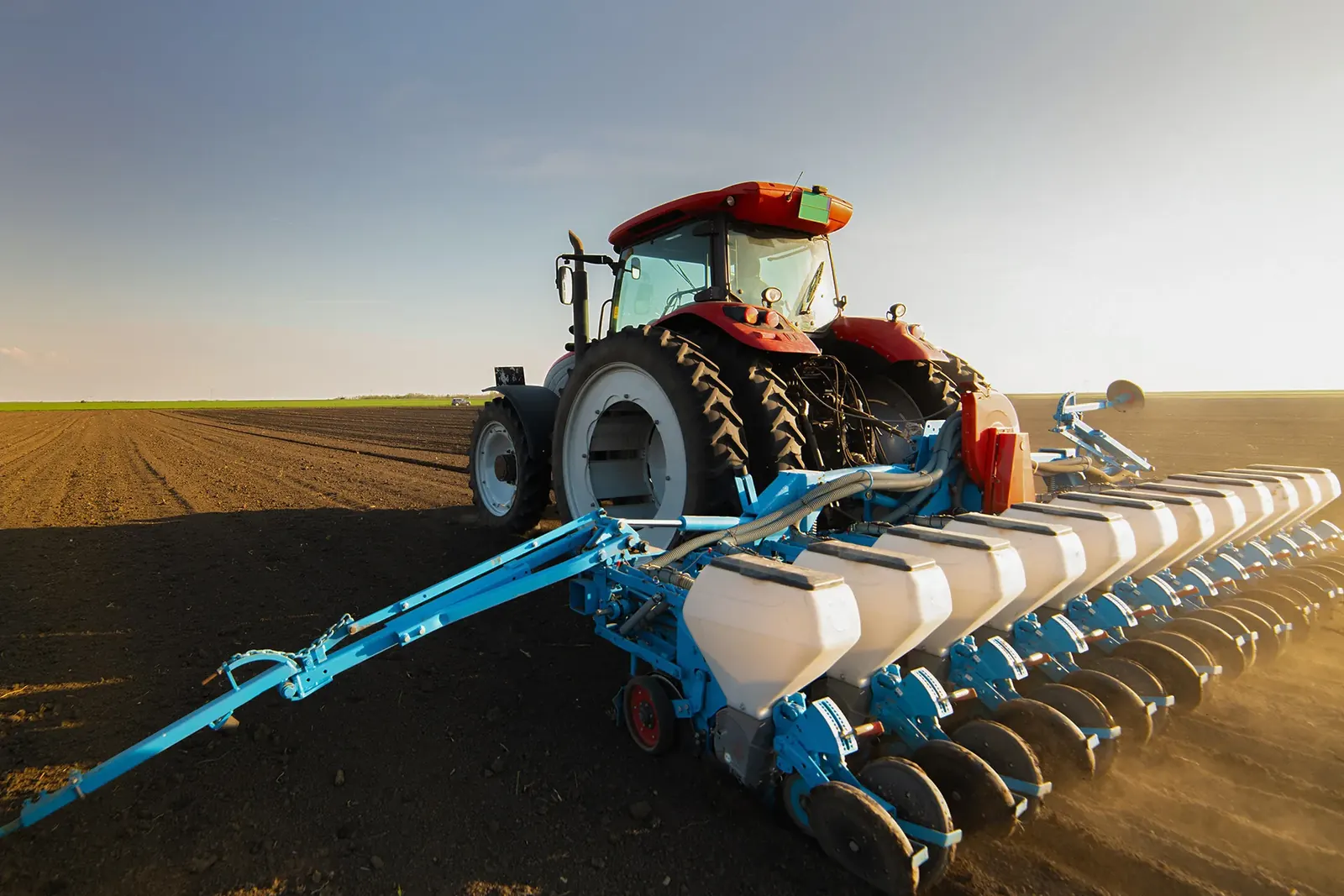
The FMB140 was chosen because it can read CAN bus data without a separate adapter, and the extended firmware with the ALL-CAN300 option supports agricultural machinery. The tracker goes on tractors, combines, loaders, round balers, municipal vehicles and all-terrain vehicles. For quad bikes and small machines, where a compact housing is needed and CAN is not required, the FMB920 is the fit.
A beacon is a small radio transmitter that broadcasts its own identifier over Bluetooth continuously. The technology is cheap, frugal with power and causes little interference. Beacons are quick to fit, easy to bring into an existing system and, if one breaks or is stolen, simply replaced.
According to the manufacturer, Teltonika trackers can see up to 100 beacons at once. Depending on the model, a beacon runs from 4 to 10 years on a single battery, and the signal reaches up to 500 m. Signal strength and transmission interval are adjustable: it is possible to get the tractor to pick up only the implement hitched to it, rather than everything standing nearby in the machinery yard.
The working arrangement is this. Beacons are fixed to everything unpowered that needs to be accounted for: ploughs, seed drills, cultivators, sprayers, trailers, mounted implements. Fitting is simple and needs no wiring, so it is quick and cheap. The FMB140 on the tractor reads the identifiers of the beacons nearby and sends them to the server together with its own GNSS position.
Software on the server matches the beacons to the nearest tracker and works out where each implement is and which machine it is working with. Neither the driver nor the foreman has to press or mark anything: the record is made automatically, and the data is available from any device with an internet connection at any time.
The result is a picture of which jobs have been done, on which parcels and with which implement. That makes it possible to plan the next operations and to cost the work field by field. Paper logs become a document for cross-checking rather than the main record.
Beacons are useful indoors too. They are hung on valuable equipment in stores, sheds, mills and dairy units, so that it is known where it is.
On the tractor the FMB140 gives far more than coordinates. The built-in CAN adapter reads more than 100 parameters: engine revolutions, engine hours, consumption, temperature, fault codes. From that a maintenance schedule is built, excess idle time is identified and it becomes clear in advance which machine needs servicing, before it stops in the middle of the harvest.
The safety functions present in Teltonika trackers are available as well: driving style monitoring, an alert on GSM jamming, excessive idling detection, an immobiliser, unplug and towing detection, accident detection, automatic and manual geofences, and trip notifications. Firmware and settings are updated remotely over FOTA WEB.
Geofences are particularly convenient in farming. The farmer draws the outlines of the fields, the stores and the machinery yard on the map and gets an event when a machine or an implement enters a zone or leaves it. It is immediately visible if a tractor has left a field during working hours, or if an implement has left the farm at night.
Beacons also help with driver identification. If the operator has not authorised himself, the starter stays blocked, and an outsider cannot start the machine without the identification key, provided the cut-out is wired into the starting circuit. For recording operators' working time, identification over 1-Wire serves as well.
Fuel is a subject of its own. Fuel level sensors in the tank show the remaining volume, the refuellings and the drains. A wireless version of the sensor simplifies fitting and rules out a broken cable. For farm machinery this is the direct way to make fuel accountable and to make theft from tanks considerably harder.
What an ordinary day on the farm looks like with this system. In the morning the operator presents his identification key and starts the tractor. The foreman hitches a cultivator with a beacon to it, and a record appears in the system: this tractor is working with that cultivator. The tractor enters the geofence of field 7, and from that moment the worked area is counted. At midday the implement is swapped for a seed drill, and the pairing in the system switches over by itself. In the evening the agronomist opens a report: how many hectares were covered, with which implement, how many engine hours and litres of fuel went on it. If the tank of a tractor standing at the field camp loses 40 litres overnight, by morning there is already a notification of the drain on the phone, with a time and a place.
Deployment usually goes in stages. First a list of machines and implements is drawn up and a decision made about what to record first. Then trackers go on the self-propelled machines and a check is made of which parameters the CAN bus of each model reports. After that the beacons are stuck onto the implements and the signal strength is tuned in the machinery yard, so that neighbouring implements are not confused with one another. Finally the field outlines are drawn, the working width is set for each implement and the reports are configured. The first season almost always goes on getting used to the data and refining the consumption norms for each type of work.
How an operation is calculated. The worked area is the tractor's track inside the field geofence, multiplied by the working width of the implement that the beacon showed alongside it at that moment. Repeat passes and turns at the field edge are counted separately, so the working width and the overlap rules are set for each implement. The time of the operation is taken from engine hours over CAN or from the ignition, and the fuel from CAN or from the level sensor. If an implement's beacon is not visible, that stretch of work goes into the report as a tractor without an implement, and the foreman can look into it.
A seasonal pilot. The most convenient time to start the system is just before a particular campaign: seedbed preparation, sowing or harvest. The pilot takes three to five tractors, their main implements and two or three fields of known area. For two or three weeks the system's data is checked against the agronomist's own records: hectares, engine hours, litres. The discrepancies are examined, the settings for working width, beacon power and geofences corrected, and only then is the system extended to the whole fleet.
What is needed from the farm. A list of machines with their makes and years of manufacture, a list of implements with their working widths, the field outlines or at least their cadastral boundaries, and an agronomist or foreman responsible for the cross-checking. For the operators — identification keys and a rule that they are presented at every start.
What you get
It is visible which implement worked where
The beacons on the implements are linked to the tractor automatically, and the field records are kept without paper sheets.
Cheap to connect an implement
Beacons are fitted without wiring in minutes, run for years on a battery and are quickly replaced if one breaks or is stolen.
Tuned to the size of the fields and the yard
Signal strength and transmission intervals are chosen so that the tractor picks up only its own implement.
Maintenance by actual running hours
The CAN bus reports engine hours, revolutions and fault codes, so servicing is planned before a breakdown rather than after it.
Fuel under control
Fuel level sensors show the refuellings and the drains, and geofences report when a machine has left the field or the farm.
Protection from theft and from other people's hands
An immobiliser with operator authorisation, towing detection and GSM jamming detection make stealing a machine harder.
Why this solution
For agriculture Teltonika has a strong pairing: the FMB140 reads the CAN bus without separate adapters and, with the ALL-CAN300 option, understands farm machinery, while the Bluetooth beacons cover what was previously not recorded at all — mounted and trailed implements with no power supply. All of it works in one monitoring system, without separate programmes for the machines and for the implements.
The solution scales well. You can start with a few tractors and beacons on the most expensive implements and extend from there. The beacons are inexpensive and the farm can fit them itself after a short briefing.
The FMB920 covers the small vehicles in this arrangement. It is compact, with built-in antennas, and easy to hide under the plastics of a quad bike or in the cab of the agronomist's pick-up. It does not read the CAN bus, but it does show the route, the mileage and the working time, and it sees Bluetooth beacons too. The result is a single map showing the combines, the implements and the vehicles the agronomists and foremen drive round the fields in.
A frequent question is what happens if a beacon is knocked off by a branch or falls off somewhere in the field. The system simply stops seeing the implement next to the tractor, and that shows up in the report. A new beacon is linked to the implement in the settings in a couple of minutes. Beacons are usually fixed in protected places on the frame, away from the working parts, the mud and the spray from a sprayer.
Now the limits. The set of CAN parameters depends on the make and the year of the machine: on a modern John Deere, Claas or New Holland there is plenty of data, while old MTZ and YuMZ tractors have no bus at all — there, consumption is measured only with a fuel level sensor. Beacons establish proximity, not the fact of a hitch: if an implement is standing next to the tractor in the yard, the system has to be set up so that this is not counted as work. The worked area from GPS is calculated using the implement's working width, and that has to be entered correctly in the settings.
How this works in Azerbaijan. The main scenario here is the cotton and grain farms of the Kura-Araz lowland: Sabirabad, Saatly, Imishli, Beylagan, Aghjabadi, and also Yevlakh and Barda. In season one tractor there changes several implements in a day, and it is precisely the implements that go missing from the records first. In the Sheki-Zagatala zone hazelnut orchards are added to that, where machines work small parcels on slopes. Summer heat up to +40 °C and dust at harvest call for careful fitting of the trackers and sensors. In remote villages the mobile network can be weak; the tracker stores the data and sends it on once an Azercell, Bakcell or Nar network appears. On machines with no CAN bus we fit Escort fuel level sensors, including wireless ones. GPS.az, a Teltonika GOLD partner in Azerbaijan, fits the FMB140 and the FMB920, sticks the beacons onto the implements, draws the field outlines and sets up the reports on worked area, engine hours and fuel on the Wialon platform. The tracker warranty is 1 year.
Related case studies
Related rollouts and equipment
Questions about the “Recording farm machinery and implements with the FMB140” scenario
Request a call
A specialist will call back and match a solution to your fleet and your task.