
Tracking parcels and pallets with Bluetooth tags
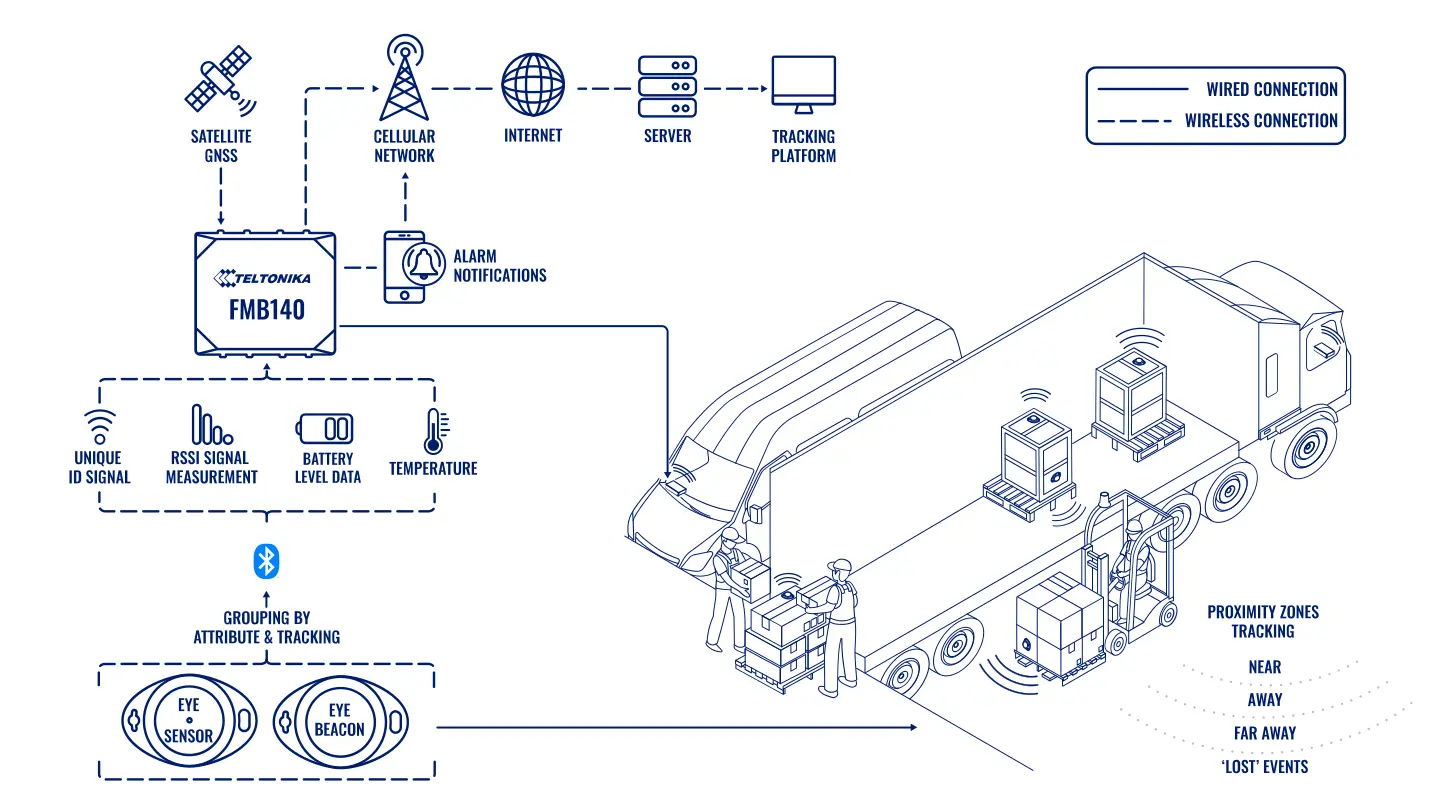
A Teltonika scenario for delivery work: EYE Beacon Bluetooth tags and EYE Sensor devices on parcels and pallets, plus an FMB140 tracker in the vehicle, show which consignment is in the load space and what condition it is in.
A Teltonika scenario for delivery work: EYE Beacon Bluetooth tags and EYE Sensor devices on parcels and pallets, plus an FMB140 tracker in the vehicle, show which consignment is in the load space and what condition it is in. A GPS tracker in the vehicle answers the question of where the van is. But the customer wants to know something else: where his box is, whether it went astray during a transfer, whether it overheated on the way. A vehicle can arrive exactly on schedule with the pallet in question not on board at all. A small Bluetooth tag on the goods solves that: the tracker hears it while it is in the vehicle, and notices when it has gone.
What this scenario solves
Most cargo is stolen in transit, not in the warehouse.
A parcel can be forgotten during loading or unloaded at the wrong address, and that only comes to light after a customer complains.
For food and medicines, temperature, humidity and the absence of shocks along the way all matter.
GPS works poorly indoors and among dense buildings, so it cannot tell you where exactly the goods are.
Most cargo is stolen in transit, not in the warehouse. A parcel can be forgotten during loading or unloaded at the wrong address, and that only comes to light after a customer complains. For food and medicines, temperature, humidity and the absence of shocks along the way all matter. GPS works poorly indoors and among dense buildings, so it cannot tell you where exactly the goods are.
The theft figures speak for themselves. According to the BSI and TT Club report for 2020, 71% of all cargo thefts happened during transport, while the share of losses from warehouses and other storage places rose to 25%.
Delivery work has quite enough difficulties as it is: shifting customer requirements, tight deadlines, price swings, handling errors, constant rerouting. To keep the customer informed and avoid losing money, a company needs to keep an eye not only on its vehicles but on what is inside them: parcels, boxes, pallets, food, pharmaceuticals, consignments for livestock farming.
There is a separate technical problem — accuracy. The satellite signal is attenuated and scattered by roofs and walls, and the error of a GPS chip is sometimes larger than the warehouse or the load space itself. Telling a box that is in the vehicle from a box left behind on the loading dock is impossible from coordinates. This calls for a different principle — the proximity of a tag to a tracker.
What Teltonika offers
An EYE Beacon Bluetooth tag or an EYE Sensor is attached to each consignment being tracked, and the FMB140 tracker in the vehicle hears them continuously and sends them to the server together with its own position: that shows which consignment is travelling where and in what condition.
Installation and setup
Fitting the device and configuring it for the fleet scenario at hand.
Data transfer
The device collects data and sends it to the monitoring platform; how often depends on the model and its settings.
Analysis and control
The person in charge gets reports and alerts and looks into what stands out.
Which equipment. All Teltonika trackers on the FMB platform support Bluetooth 4.X LE and can work with tags and sensors. In this example it is the FMB140. The tracker is fitted in the vehicle as usual, and the one condition is not to shield its Bluetooth antenna with large metal parts, or the reception range drops noticeably.
Tag or sensor. If all you need to know is where a parcel is, a tracker plus an EYE Beacon is enough. If the conditions of carriage matter — temperature, humidity, opening detected by a magnetic sensor, movement or shock — then an EYE Sensor is used. The tags are small and light, and they attach to a parcel, a box, a pallet or a container.
How the tracker identifies a consignment. Each EYE Beacon and EYE Sensor broadcasts its own identifier at intervals, and the interval is configurable. The tracker receives those packets in iBeacon or Eddystone format, adds its own GNSS position and sends them to the server. Sensors also transmit their measurements.
What the dispatcher sees. The monitoring software shows the position of all the tags — and therefore of all the tagged goods — by which tracker they are currently next to. Tags are also assigned to specific consignments there. It can all be viewed from a computer, a laptop or a smartphone.
Proximity events. The tracker records when a tag appeared within reception range and when it disappeared. In practice that means: load a pallet and the system marks the goods as on board vehicle No. 12. Unload it at a drop-off point and the mark says the goods have left the vehicle, with the place and time. If a tag vanishes in the middle of a motorway rather than at a drop-off point, that calls for an immediate check.
Filtering by name. There are always plenty of other people's Bluetooth devices near a vehicle: phones, headphones, tags on neighbouring vans in the warehouse. The tracker can be configured to count only beacons and sensors with specified names. Nothing extraneous then reaches the report, and traffic is spent only on your own goods.
What it looks like on a run. A van is carrying twenty boxes of medicines to pharmacies. Each box has an EYE Sensor on it. At 10:40 one box leaves the vehicle at a pharmacy on its own drop-off point — all according to plan. At 11:15 the temperature in the load space rises above the permitted level: the driver left the vehicle in the sun with the air conditioning off. The dispatcher receives an alert and rings him while the medicines are still intact. After the run the company has a log: where each box was and when, and what the temperature was along the way.
What changes for the warehouse. Tags can be left on reusable packaging: pallets, crates, insulated containers. The system then shows not only the goods in transit but how much packaging went out to customers and how much came back. In the warehouse, instead of checking delivery notes by hand, it is enough to look at which tags the tracker saw during loading and compare that with the order.
Where to start. It usually starts with one or two vehicles and a few dozen tags: a week is spent checking how well the tags are heard inside a fully loaded body, and the signal strength is tuned accordingly. Then it extends to the whole fleet, with alerts set up for missing goods and temperature breaches.
Limitations. The tags run on batteries, and their life depends on the transmission interval and the signal strength: the more often they transmit, the sooner the battery goes flat. Metal containers and dense stacks weaken the signal. A tag on a consignment shows proximity to a tracker, not an exact spot in the load space or the warehouse. Finding a particular box inside a large warehouse needs fixed gateways, not just a tracker in a vehicle.
A radio survey. Before going live, check how well the tags are heard in the particular bodies when fully loaded, against metal walls and deep inside a stack. The findings determine the signal strength, the transmission interval and where the tags are attached.
Last detection. For each tag the platform stores when and next to which tracker it was last heard. If a tag goes missing, that record shows which vehicle the goods were last seen in and where.
What is needed from the customer. A list of the goods or packaging to be tagged, the temperature and humidity requirements, and the procedure for removing tags at the recipient and returning them into circulation.
What you get
You can see what is actually in the vehicle
The tracker knows which tagged goods are in the load space now and which have already been unloaded.
A loss shows up immediately
If a tag disappears somewhere other than a drop-off point, the dispatcher learns about it during the run rather than from a customer complaint.
Control over conditions of carriage
The EYE Sensor reports temperature, humidity, opening and shocks, and breaches are recorded with the time and place.
Tuned to the project
Tag signal strength and transmission intervals are chosen to suit the size of the body and the warehouse and the battery life required.
Inexpensive to fit
The tags are wireless with no cabling to run, and a lost or damaged one is easy to replace.
Fewer losses and fewer arguments
A log of loading, unloading and conditions of carriage helps to settle customer claims and to work out where a consignment went missing.
Why this solution
The strength of the solution is that the tracker is already in the vehicle. Bluetooth LE support is built into every tracker on the FMB platform, so tracking goods needs no change of equipment across the fleet: it is enough to buy the tags and configure the firmware.
The EYE Beacon and EYE Sensor are made by the same company as the trackers, so compatibility and data formats do not have to be worked out. Proximity events and filtering by name run inside the device itself.
Signal strength and transmission rate are set for each project: a courier's van takes one set of values, an articulated lorry carrying pallets another. That makes it possible to balance accuracy, range and battery life.
How this works in Azerbaijan. The scenario suits courier services and online shops in Baku, pharmacy and pharmaceutical distributors carrying medicines around the regions, food suppliers serving retail chains, and hauliers working with cargo through the port of Alat and along the Middle Corridor. In summer, at +40 °C, an unrefrigerated body heats up very quickly, and a temperature sensor on a box of medicines or food often matters more than an accurate track of the vehicle. Before going live it is worth checking how well the tags are heard in your bodies and in the warehouse, and agreeing who in the warehouse removes the tags after delivery and returns them into circulation. GPS.az fits Teltonika trackers, configures reception of EYE Beacon and EYE Sensor devices and produces reports in the Wialon platform on loading, unloading and the conditions in which goods travelled.
Related case studies
Related rollouts and equipment

GPS trackers for Poland's e-TOLL system
Fleet telematics
Three ways to keep track of fuel in a fleet
Fleet telematics

Recording farm machinery and implements with the FMB140
Agriculture, construction and mining
Questions about the “Tracking parcels and pallets with Bluetooth tags” scenario
Request a call
A specialist will call back and match a solution to your fleet and your task.