
GPS trackers for Poland's e-TOLL system
Lorries over 3.5 t and buses in Poland pay for tolled roads through e-TOLL, and Teltonika has certified its trackers as on-board devices for the system.
Lorries over 3.5 t and buses in Poland pay for tolled roads through e-TOLL, and Teltonika has certified its trackers as on-board devices for the system. In June 2021 Poland replaced its old road charging arrangement with a satellite-based one. The vehicle now reports where it is driving and the charge is taken according to the actual distance covered on tolled sections. Positions can be reported through a mobile app, a dedicated on-board unit, or a GPS tracker already fitted to the vehicle for fleet monitoring. The last option is the most convenient for a haulier: one device covers both e-TOLL and ordinary vehicle monitoring. Below we look at how it is put together, which Teltonika models have been certified and what that means for Azerbaijani companies whose articulated lorries run to Europe.
What this scenario solves
Without reporting data to e-TOLL, a lorry over 3.5 t has no right to use Poland's tolled roads.
The requirement covers more than 1.3 million registered vehicles, mostly in corporate fleets.
A driver can forget to top up the account or switch the app on, and the fine goes to the owner.
The tracker has to be certified for e-TOLL, or the system will not accept its data.
Without reporting data to e-TOLL, a lorry over 3.5 t has no right to use Poland's tolled roads. The requirement covers more than 1.3 million registered vehicles, mostly in corporate fleets. A driver can forget to top up the account or switch the app on, and the fine goes to the owner. The tracker has to be certified for e-TOLL, or the system will not accept its data.
The system was launched and is run by Poland's National Revenue Administration (Krajowa Administracja Skarbowa). It replaced the earlier arrangement with radio-frequency on-board units and became compulsory for all vehicles and vehicle combinations with a maximum permissible mass over 3.5 tonnes, and for buses. Technically, e-TOLL relies on satellite positioning: the system has to know when a vehicle joined a tolled section and when it left it.
There are several ways to report that data. The driver can install an app on a smartphone, the haulier can buy a dedicated on-board unit (OBU), or he can use a GPS tracker already connected to a fleet monitoring system through an accredited telematics service provider. For a large fleet the first two options are awkward: phones go flat, drivers forget to start the app, and a separate unit means one more box in the cab and one more contract.
The human factor is expensive here. Electronic payment is simple in itself, but if the driver has not topped up the balance or has switched the app off, the vehicle uses a tolled road without reporting. The fine for non-payment goes to the owner, and across a corporate fleet that quickly becomes a noticeable line in the budget.
The second side of the problem is supply. The e-TOLL launch coincided with the worldwide chip shortage, and integrators had to equip tens of thousands of vehicles in a short time. A tracker for a project like that has to be produced in the required quantity, arrive quickly, fit without lengthy preparation and preferably arrive already configured. And above all it must hold e-TOLL certification.
What Teltonika offers
Teltonika put a whole range of vehicle trackers through e-TOLL certification at once, so a haulier can meet the Polish system's requirement with the same device that handles fleet monitoring.
Installation and setup
Fitting the device and configuring it for the fleet scenario at hand.
Data transfer
The device collects data and sends it to the monitoring platform; how often depends on the model and its settings.
Analysis and control
The person in charge gets reports and alerts and looks into what stands out.

The list of certified models includes the FMT100, FMP100, FMB001, FMB010, FMC800, FMC880, FMM880, the FMx920 series, FMB120, FMx125, FMx130, FMB140, FMC650 and FMM650. These are different classes of device: from simple trackers that connect to the vehicle's electrical system in a few minutes, to professional models with a CAN interface and sensor inputs that are usually fitted to long-haul tractor units.
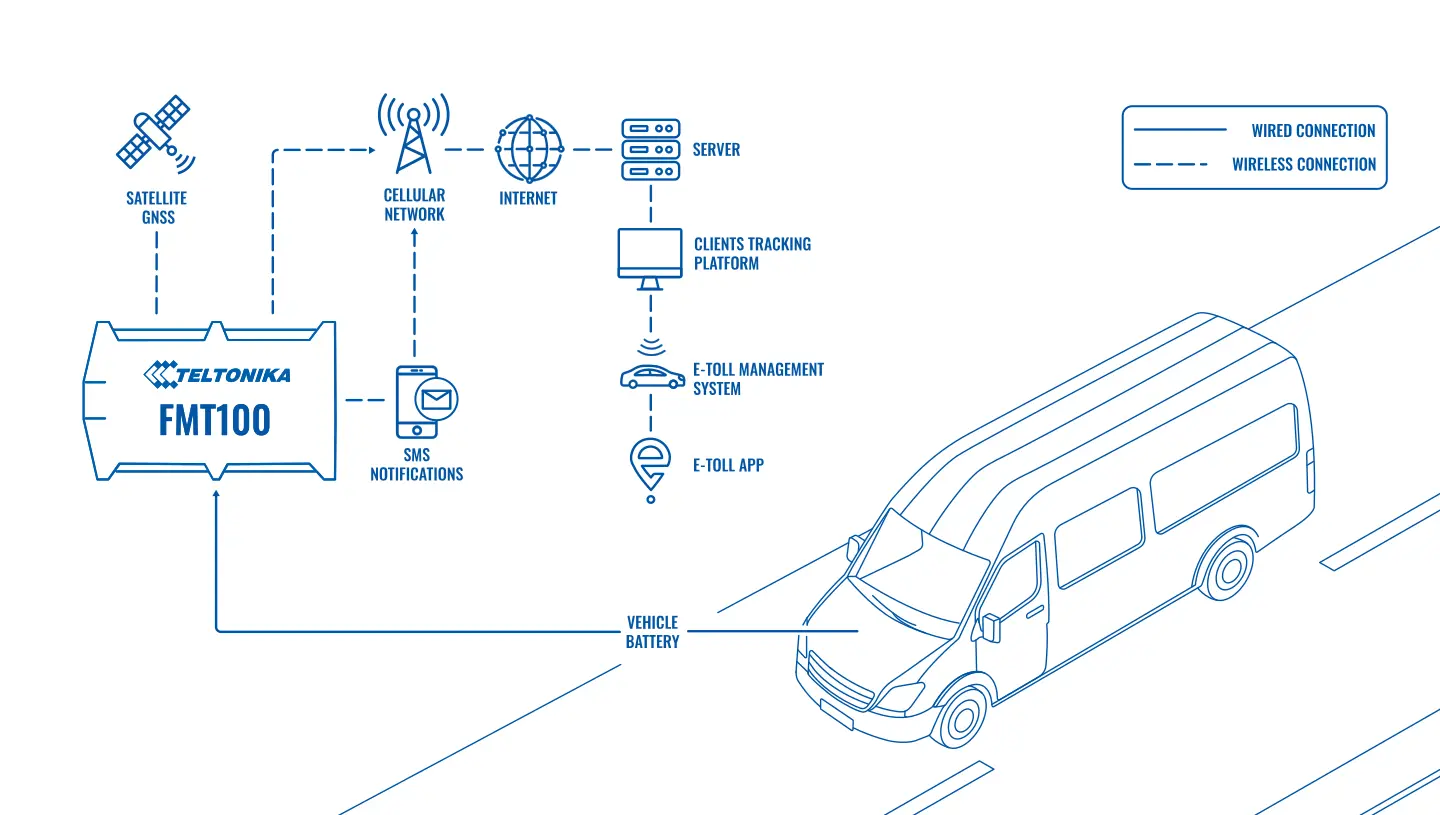
As its example Teltonika takes the FMT100 from the FAST & EASY range. It is a compact tracker with a backup battery, Bluetooth and a GNSS antenna that is large and high-gain for its class. Thanks to that antenna it can be fitted right under the bonnet, on the vehicle battery: the model has a dedicated clamp for attaching the power cable to the terminals. No special preparation, tools or ramp are needed and the fitting takes less than five minutes. The housing is rated IP65 and there is an accelerometer inside with crash detection, so the same device will also serve for insurance telematics.
How it works on the road. The tracker continuously determines the vehicle's position and speed and sends them over the mobile network to the telematics service provider's server. From there the data goes into e-TOLL. The system sees the vehicle joining and leaving a tolled section, calculates the cost at the National Revenue Administration's rate and takes the charge from the owner's account. The driver has nothing to switch on or top up by hand en route, and forgetting to pay is no longer possible.
For integrators who have to equip hundreds of vehicles in a short time, Teltonika offers delivery of trackers already configured. The configuration is written at the factory and the fitter only connects the power. That saves hours of work on every batch and reduces the risk of a configuration mistake.
After fitting, firmware and parameters can be changed remotely through FOTA WEB, Teltonika's cloud service for device management. If e-TOLL changes its requirements for the protocol or the reporting interval, a new configuration can be sent to the whole fleet without a visit to the workshop.
Alongside reporting to the payment system the tracker does its ordinary job. The dispatcher sees the vehicle on the map, its journey history, speed, stops, sharp manoeuvres and crash events. Reports are built from the same history that goes to e-TOLL, so a disputed charge is easier to check against the track.
Which model to take depends on the vehicle. For light commercial vehicles and minibuses the FMB001, FMB010 or FMT100 is enough: they run off the vehicle's electrical system, fit quickly and need no dismantling of the dashboard. For tractor units and buses it makes more sense to fit the FMB120, FMx125, FMx130 or FMB140. They have more inputs. The FMB140 reads CAN itself, the FMB120 and FMx130 can take a CAN adapter, and the FMx125 has RS232 and RS485 ports for a fuel level sensor. So besides positions for e-TOLL, the dispatcher gets mileage, fuel consumption and engine revolutions from the vehicle's own electronics or from sensors. For fleets where 4G matters there are the FMC800 and FMC880, while the FMC650 and FMM650 suit complex projects involving a tachograph and additional sensors.
One limitation is worth keeping in mind. A certified tracker does not pay for the road by itself: it reports positions to a telematics service provider, and it is the provider that is linked to e-TOLL. So when choosing a solution the haulier agrees terms both for the device and for the data reporting service.
The list changes. The list of models certified for e-TOLL and the requirements for reporting data are set by the Polish side, and they are updated over time. The list above is taken from Teltonika's material; before purchase we check a particular model's current status against the latest e-TOLL and manufacturer information.
What the haulier does and what the integrator does. Registering the vehicle in e-TOLL, the account for payment and the contract with an accredited telematics service provider are all arranged by the haulier. The integrator selects a certified tracker, fits it and configures reporting as the chosen provider requires. The road charge itself has nothing to do with the integrator's work.
What you get
One device instead of two
A certified Teltonika tracker reports to e-TOLL and works in the fleet monitoring system at the same time, so no separate on-board unit is needed in the cab.
Payment without the driver's involvement
Charges for tolled sections are taken automatically from the track, so fines caused by a switched-off app or an unfunded balance stop being the haulier's problem.
Fitting in a few minutes
The FMT100 clamps onto the battery under the bonnet, and the job can be done in the yard with no tools and no dismantling of the interior.
A complete journey history
Position, average speed, violations, harsh braking and crash events are stored and available for reports across any number of vehicles.
Driver discipline
When every event is visible to the dispatcher it is easier to build an incentive scheme and discuss specific episodes rather than argue from hearsay.
Configuration to suit the project
Factory configuration, remote updates through FOTA WEB and a choice of model to suit the vehicle type let the solution scale from a dozen vans to a large fleet of tractor units.
Why this solution
The main argument is a simple one: Teltonika has a whole range certified for e-TOLL, not a single model. A haulier can choose a simple tracker for vans and a professional model with CAN for tractor units and still work in one monitoring system.
The manufacturer produces the devices in large volumes itself and can supply them already configured. For a project that has to equip thousands of vehicles within a few months, that matters more than any individual specification.
Teltonika trackers are supported by most monitoring platforms, Wialon included. The data for e-TOLL and the data for the dispatcher come from one source, and remote configuration through FOTA WEB removes the question of servicing a fleet scattered across Europe.
How this works in Azerbaijan. This case concerns hauliers whose vehicles run to Europe above all. Articulated lorries from Baku and Sumgait travelling the M-2 towards Georgia and on through Turkey or along the Middle Corridor are obliged to report to e-TOLL on entering Poland. The simplest way to settle it is in advance: fit a certified tracker at home, before the run, rather than hunt for an on-board unit at the border. In practice we most often fit the FMB120 or FMx125 to tractor units and the FMB001/FMB010 to light commercial vehicles. Points to consider: e-TOLL accepts data only through an accredited Polish telematics service provider, so besides the tracker you need a contract with such an operator, and abroad a roaming or multi-operator SIM so the vehicle does not drop off the network after Georgia. In the mountains and on the passes the tracker stores positions in memory and sends them as soon as there is a network. As Teltonika's GOLD partner in Azerbaijan, GPS.az selects the model, fits the tracker, sets it up on the Wialon platform for your own fleet monitoring and helps with the configuration for e-TOLL requirements. The equipment warranty is 1 year.
Equipment used
Full specifications are in the catalogue.
Full specifications are in the catalogue.
Full specifications are in the catalogue.
Full specifications are in the catalogue.
Full specifications are in the catalogue.
Full specifications are in the catalogue.
Full specifications are in the catalogue.
Full specifications are in the catalogue.
Full specifications are in the catalogue.
Full specifications are in the catalogue.
Related case studies
Related rollouts and equipment
Questions about the “GPS trackers for Poland's e-TOLL system” scenario
Request a call
A specialist will call back and match a solution to your fleet and your task.