
Boat hire: on-board data ashore
A boat and yacht hire business receives the data from the on-board NMEA 2000 network ashore: an FMC650 or FMM650 tracker transmits engine parameters, tank levels, depth and wind along with the vessel's coordinates.
A boat and yacht hire business receives the data from the on-board NMEA 2000 network ashore: an FMC650 or FMM650 tracker transmits engine parameters, tank levels, depth and wind along with the vessel's coordinates. On a modern boat almost all the equipment is already connected to a shared network and exchanges data constantly: the engines, the depth and wind sensors, the fuel and water tanks. The skipper sees it on the display by the helm. The hire operator ashore sees nothing. Teltonika proposes connecting a tracker straight into that network. The hire manager then knows where the boat is, how it is being handled and what is happening to it, and spends less money on fuel, manual checks and disputed claims.
What this scenario solves
Once the boat has left the harbour the hire operator has no idea how the hirer is handling it.
Daily rounds and inspections take time but reveal nothing of what happened out on the water.
If a boat comes back damaged, proving that it happened during the hire is next to impossible.
Water and fuel tanks are checked by hand and to a schedule rather than as the need arises.
Once the boat has left the harbour the hire operator has no idea how the hirer is handling it. Daily rounds and inspections take time but reveal nothing of what happened out on the water. If a boat comes back damaged, proving that it happened during the hire is next to impossible. Water and fuel tanks are checked by hand and to a schedule rather than as the need arises.
The cost of mistakes can be measured precisely. In the United States, the largest recreational boating market, the coastguard recorded 3887 incidents in a single year. 61% of them were down to improper operation, most often the inexperience or inattention of the person at the helm. Among technical failures, engine failure accounted for 43% of incidents.
The root of the problem is the absence of data. The operator cannot see that an engine is running outside its safe range, that fuel consumption is rising, that the hirer has entered a prohibited area. Once damage has been done, it is unclear what exactly happened and who is at fault. Disputes drag on, and the hire business often pays for the repair itself, because it cannot prove that the damage arose during the hire.
Downtime hits revenue harder than it seems. Hiring a luxury yacht in Europe costs from 5,000 to 20,000 euros a day, and every day in the workshop is a direct loss. In a short season a few lost weeks can decide the fate of the whole year.
Routine adds to the load. Fuel, water and waste tank levels are checked by hand and serviced to a fixed schedule. The result is that hirers run out of fresh water mid-trip, the waste tank overflows without warning, and the staff spend their time firefighting instead of planning the work.
What Teltonika offers
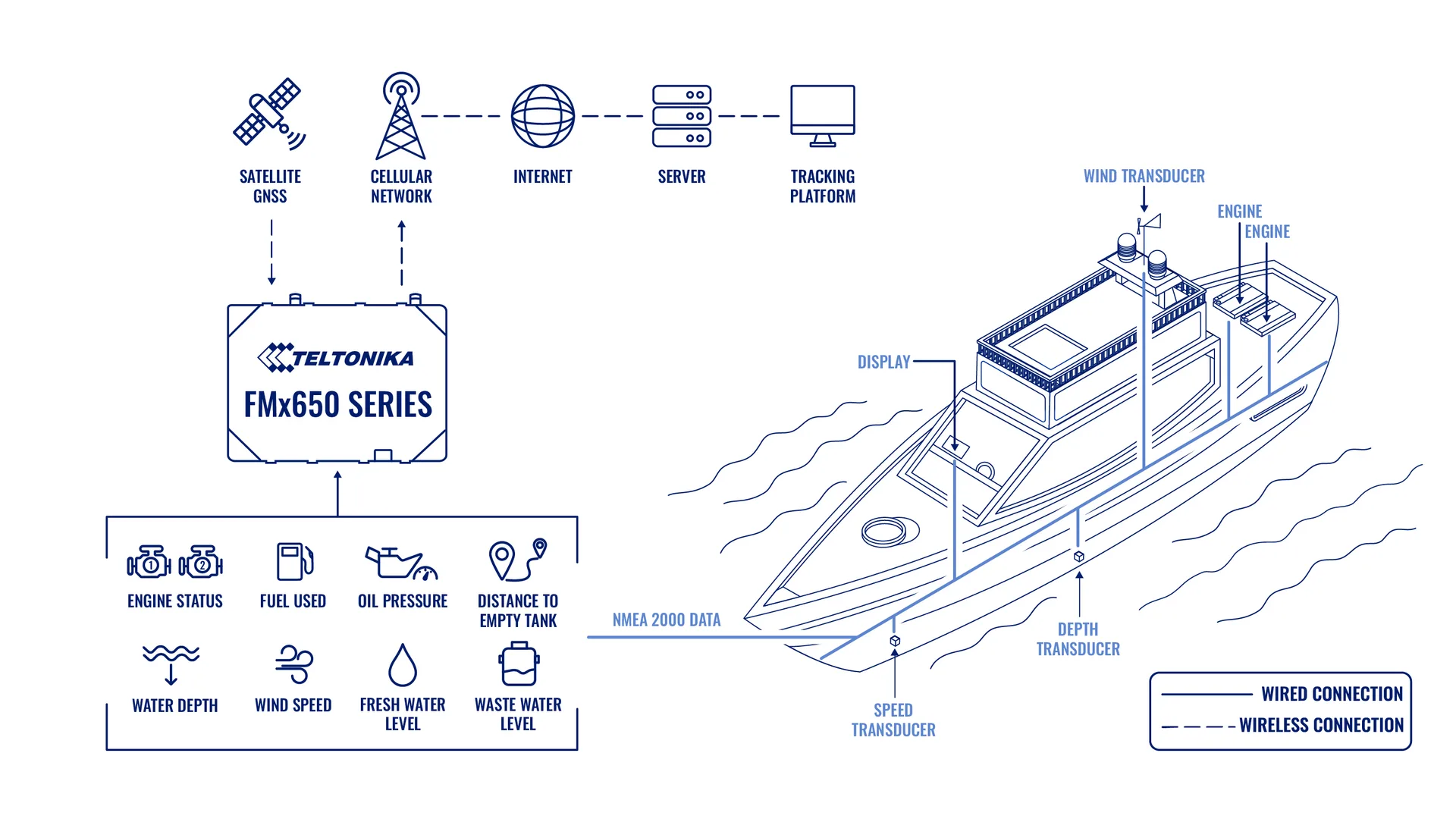
An FMC650 or FMM650 tracker is connected to the on-board NMEA 2000 backbone, and it transmits ashore the data from up to four engines and sixteen tanks, along with depth and wind if the vessel carries such sensors.
Installation and setup
Fitting the device and configuring it for the fleet scenario at hand.
Data transfer
The device collects data and sends it to the monitoring platform; how often depends on the model and its settings.
Analysis and control
The person in charge gets reports and alerts and looks into what stands out.
What the backbone is. It is the central cable on a vessel through which all the on-board equipment receives power and exchanges data. It runs on the NMEA 2000 marine communication standard. Thanks to it, several engines, displays and sensors understand one another and work together reliably.
The tracker. According to Teltonika, the FMx650 series trackers from its professional range are its only devices that support NMEA 2000. They are designed for vessels with several engines and many tanks for fuel, fresh water and waste. The FMC650 gathers data from 4 engines and up to 16 tanks, and, where the equipment is there on board, depth, wind direction and wind speed as well.
Fuel and engines. An operator usually has no idea which boats, routes or skippers burn more fuel than they should. With NMEA 2000 data the actual consumption is visible in real time, and if oil pressure or engine temperature jumps, a notification arrives before the engine fails out on the water. On a vessel with several outboard or inboard engines it is immediately clear which one needs attention.
Protection against unfounded claims. If a hirer brings a boat back damaged and insists it was always like that, the hire business has the data: when and how the on-board systems were loaded, what revs the engine was running at, whether the vessel went into shallow water. Investigating damage disputes and insurance claims becomes easier.
Tanks. Without monitoring, tanks are pumped out and filled to a schedule, which is extra work for the staff. Fresh water and waste data in real time allows that to be done when it is actually needed. Hirers with no experience can be sent automatic notifications that the fresh water is running low.
Handling style. On the water an accelerometer is useless: the vessel rocks constantly, and there is no telling a wave from a sharp manoeuvre by it. So risky behaviour is identified from the engine data. That gives the operator grounds for a word with a careless skipper and for rewarding careful customers.
Prevention. Simply telling a hirer that the boat is being tracked makes many risky ideas fall away by themselves. Speed, tank levels and depth geofences show the state of the vessel along the whole route, and the data collected helps improve the briefing for the next customers.
Communication at sea. For trips well offshore the solution is supplemented with a satellite modem through the RS232 port. If hirers get lost in open water, the operator will still receive accurate coordinates and will be able to send help in time.
What this looks like on the water. A hirer is taking a motor boat along the coast, the engine has been running at high revs for a long time and the temperature is climbing. The operator receives a notification, gets in touch with the boat by radio or phone and asks for the revs to come down and the boat to return. The engine is intact, and that evening the boat goes out to the next customer rather than into the workshop for two weeks.
How the connection is made. First you look at what equipment is on the on-board network and what data it actually transmits: not every tank sensor or engine gives out everything the standard describes. Then the tracker is connected to the backbone through a standard NMEA 2000 connector, the GNSS and mobile antennas are brought out to where the hull does not shield them, and it is checked that the parameters of every engine and tank reach the server. After that the notification thresholds and the depth geofences are set to suit the particular waters.
What you get
Lower fuel and repair costs
The engine data shows which hirers and skippers overwork an engine, and they can be worked with before there is a breakdown.
Fewer manual checks
Instead of daily rounds the staff look at tank levels and engine condition in the system.
The season's revenue protected
A fault spotted in time does not turn into downtime during the most profitable weeks.
Arguments in a dispute with a hirer
Data on how the systems ran and on geofence breaches shows what happened to the boat during the hire.
Satisfied customers
The water does not run out suddenly, the tanks do not overflow, trips go more calmly, and customers come back.
Warnings of dangerous conditions
Notifications of water too shallow or too deep and of rising wind protect the vessel and the people on board.
Why this solution
A boat is usually tracked like any other moving object: a dot on a map and a speed. The FMx650 tracker with NMEA 2000 support gives more: engine parameters, tank levels and data from the depth and wind sensors are added to the coordinates. That is exactly what turns monitoring from knowing where the boat is into knowing what is happening to the boat.
The tracker passes NMEA 2000 data out as standard IO elements, so the common monitoring platforms accept it. A hire business can run its boats and yachts in the same system as its land vehicles: the trailers, the staff cars, the plant at the base.
What to bear in mind. For the solution to work, the vessel needs an NMEA 2000 network and equipment that transmits the data required into it. On older boats with no on-board network, or with engines that have no digital interface, some parameters will be unavailable and will have to be picked up with separate sensors.
How this works in Azerbaijan. Boat and yacht hire here operates mainly in summer: in Baku Bay by the seaside boulevard, at the Absheron resorts and at Nabran in the north of the coast, and on the Mingachevir reservoir. The season is short, and every week of downtime from an engine failure hits the whole year's revenue, so an early warning of an overheating engine is particularly valuable here. In summer at +40 °C engines overheat more often, and in the shallows of the Caspian off the Absheron coast depth geofences matter. Along the coast the Azercell, Bakcell and Nar mobile networks work; for trips further offshore satellite communication is needed. Modern motor boats with engines of recent years usually have NMEA 2000; on older boats we first check what data is actually there on board. GPS.az fits the FMC650 or FMM650, connects it to the on-board network, and sets up notifications in Wialon on engines, tanks and depth along with reports on each hire.
Where the limits of the solution lie. In the scenario described, the tracker reads the data from the NMEA 2000 backbone rather than controlling the engines, and it does not replace the vessel's own navigation, echo sounder, VHF radio and life-saving equipment. Depth and wind notifications reach the operator ashore with a transmission delay, so the decisions out on the water are the skipper's. Who ashore receives the alerts, how they contact the hirer and when they send help are set down in the hire firm's procedure before the season starts.
Related case studies
Related rollouts and equipment
Questions about the “Boat hire: on-board data ashore” scenario
Request a call
A specialist will call back and match a solution to your fleet and your task.