
The FMC880 and FMM880 trackers for insurers
Insurers and corporate fleets assess driving style and investigate accidents using data from the FMC880 and FMM880 trackers, which record a vehicle's movement on six axes and fit onto the battery in five minutes.
Insurers and corporate fleets assess driving style and investigate accidents using data from the FMC880 and FMM880 trackers, which record a vehicle's movement on six axes and fit onto the battery in five minutes. Most accidents are the driver's fault. For an insurance company that means risk depends on how a person drives, while the make of vehicle, the age and the years held from the application form give only part of the picture. For a corporate fleet the same thing turns into repairs, downtime and payouts. Teltonika has released a dedicated pair of trackers in its FAST & EASY range for this job. They gather data for insurance based on driving style and mileage, record an impact at high frequency and help tell a genuine accident from a staged one.
What this scenario solves
Almost all serious accidents happen because of driver errors and dangerous actions.
The insurer assesses risk from an application form and cannot see how the person actually drives.
Motor insurance claims fraud costs the industry hundreds of millions a year.
A corporate fleet pays for aggressive driving in repairs, fines and rising premiums.
Almost all serious accidents happen because of driver errors and dangerous actions. The insurer assesses risk from an application form and cannot see how the person actually drives. Motor insurance claims fraud costs the industry hundreds of millions a year. A corporate fleet pays for aggressive driving in repairs, fines and rising premiums.
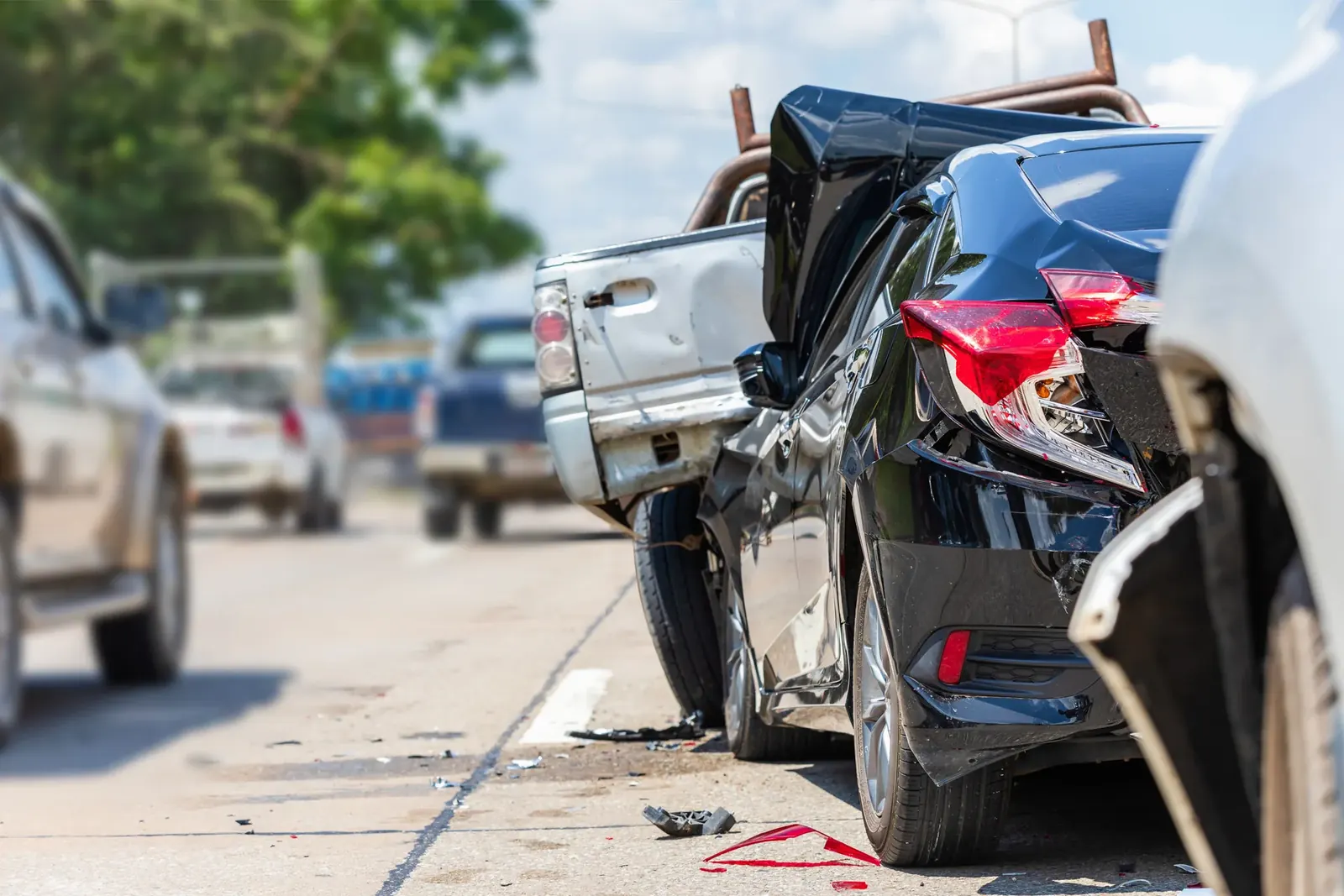
The safety figures are grim. According to the US National Highway Traffic Safety Administration (NHTSA), 94% of serious accidents are caused by dangerous actions or errors behind the wheel. The World Health Organization puts road deaths at about 1.19 million people a year, more than half of them pedestrians, motorcyclists and cyclists.
Fraud is on a large scale too. In 2023 around 65,000 fraudulent claims connected with the company Bigmotor came to light in Japan. In the United Kingdom 45,800 fake motor insurance claims worth 501 million pounds sterling were identified in a year. Every such case means a dispute, an assessment and money that honest customers pay through their premiums.
The motor insurance market, Statista forecasts, will keep growing. Insurers need a way of pricing risk from real behaviour, of learning about an incident quickly and of resting on objective data when investigating an accident. Fleet owners need the same thing, only as the payer rather than the insurer.
There is a problem of speed as well. An insurer usually hears about a serious accident when the customer gets through on the phone or comes into the office, sometimes several days later. In that time traces, witnesses and camera recordings are lost, and the vehicle gets repaired or moved on. The later settlement starts, the more it costs and the more room there is for padding the claim.
What Teltonika offers
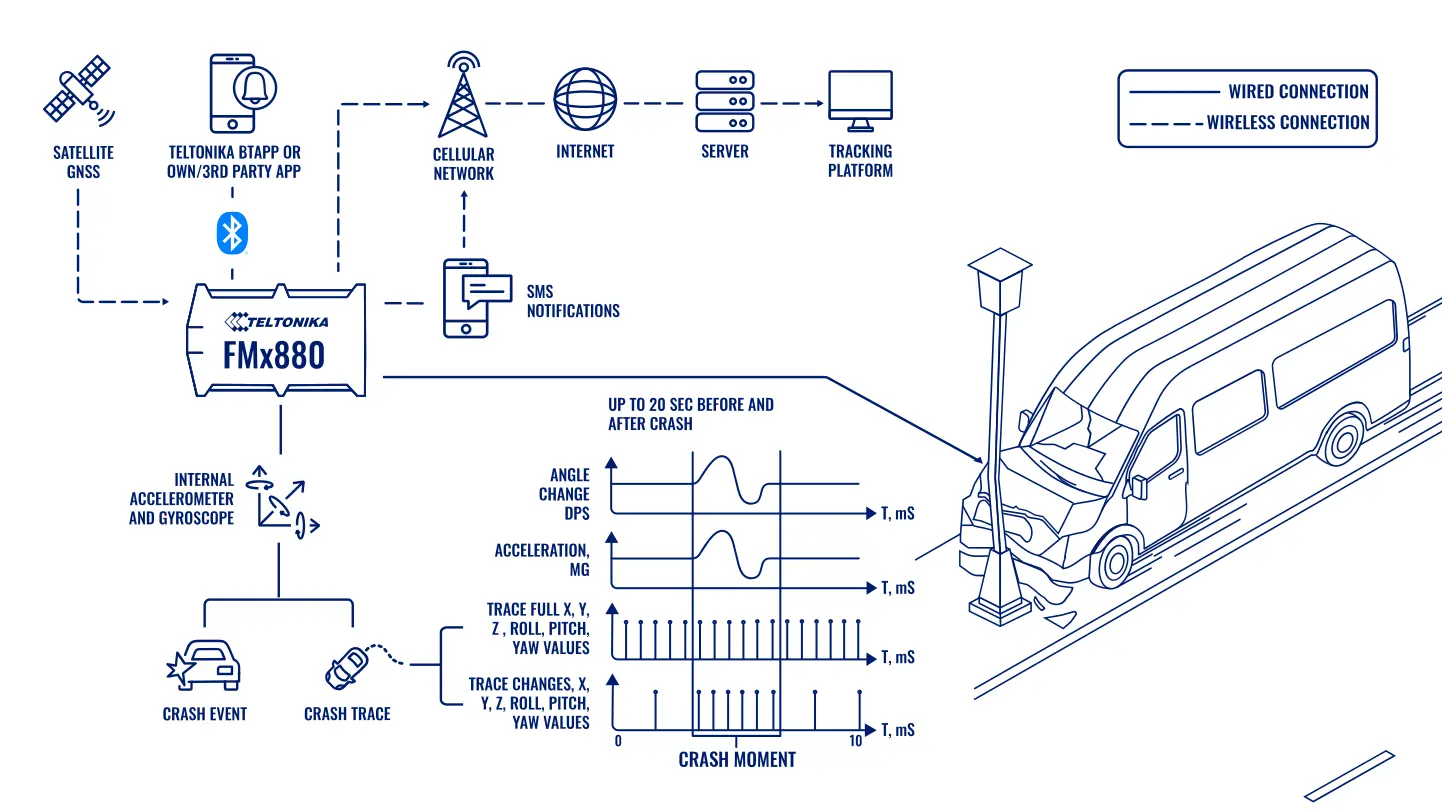
The FMC880 and FMM880 transmit coordinates, speed, harsh acceleration, braking and cornering, offences and collision data, while a six-axis sensor running at 400 Hz makes it possible to reconstruct an accident second by second.
Installation and setup
Fitting the device and configuring it for the fleet scenario at hand.
Data transfer
The device collects data and sends it to the monitoring platform; how often depends on the model and its settings.
Analysis and control
The person in charge gets reports and alerts and looks into what stands out.
What the tracker sends. A vehicle with a tracker continuously transmits its position, average speed on the journey, driving style (aggressive acceleration, braking, taking corners), speeding and accident events. From that data the insurer and the driver both get clear feedback, and the driver gains a reason to drive more carefully.
Which products it suits. The trackers are designed for insurance based on actual use of the vehicle (UBI) and its variants: pay as you drive (PAYD), pay how you drive (PHYD), driving style correction programmes (MHYD), as well as for first notification of loss (FNOL), claims settlement and accident reconstruction. Teltonika stresses that the models have been tested against the requirements of the insurance industry.
Recording an impact. In the versions with a gyroscope the tracker combines an accelerometer and a gyroscope, which means it sees both linear acceleration and the vehicle's rotation. That gives six axes of movement. The data comes at 400 Hz, hundreds of readings a second around the moment of impact. From it, tables of coordinates and changes in force and speed are built, along with graphs by the X, Y and Z axes and of angular velocity. The point of impact can be calculated, that is, from which side and in which direction the force came. This data can be displayed by the insurer's own software or by a telematics provider's platform.
How this helps in practice. A customer states that an unknown car ran into the back of him in a car park. According to the tracker data the vehicle was moving at 60 km/h at the stated time, and the impact came to the front right with harsh braking just before it. A claim like that will not go through without further checking, while in a similar situation an honest customer is helped by the data to be paid out faster.
Protection against interference. The tracker records the loss of external power as an event and, while the internal battery holds charge, sends it to the server. If there is no mobile network at that moment, the event will go later. It is thin, compact and has a good antenna, so it is also fitted as a second, hidden tracker: if a thief has found and disconnected the main one, the backup carries on transmitting the position.
Fitting and accuracy. The trackers have a powerful built-in GNSS receiver supporting the L1 and L5 bands, which noticeably improves accuracy in town. The device fastens straight onto the vehicle battery under the bonnet; fitting takes less than five minutes and needs no specialist. The IP65 housing stands up to dust, water and frost.
What first notification of an accident looks like. The tracker records an impact above a set threshold and immediately sends an event with the coordinates, the time, the speed before the impact and the direction of the force. The insurer or the fleet dispatcher sees it in the system within seconds, rings the driver and, if necessary, calls out assistance and a recovery truck. Settlement begins the same day rather than after the customer has gathered the paperwork.
How a programme like this is launched. First you decide what exactly is wanted: a discount for careful driving, pay as you drive, fast FNOL or protection against theft. The tracker model, the set of events and the data transmission rate are chosen accordingly. Next comes an agreement on how the customer consents to data about their journeys being collected and who has access to it. The last step: a pilot on a few dozen vehicles, to calibrate the thresholds for harsh manoeuvres and impacts against real roads before tariffs are changed.
How the driver score works. The tracker transmits events: harsh acceleration, braking, cornering, speeding, impacts. The score is calculated from them by the insurer's software or the monitoring platform, usually per unit of mileage, so that a driver who covers a lot of distance is not penalised for the number of journeys. The weightings of the events and the thresholds are set by the owner of the programme, not by the tracker. Data quality depends on the fitting and the connection: a tracker fastened with play in it produces false impacts, and in tunnels and underground car parks positional accuracy falls off. And the limit of the result: impact data is material for settlement and expert assessment, while the decision on fault and payment is taken by the insurer and the competent authorities.
What you get
Fewer fraudulent payouts
Six-axis impact data at 400 Hz makes it possible to reconstruct an accident and check whether the claim matches what happened.
Tariffs based on real driving
Driver scores are calculated from dangerous manoeuvres and the way the vehicle is used, and careful customers pay less.
Fast notification of an incident
The insurer or the fleet dispatcher learns of a serious impact straight away rather than when the customer rings.
A feature set built for insurance
The FMC880 and FMM880 were made and tested for insurers' tasks, with nothing superfluous.
Fitting in five minutes
The tracker goes onto the battery under the bonnet without a fitter, which matters when customers are being connected in volume.
A hidden backup tracker
The compact housing and the power loss event improve the chances of finding a stolen vehicle.
Why this solution
Driver assessment is built on the same data. The insurer calculates a customer's score from dangerous manoeuvres, the pattern of vehicle use and the environmental impact, and adjusts the premium. A careful driver pays less, a risky one more, and the insurer's loss ratio improves. For a corporate fleet the same approach works as a motivation system: drivers see their rating, aggressive driving falls away, and with it repairs, maintenance and insurance costs come down.
Teltonika has been in telematics for a long time and makes trackers that integrate with insurance platforms and with the common monitoring systems. The FMx880 series covers the main insurance telematics scenarios in one device, from mileage recording to accident reconstruction, and needs no professional fitting. That brings down the cost of connecting each customer, which settles a great deal for an insurance programme covering thousands of vehicles.
Two models exist for different networks: the FMC880 works on LTE Cat 1, the FMM880 on LTE Cat M1 and NB-IoT networks. The choice depends on which networks the operators offer in the country of the rollout.
How this works in Azerbaijan. Insurance based on driving style is still rare here, so the main users of the scenario at present are corporate fleets, leasing companies, car sharing, car hire and taxi services in Baku, Sumgait and Ganja. What matters to them is driver assessment, data for investigating accidents and a hidden backup tracker against theft. For taxis and car sharing the impact record is particularly useful: it shows on which run and with which driver a dent appeared, and the argument over who pays for the repair is settled in minutes. If a fleet negotiates a discount with an insurer itself, several months of driving style reports make a good argument. When fitting under the bonnet it is worth allowing for the engine bay heating up in summer at +40 °C outside, and for a mounting point where the tracker will not get in the way of servicing the battery. For the FMM880 you need to confirm in advance that Azercell, Bakcell or Nar support LTE Cat M1 in the region of operation; with the FMC880 there is no such issue. GPS.az connects the FMC880 and FMM880, sets up driving style reports and notifications of impacts and power loss in Wialon, and for insurance programmes helps with exporting the data into the insurer's system.
Related case studies
Related rollouts and equipment

Questions about the “The FMC880 and FMM880 trackers for insurers” scenario
Request a call
A specialist will call back and match a solution to your fleet and your task.