
Three ways to keep track of fuel in a fleet
Teltonika describes three ways to keep track of fuel in a fleet — over the CAN bus, through an OBD tracker and with a level sensor in the tank — and explains which to choose for which kind of vehicle.
Teltonika describes three ways to keep track of fuel in a fleet — over the CAN bus, through an OBD tracker and with a level sensor in the tank — and explains which to choose for which kind of vehicle. Fuel is one of the largest costs in almost any fleet, from a delivery service with five vans to a haulier with a hundred tractor units. The money goes out through three channels: driving style, idling and outright theft. The first two are visible only in data from the vehicle; the third only if the data is precise enough to tell a fuel drain from measurement error. There is no universal device here. A car-sharing hatchback, a construction tipper and a long-haul tractor unit each call for a different solution, and below we look at how they differ and where each one's limit of accuracy lies.
What this scenario solves
When fuel prices rise, a haulier either raises rates or works at a loss.
Aggressive driving and speeding noticeably increase consumption.
Fuel theft goes on in small amounts and can pass unnoticed for months.
Without data from the vehicle there is no way to tell which part of the consumption is normal and which is not.
When fuel prices rise, a haulier either raises rates or works at a loss. Aggressive driving and speeding noticeably increase consumption. Fuel theft goes on in small amounts and can pass unnoticed for months. Without data from the vehicle there is no way to tell which part of the consumption is normal and which is not.
It makes sense to start with what can be measured. The US Department of Transportation, whose figures Teltonika cites, estimates that keeping to the speed limit improves fuel economy by 15–30% on the open road and by 10–40% in a stop-start urban cycle. Feedback devices that tell the driver how he is driving change habits, on the same estimates, enough to save up to 10%.
Theft is a separate and more unpleasant story. On the estimates given in the original material, diesel is stolen worldwide to the tune of more than $13 billion a year. It is taken at filling stations, at roadside lorry parks, at depots and warehouses, but most often out on the run, a little at a time and regularly. The industry knows the arrangement well: the driver, the mechanic and the storeman act together and sell the drained fuel on.
It hits hardest those who get through a lot of fuel and keep records from receipts and job sheets: road haulage, construction, agriculture. Where plant works far from base and is refuelled from the company's own tank, checking consumption on paper is practically impossible. What is needed is continuous monitoring of the level in the tank, reconciled against how far the vehicle actually travelled or how long it actually worked.
There is also a quiet source of losses — idling. The driver warms the engine for half an hour in winter, waits for loading with the motor running, sits with the air conditioning on in the heat. Individually these are trifles, but over a month across a fleet they add up to hundreds of litres that appear nowhere in the records.
What Teltonika offers
Teltonika offers three routes: read consumption from the CAN bus, take the data through the OBD socket, or fit a fuel level sensor in the tank — choosing by vehicle type and the accuracy you need.
Installation and setup
Fitting the device and configuring it for the fleet scenario at hand.
Data transfer
The device collects data and sends it to the monitoring platform; how often depends on the model and its settings.
Analysis and control
The person in charge gets reports and alerts and looks into what stands out.
According to a 2022 report on fleet management technology that the manufacturer cites, companies with GPS monitoring reported fuel costs down by roughly 10% on average. Now for how each option works.
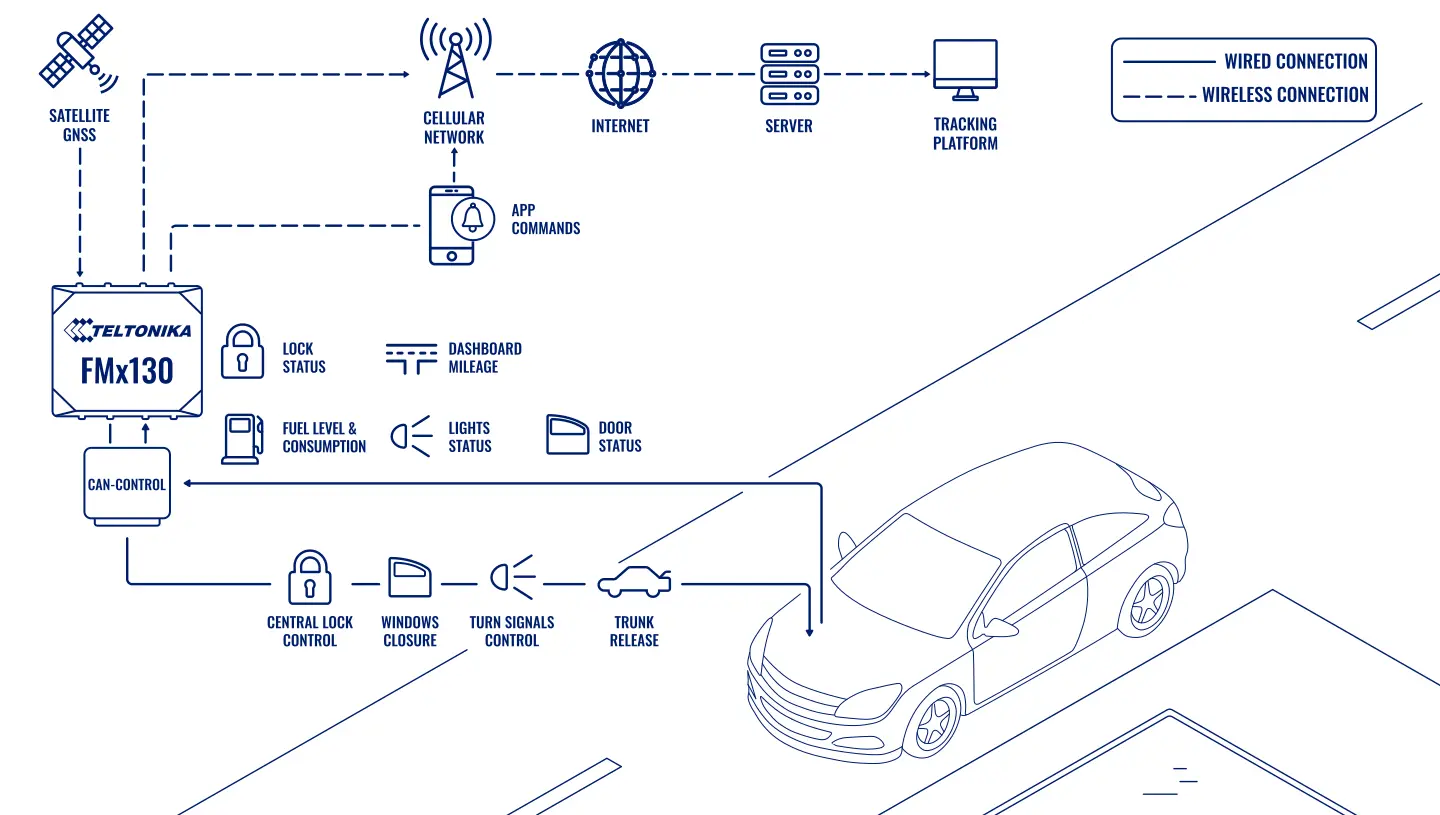
Option 1. Data from the CAN bus. On a modern vehicle, fuel level and consumption are already on the local controller network and are shown on the instrument panel. A tracker can read those values directly. Car-sharing companies most often do it this way: FMx130 series trackers together with Teltonika CAN adapters read fuel level, mileage and vehicle status, while charging is calculated by the kilometre or by time. The service also sees which car needs refuelling before the next customer. CAN adapters can control the vehicle as well: lock and unlock the central locking, close the windows, switch on the hazard lights, open the boot, and report the state of the doors, the parking brake and the lights.
If remote control of the locks is not needed, it is simpler to take a tracker with CAN reading built in — the FMB140 for 2G networks or the FMC150 for 4G LTE. These go on construction plant and lorries, where consumption, engine revolutions and engine hours are what matter.
Option 2. An OBD tracker. The simplest installation of all: the FMC003 plugs into the OBD-II diagnostic socket and reads standard and manufacturer parameters — mileage, fuel level, revolutions, engine temperature, speed, engine load. This is the solution for cars and vans, particularly where the fleet turns over often or the vehicles are leased and cannot be drilled. It complements an electronic job sheet and corporate car-sharing well.
Option 3. A fuel level sensor. For lorries, where fuel is counted in hundreds of litres, the most accurate approach is a dedicated sensor in the tank. Teltonika recommends its professional FMx125 trackers for this. They accept sensor data in three ways: digitally over RS232 or RS485, in analogue form (0–5 V or 0–10 V) and through a pulse counter. On plant with a J1939 bus, consumption can additionally be read from that.
How the dispatcher sees it. The tracker logs fuel level along with position and speed. If the level falls sharply while the vehicle is parked, the system marks it as a drain; if it rises sharply, as refuelling, and compares that against the receipt. Consumption is calculated per 100 km or per engine hour for each vehicle, and departures from the norm are highlighted in the report.
The solution can be extended with EYE Beacon beacons and EYE Sensor sensors. The first help identify the driver without wiring, the second monitor temperature, humidity and door opening in the load space.
That leaves economical driving. The trackers log idling, harsh acceleration and braking and speeding, and from that data a driver can be given feedback he understands rather than general advice to drive more carefully. Teltonika also has other devices built specifically for fuel accounting, where the standard options are not enough.
How to choose between the three options. If the task is to understand average consumption and refuel vehicles in good time, CAN or OBD is enough: the installation is quick and there is no need to go into the tank. If the task is to catch drains, you need accuracy to within a few litres, and there is no way round a level sensor. The tank's own float reads the level in steps, the value jumps about over bumps, and a drain of 15–20 litres is easily lost on a graph like that. A dedicated sensor with the tank calibrated gives a smooth curve on which both refuelling and a drain are visible.
Implementation usually goes like this. First you look at which vehicles are in the fleet and what they report over the bus. Then trackers and sensors are fitted to a trial group, the tanks are calibrated, and for a week or two the data is compared against receipts and job sheets. Only after that are consumption norms approved and drain alerts switched on — otherwise the dispatcher will drown in false triggers for the first few weeks.
How accuracy is verified. On the pilot group the tracker's data is compared against a reference: a controlled fill of a known volume, and filling station receipts over one or two weeks. If after calibration the sensor shows a fill close to the receipt, the data can be trusted for finding drains.
Event thresholds and false drains. The drain threshold is set above the spread of readings while parked. A false drop in level can come from parking on a slope, fuel warming and cooling, or long periods of idling with stops. So an event is checked against the graph and the track before anyone goes to the driver with a question.
How to measure the effect. An honest comparison means identical vehicles on similar routes over a period before and after implementation, in litres per 100 km or per engine hour. Season and load affect consumption, so compare comparable months rather than summer against winter.
What you get
You can see where the fuel goes
Tank level, refuelling and consumption for each vehicle come together in one report, and the gap between the norm and the facts stops being guesswork.
Drains are caught as they happen
A sharp drop in level while parked is marked by the system as an event, rather than turning up a month later when receipts are reconciled.
Drivers drive more calmly
Idling, harsh acceleration and braking are logged, so a conversation about driving style is based on specific journeys.
An approach for every vehicle
CAN for modern lorries and car-sharing, OBD for cars and vans, a level sensor for heavy plant and older vehicles with no bus.
Faults show up sooner
Engine data arrives continuously, and rising consumption or fault codes often point to a problem before the vehicle stops.
Reports you can decide on
Consumption by vehicle, driver and route helps you revisit norms, routes and the make-up of the fleet, and cuts emissions along the way.
Why this solution
Teltonika's strength on this job is choice. The manufacturer covers all three ways of accounting for fuel with its own devices: trackers with CAN built in, OBD models for light vehicles, professional trackers with RS232, RS485 and analogue inputs for level sensors. In a mixed fleet there is no need to keep devices of different makes and different systems.
Teltonika trackers work with most monitoring platforms, and configuration and firmware can be changed remotely. If the fleet grows or the reporting requirements change, the solution scales without replacing hardware.
An honest limitation: data from CAN and OBD depends on what the vehicle reports. The tank's own sensor is designed for a needle on the dashboard rather than for finding a drain of 20 litres, so where accuracy matters a dedicated level sensor is still needed.
How this works in Azerbaijan. Most of the fuel questions we get come from owners of tippers and plant on construction sites in Karabakh and on the Absheron peninsula, from hauliers on the M-1 and M-2, and from agricultural enterprises in the Kura-Aras lowland, where machines are refuelled from their own tanks out in the fields. The typical picture: the driver filled up at a station in Ganja, and 40 km later the level dropped by 60 litres at a lorry park — the system will mark that as a drain and send an alert to Telegram within a couple of minutes. On tractor units and tippers we fit the FMB140 or FMx125 with an Escort fuel level sensor, and on cars and vans the FMC003 in the OBD socket. Points to consider: on older KamAZ and MAZ vehicles with no CAN bus, consumption cannot be calculated over CAN, and there a fuel level sensor is unavoidable; the sensor has to be calibrated for the particular tank, or the reports will be inaccurate. In the mountain districts beyond Guba and Sheki the signal drops out, but the tracker stores the data in memory and sends it once the network returns. GPS.az fits trackers and fuel level sensors, calibrates tanks and sets up reports on refuelling, drains and consumption on the Wialon platform.
Related case studies
Related rollouts and equipment


Questions about the “Three ways to keep track of fuel in a fleet” scenario
Request a call
A specialist will call back and match a solution to your fleet and your task.