
Pay-as-you-drive insurance: the FMC003 OBD tracker
A Teltonika use case on Pay As You Drive insurance: the driver fits the FMC003 OBD tracker himself in about a minute, while the insurer receives accurate mileage straight from the dashboard together with a driving-style score, so the premium can be worked out from how the car is actually driven.
A Teltonika use case on Pay As You Drive insurance: the driver fits the FMC003 OBD tracker himself in about a minute, while the insurer receives accurate mileage straight from the dashboard together with a driving-style score, so the premium can be worked out from how the car is actually driven. Pay As You Drive is a well-known model: the less and the more carefully a person drives, the less they pay for insurance. It gives the insurance company better control over risk, and it gives the disciplined driver better terms. For telematics service providers it is a way of reaching private car owners, a market they have so far struggled to enter. There are two obstacles: fitting the device and the accuracy of the data. The Teltonika solution is aimed at precisely those two.
What this scenario solves
Fitting a tracker into every private car one by one is expensive and slow.
Without volume fitting, telematics cannot reach private car owners.
Mileage calculated from GPS is wrong in tunnels, in underground car parks and among dense high-rise buildings.
The starting mileage has to be entered by hand and then reconciled, which is extra work for the insurer.
Fitting a tracker into every private car one by one is expensive and slow.
Without volume fitting, telematics cannot reach private car owners.
Mileage calculated from GPS is wrong in tunnels, in underground car parks and among dense high-rise buildings.
The starting mileage has to be entered by hand and then reconciled, which is extra work for the insurer.
With a corporate fleet everything is clear. There are 10, 100 or 500 vehicles, there is a fleet manager, there is a day when the vehicles stand at the depot, and one fitter equips the whole fleet in a single shift. With private customers it is different: every installation is a separate logistics operation. You have to agree a time, travel out to the person, find a place in the car. An insurer that wants to offer Pay As You Drive to thousands of customers quickly runs into the fact that there are simply not enough fitters to go round.
The second problem is mileage. For pay-as-you-drive insurance this is the main figure, and the size of the premium depends on it. It is normally calculated from GPS: the tracker adds up the distance between points. For most tasks that is good enough, but in tunnels, in underground car parks and between tower blocks the signal drops out and part of the journey is lost.
There is an administrative difficulty as well. For the GPS mileage to agree with the odometer, the driver has to enter the starting value by hand, and it then has to be synchronised from time to time. Across thousands of policies this turns into constant manual reconciliation and fertile ground for disputes with the customer.
What Teltonika offers
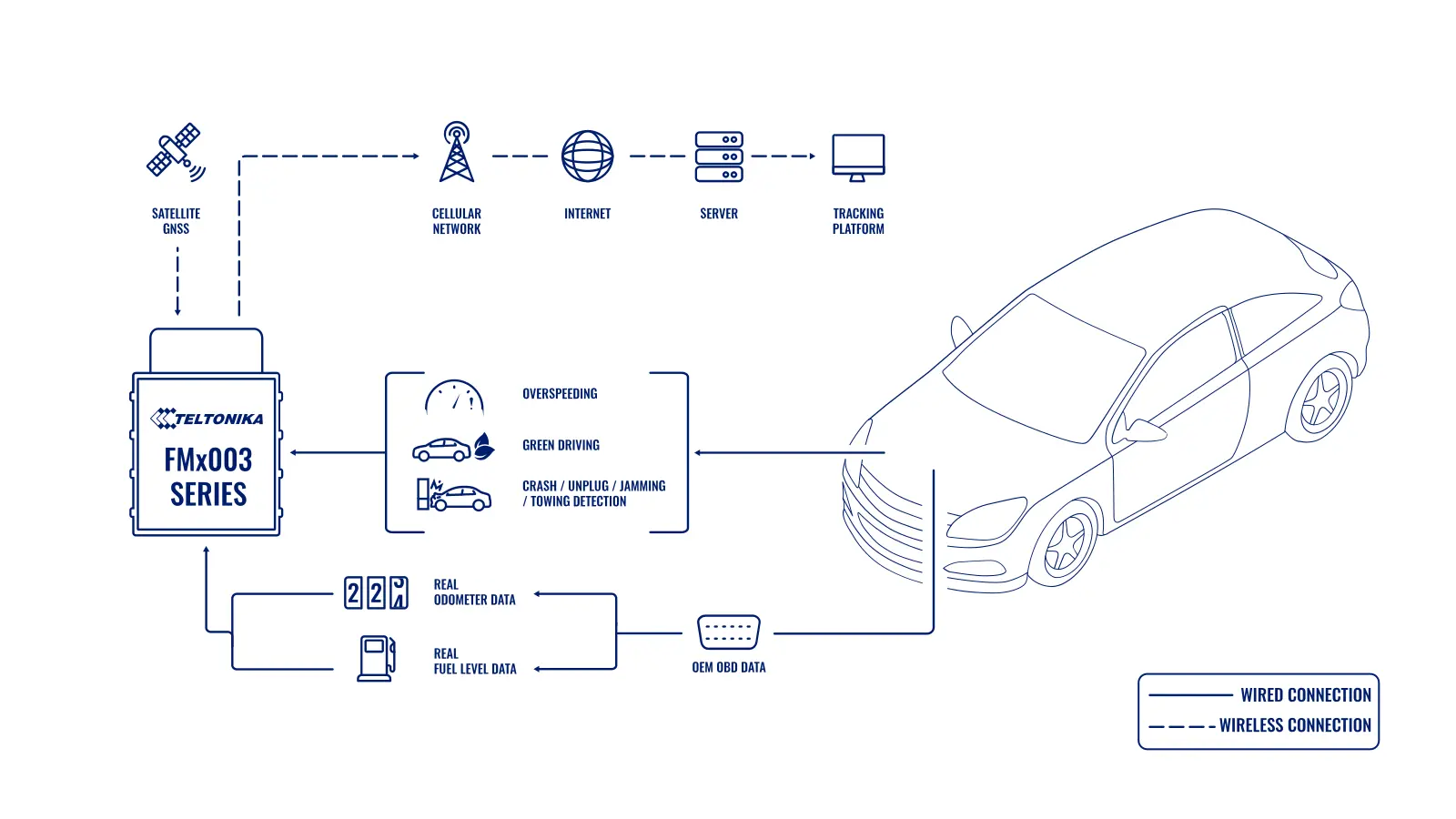
Teltonika solves both problems with a pairing of the compact FMC003 OBD tracker and cloud VIN decoding backed by a database of car manufacturers' requests: the driver plugs the tracker into the OBD-II socket himself, and it reads the real mileage from the dashboard.
Installation and setup
Fitting the device and configuring it for the fleet scenario at hand.
Data transfer
The device collects data and sends it to the monitoring platform; how often depends on the model and its settings.
Analysis and control
The person in charge gets reports and alerts and looks into what stands out.

The FMC003 is a tracker from the FMx003 series, only slightly larger than the OBD-II connector itself, with LTE Cat 1 and 2G fallback, GNSS and Bluetooth. The antennas are built in. An OBD-II socket is present in practically every modern passenger car, usually under the steering wheel or next to it. The driver can fit the tracker himself following a short instruction sheet: find the socket, plug it in, check the indicator. No visit from an engineer, no trim panels to remove.
For the insurer this means the tracker can be posted out to the customer along with the policy. The main brake on volume sales in the private segment falls away.
Mileage and fuel. Through cloud VIN decoding the system identifies the make and model of the car and selects from the database the requests that this particular vehicle understands. The FMC003 reads the real mileage from the odometer and the fuel consumption figures exactly as the driver sees them on the dashboard. There is no starting value to enter and no need to synchronise it with GPS, and tunnels and car parks no longer affect the calculation.
Driving style. The tracker runs on the FMB platform and inherits its set of functions. The key one for Pay As You Drive is the eco driving scenario: harsh acceleration, braking and cornering are recorded by the built-in accelerometer. Since it does not depend on satellites, events are logged even when there is no GPS. The speed control scenario adds speeding.
From these events the insurer builds a driver score. Someone who drives calmly and not very much earns a discount. Someone who brakes hard all the time pays more, and that is justified by data rather than by a questionnaire.
Road traffic accidents. The crash detection scenario records data immediately before the impact and during it: speed, accelerations, coordinates. The insurer gets an objective picture of the incident and can settle the claim faster.
The limitations are worth knowing. Older cars may have no OBD-II socket at all, or a non-standard one. The set of data that can actually be read depends on the make and model. And a tracker in a socket is easy to pull out: the insurer needs to monitor device disconnection and set out the consequences in the contract.
How events turn into a score. The scoring method remains the insurer's own. The tracker and the platform supply the raw data: mileage over the period, the number of harsh accelerations, braking events and cornering events per 100 km, speeding, the share of driving during night hours. The weighting of these parameters, the thresholds and the way a score becomes a discount are all decided by the insurer and written into the product rules. Before launch it is worth running a pilot on a few dozen cars and looking at the real distribution of scores, rather than carrying thresholds over from someone else's programme.
The quality of the telemetry also has to be watched. For each device the report should show when it was in contact, how far the car travelled with no data, and whether the tracker was pulled out of the socket. Periods without data must not be quietly counted as calm driving: it is better to write down the rule for handling them in advance.
The limit of the result. Telematics gives the insurer objective data on mileage and driving manner, but it does not guarantee a fall in the loss ratio of the portfolio. That depends on the tariff, on customer selection and on how the programme works with drivers.
What you get
The driver fits it himself
The FMC003 goes into the OBD-II socket following a short instruction sheet, and the insurer does not have to send a fitter out to every customer.
Mileage from the odometer, not from GPS
Cloud VIN decoding makes it possible to read the real mileage and fuel consumption with no manual entry and no reconciliation.
Driving-style scoring
The accelerometer records harsh acceleration, braking and cornering even where there is no satellite signal.
Accident data
The crash detection scenario preserves the picture before and during the impact, which speeds up claims settlement.
A small housing with built-in antennas
The tracker sits in the tight space by the socket and does not get in the driver's way.
Connectivity for years ahead
LTE Cat 1 with 2G fallback holds the link now and after the older networks are switched off.
Why this solution
Teltonika has been making OBD trackers since 2012, and the FMx003 is already the third generation. The company develops the hardware, the firmware and the cloud side itself, so the pairing of tracker and VIN decoding works as one whole rather than as a set of modules from different suppliers.
The FMB platform on which the FMC003 is built is the same one used in Teltonika's professional trackers. The driving scenarios, crash detection, configuration through the Configurator and remote updates have long been working in production trackers; they were not written specially for this product.
For an insurer it also matters that the data can be handed to any monitoring platform or to an in-house scoring system: the tracker is not tied to a single software product.
How this works in Azerbaijan. Insurance based on mileage and driving style has not yet become a mass product in Azerbaijan, and we will not pretend that local insurers have ready-made programmes. The technology itself, though, is already in use: OBD trackers are fitted to corporate passenger cars, to taxis and to rental cars in Baku, where mileage and driving manner need to be visible without complicated fitting. The scenario for insurers and leasing companies is clear enough: a discount on comprehensive cover for those who drive carefully, and objective data when an accident is investigated. One thing to bear in mind: the fleet here contains many cars imported from various countries, and before launching a programme you need to check what data the FMC003 will actually read on the models that are common locally. GPS.az supplies the FMC003, checks compatibility with the customer's vehicles and sets up mileage and driving-style reports on the Wialon platform.
Related case studies
Related rollouts and equipment


Questions about the “Pay-as-you-drive insurance: the FMC003 OBD tracker” scenario
Request a call
A specialist will call back and match a solution to your fleet and your task.