
In brief
In rental and rent-to-own taxi work the owner cannot see how the vehicle is used once it has left the base. A tracker gives an objective picture: mileage, engine running hours, stops, power cuts. But a tracker shows a signal, not a proven violation. Below are the typical scenarios, how they look in the reports, and how to check a suspicion before you put it to the driver.
Renting cars out, or letting them on a rent-to-own basis, looks like a simple business in Baku: you buy ten Cobalts, hand them out to drivers and collect against the plan. But the moment a vehicle is through the gates of the base, the owner knows only what the driver chooses to tell him.
The driver says the car was standing outside his house, and the odometer shows modest figures. Yet the suspension is worn out within six months and the battery stopped holding a charge after a month. Let us look at the scenarios behind stories like these, at what of them is visible in monitoring data and at where the tracker's capabilities end.

Scenario 1. Working on the side
The commonest case in rental work is a vehicle that works more than the contract provides for: the owner is paid for a shift or for a fixed daily mileage, while the car runs almost round the clock.
How it looks in the reports
The contract sets a limit of 200 km a day. During the day the track matches the bookings. In the evening the car goes out again, makes several trips around the city or an intercity run — to Quba or Gabala, say — and is back by morning. In the Trips report this shows up as a second working cycle, and in the engine hours report as 18–20 hours of engine running a day instead of 8–10.
What this does to the car: the engine barely gets a chance to cool. In Baku heat and Baku traffic that accelerates the wear of the engine, the gearbox and the running gear.
An important point: a night-time track is a fact of movement, but not proof that the driver was carrying passengers. What is allowed and what is not is set by the rental contract. If it contains no mileage limit and no ban on working for other services, there will be nothing to argue about with the driver.
Scenario 2. Winding the mileage back
If a car covers a lot of ground, the mileage on the dashboard ought to grow. But adjusting the odometer is a service that is not hard to find.
The consequences:
- A wrecked service schedule. The oil is changed every 8,000 km by the odometer, while by that point the car has actually covered 12 to 15 thousand. The oil loses its properties and engine wear grows.
- An error in the residual value. You plan the sale on the mileage shown on the dashboard, and at the inspection the buyer sees the real condition of the components.
How it is done:
- A correction tool through the diagnostic socket. It changes the odometer readings stored in the control units.
- A blocker in the speed sensor circuit. While it is switched on, mileage is not counted.
What monitoring shows: GPS mileage is counted independently of the odometer. If over a month the difference between the two is noticeably larger than the usual margin of error (a few per cent), that is grounds for a check. The convenient way to compare is a Wialon report with two columns: mileage by GPS and mileage from the CAN bus, if the vehicle supports it.
Scenario 3. Swapping parts
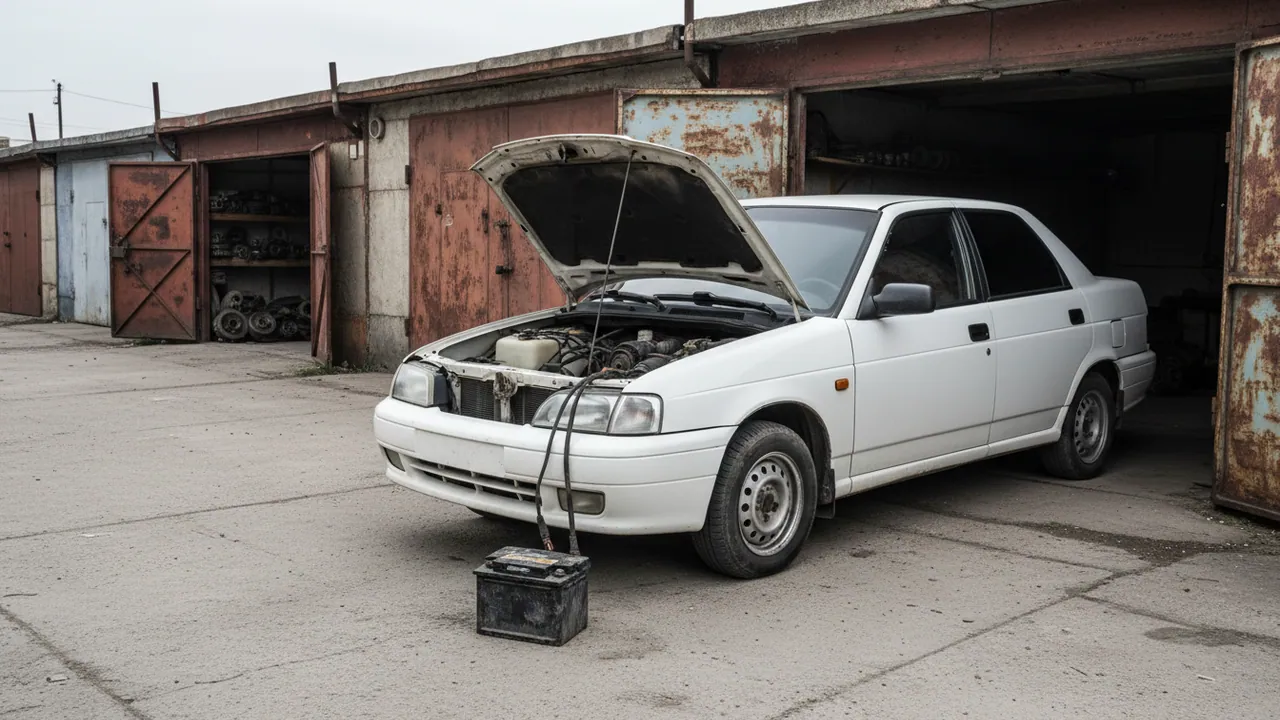
This affects fleets of identical models in particular — Cobalt, Nexia, Gentra. Working components (the battery, ignition coils, lambda sensors, tyres) are taken off a new car and replaced with worn ones or with cheap equivalents.
What traces are left in the data
- Regular stops of 20–40 minutes in the same place, unconnected with any booking.
- The tracker's external power being cut during a stop like that — typical of a battery being removed.
- After the stop, a change in the on-board voltage in the report, if the tracker transmits it.
- Some time later, an unscheduled repair of that same component.
The tracker does not see the part itself. It shows where and when the vehicle stood and what was happening to its power supply at the time. Only an inspection can confirm a swap — by serial numbers, by markings or by tags you applied in advance.
A signal and a proven violation are not the same thing
This is the main thing to take in before rolling monitoring out. Monitoring produces technical events. What makes them a violation is matching them against the contract and checking.
| Signal in the monitoring system | Possible harmless causes | How to check it |
|---|---|---|
| Mileage above the limit | an arrangement with the dispatcher, a trip to the garage | the track for the period, a conversation with the driver, the terms of the contract |
| A discrepancy between GPS and the odometer | tyre size, margin of error, gaps in the data with no connection | a comparison across several months, a check of the odometer at a service centre |
| The tracker's power being cut | a battery change, wiring repairs | the repair request, an inspection of the connection point |
| No data for several hours | an area without coverage, an underground car park | downloading the data from the tracker's memory once the connection returns |
| Frequent stops by the same garage | a mechanic he knows, the driver's own rest spot | an unscheduled inspection of components, a check of serial numbers |
How to work out the losses in your own fleet
We do not quote ready-made figures for "the loss per vehicle": they depend heavily on the model, on the rental price and on the terms of the contract. You can work them out from your own data over the first month or two of monitoring:
- excess mileage — how many kilometres above the limit × your cost per kilometre (depreciation, servicing, tyres);
- missed servicing — how many vehicles actually passed the oil change interval earlier than the odometer showed;
- repairs — a comparison of the number of unscheduled component replacements before and after the rollout;
- fuel — if you are the one paying for it: the difference between refuelling and consumption according to CAN data or a fuel level sensor; how this works is covered in the section on fuel control.
Questions owners ask often
Can odometer tampering be caught without stripping the dashboard?
Indirectly, yes. GPS mileage is counted by the tracker independently of the odometer, and a persistent discrepancy between the two shows up in the report. But a discrepancy is grounds for having the vehicle checked at a service centre, not a ready-made accusation: tyre size and periods without a connection both affect the difference.
Will the driver find the tracker and disconnect it?
A tracker under the mat he will find quickly. With concealed fitting the device sits behind the standard trim and is wired into the factory looms — it is harder to find, though it cannot be ruled out entirely. So something else matters more: cutting the power is registered as an event, and you learn about it as soon as the tracker is back in contact.
Will this help get swapped parts back?
Directly, no. Monitoring shows the place and the time of the stops. If a vehicle regularly stands for forty minutes at the same lock-up garages, that is a signal to send it in for an unscheduled inspection. After that it comes down to the inspection and the contract.
A checklist for the fleet owner
- the rental contract sets out the mileage limit, the permitted areas and the presence of monitoring;
- the driver has signed an acknowledgement that the vehicle is fitted with a tracker;
- notifications are configured for power cuts and for leaving the permitted geofence;
- once a week someone reconciles GPS mileage against the odometer and engine hours against the shift schedule;
- the key components are marked, or their serial numbers recorded when the vehicle is handed over.
In conclusion
Monitoring does not replace the contract and the inspection, but it removes the main thing — the blind spot between handing a vehicle over and getting it back. The technology makes it possible to see mileage, working time, stops and interference with the power supply for every vehicle. That makes the business noticeably more transparent, on one condition: that someone regularly looks at the reports and checks the signals before drawing conclusions.
How this is arranged for rental fleets is on the page about monitoring for rental and taxi work; on protection against theft and remote immobilisation there is the section on remote engine immobilisation. If your drivers' style raises questions too, read the breakdown of Eco-Driving, and on what a project like this costs — how much GPS monitoring costs.