
Load temperature from Bluetooth sensors
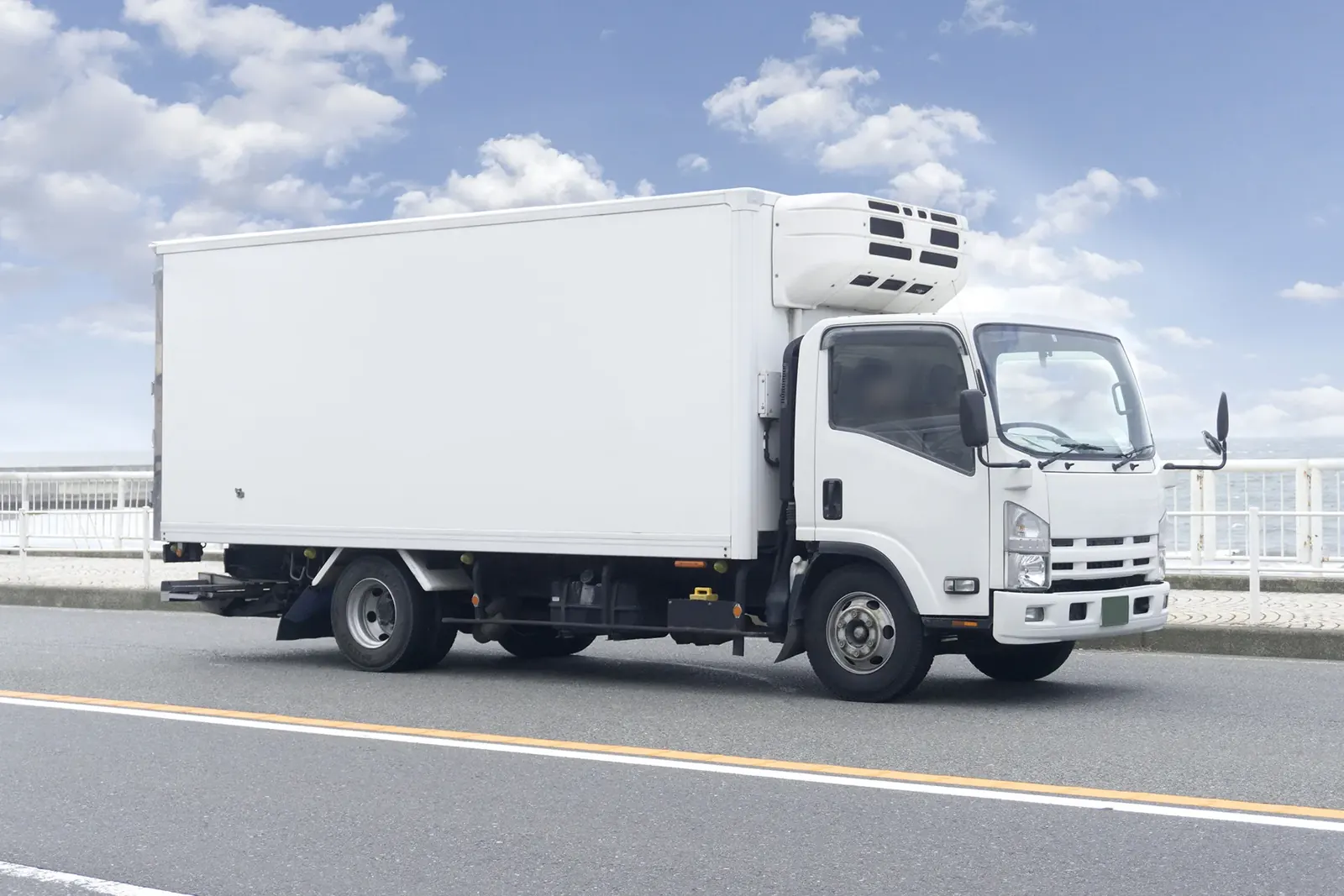
A refrigerated lorry is carrying meat, dairy or medicines, and EYE Sensor devices on the boxes and pallets pass the temperature over Bluetooth to an FMB140 tracker, which sends it on to the server together with the position.
A refrigerated lorry is carrying meat, dairy or medicines, and EYE Sensor devices on the boxes and pallets pass the temperature over Bluetooth to an FMB140 tracker, which sends it on to the server together with the position. In this scenario Teltonika monitors not the air in the load space in general but particular places within the load. The dispatcher sees where the vehicle is, what the temperature and humidity are at each tagged pallet, and the moment at which something went wrong. No wires are needed between the sensors and the tracker. The sensor is stuck or clipped to the packaging, the tracker goes in the cab or in the load space, and the link between them runs over Bluetooth Low Energy.
What this scenario solves
The temperature in the load space jumps about because of a failure of the refrigeration unit, because of traffic and because of long stops.
At a border a vehicle can stand for hours with its doors open while it is inspected.
Bad loading and poor insulation create warm zones that the refrigerated body's own thermometer never sees.
Without data for each place in the load, there is no way of proving at which stage the goods spoiled.
The temperature in the load space jumps about because of a failure of the refrigeration unit, because of traffic and because of long stops. At a border a vehicle can stand for hours with its doors open while it is inspected. Bad loading and poor insulation create warm zones that the refrigerated body's own thermometer never sees. Without data for each place in the load, there is no way of proving at which stage the goods spoiled.
The scale of the problem is large. The International Institute of Refrigeration estimates that the lack of a proper cold chain loses almost 20% of the world's food. In developed countries that is about 9% of everything produced, and in developing countries 23% on average.
Many loads need temperature control, and meat and fish are only the most obvious example. Poultry, dairy products, fruit and vegetables, flowers, chemicals and pharmaceuticals all require a narrow range while they are being carried. For some loads humidity matters as well, and for antiques or works of art this is a question of preserving an object that cannot be replaced.
There is another affliction in cold chain logistics: the carrier is often the last to hear about a problem. The driver does not look at the refrigeration unit's display, the dispatcher cannot see what is happening in the load space, and the spoilage is reported by the consignee, who refuses to accept the consignment. Theft of a load in transit, in this arrangement, is also discovered far too late.
What Teltonika offers
The FMB140 tracker in the vehicle collects the readings of the EYE Sensor devices attached to the load over Bluetooth and sends them to the server together with the GPS position, so the temperature and humidity of every tagged item of the load are visible online.
Installation and setup
Fitting the device and configuring it for the fleet scenario at hand.
Data transfer
The device collects data and sends it to the monitoring platform; how often depends on the model and its settings.
Analysis and control
The person in charge gets reports and alerts and looks into what stands out.
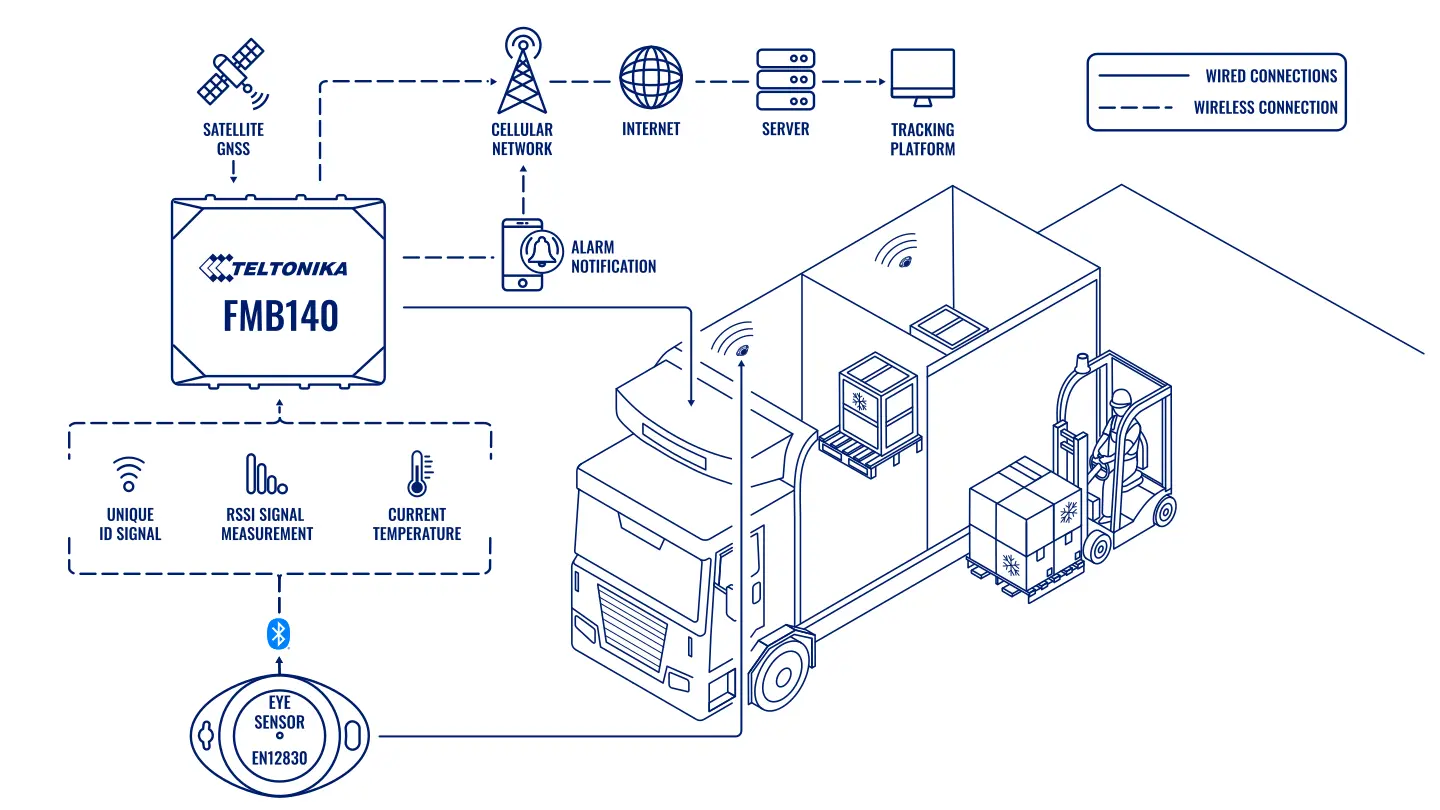
The FMB140 belongs to the FMB line and can read the vehicle's CAN bus. For this scenario something else matters: it has a Bluetooth LE module through which it talks to the wireless sensors. The tracker goes into a vehicle with a refrigeration unit, but the position is chosen so that no large metal parts block the Bluetooth antenna. The metal of the body and a tightly packed load damp the signal noticeably, so the mounting point is checked in practice rather than on a drawing.
The EYE Sensor in its EN12830 version is certified to the European standard for temperature recorders used in transporting and storing food. It is small and light, and is fixed wherever monitoring is needed: on a thermal bag, a cardboard box, a container, a drum or a pallet. The sensor measures temperature and humidity and broadcasts its ID in iBeacon or Eddystone format.
The tracker polls the sensors at an interval set in the configuration. Each reading it ties to its current GNSS position and sends the packet to the server. If the connection is lost, the data banks up in memory and goes out later, so there will be no gaps in the history.
On the platform side, software works out which sensors are near the tracker at any moment and shows the temperature, the humidity and the place for each of them. If a tag has dropped out of the tracker's range, the box was unloaded in the wrong place or has been carried off. The dispatcher sees all this from a computer or a phone, gets a notification when the temperature goes beyond a threshold and can ring the driver straight away instead of piecing it together afterwards.
What this looks like on a run. A vehicle with chilled poultry is standing at the second customer's bay being unloaded, and the driver has left the doors open for forty minutes. The sensor on the pallet by the doors shows the temperature rising from +3 to +9 °C. The dispatcher gets a notification and rings the driver, the driver closes the body, and twenty minutes later the readings are back to normal. In the report on the run this episode is visible with its exact time, address and duration, and there is nothing left to argue about with the consignee.
Where the sensor measures, and what. The EYE Sensor shows the air temperature at the point where it is fixed, not the temperature inside the product, so the mounting places are chosen in advance: the middle of the load space, the area by the doors, the far corner and, where necessary, a particular pallet. The alert log for the run contains the time the deviation started, the maximum value, the duration and the vehicle's location. The decision on whether the load is fit for use after a deviation belongs to the cargo owner, on their own standards: the temperature graph supports it but does not replace it. The procedure and the frequency of accuracy checks on the sensors we confirm against the manufacturer's documentation and your client's requirements.
What you get
Certified measurements
The EYE Sensor EN12830 conforms to the standard for temperature recorders, so the data can be shown to a client or an inspector as confirmation of the conditions in transit.
Monitoring of every item of the load
What is visible is not an average temperature in the body but the readings of a particular pallet or box, and where they were at that moment.
Firmware scenarios for the cold chain
In the FM firmware, events can be set for going beyond a threshold, losing a tag, opening the doors and stopping, so that a deviation is answered at once rather than at the end of the run.
No wiring and no complicated fitting
A Bluetooth sensor takes minutes to fit, uses almost no power and costs little. If one is damaged or lost, a new one is simply linked in its place.
Tuned to the project
The sensor's signal strength and the data transmission interval are chosen to suit the particular body, load and reporting requirements.
Fewer write-offs and claims
When spoilage is visible in time it can be prevented, and when it could not be, it is clear where the responsibility lies and where the failure happened.
Why this solution
With Teltonika, in this scenario the tracker and the sensors come from the same manufacturer. The FMB140 was designed from the start to work with EYE Sensor, the configuration is done in a single configurator, and there is no need to join up equipment from different brands whose protocols are arranged differently.
Data from the tracker is accepted by all the main telematics platforms, so the solution fits into a fleet monitoring system that is already running. If fuel accounting, driver identification or CAN reading is needed later, it is done on the same FMB140 without changing the hardware.
One more advantage: EN12830 certification. For a carrier of food and medicines it matters not simply to know the temperature, but to have data that will be accepted in a dispute with the consignee.
How this works in Azerbaijan. The most frequent scenario here is fruit and vegetables from Guba, Gusar and Goychay, greenhouse tomatoes and cucumbers going by articulated lorry along the M-1 route through Yalama into Russia, and also meat, poultry and dairy around Baku and Absheron. In summer it is +40 °C outside, and in an hour standing at a border crossing or in a queue on the approach to Baku the load by the doors warms up faster than the refrigeration unit's display will show. So we put one sensor in the middle of the load space and one each by the doors and in the far corner. On the mountain roads beyond Guba and on the passes the signal drops out; the tracker holds the data in memory and sends it on once an Azercell, Bakcell or Nar network appears. Allow for the limits as well: a Bluetooth tag runs on a battery, its life depends on how often it transmits, and with very frequent polling the battery will have to be changed sooner. The range inside a loaded body is also less than the specification suggests, so in a long semi-trailer a second receiver is sometimes needed. During fitting we check how well the tags are seen through a tight load and through metal, and choose the position for the tracker. GPS.az fits the FMB140 and the EYE Sensor devices and sets up the thresholds and notifications in Wialon along with the temperature reports for every run.
Related case studies
Related rollouts and equipment

GPS trackers for Poland's e-TOLL system
Fleet telematics
Recording farm machinery and implements with the FMB140
Agriculture, construction and mining

Three ways to keep track of fuel in a fleet
Fleet telematics
Questions about the “Load temperature from Bluetooth sensors” scenario
Request a call
A specialist will call back and match a solution to your fleet and your task.