
Video monitoring in a quarry: DSM and ADAS
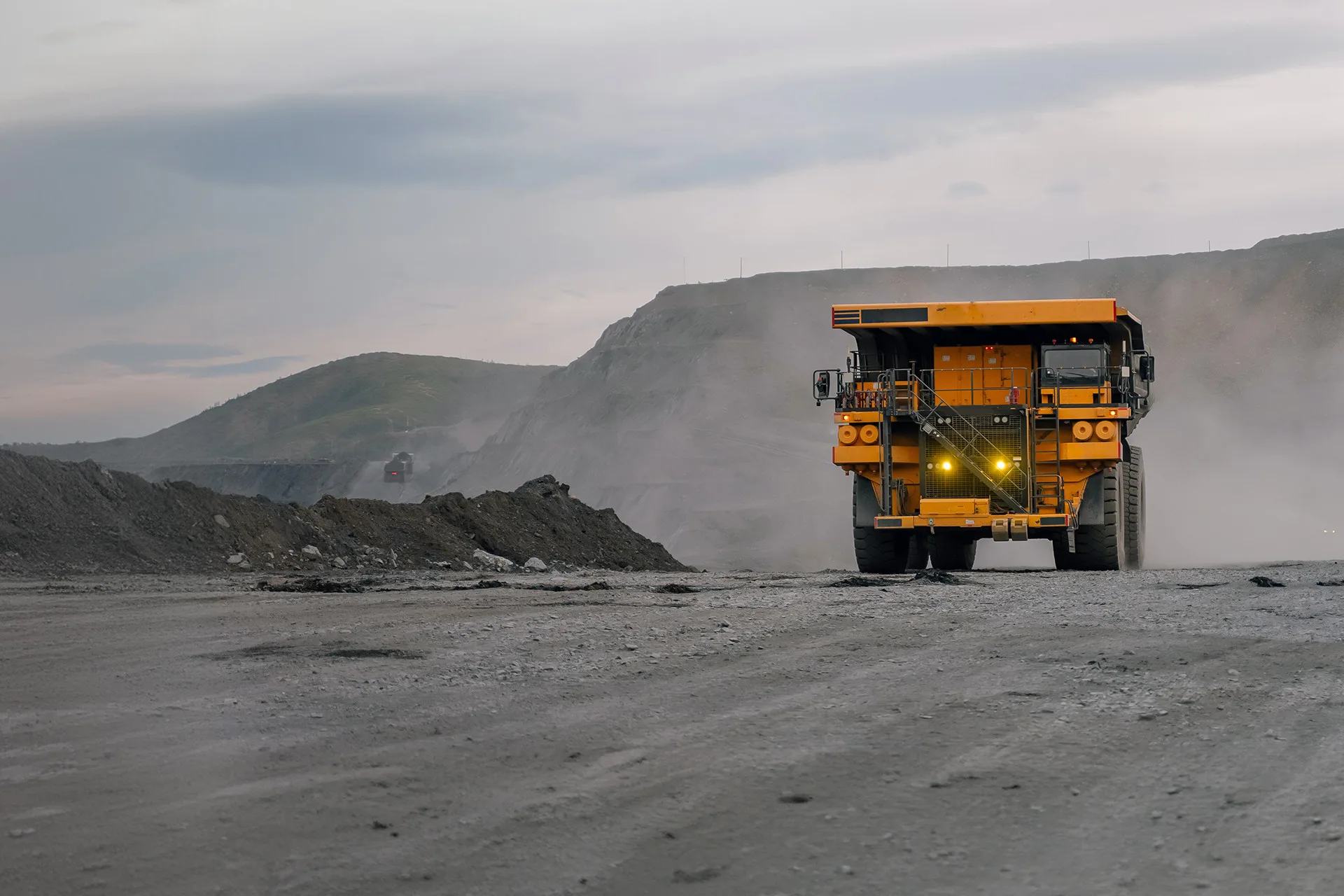
For mining companies Teltonika offers the FMC650 tracker paired with two video systems: a DSM camera that watches the driver in the cab, and an ADAS camera that watches the road ahead.
For mining companies Teltonika offers the FMC650 tracker paired with two video systems: a DSM camera that watches the driver in the cab, and an ADAS camera that watches the road ahead. Together they warn about people in the path of a tipper, about driver fatigue and about an unauthorised person trying to take the wheel. The case is addressed to quarries, mines and contractors that haul ore, aggregate and valuable loads in large vehicles on remote sites. Below: the risks that come with mining work, how both systems operate and what the dispatcher sees.
What this scenario solves
Quarries and mines are usually a long way from towns, and the machines on them become easy targets for theft.
If an untrained person gets behind the wheel of a heavy vehicle, it can end in a serious accident.
Visibility in a quarry is often poor, and a worker who steps onto a haul road can go unnoticed.
Accidents and thefts inflate insurance premiums, which for expensive mining equipment are high to begin with.
Quarries and mines are usually a long way from towns, and the machines on them become easy targets for theft. If an untrained person gets behind the wheel of a heavy vehicle, it can end in a serious accident. Visibility in a quarry is often poor, and a worker who steps onto a haul road can go unnoticed. Accidents and thefts inflate insurance premiums, which for expensive mining equipment are high to begin with.
The mining market is growing. On the forecast quoted in the case, it will rise from 2,138.73 billion dollars in 2023 to 2,825.81 billion by 2028 — around 5.5% a year. The growth is fed by infrastructure projects, construction and the adoption of autonomous machinery. The more machines and the greater the volumes, the higher the price of every mistake.
The first group of risks is unauthorised access. A remote site, a night shift, minimal security. Somebody tries to drive off a tipper, or a vehicle with a valuable load. Even if the attempt fails, an inexperienced driver on a heavy machine can cause an accident that costs more than the machine itself.
The second is people on the road. Dust, the blind spots of enormous tippers, bends on the benches. A worker steps onto the carriageway, his colleague at the wheel does not see him — and that is no longer a safety breach but a tragedy.
The third is money. Mining machinery is expensive and works in hard conditions, so insurance premiums are high. Every accident and every theft pushes them up. To the financial loss is added reputation: for a mining company, incidents involving people mean inspections, stoppages and questions from clients.
What Teltonika offers
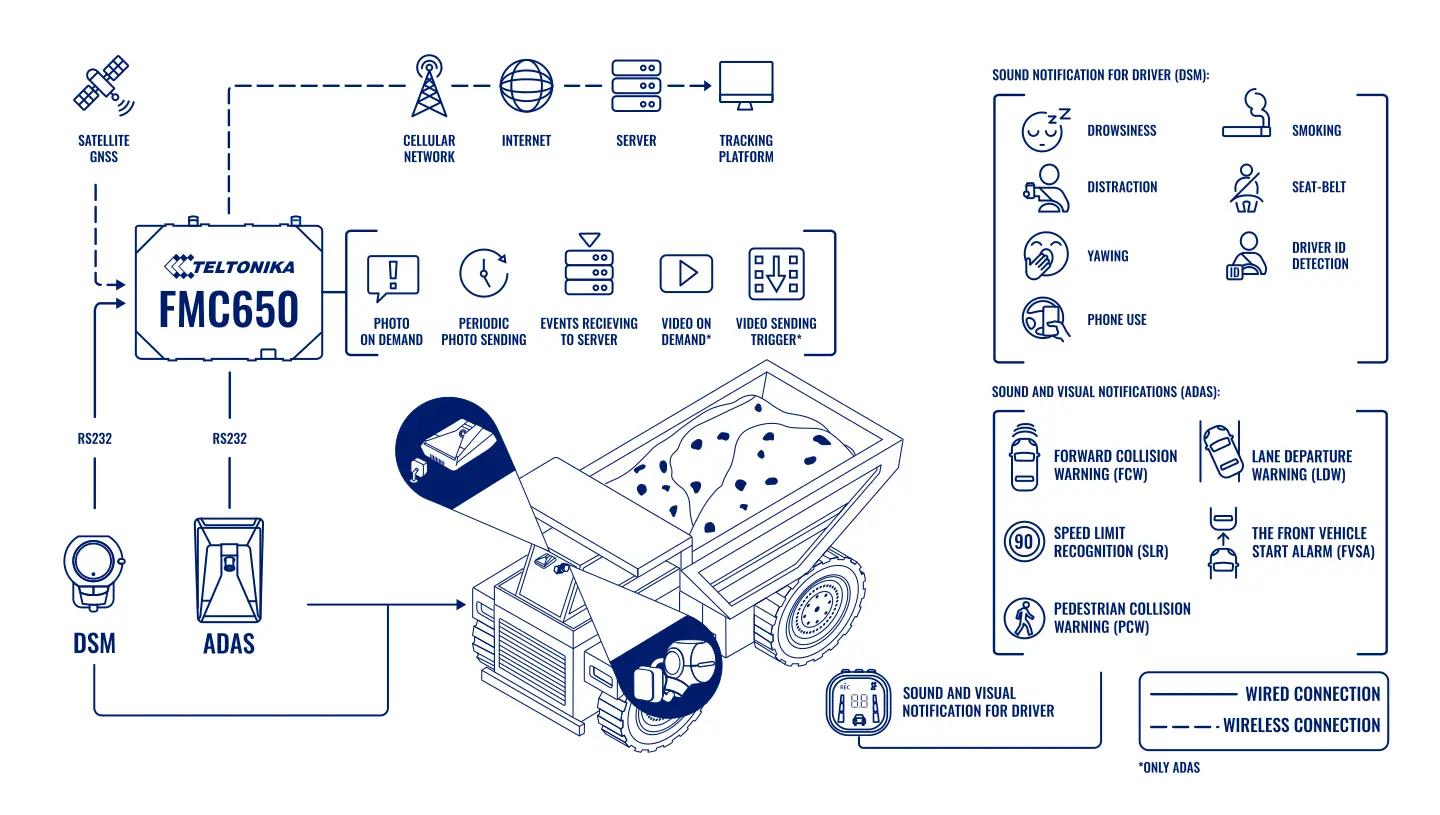
For mining machinery Teltonika offers a video telematics solution built from two systems — DSM driver status monitoring and ADAS driver assistance — which connect to the FMC650 tracker either separately or both at once through its two RS232 ports.
Installation and setup
Fitting the device and configuring it for the fleet scenario at hand.
Data transfer
The device collects data and sends it to the monitoring platform; how often depends on the model and its settings.
Analysis and control
The person in charge gets reports and alerts and looks into what stands out.
The FMC650 is a tracker for heavy machinery and goods vehicles with a rich set of interfaces. Two RS232 ports allow both cameras to be connected at the same time, and the tracker gathers their events together with the position, the speed and the vehicle data and sends them to the server.
DSM (Driver Status Monitoring) is a camera in the cab aimed at the driver. It does two jobs. The first is to check that the right person is at the wheel. If an outsider tries to start a vehicle that carries, say, precious metals, the system notices and sends stills to the control room in real time. Security has time to react before the vehicle leaves. The second is to watch the driver's condition: signs of fatigue, distraction, breaches such as an unfastened seat belt.
ADAS (Advanced Driver Assistance System) is a camera on the windscreen that analyses the road ahead continuously. It recognises dangerous situations: a person in the vehicle's path, an obstacle alongside, a sudden stop ahead, drifting out of the lane. The driver gets an audible and visual warning immediately and has time to brake or steer round.
It used to be a choice between one system or the other; now Teltonika allows both to be connected. That closes the risks from both sides: DSM covers the person in the cab, ADAS the situation outside.
How they work together. A tipper is running along a haul road. ADAS sees a worker step out from behind a spoil heap and sounds a warning — the driver brakes. At the same time DSM has noticed that over the last half hour the driver has closed his eyes for longer than usual several times, and warns him about fatigue. Both events, with a photograph or a video, go to the server through the FMC650. The dispatcher sees them on the map and can take the driver off the run before an accident happens.
Besides the automatic events, the operator can request a photograph or video at any moment — of the road ahead or of the cab. That helps to confirm an incident, to deal with a complaint or a claim, and to check what is happening on a remote part of the site.
All the data is recorded and stored on the server. Beyond the immediate response, that gives material for analysis: which drivers get warnings more often, on which stretches of road dangerous situations arise more often, at what point in the shift fatigue increases. Routes, schedules and driver training are adjusted on the strength of that data.
Deployment at a mining operation usually goes in several stages. First the pilot vehicles are chosen — as a rule, the tippers on the busiest routes and the machines that carry a valuable load. The FMC650 and both cameras go on them, the CAN bus is connected and a decision is made about which events count as critical. The first few weeks go on calibration: the ADAS camera is set for height and angle to suit the particular cab, and the DSM thresholds are chosen so that drivers do not get dozens of false warnings in a shift. If the alerts sound too often, people start to ignore them and the system loses its point.
It is worth reaching an understanding with the drivers separately. A camera aimed into the cab meets resistance from many of them. It is better to explain in advance that it does not record continuously but on events, and that the main aim is to warn of danger rather than to collect evidence against anyone. Where this has been done openly, drivers get used to it faster, and the recordings begin to protect them: in a dispute about an incident, the video shows who was actually at fault.
Another practical point is who responds to the alerts. If events arrive at night and there is nobody in the control room, the system works only as an archive. So before the start the people responsible on each shift are named and the procedure is set: who to call on an attempted theft, when to take a driver off a run, how to record breaches and how to go through them with the driver.
What stays in the system after an event. The event record in Wialon contains the type of warning (a person in the path, say, or signs of fatigue), the time, the coordinates, the vehicle's speed and a still or a short clip, if video transmission is enabled for that event. The response procedure is conveniently built as a chain: alert, the dispatcher looks at the still and rules out a false trigger, a call to the driver, and on a repeat or on an attempted start by an outsider, escalation to the shift manager and to security. The particular DSM and ADAS camera models and the required FMC650 firmware version we check against Teltonika's documentation before purchase: the set of events depends on the combination of camera and firmware.
What you get
An outsider at the wheel will be noticed
DSM checks who is sitting in the cab and sends stills to the control room on an attempted unauthorised start.
A warning about a person on the road
ADAS sees people and obstacles ahead and gives the driver an audible and visual signal.
Fatigue is visible before the accident
DSM notices drowsiness, distraction and an unfastened seat belt and warns the driver at once.
Photographs and video on request
The operator can look at the road ahead or at the cab at any moment, to confirm an incident or deal with a claim.
Data for working on the weak points
The warning history shows the dangerous stretches, the problem drivers and the hours when fatigue builds.
Why this solution
The main thing in this solution is the ability to connect DSM and ADAS to one tracker at the same time. The FMC650 with its two RS232 ports does that without additional controllers, and all the events — from the cameras, from the CAN bus, from the sensors — arrive in one monitoring system tied to a place and a time.
The FMC650 is designed for heavy machinery: it has many inputs and outputs, support for the CAN bus of goods vehicles and plant, and the ability to connect sensors and accessories. For mining machinery, where one vehicle has to show the engine, the fuel and the cameras, that matters.
The limits are worth allowing for in advance. Cameras in a quarry work in dust, and the glass has to be cleaned, or ADAS recognises objects less well. Heavy vibration calls for a solid mounting. On huge quarry tippers the blind spots are large, and a single forward-facing ADAS camera does not cover them — side and rear views need additional cameras. Transmitting video uses data, and in deep pits the mobile network can be weak: events will be stored and sent later.
How this works in Azerbaijan. Similar conditions exist here in the quarries of the Garadagh district near Baku, where aggregate and limestone are extracted, at the deposits in the Dashkasan and Gadabay districts, where iron ore, gold and copper are mined, and also at the building materials quarries serving the reconstruction of Karabakh and East Zangezur. In summer it is +40 °C there with thick dust, and in winter in the mountains there is snow and ice on the hairpins. For tippers that leave the quarry onto the M-2 or M-4 routes, ADAS is useful beyond the site as well. In mountain districts the network is unsteady, so we set event transmission up so that the important stills go out first. Fuel monitoring on machines like these we add with Escort fuel level sensors. GPS.az, a Teltonika GOLD partner in Azerbaijan, fits the FMC650 with the DSM and ADAS cameras, calibrates them on the particular machine and connects them to the Wialon platform, where the dispatcher sees the alerts, the photographs and the video on the map. The equipment warranty is 1 year.
Related case studies
Related rollouts and equipment
Ore haulage control: load weight and satellite
Agriculture, construction and mining
Vehicle monitoring where there is no cellular coverage
Logistics and delivery
GPS monitoring of police vehicles
Utility services
Questions about the “Video monitoring in a quarry: DSM and ADAS” scenario
Request a call
A specialist will call back and match a solution to your fleet and your task.