
GPS monitoring of police vehicles
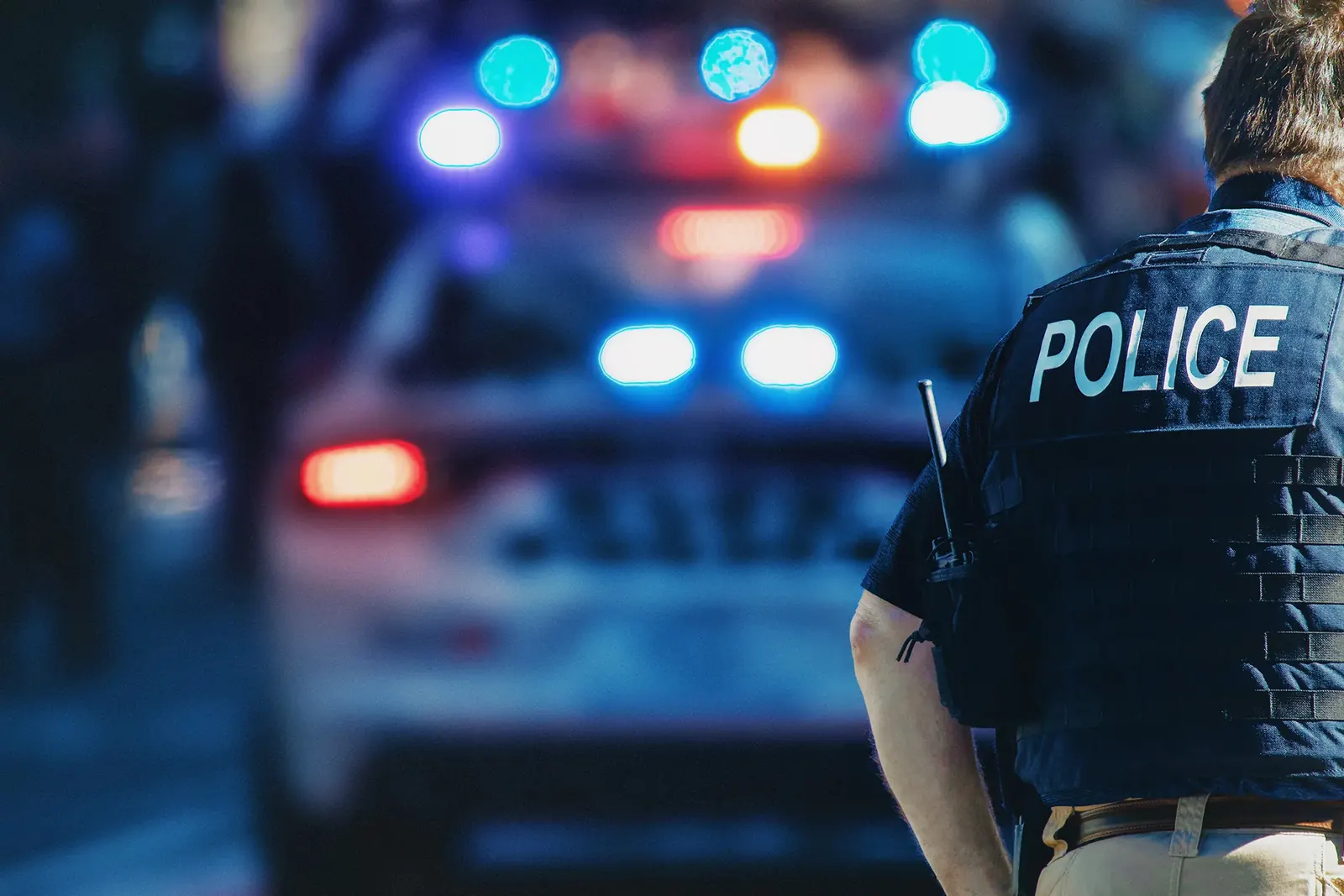
A Teltonika scenario for the police: the FMC650 tracker shows the control room where every patrol car is and whether its crew is free, so that the nearest one goes to the call.
A Teltonika scenario for the police: the FMC650 tracker shows the control room where every patrol car is and whether its crew is free, so that the nearest one goes to the call. In police work minutes matter more than in any logistics operation. If the operator spends time working out over the radio who is where and who is already busy, the offender gets away and the victim waits longer than they should. Teltonika describes a solution based on the PROFESSIONAL series trackers: the vehicle transmits its coordinates, the crew status, the state of the siren and the doors, and data from the CAN bus. All of it goes over a secure channel to the force's own server rather than into a public cloud.
What this scenario solves
The operator cannot see which patrol car is closest to the scene.
The crew status has to be established over the radio, and that costs precious minutes.
The cars run almost around the clock, and a missed service turns into a breakdown in the middle of a shift.
Nobody keeps track of who is behind the wheel of a service vehicle or whether it is being used off duty.
The operator cannot see which patrol car is closest to the scene. The crew status has to be established over the radio, and that costs precious minutes. The cars run almost around the clock, and a missed service turns into a breakdown in the middle of a shift. Nobody keeps track of who is behind the wheel of a service vehicle or whether it is being used off duty.
A police fleet has its own particular character. The car does not sit in a garage overnight: one shift hands it over to the next, mileage builds up faster than on an ordinary service vehicle, and the driving regimes are harsh — hard acceleration, long periods idling with the lights and siren on.
There is a security question too. When there is a detainee on the back seat, the crew and the control room need to know whether the rear door has been opened. And data about police movements is itself sensitive information that must not be pushed through third-party servers.
What Teltonika offers
Every patrol car is fitted with an FMC650 tracker, which sends coordinates, crew status and vehicle data to the force's dedicated server over a VPN.
Installation and setup
Fitting the device and configuring it for the fleet scenario at hand.
Data transfer
The device collects data and sends it to the monitoring platform; how often depends on the model and its settings.
Analysis and control
The person in charge gets reports and alerts and looks into what stands out.
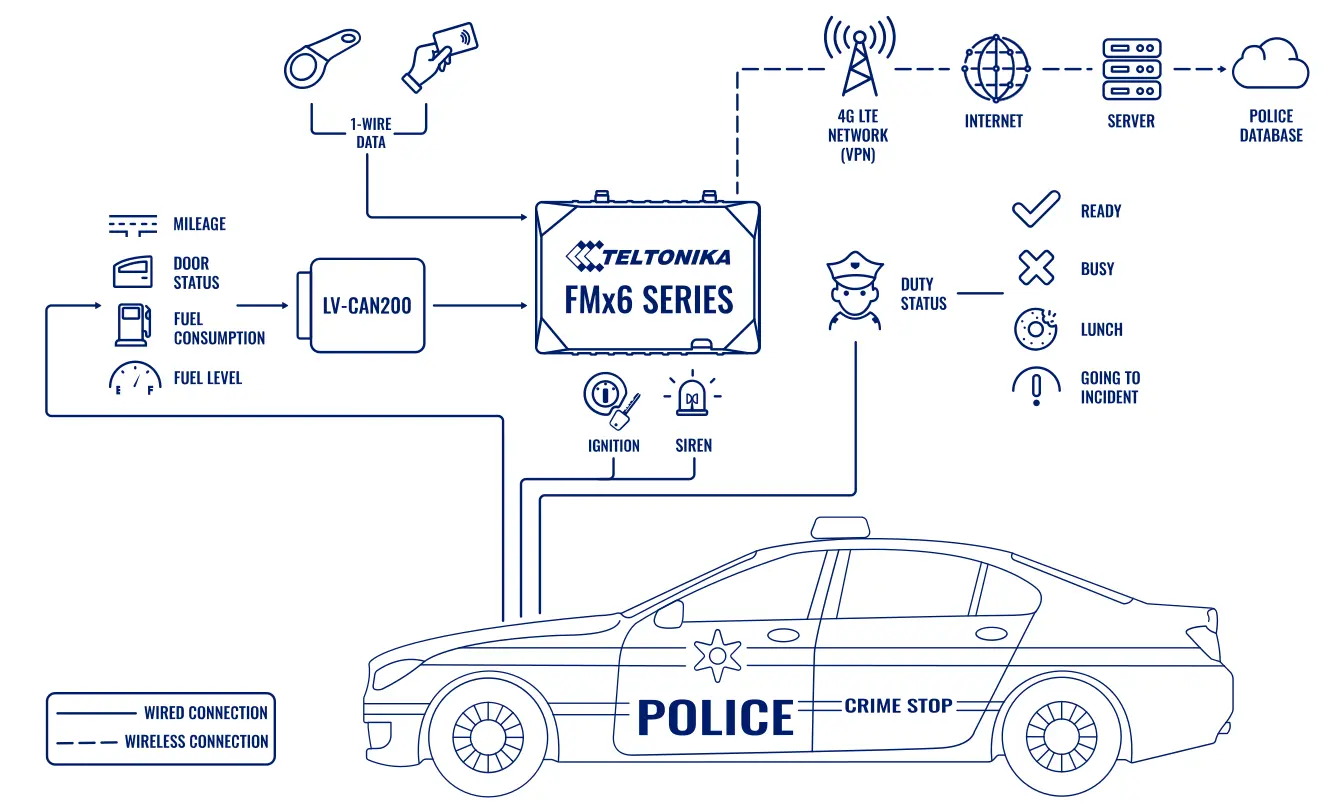
The FMC650 works on a 4G LTE Cat 1 network and falls back to 2G by itself if LTE disappears. It is a tracker from the PROFESSIONAL range: it has plenty of inputs and outputs, CAN support and the ability to connect external sensors and readers. The data goes not into a public cloud but over a VPN to the police server and database.
Crew status is transmitted in a simple and reliable way. A small keypad or external device is wired to the tracker's analogue input, producing a different voltage for each button. For instance 5 V means "Ready", other values mean "Busy", "Meal break" or "En route to call". The tracker distinguishes the voltage levels and sends the status along with the coordinates. The operator sees on the map not just dots but vehicles with a clear label showing who can be dispatched right now.
A digital input records when the siren and the beacons are switched on. From that data it is straightforward to reconstruct later when a crew was travelling to a call under priority and when it was simply moving around the district.
An LV-CAN200 adapter takes data off the vehicle's CAN bus without cutting into the wiring: door status, mileage, fuel consumption and fuel level, engine revolutions, temperature, accelerator pedal position. For the police the rear door matters most of all: if it opens while a detainee is in the vehicle, the system can raise an alert immediately.
Access to the vehicle is restricted through driver identification. The officer presents an RFID card or an iButton key, and the tracker records who took the car. It can be set up so that without authorisation the system raises an alert or blocks starting through a relay.
Service reminders are built on mileage or engine hours. When a car approaches its oil or brake pad change interval, the person responsible receives a notification in advance instead of hearing about the problem from a crew stranded on the hard shoulder.
The dispatcher ends up working with a single map: where the cars are, what status each has, who is driving, whether the siren is on, whether everything is in order mechanically. When a call comes in, the nearest free crew is chosen in seconds.
Imagine an ordinary night. A call comes in about a break-in at a shop. There are three cars nearby on the map: one with the status "Busy", a second on a meal break two kilometres away, a third free but further off. The operator sees this at once and decides for himself whom to pull off the break, instead of calling each of them in turn on the radio and waiting for an answer. In the morning the shift supervisor opens a report and sees how many minutes the crew took to reach the address and whether the siren was used.
What counts as a call attended. A car driving past an address does not yet mean the crew dealt with the call. In a report for management it is therefore better to separate three marks: the time the crew pressed "En route to call", the time of entry into the geofence around the address, and the time the status changed back to "Ready". The first and third marks are crew actions on the keypad, the second is a GPS measurement. Discrepancies between them show where statuses are being forgotten.
It is worth stating the source of each figure in the report itself: coordinates and speed come from the tracker's GNSS, mileage and doors from the CAN bus, the driver from RFID or iButton, the siren from a digital input. Then, when a complaint is investigated, it is clear which figure was measured by an instrument and which was entered by a person.
Limitations. The response time measured by GPS depends on the logging interval and on signal quality among dense buildings. If timing accurate to the second is needed, the reporting interval while the status is "En route to call" is set more frequent than during ordinary patrolling.
What you get
The nearest crew takes the call
The operator sees the free cars on the map and sends the closest one without a radio roll call.
Shift status visible without phone calls
"Ready", "Busy", "Meal break" and "En route to call" are sent from the keypad through the tracker's analogue input.
Only authorised officers drive
An RFID card or iButton ties the trip to a particular person, and a trip without authorisation lands in the report or raises an alert straight away.
The rear door under control
Door data from the CAN bus helps avoid losing a detainee and allows an immediate response to an opening.
Servicing by mileage, not by memory
Notifications arrive before the service interval, and cars break down mid-shift less often.
The history of every call-out is kept
The route, speed, siren and driver in the reports come in useful when disputed situations and complaints are investigated.
Why this solution
The FMC650 is chosen for jobs like this because of the headroom in its connections. The tracker has enough analogue and digital inputs to accept the crew status, the siren signal and the driver reader at the same time and still drive an immobiliser relay. For an ordinary passenger car tracker that would be overkill, but for a service vehicle with special equipment it is the norm.
The second reason is connectivity. LTE Cat 1 with a fallback to 2G holds the link where 4G is unstable, and with no network at all the tracker accumulates positions in memory and uploads them once coverage returns. The route is not broken up.
The third is working with CAN without interfering in the vehicle's electronics. The LV-CAN200 reads data off the bus without disturbing the operation of the factory electronics, and the set of available parameters depends on the make and model: on some cars doors and fuel can be read, on others only mileage and revolutions. This is tested on the specific model before purchase.
And finally, Teltonika makes it possible to send data to the customer's own server over a VPN. For law enforcement bodies this is often a mandatory condition.
How this works in Azerbaijan. We come across a similar scenario not only in government bodies but also in private security companies with rapid response teams, in cash-in-transit operations and in the emergency services of the gas and electricity networks in Baku and Sumgait. The logic is the same: knowing who is free and who is closer. In summer in Baku cars stand for hours with the engine running and the air conditioning on, so we advise keeping a separate eye on engine hours at idle — servicing based on mileage alone falls behind here. On call-outs to the mountain districts beyond Guba or Sheki the network drops out, and this is where the tracker's internal buffer saves the day. GPS.az, Teltonika's GOLD partner in Azerbaijan, fits the FMC650, connects the status keypad, the siren and the driver reader and sets everything up on the Wialon platform: statuses on the map, door and servicing notifications, call-out reports. If the data may not leave the organisation, we discuss the option of a separate server.
Related case studies
Related rollouts and equipment
Questions about the “GPS monitoring of police vehicles” scenario
Request a call
A specialist will call back and match a solution to your fleet and your task.