
Snow clearing machinery under FMC650 control
A Teltonika use case about the municipal services that clear roads in winter: the FMC650 tracker shows which streets have already been covered, how much salt and grit has been spread, how long the driver has worked without a break and what condition the machine is in.
A Teltonika use case about the municipal services that clear roads in winter: the FMC650 tracker shows which streets have already been covered, how much salt and grit has been spread, how long the driver has worked without a break and what condition the machine is in. In northern countries winter lasts from three to six months, and a snowfall can paralyse a city overnight. Municipalities prepare for the season well in advance, but when the snow actually comes everything turns on the live picture: where each machine is right now, what it has done and whether it will break down halfway through the shift. The FMC650 in this arrangement gathers data from several sources at once: its own GNSS module, the digital tachograph, the gritter and the lorry's on-board bus.
What this scenario solves
The dispatcher cannot see which streets have been cleared and which have been missed.
Salt and grit are written off by the tonne, but there is no way of checking the real consumption route by route.
Winter shifts are long, and drivers easily run past the limits on time at the wheel.
A breakdown of the gritter or the lorry in the middle of a snowfall leaves a whole district untreated.
The dispatcher cannot see which streets have been cleared and which have been missed.
Salt and grit are written off by the tonne, but there is no way of checking the real consumption route by route.
Winter shifts are long, and drivers easily run past the limits on time at the wheel.
A breakdown of the gritter or the lorry in the middle of a snowfall leaves a whole district untreated.
Snow hits a city from several directions at once. Ambulances and emergency services travel more slowly, logistics grinds to a halt, repair crews cannot reach their sites. On pavements and uncleared streets the number of injuries and accidents goes up. So the municipal service is asked not simply to do the work, but to show which roads were treated and when.
In practice, without telematics, that picture is assembled from radio traffic and paper job sheets. One section may be covered twice because two crews did not know about each other, while the next side street stays untouched until morning. When a complaint comes in afterwards, there is nothing to prove the machine was ever there.
Materials are harder still. How much de-icer went onto a particular street, at what spreading width and at what speed, the driver usually does not know either. Yet the report the city wants is exactly that, with volumes and sections.
And finally the machinery. Snow clearing vehicles work at their limit, often at night and in the frost. If an engine problem only comes to light when the machine has stopped, the district goes untreated for several hours.
What Teltonika offers
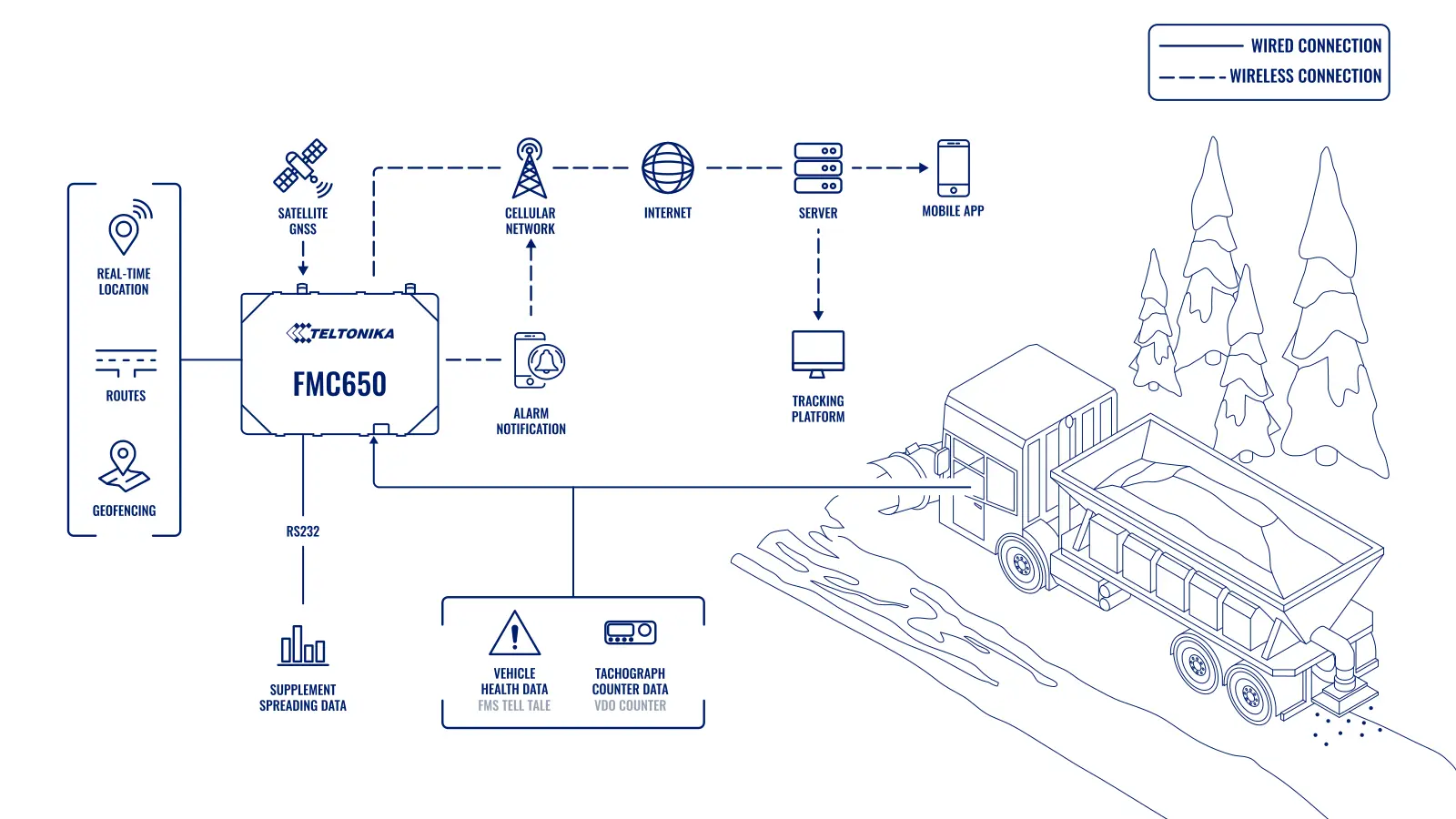
Teltonika proposes fitting snow clearing machinery with the FMC650: a single tracker collects the route, the data on de-icer spreading, the driver's working time from the tachograph and fault signals from the FMS bus.
Installation and setup
Fitting the device and configuring it for the fleet scenario at hand.
Data transfer
The device collects data and sends it to the monitoring platform; how often depends on the model and its settings.
Analysis and control
The person in charge gets reports and alerts and looks into what stands out.
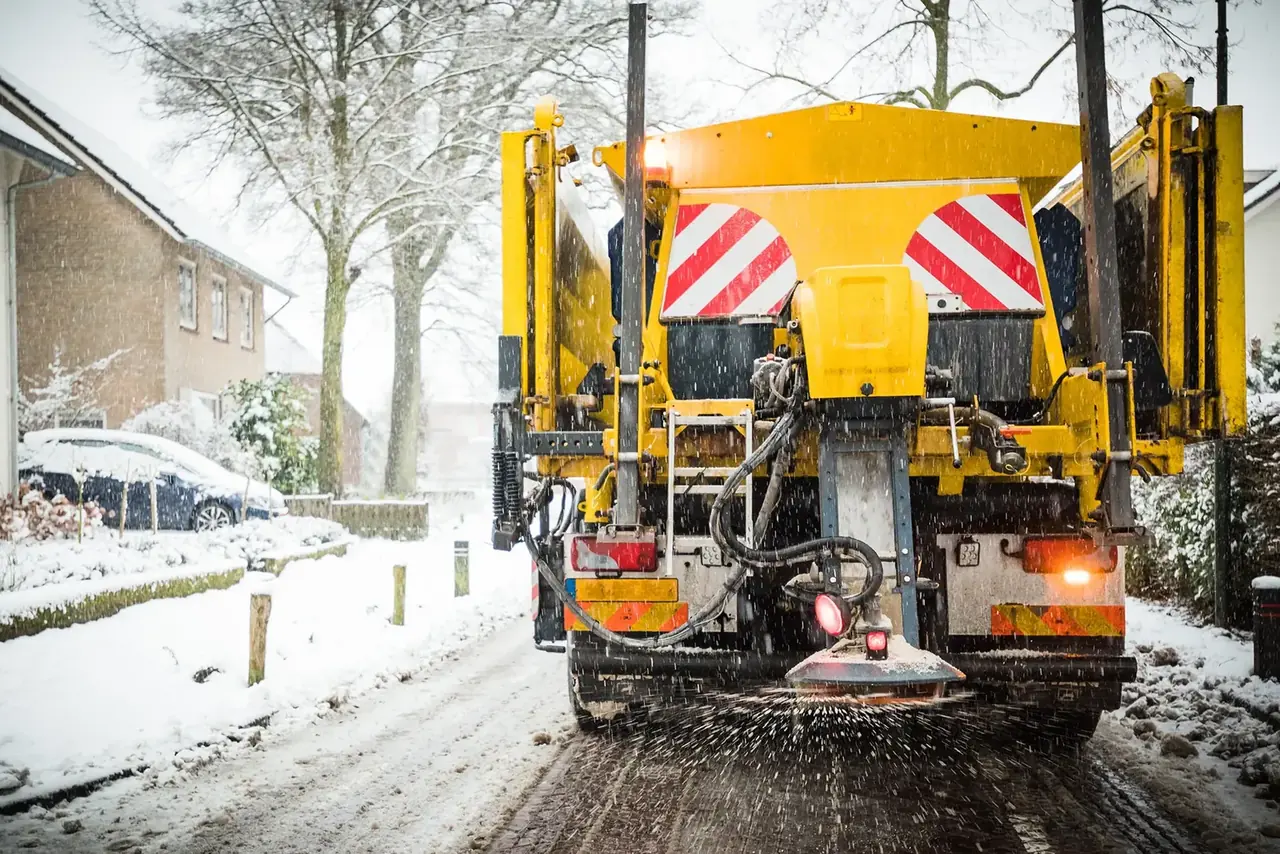
The FMC650 belongs to the professional range. It has its own GNSS module with high positioning accuracy, so the machine's track lands on the map street by street. The dispatcher sees in real time where each grader and gritter is, and after the shift receives the route overlaid on the plan of the roads being serviced. Missed sections and repeat passes are visible straight away, rather than after complaints from residents.
The second block of data is materials. The gritter controller is connected to the tracker through the RS232 port. The FMC650 takes from it the quantity of material spread and the spreading width and sends that to the server together with the coordinates. The result is a report: on such a street, such a machine spread so much salt. That is the basis for the report to the city and for finding waste, when de-icer is spread where the surface is already clear or while the machine is standing still.
The third block is people. Winter shifts are often longer than usual, and overrunning is easy. The FMC650 can read the data of a VDO digital tachograph remotely: who is at the wheel (the driver card number), what mode they are in, how long they have been driving without a break. One of the parameters is called exactly that — remaining driving time in the current shift, in minutes. The dispatcher sees that the driver has to stop in 20 minutes and plans a relief in advance, while the accounts department gets an honest basis for paying overtime.
The fourth block is technical condition. Through the FMS interface the tracker reads Tell Tale Status, that is, the same indicators that light up on the driver's dashboard: oil pressure, temperature, system faults. A signal about a problem reaches the dispatcher before the machine stops, and it can be taken off its route ahead of the breakdown rather than recovered out of a snowdrift.
In the monitoring system all these data come together in a single vehicle card. Where it is, what it has done during the shift, how much material has gone, who is at the wheel and how much time they have left, whether any warning indicators are on. For the head of the service that is a daily report; for the dispatcher it is a working screen for the whole night.
An example from a typical night. Snow starts falling at two o'clock, and the dispatcher sends six machines out on their assigned sections. By four in the morning he can see on the map that one section by the hospital is still grey: the machine that should have covered it is standing at the depot with an engine temperature indicator lit. The neighbouring gritter has already finished its route and is given an extra job. In the morning the report shows that every street was covered, and how many tonnes of material went onto each.
Drove past or treated. The track only shows that the machine drove past. A section counts as treated when the gritter controller reports at the same moment that it was working — or, on machines with older equipment, when a sensor shows the gritter switched on or the blade position. Otherwise a lorry that drove down a street empty looks the same in the report as one that gritted it.
Where the figures come from. The volume and the spreading width are the controller's readings, passed over RS232, not a weighing. How accurate they are depends on the calibration of the controller itself, so before the season it is checked against a known volume of material.
What the customer gets. A report for each section: when it was covered, by which machine, whether the gritter was working, how much material went and at what width. Missed sections come as a separate list, so that they can be dealt with the same night.
There is one limitation, but it matters: the tracker only gets the volume and the spreading width from a controller able to supply them over RS232. With an old mechanical gritter with no electronics you will have to settle for the fact of operation from a switch-on sensor.
What you get
It is visible which streets have been covered
Tracks land on the map of the roads being serviced, and gaps or double passes stand out the same night.
Salt and grit accounted for
The volume and spreading width for each section go to the server, a report for the customer is built from them and waste becomes visible.
Working time from the tachograph
Remote reading of the driver card and the remaining driving time helps change shifts on time and pay overtime honestly.
Breakdowns visible in advance
Dashboard indicators come through FMS to the dispatcher, and the machine can be taken off its route before it stops.
One tracker instead of several systems
Route, materials, tachograph and diagnostics are gathered by one device and visible in one vehicle card.
Why this solution
The FMC650 was chosen because a snow clearing machine has many sources of data and all of them have to be brought into one place. The tracker has RS232 for the gritter controller, FMS and CAN support, remote tachograph reading, and spare digital and analogue inputs. There is no need to fit a separate unit for each job.
The tracker is built for work in commercial vehicles: a wide supply voltage range, operation in the frost, a backup battery. If the connection drops on a rural section, the data accumulate in internal memory and go to the server as soon as the network comes back.
Configuration goes through the Configurator, and firmware is updated over the air. For a fleet of dozens of machines that means the data transmission interval can be changed or a new sensor added without gathering the vehicles at the depot.
How this works in Azerbaijan. Heavy snowfalls do not happen here every year, but in winter they regularly close passes and roads in the Guba-Gusar region, on the Baku — Shamakhi road (M-4), in Sheki, Zagatala, Kalbajar and Lachin. Once every few winters snow falls in Baku as well, and then the city discovers that there is little machinery and no way of telling where it is at the moment. For the road services and contractors that maintain the M-1 and M-4 routes, control of routes and de-icer consumption matters just as much as it does in Europe. What to allow for: in the mountains Azercell, Bakcell and Nar coverage drops out, and without data buffering the track tears; tachographs are not fitted to every machine, and domestic and older equipment often has no FMS, so engine condition there is picked up through sensors rather than off the bus. GPS.az fits the FMC650 to road machinery, connects gritters and tachographs and sets up route and material reports on the Wialon platform.
Related case studies
Related rollouts and equipment

Questions about the “Snow clearing machinery under FMC650 control” scenario
Request a call
A specialist will call back and match a solution to your fleet and your task.