
Automatic top-ups for the SIM cards in Teltonika trackers
The Auto Top-Up feature in Teltonika's connectivity service renews the data plan on a tracker's SIM card by itself when the allowance runs out, so a lorry does not drop off the network over a weekend or while stuck in a queue at the border, and keeps sending its tachograph and e-TOLL data.
The Auto Top-Up feature in Teltonika's connectivity service renews the data plan on a tracker's SIM card by itself when the allowance runs out, so a lorry does not drop off the network over a weekend or while stuck in a queue at the border, and keeps sending its tachograph and e-TOLL data. The problem sounds mundane: the megabytes ran out. But for a haulier working in Europe it is more than a blank space on the map. If the tracker goes quiet, nothing reaches the electronic road-toll system and no tachograph files are downloaded — and there are fines for that, substantial ones. The Teltonika case explains how automatic top-ups are set up and which Azerbaijani hauliers actually need them.
What this scenario solves
A tracker without data is a tracker that is not there.
In many countries, tachograph and electronic road-toll systems require the haulier to submit information on time.
If a tracker's SIM card is left without data, the information stops flowing and the fine lands on the fleet owner.
Most often this happens at the weekend or on a long run, when there is nobody around to top the balance up.
A tracker without data is a tracker that is not there. In many countries, tachograph and electronic road-toll systems require the haulier to submit information on time. If a tracker's SIM card is left without data, the information stops flowing and the fine lands on the fleet owner. Most often this happens at the weekend or on a long run, when there is nobody around to top the balance up.
On tachographs. Hauliers in Europe are obliged to download digital tachograph and driver card data regularly. According to the UK government website GOV.UK, breaking the tachograph rules can bring a fine of up to £10,000 and even up to two years' imprisonment. Many companies download these files remotely, through the tracker — which means that without a connection the download simply does not happen.
On roads. In systems such as Poland's e-TOLL, the tracker reports the vehicle's position, the system works out the distance covered on tolled sections and issues the bill. If the data does not arrive in time then, according to the Polish Ministry of Finance at etoll.gov.pl, the fine starts at €300 per violation.
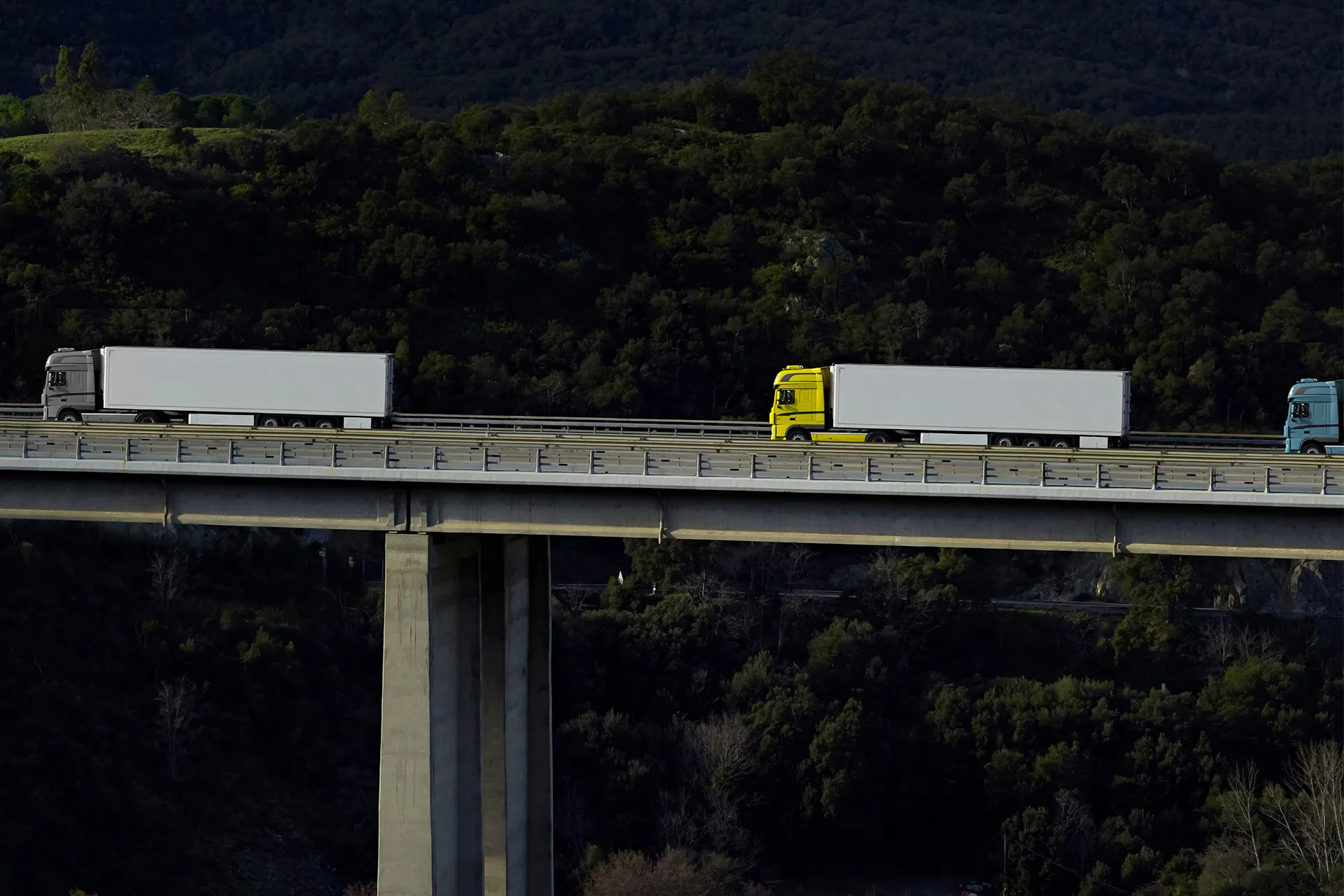
Now the real situation. A lorry spends several days in a queue at customs. The tracker works the whole time, sending positions, and the data allowance drains away or the plan expires. The lorry finally crosses the border — and the connection is already gone. The dispatcher gets no alerts, the tachograph data is not downloaded, e-TOLL cannot see the vehicle.
The second scenario is simpler still. The data runs out on a Saturday evening. The logistics and accounts teams are off, the low-balance notification went to a work mailbox and is sitting there unread. Until Monday the fleet runs without data, and by Monday there is already something to be fined for.
The bigger the fleet, the higher the chance that at least one SIM is about to run dry at any given moment. Keeping track of a hundred cards with different renewal dates by hand does not work even for a conscientious administrator: someone is on holiday, notifications go to spam, and the card in one particular lorry runs out on the least convenient day possible.
What Teltonika offers
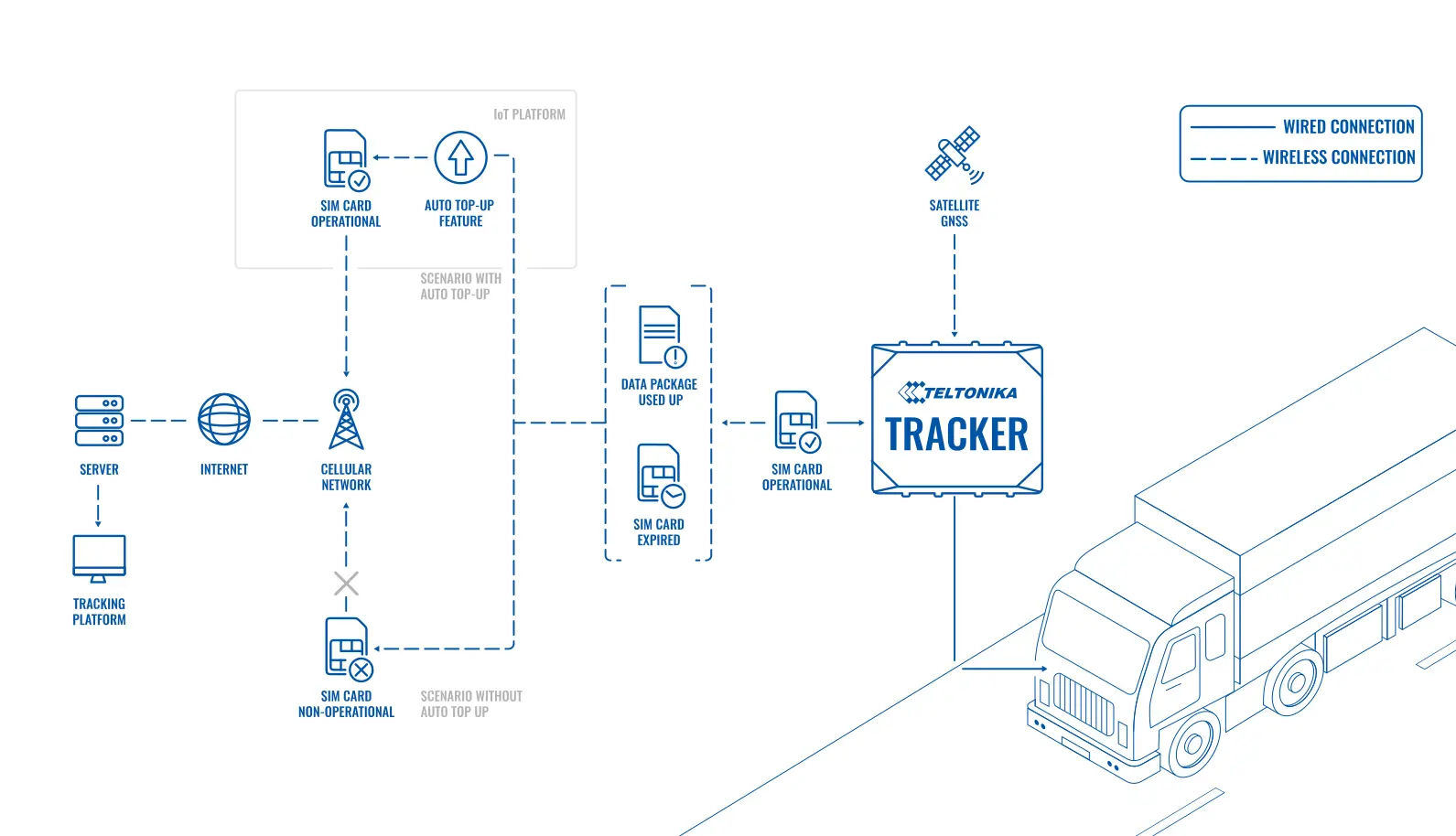
Teltonika's connectivity service has the Auto Top-Up feature for exactly this. It works with Teltonika's own SIM cards and eSIMs, and on condition that top-up packages have been bought in advance: when the remaining data falls to a set threshold, the platform renews the same plan on the same terms with no human involved. Tariffs and the list of countries change, so they are checked against Teltonika's current offer at the time of connection.
Installation and setup
Fitting the device and configuring it for the fleet scenario at hand.
Data transfer
The device collects data and sends it to the monitoring platform; how often depends on the model and its settings.
Analysis and control
The person in charge gets reports and alerts and looks into what stands out.
Where the SIM comes from. Any Teltonika vehicle tracker takes either an ordinary SIM card or an eSIM module. Teltonika's own SIM and eSIM are part of its Teltonika Connectivity Solution. The Teltonika Global Plan, for instance, worked in 134 countries at the time the case was published (May 2022), with no roaming surcharges and the same data allowance wherever the vehicle happens to be. The main operators are supported in each country, and the SIM picks the network with the best signal by itself.
But every plan has a limit in megabytes and an expiry date. Once it is used up, the tracker drops off the network — and that is the gap automatic top-ups close.
How it works. Top-up packages are bought in advance, in the quantity needed, through a Teltonika manager. The rules are then set in the IoT platform for SIM card management:
• which SIM cards to top up automatically;
• at what remaining data level the top-up is triggered;
• who to notify and how — by email or SMS, for example when 90% of the data has been used or when the last purchased top-up package has gone.
After that the balance needs no watching. The plan runs out on a Sunday afternoon, a few minutes later it is renewed, the tracker is online and the data keeps flowing.
Back to the border example. The lorry spent a day in the queue and the plan ran out right there at customs. Auto Top-Up renewed it, and by the time the vehicle crossed the border the tracker was already online: e-TOLL sees the vehicle, the tachograph downloads on schedule, the dispatcher gets positions. Nobody in the office did a thing.
How many packages to buy. That is worked out from average consumption. A tracker that reports a position every 30–60 seconds while moving and once an hour while parked uses comparatively little. Remote tachograph downloads, frequent CAN data requests and camera images use noticeably more. A practical approach: look at consumption per SIM in the IoT platform over two or three months, pick out the hungriest vehicles and keep a larger reserve of top-ups for them. A small reserve is enough for the rest. The reserve is worth revisiting once a quarter: the fleet grows, routes change, and yesterday's reserve may no longer be enough.
What the IoT platform shows. For each SIM card — remaining data, plan expiry date, top-up history, current operator and country. It can be filtered by group: the SIMs in international tractor units separately from those in urban vans, for example. The same view shows which cards have not been in touch for a while, which is a reason to check the tracker and not just the balance.
Another useful habit is the last-package notification. When the purchased stock of top-ups runs low, the system writes to the person responsible, who then has time to buy more while there is still data on the cards.
The case uses the FMC650 as its example — a tracker for goods vehicles that supports remote tachograph downloads. But the feature itself belongs to the SIM cards, so it works with any tracker carrying a Teltonika SIM.
An honest caveat: Auto Top-Up is no substitute for coverage. If a vehicle is driving where there is no network at all, data will not help — the tracker stores the positions in memory and sends them later. And top-up packages have to be bought in advance: if the stock runs out, the system will warn you, but there will be nothing left to renew with.
What you get
The tracker does not drop off the network over data
The plan renews automatically, at night and at weekends too.
Less risk of tachograph and e-TOLL fines
The data goes out on time, even if the vehicle has spent a day at the border.
Every SIM card in the fleet in one window
The IoT platform shows balances, rules and notifications from a computer, tablet or phone.
One tariff across many countries
The Global Plan covers 134 countries (as of May 2022) with no roaming surcharges.
The best network available locally
The SIM works with the main operators in each country and picks whichever has the stronger signal.
Everything from one supplier
Trackers, SIM cards, the management platform and support, with no seams between contractors.
Why this solution
Teltonika makes not only the trackers but the connectivity for them. When the SIM card, the SIM management platform and the tracker come from one manufacturer, setting things up is easier and so is working out what happened when something goes wrong: there is no need to establish who is at fault — the operator, the integrator or the firmware.
Auto Top-Up is a small feature, but it closes one of the most common and most foolish causes of lost data. Set the rules once, buy a stock of packages, and stop thinking about balances.
That matters most for companies working to regulators' requirements: remote tachograph downloads, reporting into road-toll systems. Missing data there costs more than any tariff.
How this works in Azerbaijan. Inside the country most fleets run on local Azercell, Bakcell or Nar SIM cards, and the out-of-data problem is solved by topping up with the operator. For international hauliers moving freight from Baku into Georgia, Turkey and on into Europe the situation is different. The vehicle is abroad for weeks, roaming on a local SIM is expensive, and the queues at the Red Bridge and Sarpi crossings or at the EU border stretch out for days. For fleets like these a SIM with a single international tariff and automatic top-ups is a practical option, particularly where the vehicle falls under tachograph and toll-road requirements in the EU, such as Poland's e-TOLL. Auto Top-Up does not work with local Azercell, Bakcell and Nar SIMs — it is part of the Teltonika service. Whether an operator offers automatic plan renewal on a corporate tariff is a question for that operator, and in Wialon you can in any case set up a notification for a tracker that has stopped reporting. For transit along the Middle Corridor through the port of Alat and the ferry to Aktau or Turkmenbashi, it is important to check in advance which countries on the route the tariff covers. GPS.az fits the FMC650 with remote tachograph download to lorries, helps you choose between a local and an international SIM, and configures loss-of-connection notifications in Wialon so the dispatcher hears about the problem straight away rather than on Monday.
Related case studies
Related rollouts and equipment

Questions about the “Automatic top-ups for the SIM cards in Teltonika trackers” scenario
Request a call
A specialist will call back and match a solution to your fleet and your task.