
The FMC130 tracker at the Dakar 2022 rally
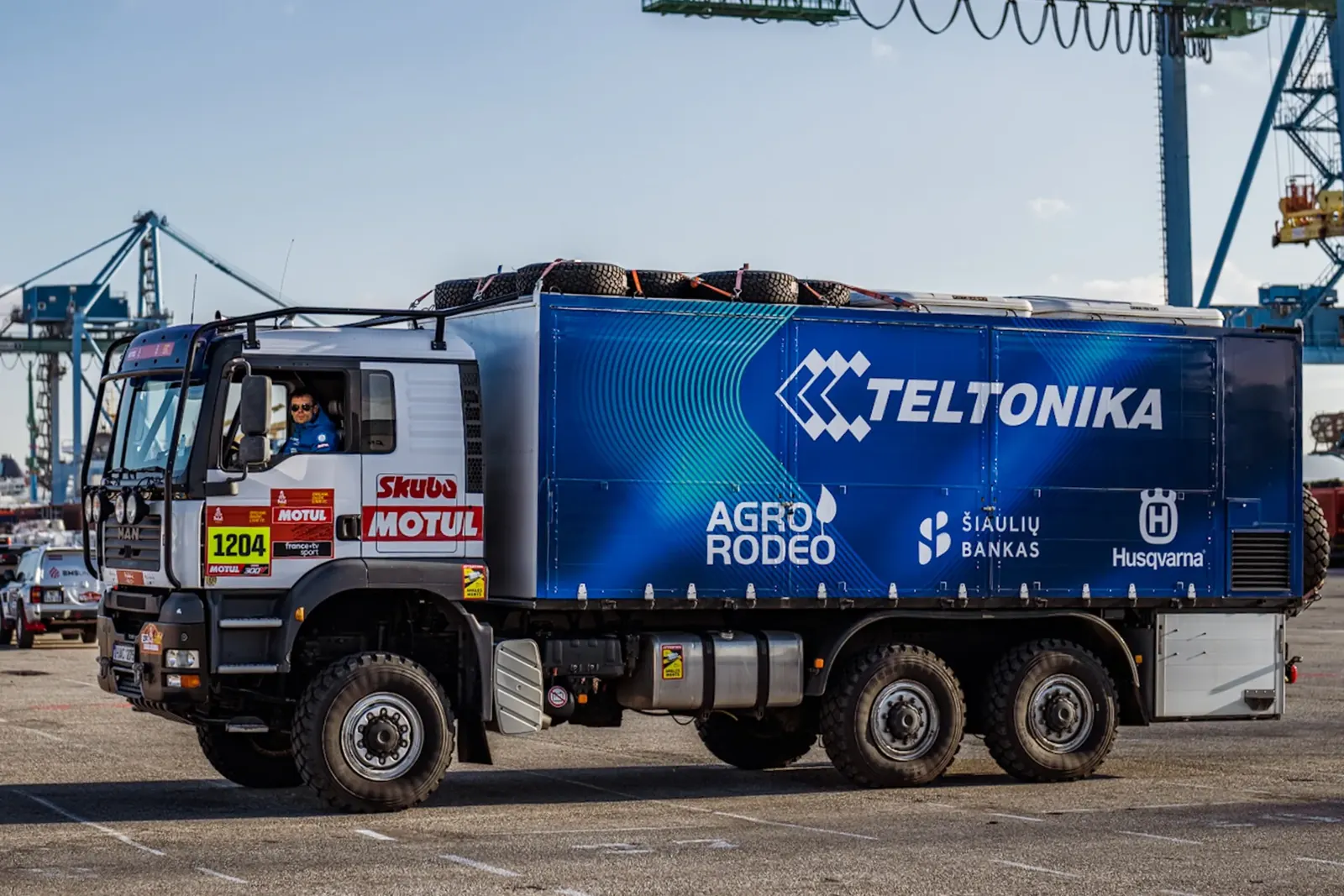
Teltonika tested a production FMC130 tracker with the LV-CAN200 CAN adapter and wireless EYE sensors on the Teltonika Racing team's support lorry during the Dakar 2022 rally in Saudi Arabia — and the equipment kept sending data throughout the race.
Teltonika tested a production FMC130 tracker with the LV-CAN200 CAN adapter and wireless EYE sensors on the Teltonika Racing team's support lorry during the Dakar 2022 rally in Saudi Arabia — and the equipment kept sending data throughout the race. The case will interest anyone who works in hard conditions: haulage firms, miners, oilfield service companies, builders. A race across the desert brings the same heat, dust, vibration and loss of signal, only compressed into two weeks. Below: what was fitted to the lorry, what data was collected and why this was an ordinary production device rather than a specially prepared sample.
What this scenario solves
Professional drivers often have to work in heat, cold, dust, mud and water, on broken and mountain roads.
The same conditions punish the tracker: vibration works connectors loose, dust clogs the housing, overheating causes faults.
Off road and in the desert the signal disappears, and the data is still needed without gaps.
If a tracker fails at the hardest moment, a monitoring system loses its point precisely where it is needed most.
Professional drivers often have to work in heat, cold, dust, mud and water, on broken and mountain roads. The same conditions punish the tracker: vibration works connectors loose, dust clogs the housing, overheating causes faults. Off road and in the desert the signal disappears, and the data is still needed without gaps. If a tracker fails at the hardest moment, a monitoring system loses its point precisely where it is needed most.
The list of what a vehicle meets in hard conditions is a long one: severe heat and severe cold, sometimes within the same day, vibration, sand, mud, downpours, dirty water, high humidity, salt air by the sea. To that are added uneven and mountain roads, where the impacts and the shaking do not stop for hours.
For drivers and passengers that means a risk of accidents and fatigue. For the vehicle it means accelerated wear. For telematics equipment it is a test of endurance that not every device passes.
Off-road racing takes these conditions to the limit. Deserts, gravel stages, mountains, canyons. And every vehicle still has to be visible in real time and its condition known precisely: where it is, how the engine is doing, whether there is enough fuel to the next point. The question Teltonika puts is a simple one: will an ordinary tracker stand up to such conditions and keep its accuracy and a steady flow of data?
What Teltonika offers
To answer that question, Teltonika fitted a production FMC130 tracker, together with an LV-CAN200 CAN adapter and wireless EYE Beacon and EYE Sensor devices, to the support lorry of its own Teltonika Racing team at the Dakar 2022 rally — and watched the data throughout the race.
Installation and setup
Fitting the device and configuring it for the fleet scenario at hand.
Data transfer
The device collects data and sends it to the monitoring platform; how often depends on the model and its settings.
Analysis and control
The person in charge gets reports and alerts and looks into what stands out.
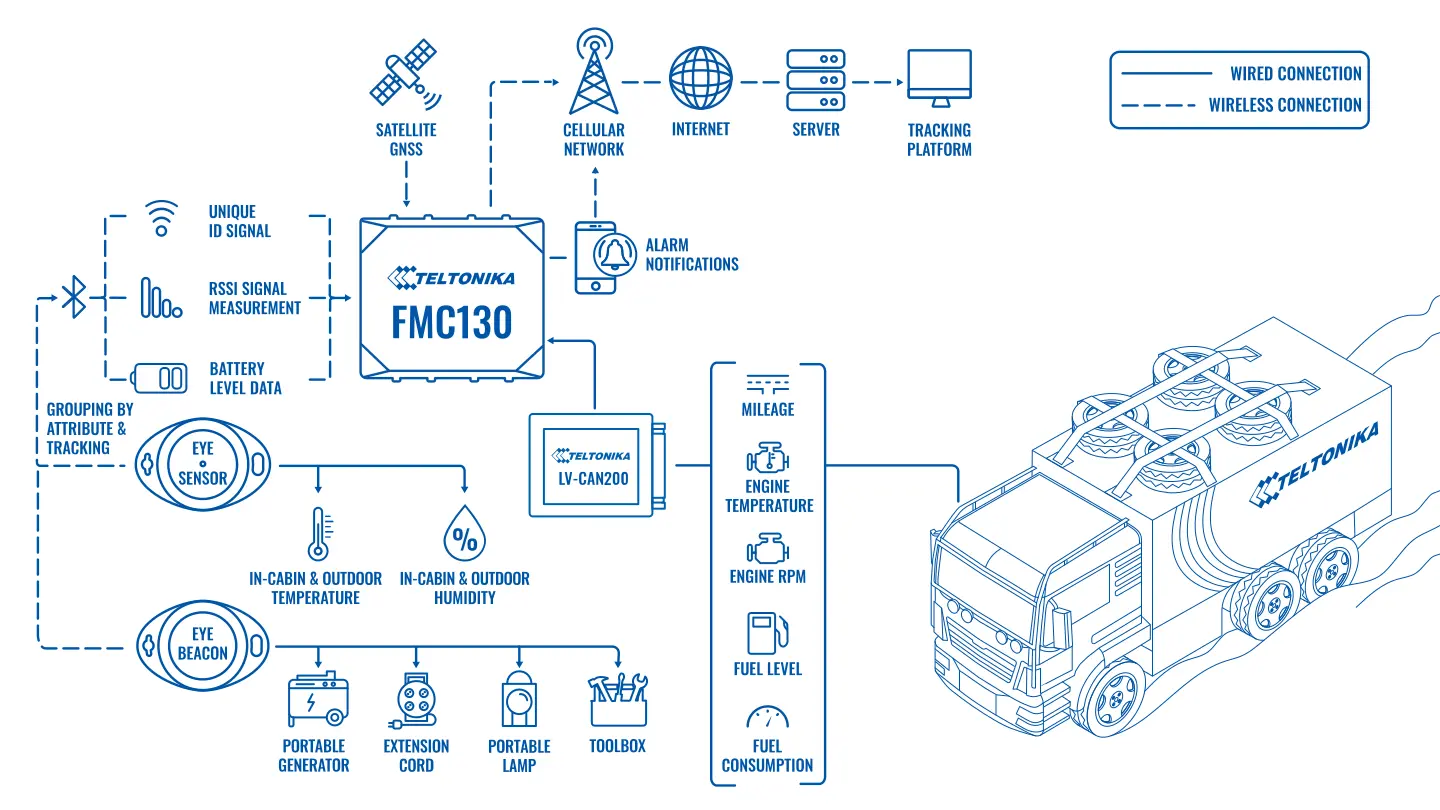
The FMC130 is a tracker from the ADVANCED line with a 4G LTE Cat 1 modem and a fallback connection to 2G networks. That combination suits large territories well: where there is LTE the tracker works over it, and where there is not it switches to 2G.
The LV-CAN200 takes data from the lorry's CAN bus: engine revolutions, fuel level, consumption, engine temperature and other parameters. EYE Beacon units are beacons for tracking individual items. EYE Sensor units are wireless temperature and humidity sensors.
Where it was tested. The route of Dakar 2022 ran through the canyons and rocks of the Neom region in north-western Saudi Arabia, along the Red Sea coast, over the dunes around Riyadh and across the sands of the Rub al Khali desert (the Empty Quarter). For any driver, any engine and any electronics these are among the harshest conditions there are — and at the same time the best proving ground. The FMC130 is approved and certified by the Communications and Information Technology Commission of Saudi Arabia (CITC), so it was officially allowed to operate in the country.
What the system collected. The position and speed of the lorry. Battery voltage. Engine temperature and revolutions. Fuel level and daily consumption. Mileage. Temperature and humidity in the cab and outside it, through the EYE Sensor units. And also the proximity of the portable equipment that had EYE Beacon units attached to it: the generator, a halogen lamp, an extension lead, a tool box. If something was left behind at the bivouac, it showed.
Teltonika reports that after the race all the equipment had worked within its specifications and had transmitted data continuously in real time. The team could see the condition of the lorry and of the equipment, allocate resources and plan the next steps on the basis of figures rather than radio traffic and guesswork.
An important detail the manufacturer stresses. The FMC130 on the lorry was an ordinary tracker off the production line. No modifications, no special settings and no reinforcement of the housing were made. It was exactly the same device as goes out to customers on a normal order. That makes the result of the race meaningful for ordinary customers: a production device worked in hard conditions, and that is a good argument for a quarry or a desert route, although it is no substitute for a trial on your own vehicles.
When and under what conditions this happened. The trial took place during the Dakar 2022 rally in January 2022. It was one support vehicle rather than a fleet, and about two weeks of operation rather than years of service. The account of the result is Teltonika's own report; the case contains no independent measurements.
How far this carries over to current devices. Since 2022 the firmware of the FMC130 and of the accessories has been updated, and the tracker range has grown. The principle itself — a production tracker, a CAN adapter and wireless sensors on one vehicle — still holds, but we check the current model, the firmware version and the compatibility of the LV-CAN200 with the particular machine at the time of the project, not from the data of the race.
What is worth doing on your own vehicles. Before equipping a fleet for hard conditions, it is useful to fit a kit to one or two vehicles for a month of work in a real cycle: the hot season, a dusty quarry or a mountain route. Then check for gaps in the data, the stability of the CAN parameters and the state of the connectors after the vibration.
What you get
Tested by the desert
On Teltonika's data, a production FMC130 with its accessories transmitted the position and the lorry's parameters throughout the Dakar.
The engine is visible
The LV-CAN200 brings in engine revolutions, engine temperature, fuel level and consumption, and battery voltage.
Climate in the cab and outside
EYE Sensor units show temperature and humidity, which matters both for the driver and for the load.
Less left behind at a stop
EYE Beacon units on the generator, the lamps and the tools show that the equipment is near the vehicle, and make it possible to notice when it is not.
An argument for difficult projects
It is easier for providers and integrators to take on fleets working in hard conditions when the equipment has been tested in a real race.
Why this solution
The main conclusion of the case is that what was tested was a production device. Many manufacturers demonstrate endurance on specially prepared samples. Here what went on the lorry was what sits in the warehouse and, on the manufacturer's account, it worked through a desert race with no special treatment.
The set is good for its modularity. The FMC130 provides the connection and the position, the LV-CAN200 the engine data, and EYE Sensor and EYE Beacon the temperature, the humidity and the check on equipment. The sensors are wireless, so they are easy to add or move without extra wiring. There is a mobile app for Android and iOS through which the beacons are configured.
Honestly about the limits. A rally lasts about two weeks, while a fleet works for years, so a race is no substitute for long-term operating experience. In places with no mobile coverage the tracker stores data in memory and sends it later — there will be no live picture there. A CAN adapter reports only the parameters that are actually present on the bus of the particular vehicle. The housing stands up to vibration and dust, but the mounting position still matters: a tracker under the bonnet next to the exhaust manifold will overheat whoever made it.
How this works in Azerbaijan. Conditions resembling the rally are more common here than one might think. In summer it is +40 °C and above on Absheron and in the Kura-Araz lowland, there is dust on the quarry roads of the Garadagh district, salt air by the Caspian at the oilfields, mountain hairpins and snowy passes in the Guba-Gusar region, and broken approach roads to the construction sites in Karabakh and East Zangezur. Articulated lorries, tippers and the oil companies' service vehicles work in conditions like these every day, and a tracker has to survive them for years. In the mountains Azercell, Bakcell and Nar coverage drops out, so the tracker banks up the points and sends them when the network returns. When fitting, we choose a position away from sources of heat, secure the connectors against vibration and check which CAN parameters the particular vehicle reports. GPS.az, a Teltonika GOLD partner in Azerbaijan, fits the FMC130 with the LV-CAN200 and the EYE sensors and connects everything to the Wialon platform, where both the vehicle's position and the condition of its engine are visible. The equipment warranty is 1 year.
Related case studies
Related rollouts and equipment
Questions about the “The FMC130 tracker at the Dakar 2022 rally” scenario
Request a call
A specialist will call back and match a solution to your fleet and your task.