
A live leaderboard at boat races
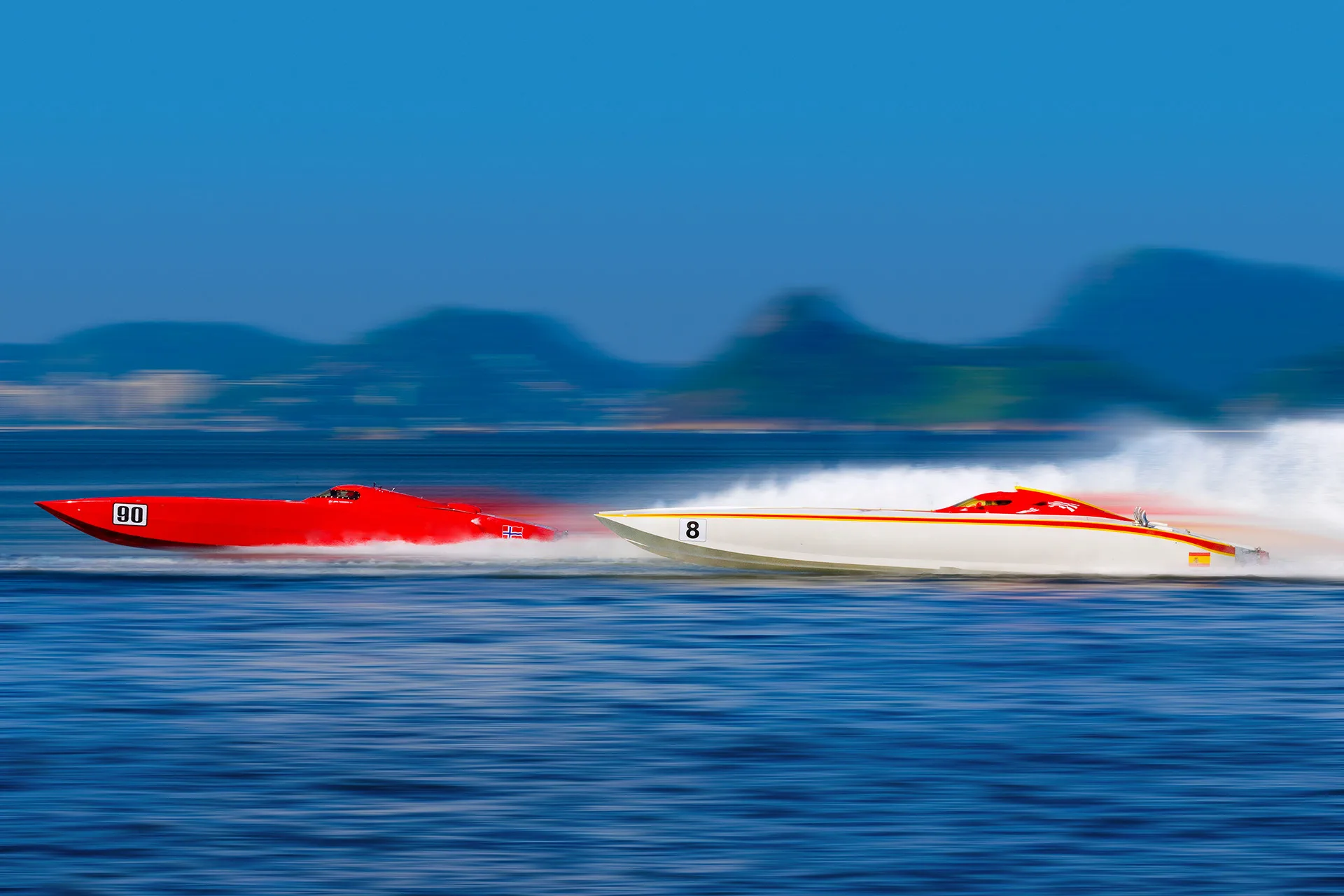
A scenario from the Teltonika library: a developer in New Zealand fitted FMC130 trackers to racing boats and wrote a web application in which the officials see the course, the checkpoints and the leaderboard almost in real time.
A scenario from the Teltonika library: a developer in New Zealand fitted FMC130 trackers to racing boats and wrote a web application in which the officials see the course, the checkpoints and the leaderboard almost in real time. This is someone else's project; below we look at what carries over to competitions in Azerbaijan and on what conditions. The boating season in New Zealand runs from April to July: six races, one a week, from marathons to river courses and open-water events. The venues vary and are often remote, and the officials physically cannot see the whole distance. The solution grew out of a practical pain — timing by hand, and dangerous situations on the water that nobody noticed in time. In the end a general-purpose tracker turned into a timing and safety system for a whole season.
What this scenario solves
The officials stood on the bank, took the times by hand and then filled in the records, and mistakes in the results were an everyday matter.
The courses run on various bodies of water around the country, often far from spectators and organisers.
If a boat capsized or broke down out of sight, it could be a long time before anyone knew.
After the race the patrol boats risked colliding with boats that had fallen behind in the narrow channels, while stranded crews went unnoticed.
The officials stood on the bank, took the times by hand and then filled in the records, and mistakes in the results were an everyday matter. The courses run on various bodies of water around the country, often far from spectators and organisers. If a boat capsized or broke down out of sight, it could be a long time before anyone knew. After the race the patrol boats risked colliding with boats that had fallen behind in the narrow channels, while stranded crews went unnoticed.
Timing by hand is poor for more than its accuracy. The results appear with a delay, they are hard to check, and in a disputed situation there is nothing to show but a note in a notebook. For competitors who spend months preparing for the season, that rankles.
The second side of it is safety. Boats disappear round a bend in the river or out into open water, and from the bank they can no longer be seen. The organiser learns of a problem only when a crew fails to reach the finish. And in cold water at the end of the New Zealand autumn, time matters.
And the third is the work after the race. Patrol boats go along the course to check that everyone has come back. In the narrow stretches, not knowing where boats have been left, it is easy to collide with the very craft you are looking for.
What Teltonika offers
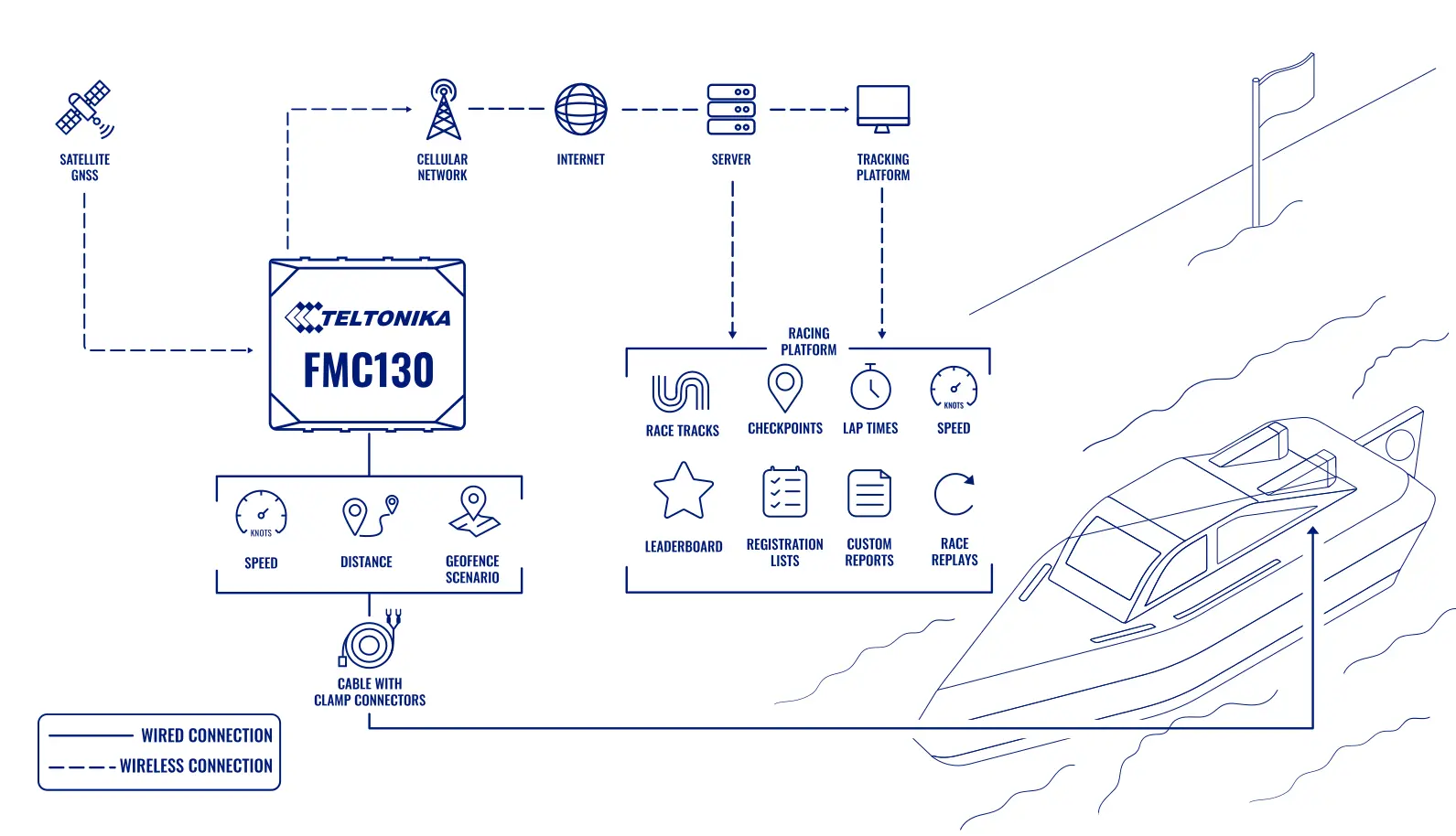
Each boat is given an FMC130 tracker that sends coordinates to a web application: the application works out for itself when checkpoints are passed, the lap time and the speed, and updates the leaderboard.
Installation and setup
Fitting the device and configuring it for the fleet scenario at hand.
Data transfer
The device collects data and sends it to the monitoring platform; how often depends on the model and its settings.
Analysis and control
The person in charge gets reports and alerts and looks into what stands out.
The FMC130 is a tracker from the ADVANCED range with 4G LTE Cat 1. A Teltonika customer, a developer in New Zealand, reworked the device's online interface for his own purpose and wrote a web application that turns a stream of coordinates into racing analytics.
Preparing for the season. Before the racing starts, each tracker is configured in advance and posted out to the registered teams around the country. The teams connect the device to the boat battery themselves, using a cable with crocodile clips. It can be done beforehand or right before the start. No technical knowledge is required.
The pre-start check. The web application holds the list of races, boats and trackers. Before each heat it automatically runs a series of checks: whether all the devices are online and whether they are sending valid data. If some boat does not respond, the official finds out before the start rather than halfway down the course.
During the race. The tracker fixes its position from GNSS satellites and sends it to the server. On the water, where there is no steady connection, the tracker carries on writing points to memory and sends them once the network appears. The officials see all the boats on one map and can run the race remotely, even from the office.
The virtual course is built from geofences. The checkpoints are zones on the map; as soon as a boat passes through them, the application records the time. From that it works out lap times, average speed and positions in the leaderboard, which updates in real time.
After the race the officials have everything: detailed results, checkpoints, lists of competitors, maps, reports and a replay of the heat, which can be scrolled through to check a disputed moment.
Safety. The system gives warning of collisions and accidents. The patrol boat knows at once where the boat is and what has happened, and can judge how serious the situation is before it even arrives. It can also see which boats are still on the water, and does not risk running into them in a narrow channel.
The choice of equipment was a deliberate one: the developer tested trackers from other manufacturers, but they turned out to be either too slow or too expensive for this purpose.
What the accuracy of time and position depends on. The tracker fixes its position from GNSS to within a few metres on open water, and less well under high banks and beneath bridges. The time at which a checkpoint is passed depends on the recording interval: if a boat crosses the zone faster than the tracker writes its next point, the mark shifts or is lost. So for the duration of the race the recording interval is shortened, and the checkpoint geofences are made generously wide.
Delay. A point is first written to the tracker's memory and then goes over the cellular network to the server. With a good connection the table updates within seconds; with a poor one, when the network returns. For spectators that is acceptable, for a finish decided by fractions of a second it is not: there you need separate official timing, and the tracker serves as a check and as data for review.
What carries over to a local project. The scheme itself — a tracker on every competitor, geofences instead of officials along the course, and a check on who has not yet finished — does not depend on the country. Network coverage on the particular course, where the tracker is mounted and the competition rules, though, all have to be checked in advance, preferably with a test run.
What you get
Results without timing by hand
Times at the checkpoints are recorded automatically, and the records no longer depend on an official with a stopwatch.
The leaderboard updates as the race goes on
Competitors and spectators see the positions in real time rather than after a count-up on the bank.
The whole course visible from one screen
The officials run the race from the map, including the stretches that cannot be seen from the bank.
Accidents are spotted sooner
A collision alert shows the boat's last point, and the patrol heads for it instead of sweeping the whole course, provided the tracker was online.
Fitting without a technician
The teams connect a pre-configured tracker to the battery themselves with clips, in a couple of minutes.
A replay of the heat for disputes
The recording of the race makes it possible to check how a boat passed the checkpoints and settle a disputed moment with facts.
Why this solution
The developer was choosing between several trackers, and what decided it was transmission speed, accuracy and price. On test, the competing devices worked more slowly or cost too much for the scale of a sporting season.
The FMC130 also proved convenient in that it is easy to configure in advance and send out to the teams in a box. No fitter visiting each boat: connect it to the battery and it is ready. For a project whose participants are scattered across the whole country, that is a decisive advantage.
Reliability matters too: one lost point on a timed section and the result is open to dispute. The tracker has to send data steadily for several hours on end amid spray and vibration.
This case shows well how a standard vehicle tracker becomes the foundation for an entirely different industry once you add software of your own.
How this works in Azerbaijan. A similar approach suits competitions on the water and off it. There is a rowing base on the reservoir at Mingachevir, sailing regattas are held on the Caspian at Baku, and around the country there are cycling marathons, rallies and races on mountain courses in the Guba, Gabala and Sheki districts. Everywhere the task is the same: to see the competitors along the course, record the checkpoints automatically and react quickly if someone leaves the route. The same trackers are useful for boat hire firms and small craft on the Caspian and the reservoirs, where it matters to know that everyone has come back to the jetty. Points to bear in mind: by the water and in the mountains the connection is unsteady, so we set the recording interval and the tracker buffer generously, and for boats we choose a sheltered mounting position. GPS.az supplies the FMC130 and sets up checkpoints as geofences, notifications on entry and exit, reports on checkpoints passed and tracks on the Wialon platform.
Related case studies
Related rollouts and equipment
Questions about the “A live leaderboard at boat races” scenario
Request a call
A specialist will call back and match a solution to your fleet and your task.