
Moving vaccines with temperature control
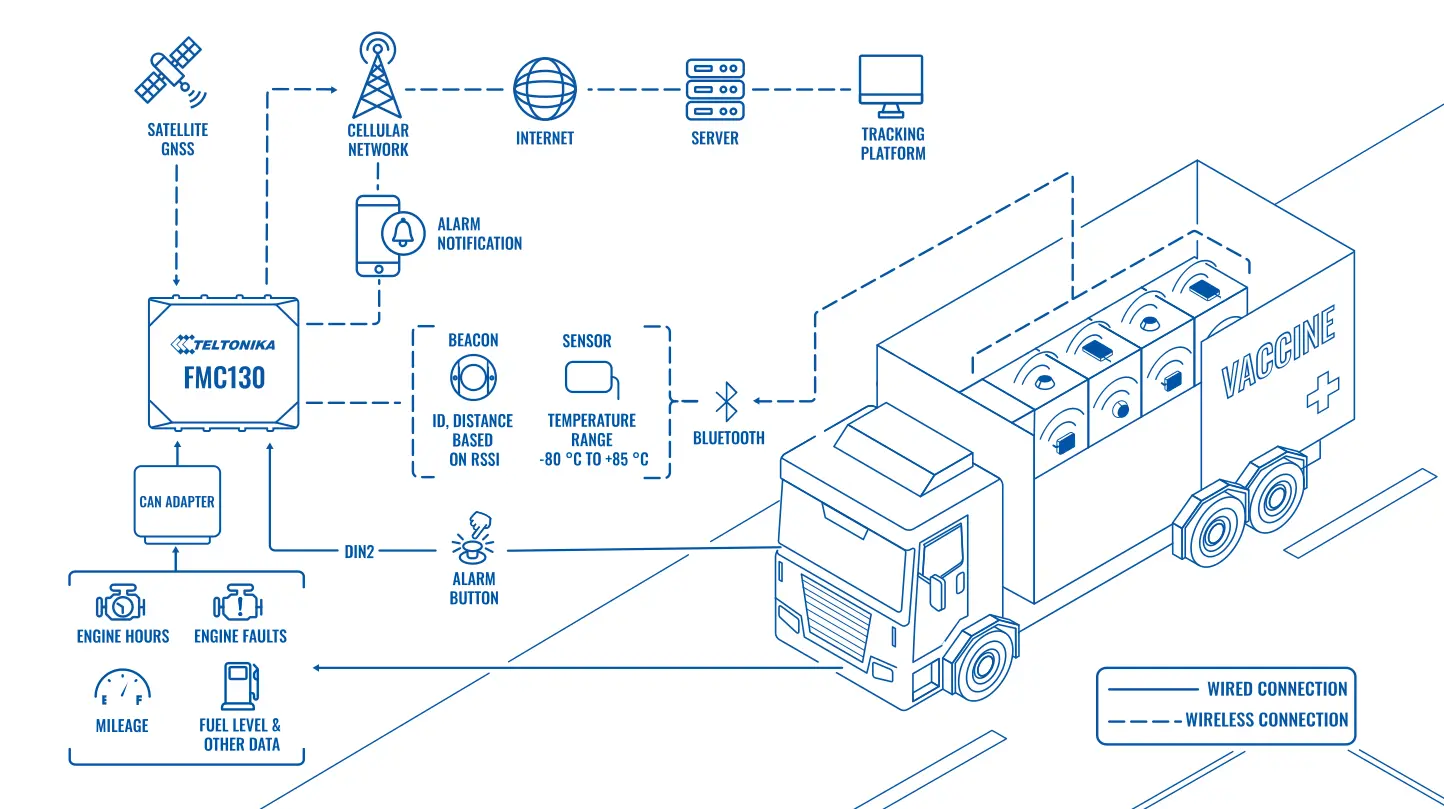
The Teltonika scenario for vaccine hauliers: an FMC130 tracker and Bluetooth sensors keep watch on the temperature in the load space and on the vehicle's position all the way from the warehouse to the vaccination point.
The Teltonika scenario for vaccine hauliers: an FMC130 tracker and Bluetooth sensors keep watch on the temperature in the load space and on the vehicle's position all the way from the warehouse to the vaccination point. A vaccine loses its potency without any sign of it. The vial looks the same as it did yesterday, but if it has spent two hours at +15 °C instead of +2…+8 °C there is no good in it any more. So for pharmaceutical logistics it is not enough to know where the vehicle is; you need to know what was happening to the load every minute of the run. The case study grew out of the COVID-19 pandemic, when millions of doses were being moved into every country at once, but the arrangement itself suits any temperature-sensitive product: routine vaccines, insulin, biological medicines, diagnostic reagents.
What this scenario solves
Vaccines are kept within a narrow temperature range, usually from +2 to +8 °C, and some require as low as -80 °C.
Going outside that corridor even briefly renders a dose unusable, and there is no seeing it with the eye.
WHO estimates that about half the vaccines distributed worldwide are thrown away, and a break in the cold chain is one of the main reasons.
During the pandemic volume and deadlines were added to that: hundreds of millions of doses had to be delivered almost simultaneously.
Vaccines are kept within a narrow temperature range, usually from +2 to +8 °C, and some require as low as -80 °C. Going outside that corridor even briefly renders a dose unusable, and there is no seeing it with the eye. WHO estimates that about half the vaccines distributed worldwide are thrown away, and a break in the cold chain is one of the main reasons. During the pandemic volume and deadlines were added to that: hundreds of millions of doses had to be delivered almost simultaneously.
Temperature is only part of the job. The logistics manager is answerable for the consignment reaching exactly the right point on exactly the right day. A refrigerated vehicle running half a day late wrecks the vaccination schedule at a district clinic, and people are already booked in.
Everything else travels with the doses: syringes, cool boxes, consumables. If any of that gets stuck, the vaccination point stands idle all the same.
Some recipients are in remote villages reached by poor roads, and local hauliers' vehicles are not always new. A breakdown en route with a load like this means the refrigeration unit may stop along with the engine.
There remains the risk of theft. A product in short supply during a pandemic becomes as tempting a load as electronics or cigarettes. Without end-to-end monitoring from the factory to the recipient, the haulier is the last to hear about a problem.
What Teltonika offers
Teltonika proposes building the monitoring around the FMC130 tracker, to which wireless temperature sensors connect over Bluetooth: the tracker gathers the readings from the load space itself and sends them to the server along with the coordinates, and the dispatcher receives an alert the moment the temperature goes outside its limits.
Installation and setup
Fitting the device and configuring it for the fleet scenario at hand.
Data transfer
The device collects data and sends it to the monitoring platform; how often depends on the model and its settings.
Analysis and control
The person in charge gets reports and alerts and looks into what stands out.
The FMC130 works on the 4G LTE Cat 1 network and can drop to 2G if there is no LTE in the area. For runs out into the countryside that matters: the connection does not disappear altogether but degrades, and the tracker carries on sending data over whatever channel there is. If there is no network at all, the points and readings build up in memory and go to the server once the vehicle is back in coverage.
The sensors go straight into the load space or into a thermal container. The tracker sees them over Bluetooth, with no wiring, through the cab bulkhead. The thresholds are set for the particular product: for ordinary vaccines that is a corridor of +2…+8 °C, while ultra-cold consignments need sensors with a remote probe that measure down to -80 °C. As soon as a value goes outside the corridor, an event reaches the system, and the responsible person sees it straight away rather than at unloading.
Sensors from various manufacturers will suit. If a sensor simply broadcasts its data over the air, it is connected through the configurator's advanced settings. Sensors that need a connection of their own are supported by Teltonika through a firmware modification.
Alongside that the tracker carries on ordinary monitoring of the run. The dispatcher sees the vehicle on the map, its speed and its stops, can rearrange the route if there is a jam ahead or a section is closed, and can warn the recipient of a change in the arrival time.
To protect the load the FMC130 works together with a CAN adapter: the tracker receives data from the vehicle's on-board network and can take part in an anti-theft arrangement. Towing detection and operation from the built-in battery help if somebody tries to take the vehicle away or cuts the tracker's power.
A panic button is fitted in the cab. The driver presses it in the event of an accident, an attack or a breakdown on an empty road, and the dispatcher immediately receives a signal with the coordinates. The FMx130 series has a negative input, so the button, door sensors and other accessories are connected more quickly, with no extra relays.
Geofences mark the dispatch warehouse, the intermediate points and the recipients' addresses. The vehicle entering a recipient's zone can be treated as confirmation of delivery, and leaving the warehouse without a plan as a reason to ring the driver.
Using mileage and engine hours the tracker gives reminders about scheduled servicing. For pharmaceutical work that is no formality: a vehicle that has come to a stop on the road takes the refrigeration unit with it.
The FMC130 reads CAN data and records speeding and long periods of idling. If a company already has Teltonika trackers with Bluetooth and only temperature monitoring is missing, the sensors are simply added to the existing fleet: the new configuration and firmware are sent remotely through FOTA WEB, with no need to bring the vehicle into the workshop.
What a typical run looks like. In the morning the vehicle collects a consignment at the distributor's warehouse, the driver closes the load space, and the tracker records it leaving the warehouse geofence. On the way the sensors transmit the temperature every few minutes, and on the dispatcher's map the current figure is shown next to the vehicle. At the second drop the driver has been held up: the door has been open twenty minutes already and the temperature by the door has risen to +9 °C. The system sends a notification, the dispatcher rings the driver, and he closes the load space. Fifteen minutes later the readings are back inside the corridor, and the report for the run carries a note of a brief deviation with the exact time and place. When the pharmacist on goods-in asks whether everything was in order, the haulier has an answer with a graph to go with it.
What is worth thinking through before the rollout. How many sensors the load space needs: in a large refrigerated body the temperature by the door and by the front wall can differ by several degrees. What thresholds to set: a warning is better given slightly before the critical limit, so that there is time to react. Who receives the alerts: at night somebody has to be watching the notifications, otherwise there is little point in them. And how often the tracker sends data: frequent transmission gives a detailed graph but uses more data allowance.
How to read the alert log. For every deviation the report shows the start and end time, the maximum value, the sensor and the vehicle's position. This is data about the air next to the sensor, while the decision on whether a consignment is fit for use is taken by the distributor's quality department on the vaccine manufacturer's data. Sensor accuracy is checked to a schedule set by their manufacturer and by your quality system, and third-party Bluetooth sensors are compared against a reference thermometer before the rollout.
What you get
The load space temperature watched the whole run
The sensors record readings from +8 °C down to -80 °C, and going outside the corridor comes through as an alert while the load can still be saved.
Delivery exactly on schedule
The dispatcher sees where every vehicle is and rearranges the route before a delay wrecks a vaccination day.
Protection against theft and help for the driver
A CAN adapter, the towing sensor and the panic button give a signal with coordinates in the first minutes.
Vehicles do not come to a stop en route
Servicing reminders based on mileage and engine hours reduce the risk of a breakdown that switches the refrigeration off.
Sensors added to trackers already fitted
The new configuration goes out through FOTA WEB, with no visit to the workshop.
A temperature record for the whole route
In a dispute with a recipient or an inspection the haulier shows a graph rather than words.
Why this solution
The scenario is built on standard production equipment rather than a special pharmaceutical kit. The FMC130 is a mass-market tracker with LTE Cat 1 and a fallback to 2G, Bluetooth temperature sensors come from various manufacturers, and they can be chosen for the range needed, including ultra-cold down to -80 °C. For a company that means the same fleet can be switched to other loads tomorrow without changing trackers.
The second advantage is remote maintenance. Temperature thresholds, transmission intervals and the list of sensors are changed in the configuration and sent to the tracker through FOTA WEB. When a haulier takes on a new product with a different temperature regime, there is no need to visit the vehicles.
The data goes to a monitoring platform, where run reports, temperature graphs and an alert log are assembled from it. A log like that is needed by more than the dispatcher: pharmaceutical companies and distributors ask for it when taking a haulier onto contract.
An honest limitation: the tracker records a breach but does not repair the refrigeration. If the refrigerated body has no reserve of cold and the nearest warehouse is three hours' drive away, the system will only report the problem sooner. So the alerts are worth setting with a little margin before the critical limit rather than exactly on it. And one more thing: the sensor measures the air next to itself rather than the contents of the vial, so where it is fitted decides a great deal.
For smaller hauliers the cost of entry matters. Wired temperature sensors in the load space mean running a cable through the cab and maintaining connectors that corrode with time. A wireless sensor is fixed in a few minutes, its battery lasts a long while, and when the vehicle is changed it is simply moved to another load space along with its entry in the tracker's configuration.
A frequent question: is a separate temperature logger needed if there is a tracker? A standalone logger records the data, but it is read after the run, once the load has been delivered. A tracker and a Bluetooth sensor together transmit the readings en route, and a deviation can be dealt with before unloading. Many distributors use both: the logger travels inside the box with the product as independent evidence, while the tracker gives a live picture of the whole load space and the whole fleet at once.
One more detail is the drivers themselves. Once they know that an open door and an engine switched off in a lay-by are visible to the dispatcher, the habit of airing out the load space or leaving the vehicle with the refrigeration off over lunch fades fairly quickly.
How this works in Azerbaijan. The cold chain is needed by distributors of medicines and vaccines who take products out from Baku to regional hospitals and clinics: to Ganja, Sheki, Lankaran, Guba, Mingachevir and Shirvan. The main difficulty here is the summer heat. At +40 °C on the M-2 or M-3 a poorly insulated body warms up in a matter of minutes, the moment the driver opens the door at a drop or switches the engine off over lunch. So we advise putting a sensor both in the far end of the load space and by the door, and connecting a door sensor to the tracker, so that you can see why the temperature jumped. The second point is coverage in the mountains. On the roads to Gusar, Guba and Sheki and in Karabakh there are stretches with no LTE, and there 2G and the tracker's memory come to the rescue: the readings are not lost but arrive in a batch once the vehicle is out of the shadow. We take multi-operator SIM cards, or Azercell, Bakcell or Nar depending on coverage along the route. As Teltonika's GOLD partner in Azerbaijan, GPS.az fits the FMC130, connects the Bluetooth temperature sensors and sets up on the Wialon platform the thresholds, the recipients' geofences, notifications in Telegram and a temperature report for the run that is convenient to hand to the customer.
Related case studies
Related rollouts and equipment

Questions about the “Moving vaccines with temperature control” scenario
Request a call
A specialist will call back and match a solution to your fleet and your task.