
Finding medical equipment in a hospital over a Mesh network
A Teltonika use case: a hospital locates beds, wheelchairs and infusion pumps by EYE Beacon Mesh tags that build a network between floors and buildings on their own.
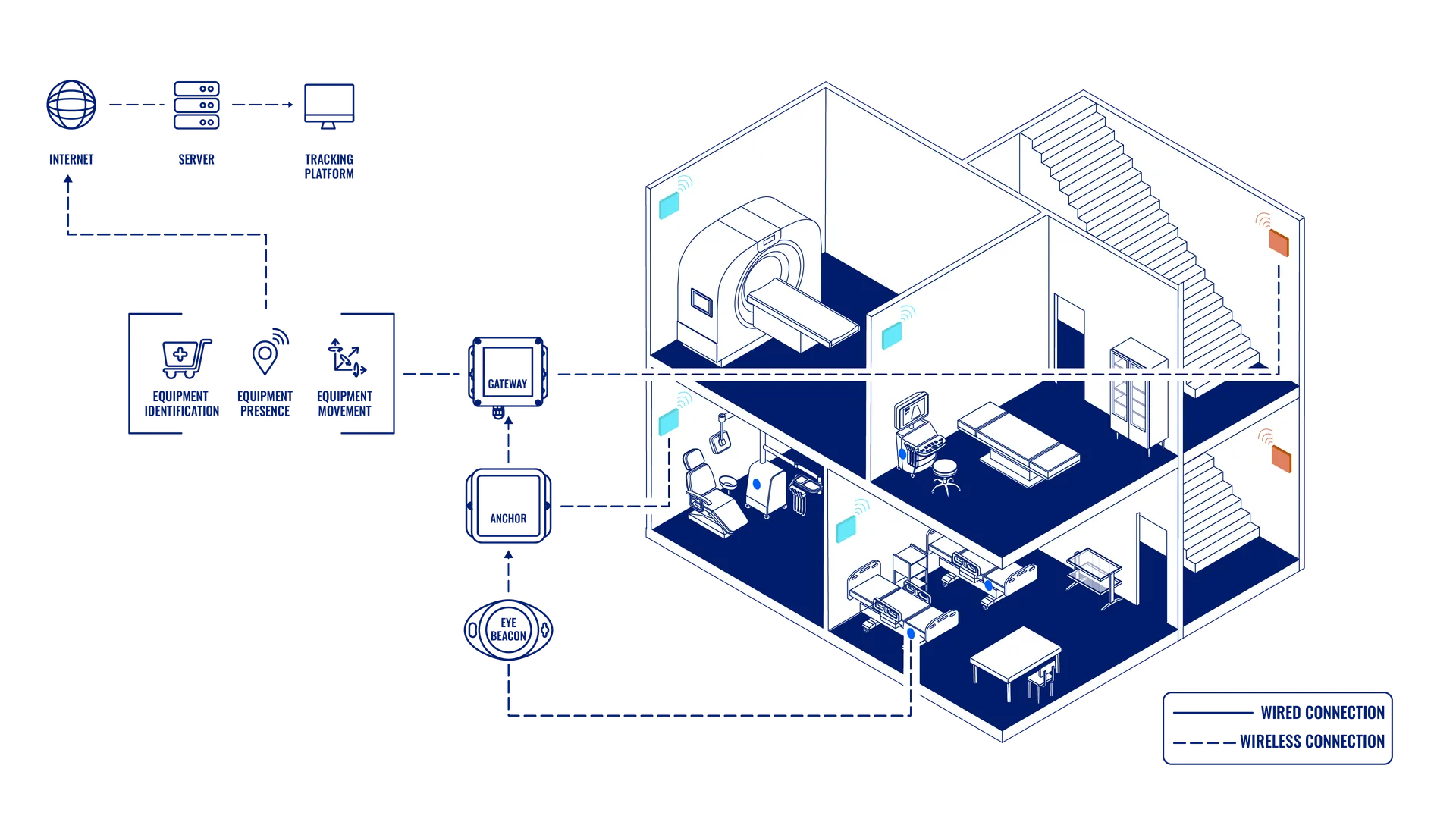
A Teltonika use case: a hospital locates beds, wheelchairs and infusion pumps by EYE Beacon Mesh tags that build a network between floors and buildings on their own. In a large clinic, equipment is on the move all the time. A bed has been wheeled off for a CT scan, a pump has been taken to intensive care, a wheelchair has been left by the lift in the building next door. On paper all of it still belongs to a department; in practice a nurse walks the corridors looking for it. In the Teltonika scenario, a small tag goes onto every mobile asset, reference points are fitted in wards and consulting rooms, and gateways on each floor. All three types of device form a single Mesh network, and staff see on screen where the instrument they need is and which of the free ones is closest.
What this scenario solves
Nurses spend a noticeable part of their shift searching for equipment.
According to the figures Teltonika cites, more than a third of nurses spend at least an hour per shift looking for devices.
Because things go missing, hospitals buy 10–20% more equipment than they actually need.
The classic tag-plus-gateway arrangement scales poorly across several buildings and floors.
Nurses spend a noticeable part of their shift searching for equipment. According to the figures Teltonika cites, more than a third of nurses spend at least an hour per shift looking for devices. Because things go missing, hospitals buy 10–20% more equipment than they actually need. The classic tag-plus-gateway arrangement scales poorly across several buildings and floors.
The consequences are easy to see. While the pump is being hunted down, the patient waits. While one department keeps three spare wheelchairs of its own, another has none. The facilities manager sees one quantity in the records and finds a different one on the round, and the gap is closed with a new purchase, because that is easier than getting to the bottom of it.
Why ordinary BLE systems fall short. In a simple setup, each beacon broadcasts a signal, the nearest gateway picks it up and forwards it to the server. For a warehouse or a small office that is enough. In a hospital with a basement, connecting corridors, lift lobbies and thick walls, a great many gateways are needed, each with power and a network drop run to it. The data path is rigid: if a gateway is switched off or ends up hidden behind a cabinet, that area drops out of sight until somebody comes and fixes it.
The more assets and buildings there are, the more expensive this infrastructure becomes and the more places it contains where something can fail unnoticed. And it is the same small technical department of the hospital that has to maintain it.
What Teltonika offers
Teltonika suggests building the tracking on EYE Beacon Mesh: tags, reference points and gateways work in one self-organising network, and the data finds its own way round if some device drops out.
Installation and setup
Fitting the device and configuring it for the fleet scenario at hand.
Data transfer
The device collects data and sends it to the monitoring platform; how often depends on the model and its settings.
Analysis and control
The person in charge gets reports and alerts and looks into what stands out.
What the system consists of. Three types of Mesh device.
• EYE Beacon Mesh tags. They go onto everything that rolls or gets carried: ventilators, infusion pumps, beds, trolleys, wheelchairs, monitors. Each tag has its own identifier, linked in the asset register to a specific inventory item. So what appears on screen is not “beacon no. 4471” but “pump, asset number such-and-such, assigned to surgery”.
• Reference points (anchors). Fixed devices, one per ward, consulting room, store or stretch of corridor. A tag communicates with the nearest anchors, and from that the system works out which room the instrument is in. Anchors pass data through one another, so one of them failing does not break the chain.
• Gateways. One or two per floor is usually enough. They are part of the Mesh network too: they collect data from the anchors and send it to the server.
How staff see it. In the software or on a mobile interface, a nurse enters the type of equipment and gets a list: where each unit is and which free one is closest. The senior nurse of a department sees what is in place at the moment and what has been taken elsewhere.
Assignment to zones. A tag can be tied to the anchors of a particular ward or department. If an instrument leaves its zone outside the agreed process — not against a transfer request, for instance — the responsible person receives a notification. That catches both the departments that like to keep a stock of their own and genuine disappearances.
An example from practice. One night the medical ward needed a second infusion pump. Instead of walking three floors, the nurse opens the app and sees a free pump in the treatment room of the neighbouring wing, forty metres away. In the morning the facilities manager looks at the report and notices that two pumps from the medical ward have been standing in the admissions department for a week — they are brought back without a new purchase.
What data is collected. For each instrument the system keeps a history: which rooms it has been in, how long it spent in each zone, when it last moved. Out of that come reports nobody can usually put together by hand: how many pumps are genuinely in use over a day, which beds have been sitting in the store for months, in which department instruments go astray most often. Nurses have almost no use for them, but for the service that plans purchasing and equipment maintenance they give figures instead of impressions.
How a rollout goes. First, the floor plans are used to decide where anchors are needed and how many gateways will cover a floor. Then tags are linked to inventory numbers, anchors to rooms, and zones and notification rules are configured. Practice shows it is easiest to start with a single building and the expensive equipment, and then extend the network once staff have got used to searching instead of walking the corridors.
The network is built on the Wirepas Mesh protocol. The devices choose the transmission route themselves, so adding a new building or floor only takes placing anchors and mounting a gateway, with no rebuilding of the whole system.
A survey before the project. Before any anchors are bought, the floor is walked with test devices: thick walls, lift shafts, metal cabinets and shielded X-ray rooms change the radio environment more than the plan suggests. The results show how many anchors a room needs and where one will do for a stretch of corridor. How the anchors and gateways are powered, and what link the gateway uses to reach the server, are agreed with the clinic’s technical and IT departments at the same stage.
Acceptance criterion. An instrument placed in a known ward shows up in that ward or its zone several times in a row, and when it is moved to the next room the system reflects the change of zone. For every tag the time of the last detection is visible: if no anchor has heard a tag for a long time, the screen keeps the last known place with a timestamp, and that is a reason to check the instrument and the tag’s battery.
What you get
Grows together with the hospital
The network is designed for dense scenarios with thousands of tags across several floors and several buildings, and a new building is brought in by placing anchors rather than by a project from scratch.
Less cabling and fitting
Tags and anchors are wireless and few gateways are needed, so there is no need to run network and power into every ward or to close departments while the work is done.
No areas that quietly drop out
If an anchor is switched off or its battery dies, the data travels through neighbouring devices, and an instrument does not vanish from the map until an engineer arrives.
Order in how equipment is distributed
Zone assignment and movement notifications show which department is holding spares and where there is not enough equipment.
Fewer unnecessary purchases
When the real number and location of every instrument is visible at any moment, a decision to buy is based on actual utilisation rather than on a just-in-case basis.
Why this solution
Teltonika has a Mesh version of the EYE beacons, designed from the start for premises with a large number of devices and a complicated layout. A network on Wirepas Mesh lays out its own routes and recovers after failures, so it can be relied on in a building where something is constantly being moved or refurbished.
One practical point matters a great deal: the tags are small and go onto the equipment without any modification to the instrument itself. For medical devices that is significant — nobody will allow a hole to be drilled in the casing of a ventilator for the sake of a beacon.
The limits are worth stating honestly too. Accuracy here is zonal: the system shows a room or a stretch of corridor, not centimetres. For finding an instrument that is enough; for tracking movement inside one large ward it is not. Anchors have to be placed according to the building plan, and the first weeks go on calibrating zones and linking tags to inventory numbers.
How this works in Azerbaijan. The scenario suits large multi-speciality clinics and hospital complexes in Baku, republican and regional hospitals in Ganja, Sumgait, Mingachevir and Lankaran, and also the new medical facilities being built in Karabakh, where the infrastructure is easier to design in from the start. Besides hospitals, the same arrangement works for the warehouses of medical distributors in Absheron. When rolling it out, it is worth starting with one or two departments holding the most expensive and most nomadic equipment, agreeing with the administration who receives the notifications, and reconciling the inventory database in advance, otherwise tags will be linked to the wrong numbers. GPS.az, as a Teltonika GOLD partner in Azerbaijan, selects the kit, runs a pilot and sets up the display and the reports; if the clinic has its own vehicles — ambulances, medical transport — we fit and configure their tracking on the Wialon platform, so that the facilities service has a single contractor for both the premises and the vehicles.
Equipment used
Related case studies
Related rollouts and equipment


Questions about the “Finding medical equipment in a hospital over a Mesh network” scenario
Request a call
A specialist will call back and match a solution to your fleet and your task.