
Finding pallets in the warehouse with EYE Mesh tags
A Teltonika scenario for large warehouses: EYE Beacon Mesh and EYE Sensor Mesh tags on pallets, cartons and tools show which aisle and which rack the item you want is on, and the Wirepas Mesh network carries that data without a dense grid of gateways.
A Teltonika scenario for large warehouses: EYE Beacon Mesh and EYE Sensor Mesh tags on pallets, cartons and tools show which aisle and which rack the item you want is on, and the Wirepas Mesh network carries that data without a dense grid of gateways. In a warehouse with thousands of storage locations a lost pallet is not a theft, it is half an hour of searching. The storekeeper remembers putting it somewhere in the third row, and by now it has been moved again. Over the course of a day goods are received, carried, replenished and picked dozens of times, and a paper log cannot keep up. The tags record every movement by themselves.
What this scenario solves
Paper logs, periodic stocktakes and scattered spreadsheets do not give an accurate picture of a warehouse.
Data is updated late, goods are put in the wrong place, orders are picked more slowly.
Poor visibility leaves the warehouse short of some lines and overstocked on others at the same time.
Money is frozen in inventory that nobody can find quickly.
Paper logs, periodic stocktakes and scattered spreadsheets do not give an accurate picture of a warehouse. Data is updated late, goods are put in the wrong place, orders are picked more slowly. Poor visibility leaves the warehouse short of some lines and overstocked on others at the same time. Money is frozen in inventory that nobody can find quickly.
The second trouble is space. When storage zones are laid out badly and rack height and aisle width are poorly allocated, storekeepers and forklifts cover hundreds of extra metres. Putaway and picking take longer, and so does finding tools and equipment.
Many indoor tracking systems are designed for small sites. A tag on the item plus a gateway listening for it works well in a single workshop. In a large warehouse so many gateways are needed that the cost of fitting, power and networking quickly becomes prohibitive.
There is also the problem of blind spots. Tall racking, dense storage and steelwork attenuate the signal. In a conventional system data travels along fixed paths, and if a path is blocked the item simply disappears from view until somebody notices the fault.
What Teltonika offers
Teltonika solves this with EYE Beacon Mesh and EYE Sensor Mesh tags built on Wirepas Mesh technology: the tags, anchors and gateways form a self-organising network in which data is passed from device to device along a chain, so few gateways are needed and the network routes around blind spots by itself.
Installation and setup
Fitting the device and configuring it for the fleet scenario at hand.
Data transfer
The device collects data and sends it to the monitoring platform; how often depends on the model and its settings.
Analysis and control
The person in charge gets reports and alerts and looks into what stands out.
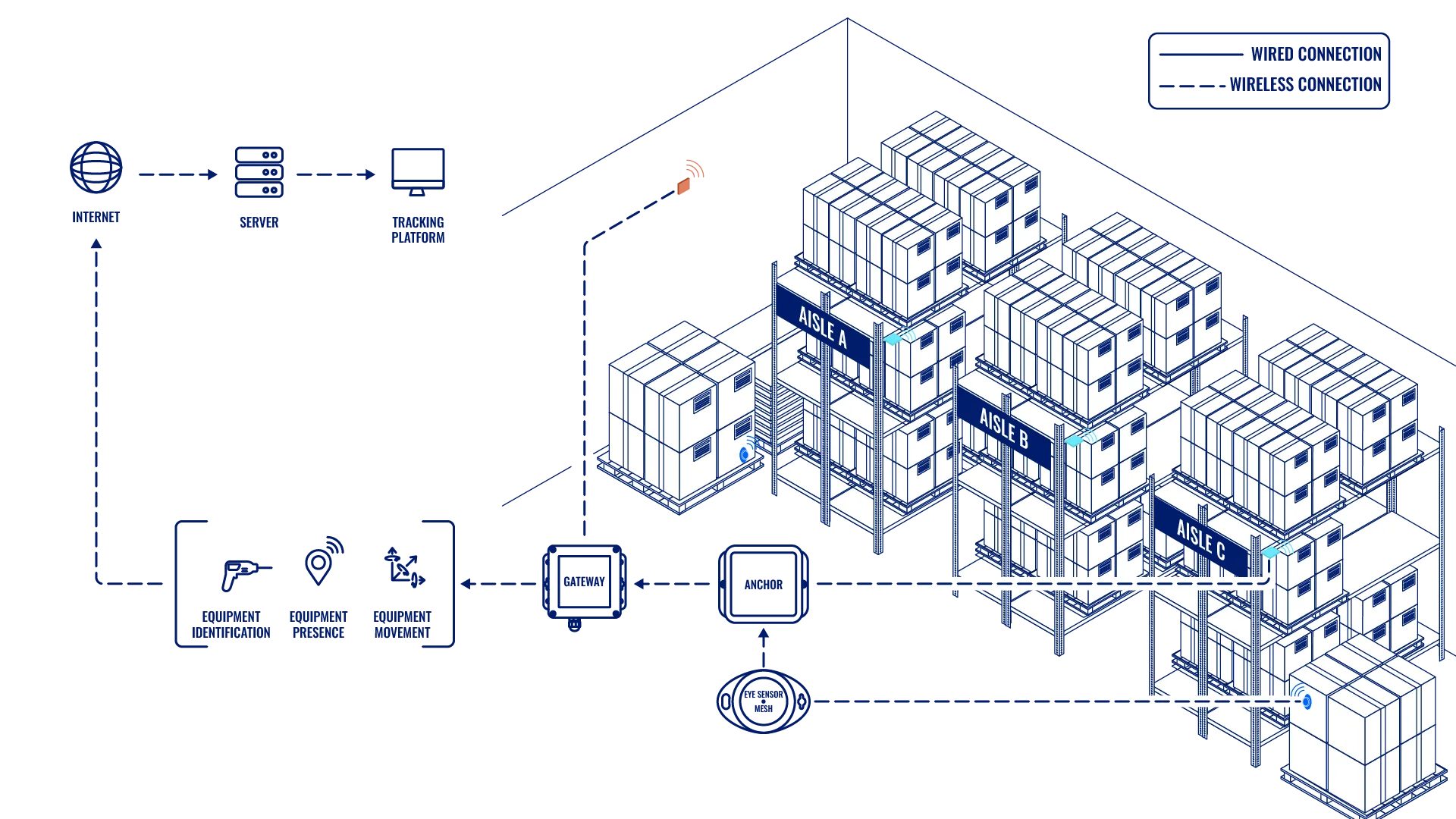
There are three types of device in the system. Tags go on whatever moves: pallets, cartons, trolleys, tools. Anchors are fixed at known points around the warehouse. Gateways gather the data from the whole network and send it to a server, where it is shown on a floor plan and analysed. A tag hears the nearest anchors, and the anchors pass the information to one another until it reaches a gateway, even one at the far end of the building. If an anchor drops out, the network rebuilds the route through its neighbours.
Teltonika describes two levels of precision, and they can be combined in one warehouse.
The first level: which aisle the item is in. It suits whatever moves around the warehouse constantly — tools, trolleys, pallets in the picking area. Anchors are placed at the entrance to a row, at the end of an aisle, on side walls or on columns, and each anchor covers its own zone. There are few gateways, mounted on the ceiling or walls wherever is convenient. EYE Sensor Mesh tags with a built-in accelerometer are stuck to the items. A tag works out for itself whether it is moving or at rest: on the move it goes on air more often so the system sees the new aisle quickly, and at rest less often to save the battery. When a pallet has been moved to another row, its position is updated from the strongest signal among the nearest anchors. This arrangement needs comparatively few anchors, which makes it good for busy zones.
The second level: which rack the item is on. This is for goods held for a long time that have to be found precisely — cartons of expensive lines, spare parts, valuable materials. Such items get an EYE Beacon Mesh, which broadcasts its own identifier tied to a specific unit. Anchors are mounted on the racking itself, on the uprights or on individual bays. If the level matters too, anchors are placed at different heights on the rack. Each anchor is tied to its own rack or part of one, and the system shows not just the third aisle but rack 3-14, top level. The number of gateways does not grow: only anchors are added for precision.
How it looks in practice. A picker needs a carton with a particular part number. Instead of walking to the location the WMS gives and finding an empty space, he checks the system: the carton was moved yesterday to the next rack along, two bays to the left. The search takes a minute and the order goes out on time. In the morning the shift supervisor sees that two of the five hand pallet trucks have been sitting in the far corner of the returns area for days while goods-in is complaining of a shortage — and redistributes them.
The system can be built in stages. First one zone or one type of item is equipped — tools and trolleys, say — and the behaviour of the network is checked. Then a racking area with tags for valuable goods is added. A mesh network needs no rework when it grows: new anchors simply become part of it.
A survey before the project. Before buying anchors for the whole warehouse, a pilot is run in one zone: anchors are placed to plan, someone walks the aisles and the spaces between racks with tags, and it is seen where a tag is located confidently and where it jumps between neighbouring anchors. The findings refine the anchor spacing, the gateway positions and the tag transmission intervals. For every tag the system shows the zone, the anchor and the time it was last seen, and tags not seen for a long while go into a separate list for checking.
What you get
Accurate records without manual stocktakes
Tags on the items show where everything is at all times, and discrepancies with the inventory system show up immediately.
Two levels of precision in one network
Aisles for busy zones and racks for long-term storage work side by side.
Tools and trolleys where they are needed
The movements show what is standing idle and what is in short supply, and equipment is redistributed.
Fewer needless purchases and less labour
Things are found rather than bought again, and hours are not spent searching.
Growth zone by zone
The system is started in one area and extended across the warehouse without heavy infrastructure.
The network routes around failures by itself
If an anchor is unreachable the data travels through its neighbours and items do not drop out of sight.
Why this solution
Wirepas Mesh removes the main limitation of ordinary indoor Bluetooth systems: dependence on the number of gateways. In a mesh network every anchor acts as a repeater, so a large warehouse is covered by a handful of gateways while precision is built up with inexpensive anchors. EYE Mesh tags are part of the same EYE range Teltonika has long produced for telematics, and they slot into existing mesh infrastructure without a platform of their own.
Honestly about the limits. The system shows which zone, aisle or rack a tag is at; this is not centimetre-level navigation. Precision is set by how closely the anchors are spaced, and it has to be planned for the job before rollout rather than promised as a dot on a map. The tags run on batteries, and frequent transmissions while moving shorten their life — worth bearing in mind for items that move all day. And finally, a tag has to be physically attached to the item: for goods that arrive and leave within a day it pays to tag the returnable packaging or the pallet rather than every carton.
The system does not replace the warehouse management software. It tells you where an item physically is, while the WMS knows where it should be. The greatest benefit comes when the two are reconciled. Stocktaking then turns from an all-hands overnight count into a daily discrepancy report that one person works through.
How this works in Azerbaijan. This kind of problem comes up at the large distribution warehouses around Baku and Absheron, in the logistics centres by the port of Alat and inside the Alat Free Economic Zone, at distributors of food, household appliances and building materials, and in the spare parts stores of oilfield service companies, where an expensive line can sit in the wrong place for weeks. What we allow for: in summer it can get very hot inside unheated warehouses, so positions for anchors and tags are chosen well away from the roof deck and the roof lights; metal racking affects the signal strongly, and the anchor plan is better checked on a pilot area. It makes sense to roll out in stages, starting with one zone. As a Teltonika GOLD partner in Azerbaijan, GPS.az helps plan the network of anchors and gateways, runs the pilot and links the warehouse picture with monitoring of forklifts and delivery vehicles on the Wialon platform, so that the path of goods from rack to customer is visible.
Related case studies
Related rollouts and equipment

Questions about the “Finding pallets in the warehouse with EYE Mesh tags” scenario
Request a call
A specialist will call back and match a solution to your fleet and your task.