
FMS Eco Driving: a driving style report for articulated lorries
The FMS Eco Driving feature in Teltonika FMx6 series trackers reads a lorry's FMS data and, after every run, sends a report on how the driver used the vehicle.
The FMS Eco Driving feature in Teltonika FMx6 series trackers reads a lorry's FMS data and, after every run, sends a report on how the driver used the vehicle. Two drivers on identical tractor units covering the same route can burn noticeably different amounts of diesel. One keeps the cruise control on, brakes with the engine and coasts before a descent. The other accelerates, hits the brake pedal before every bend and then accelerates again. The difference shows up in the fuel receipts, but not in the route report. FMS Eco Driving shows exactly that difference. Using the FMC650 tracker as an example, we will go through how the reports are built and what can be drawn from them.
What this scenario solves
Fuel is one of the largest cost items in a lorry fleet.
An ordinary GPS track shows where the vehicle went, but not how it was driven.
The manager sees the overspend but cannot tell which driver is creating it, or how.
Streaming all FMS data in real time is expensive in traffic and hard to sift through by hand.
Fuel is one of the largest cost items in a lorry fleet. An ordinary GPS track shows where the vehicle went, but not how it was driven. The manager sees the overspend but cannot tell which driver is creating it, or how. Streaming all FMS data in real time is expensive in traffic and hard to sift through by hand.
The saving potential is real, though. In a large eco-driving experiment with the Madrid public transport company, fuel consumption fell by 15%. For a fleet of several dozen articulated lorries, even a few per cent means thousands of litres a year.
There are knock-on losses as well. A driver who brakes with the pedal instead of the engine wears out pads and discs faster. Unnecessary acceleration increases CO2 emissions and the load on the transmission. A harsh driving style raises the risk of an accident, particularly on a heavy vehicle with a semi-trailer.
What Teltonika offers
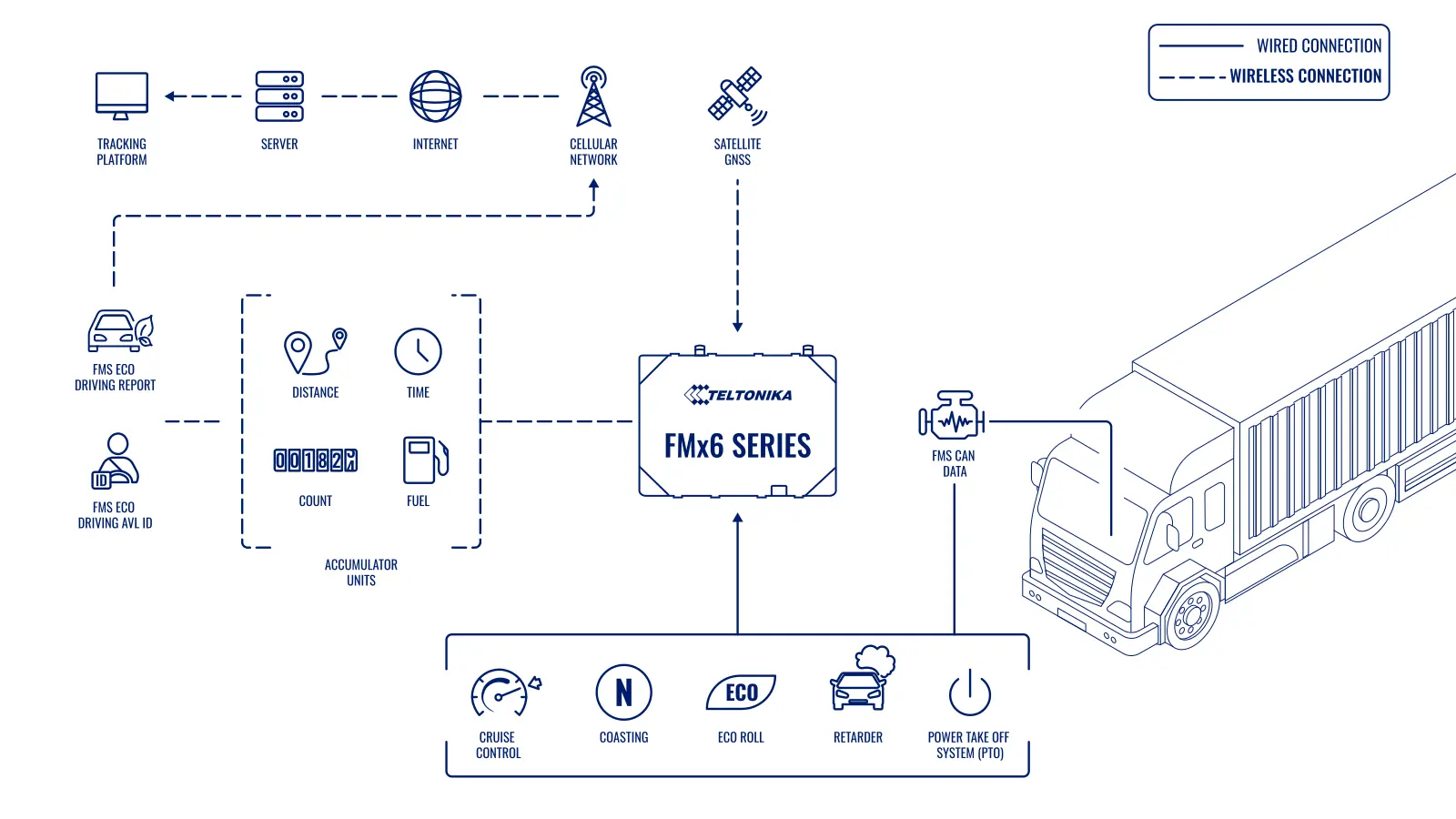
The tracker accumulates FMS data over the course of the trip and sends the server one compressed report showing how much of the distance the driver covered on cruise control, coasting, on the engine brake and on the brake pedal.
Installation and setup
Fitting the device and configuring it for the fleet scenario at hand.
Data transfer
The device collects data and sends it to the monitoring platform; how often depends on the model and its settings.
Analysis and control
The person in charge gets reports and alerts and looks into what stands out.
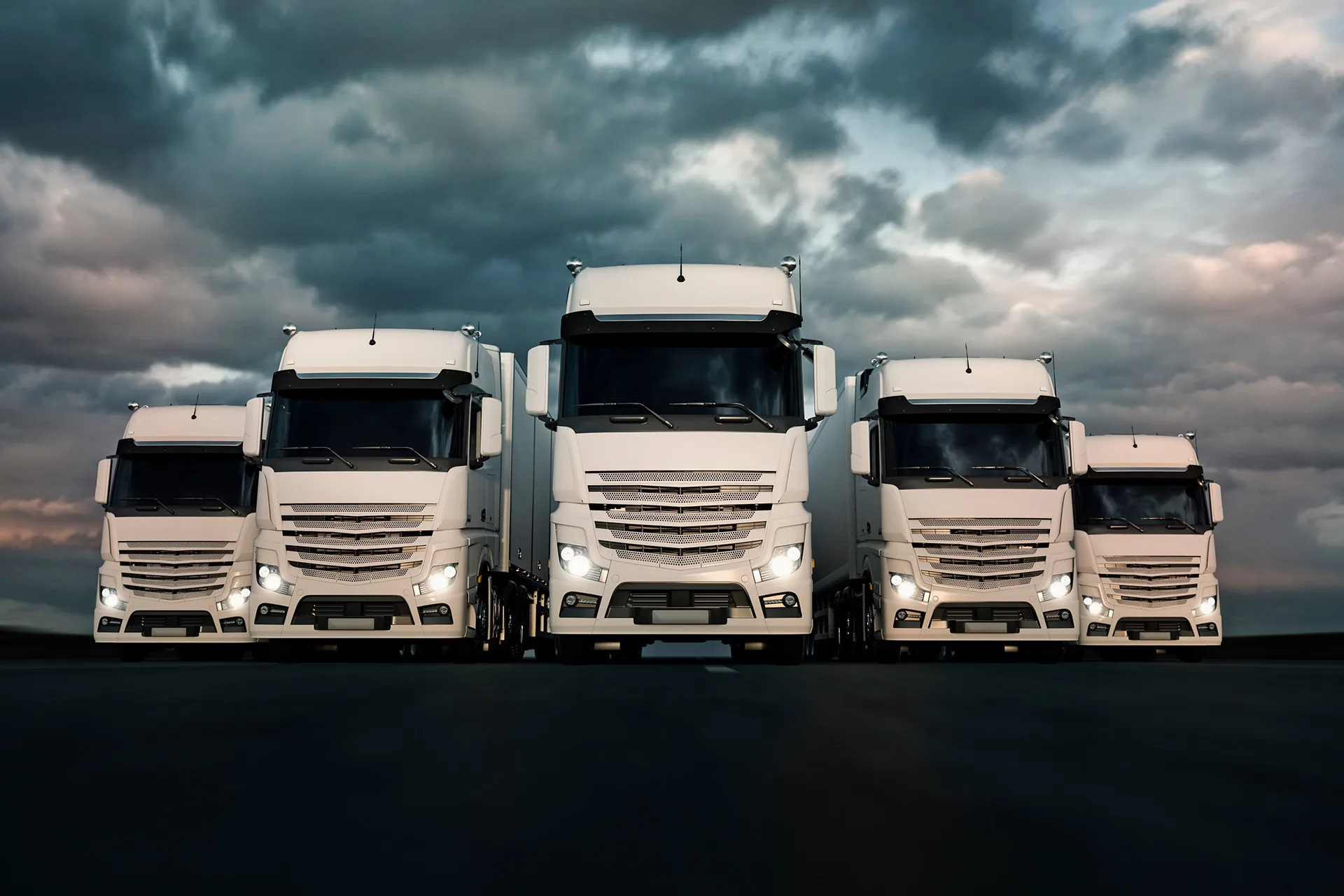
Which devices support it. The feature is available in the Teltonika FMx6 professional range, which includes the FMC650. The tracker connects to the lorry's FMS bus — a standardised CAN interface fitted to most modern European tractor units and buses.
When the report is generated. Some events are hard-coded: engine startup, power down, a change of driver ID, end of day. Your own triggers can be added to those: trip start, trip end and periodic sending, once an hour for example. The tracker does not push a data stream for the whole run but delivers summary figures, so traffic and server storage are noticeably lower.
What gets counted. For each element you choose the accumulators: distance travelled, fuel consumed, time spent in a given state and the number of occurrences. The elements are cruise control, movement, coasting, ECO Roll, engine braking, power take-off (PTO) operation and brake pedal presses. The accumulators you need are enabled in the configurator, and each has its own AVL ID, so the platform knows exactly what has arrived.
How to read the report. Say that over one run the braking counter showed 10 presses and the vehicle covered 2 km with the brake pedal down. That means the driver was killing speed with the pads where the engine brake or the retarder would have done the job. The pads wear faster, and then the tractor unit accelerates again and burns extra fuel. Comparing that report with the reports of other drivers on the same route, the manager knows who to talk to and what to teach.
What a bad style looks like in figures. Few kilometres on cruise control out on the motorway, almost no coasting or engine braking, many kilometres on the brake pedal, high revs. A driver like that is not reading the road ahead and is not using the vehicle's momentum.
Range accumulators. FMS Eco Driving can break distance, time and fuel down by value ranges, up to 10 configurable ranges per element. For speed, for instance: how many metres the vehicle covered at 0–10 km/h, at 11–20, at 21–30 and so on. Or just three ranges — up to 50, up to 70 and up to 90 km/h — to separate city driving from rural roads and the motorway. Engine revs are broken down the same way.
Why this is worth having. If most of the run was spent at low speed and high revs, there are two possibilities. Either the driver was in the wrong gear, and then it is a training matter. Or the vehicle was stuck in traffic, and then it is a reason to review the route or the departure time. The report does not hand down a verdict, but it points to where to look.
What the fleet manager sees. A card for each run with the summary figures, a comparison between drivers, and the trend week by week. If the driver is identified by card or key, the report is tied to the driver and not only to the vehicle.
An example from a working fleet. Two tractor units of the same model carrying the same load cover the same route. Over the week, the first driver spent 60% of the motorway distance on cruise control, took a noticeable share of the descents on the engine brake and used less than a kilometre of brake pedal per run. The second barely switches cruise control on, does not coast at all, and racks up several kilometres on the brake pedal. His consumption is higher, and now it is clear why. The conversation with the driver rests on figures rather than suspicions, and a couple of weeks later the same reports show whether anything has changed.
Where to start. Begin with a small set of accumulators: cruise control, coasting, engine braking, the brake pedal and speed ranges. Spend a month collecting data without drawing conclusions, to establish what is normal for your own routes. Then set benchmarks and start going through the figures with drivers. Switch everything on at once and the report turns into a table nobody reads.
What to bear in mind. FMS does not deliver every parameter on every vehicle: the set depends on the manufacturer, the model and the tractor unit's software version. The feature does not replace fuel monitoring in the tank and does not catch fuel drains — a fuel level sensor is fitted for that.
Checking against the vehicle. Before the reports are switched on, check which FMS counters each tractor model actually delivers: cruise control, coasting, engine braking, brake pedal. If an element does not come through, drop it from the report for that model so that zeros do not look like poor driving.
An example of a finished run card. Driver, vehicle, start and end times, kilometres and fuel, the share of the distance on cruise control, coasting and engine braking, the number of brake presses and the kilometres on the brake, and the breakdown by speed and rev ranges. The figures for a particular fleet appear after the first month of data collection.
What you get
Fuel savings
You can see which drivers are spending extra and which habits cause it, so training becomes targeted rather than a general briefing for everyone.
Less traffic and less data
Instead of a continuous FMS stream, the server receives summary reports on events or on a schedule.
Brakes and transmission last longer
Drivers who use engine braking and coasting more often send the vehicle in for new pads less often.
A fair comparison between drivers
Reports on identical routes show driving style without the subjective judgement of a mechanic or a dispatcher.
Lower emissions
Cutting unnecessary acceleration and idling reduces both consumption and CO2 output.
Calmer on the road
Smooth driving without harsh braking lowers the accident risk for a heavy road train.
Why this solution
The FMx6 range, the FMC650 included, is designed for lorries and buses: several CAN interfaces, FMS and tachograph support, plenty of inputs and outputs for sensors. FMS Eco Driving is built into the firmware, so no separate module or third-party analyser is needed.
The reporting logic is the feature's strong point. The tracker aggregates the data itself, so it can be sent less often and more cheaply, and the server does not have to work through millions of records to answer the simple question of who drove economically.
Configuration is done through the configurator and remotely over FOTA WEB. When the fleet changes its approach to assessing drivers, ranges and triggers are updated on every vehicle at once.
How this works in Azerbaijan. The scenario fits international hauliers running articulated lorries along the Middle Corridor through the port of Alat and on the M-2 towards Georgia, hauliers on the M-3 towards Astara and Iran, and intercity coach operators. Most European-brand tractor units working in Azerbaijan support FMS, but on older vehicles and some Chinese and Russian models the FMS data set may be incomplete, and that is worth checking before deployment. The mountain sections on the M-4 through Shamakhi and the passes in the Guba and Gusar region are a good test of whether a driver can brake with the engine on descents. GPS.az fits FMC650 trackers, connects them to the FMS bus and sets up driving style reports in the Wialon platform so that they can be compared across drivers and routes.
Related case studies
Related rollouts and equipment
Keeping track of trailers with EYE Bluetooth beacons
Logistics and delivery
Cold chain: temperature recorder plus FMC650 tracker
Logistics and delivery
A lorry's warning lights in the control room
Logistics and delivery
Questions about the “FMS Eco Driving: a driving style report for articulated lorries” scenario
Request a call
A specialist will call back and match a solution to your fleet and your task.