
A lorry's warning lights in the control room
The FMC650 tracker reads the dashboard warning lights (FMS Tell Tale) from a lorry's FMS interface and sends them to the server, so that the mechanic sees the problem before the vehicle comes to a stop out on the road.
The FMC650 tracker reads the dashboard warning lights (FMS Tell Tale) from a lorry's FMS interface and sends them to the server, so that the mechanic sees the problem before the vehicle comes to a stop out on the road. The dashboard of a modern tractor unit carries dozens of indicators: oil pressure, brakes, fluid levels, seat belts, lights. The driver sees them every day and often stops noticing them. The dispatcher and the mechanic back at the office do not see them at all. In this use case Teltonika brings what is lit up on the dashboard into the monitoring system. The decision to repair is then taken by the person answerable for the budget and the schedule, not by a driver in a hurry to deliver the load.
What this scenario solves
The driver is in a hurry to deliver the load and puts off small repairs until later.
Nobody at the office sees the oil pressure or fluid level light burning away.
Over a few runs a minor fault turns into an expensive repair and a vehicle off the road.
The fleet manager has no idea whether drivers belt up or switch their lights on.
The driver is in a hurry to deliver the load and puts off small repairs until later. Nobody at the office sees the oil pressure or fluid level light burning away. Over a few runs a minor fault turns into an expensive repair and a vehicle off the road. The fleet manager has no idea whether drivers belt up or switch their lights on.
Parts and workshop labour are getting dearer, and maintenance and repair remain one of the largest cost lines for a logistics company, alongside fuel. Every warning missed on the dashboard comes back later as an invoice from the workshop.
A typical example: an oil change is left too long, the engine starts to overheat, components wear faster, and instead of scheduled servicing the fleet gets an engine rebuild and a week with the tractor unit standing idle. The warning had been lit on the dashboard long before the breakdown — it was just that only one driver knew about it.
The second problem is about discipline. A company needs to understand how its drivers treat the vehicles: whether they report faults, whether they react to a check engine signal or simply drive on. Without objective data the conversation with a driver comes down to one person's word against another's, and company policy has nothing to rest on.
The third is about safety. An unfastened seat belt, lights that do not work, faulty brakes — these put the driver's life at risk and the company's reputation too, if the lorry is involved in an accident.
What Teltonika offers
The FMC650 tracker is connected to the lorry's FMS interface, and every dashboard warning light the driver sees reaches the server in real time, where the dispatcher and the mechanic can see it.
Installation and setup
Fitting the device and configuring it for the fleet scenario at hand.
Data transfer
The device collects data and sends it to the monitoring platform; how often depends on the model and its settings.
Analysis and control
The person in charge gets reports and alerts and looks into what stands out.
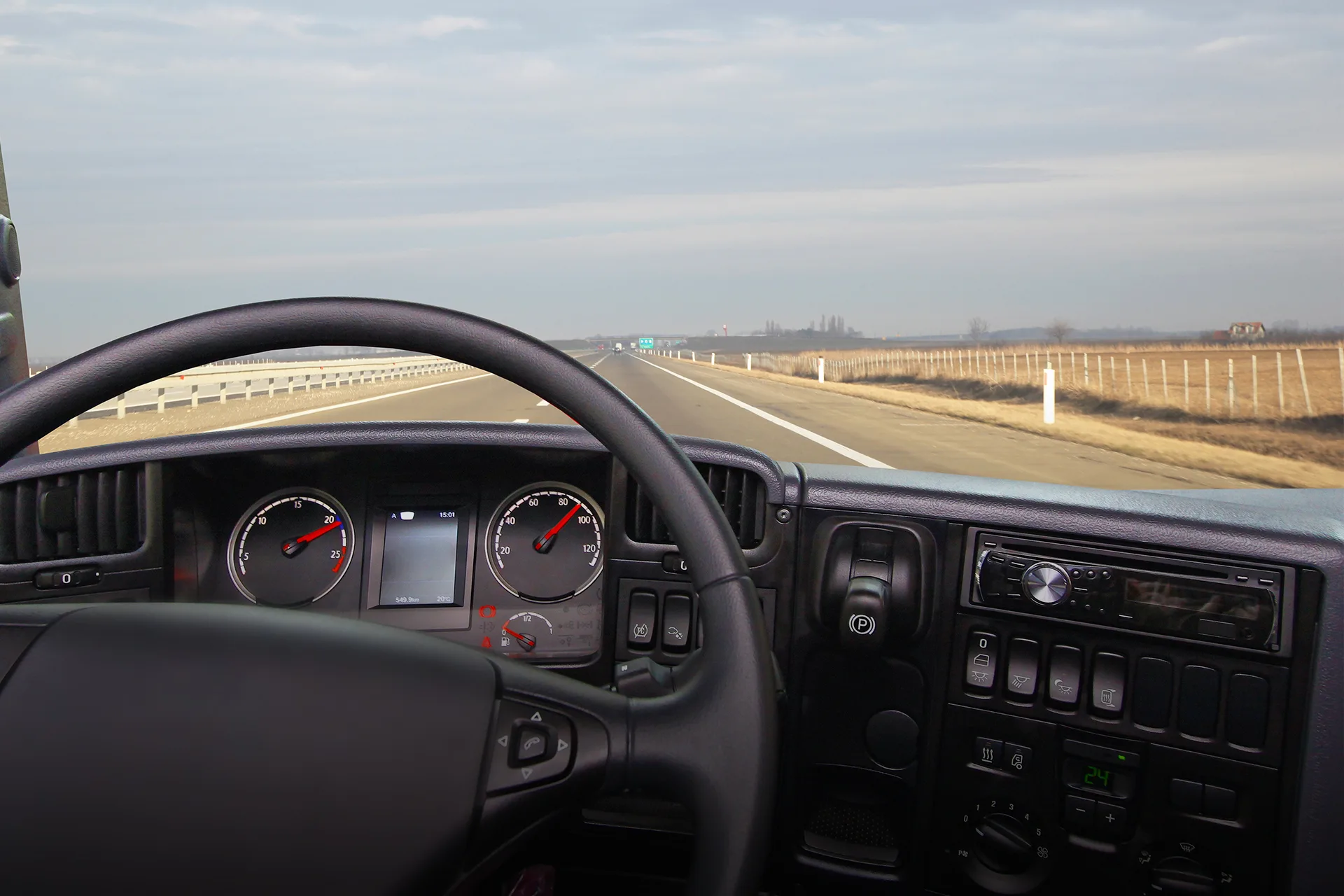
The FMC650 belongs to Teltonika's professional range for heavy vehicles. It has two CAN lines: one for the tachograph, the second for the lorry's FMS interface. Over FMS the tracker receives fuel consumption, engine hours, mileage and other data that the manufacturer exposes through the standard protocol, and the FMS Tell Tale function adds the state of the dashboard indicators to that.
Tell Tale is carried in the FMS protocol in four blocks of identifiers. They cover dipped and main beam headlights, indicators, hazard warning lights, seat belts, engine oil pressure and level, power steering fluid, retarder status, transmission fluid, brake system failure, general system faults and other signals. Each indicator arrives with a status: off, lit red, amber or as information.
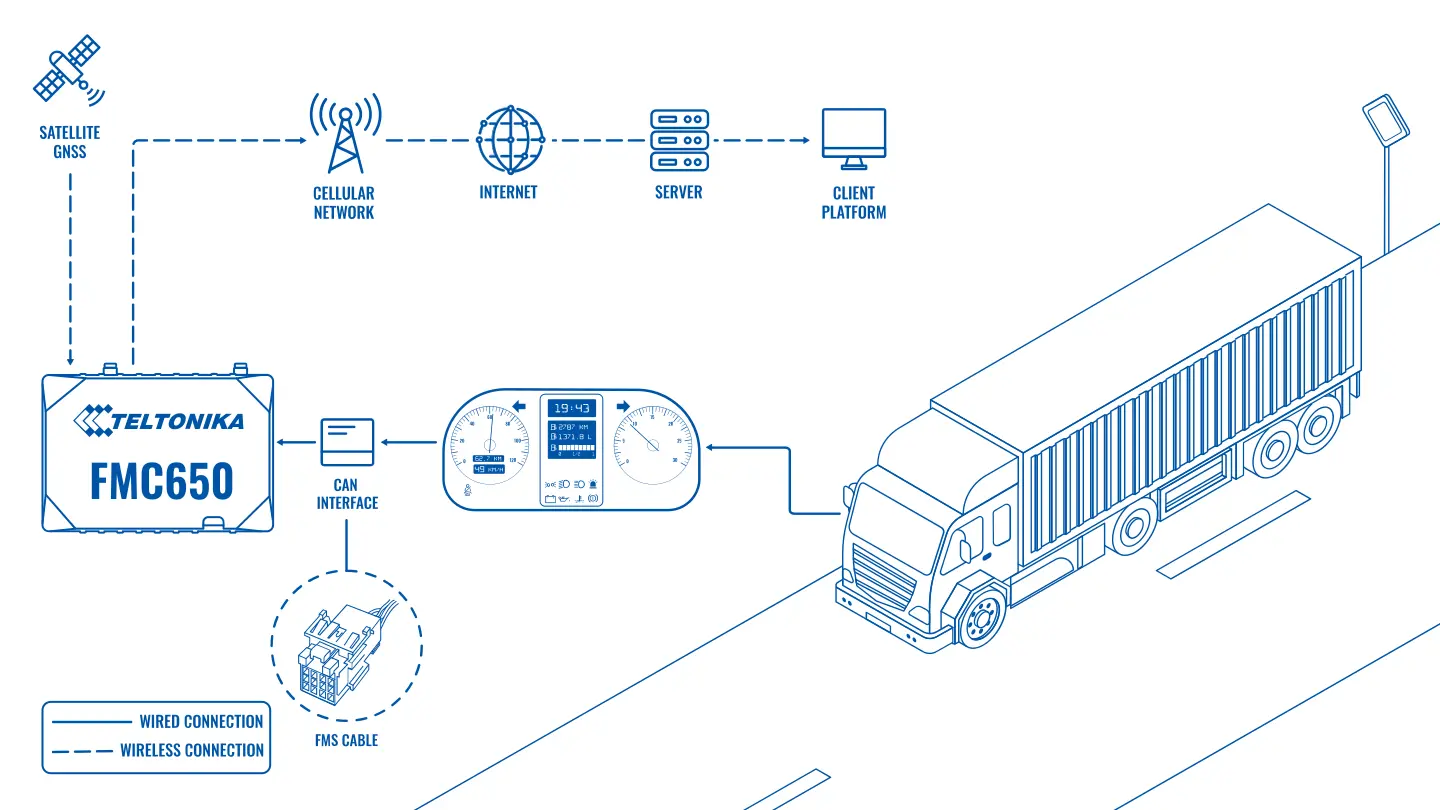
In the monitoring system a notification is set up for each important light. The oil pressure indicator comes on, the mechanic receives a message with the vehicle number and its location, rings the driver and decides whether he can make it back to base or has to stop. Lights that stay on for weeks show up in a report, and a workshop visit is planned around them.
What this looks like on a run. A tractor unit is climbing a gradient with a load and an amber coolant level indicator lights up on the dashboard. The driver decides to press on to the unloading point and does not call in. A minute later the mechanic at the office receives a notification with the coordinates, gets hold of the driver and sends him to the nearest workshop to top up the coolant and check the hoses. The price of the matter is an hour of standing time, not a new cylinder head. A month on, the report shows which vehicles bring that indicator up more often than the rest, and they are first in the queue for a cooling system check.
On positioning the FMC650 is stronger than an ordinary tracker as well. It has a separate GNSS module supporting two frequency bands, L1 and L5. The L5 signal copes better with reflections off buildings, so the track in town and on the yards by the warehouses comes out more accurate. Teltonika calls the FMC650 the first mass-market tracker with dual-band GNSS.
Communication runs over a 4G LTE Cat 1 modem with a 2G fallback and a wide set of LTE bands. Built-in flash memory is 16 MB, roughly eight times as many records as previous professional models held, with no microSD card. Firmware and settings are changed remotely through FOTA WEB, without calling the vehicle back to base.
How to check a particular vehicle. Before setting up notifications we compare the dashboard with the data in Wialon: we switch on dipped and main beam, the indicators and the hazards, unfasten the seat belt and look at which indicators came through and with what status. Whatever did not come through we leave out of the reports. A service event in the system looks like this: vehicle number, indicator, status colour, time, place and how long it was lit. The mechanic plans the workshop visit from those lines.
What you get
Repair on a signal rather than after a breakdown
The mechanic sees the indicator light straight away and plans servicing before a small fault becomes an expensive one.
Figures for the conversation with drivers
The reports show who drives with warning lights on and says nothing about faults, and who reacts in good time.
Seat belt and lighting checks
Data on seat belts and lighting equipment help reduce the risk of accidents and protect the company's reputation.
An accurate track and a stable connection
Dual-band GNSS and a 4G modem with a 2G fallback give precise coordinates and dependable data transfer across different regions.
Configuration without a workshop visit
Firmware and configuration updates are loaded onto the tracker remotely through FOTA WEB.
Why this solution
The FMC650 is designed for heavy vehicles and for jobs where an ordinary tracker is not enough. Two CAN lines let it work with the tachograph and with FMS at the same time, and FMS Tell Tale support is there in the firmware itself, with no separate adapters.
Teltonika has been in telematics for almost 25 years, and its trackers support the common monitoring platforms. For a fleet that means dashboard data can be received in the same system that already keeps track of routes and fuel.
An important limitation: FMS Tell Tale only works on vehicles where the manufacturer has brought out an FMS interface and transmits indicator states through it. On newer European tractor units that is usually the case; on older plant and on many vehicles without FMS you will have to make do with CAN data, and some indicators will not be available. This needs checking before the equipment is bought, against the specific model and year of manufacture.
How this works in Azerbaijan. The scenario is needed first of all by international haulage firms carrying loads along the Middle Corridor through the port of Alat, along the M-2 into Georgia and Turkey, the M-1 into Russia and the M-3 into Iran. Their fleets are mostly Volvo, Scania, MAN, DAF and Mercedes-Benz Actros, where FMS is fitted as standard. Summer heat up to +40 °C and long climbs over the passes load the engine and the cooling system, and an overheating or oil pressure light spotted by the dispatcher in time saves a tractor unit an engine repair somewhere between Ganja and Gazakh. For construction plant on the sites in Karabakh and tippers in the quarries it is also useful to see the indicators, if the machine transmits them. GPS.az fits the FMC650, connects FMS and the tachograph, and sets up notifications in Wialon for the lights that matter along with a report on them for the mechanic.
Related case studies
Related rollouts and equipment
Vehicle monitoring where there is no cellular coverage
Logistics and delivery
Cold chain: temperature recorder plus FMC650 tracker
Logistics and delivery

Separate tachograph download schedules
Logistics and delivery
Questions about the “A lorry's warning lights in the control room” scenario
Request a call
A specialist will call back and match a solution to your fleet and your task.