
Remote tachograph downloads through the FMC650
The FMC650 and FMM650 trackers download digital tachograph and driver card files remotely, on a schedule, and the TachoSync service stores them and passes them on to whichever systems need them — with no trips out to every lorry carrying a card reader.
The FMC650 and FMM650 trackers download digital tachograph and driver card files remotely, on a schedule, and the TachoSync service stores them and passes them on to whichever systems need them — with no trips out to every lorry carrying a card reader. In Europe a digital tachograph is compulsory on goods vehicles, and the company has to download and keep its data regularly. While you have five vehicles this can be done by hand. When there are a hundred and half of them are out on runs across the continent, downloading by hand turns into a job of its own that nobody ever gets round to on time. Below is how the Teltonika solution is put together and what it offers Azerbaijani hauliers working international routes.
What this scenario solves
Drivers break the rules on driving and rest time, and the company collects the fines.
In Europe those fines run into hundreds and thousands of euros per violation.
The authorities require tachograph data to be downloaded and stored regularly in the correct format.
To download the files by hand, someone has to walk up to the vehicle and connect to the tachograph.
Drivers break the rules on driving and rest time, and the company collects the fines. In Europe those fines run into hundreds and thousands of euros per violation. The authorities require tachograph data to be downloaded and stored regularly in the correct format. To download the files by hand, someone has to walk up to the vehicle and connect to the tachograph.
With a small fleet that is tolerable. With a large one it is not, and there are three reasons. The first is time: walk up to each vehicle, insert the company card, wait for the download, save the file. The second is organisation: you have to remember which vehicle and which driver is due for a download and when. The third is sheer physical impossibility.
The third reason is the most awkward. The company office is in Austria and the lorry has gone off to work in Spain for three months. Nobody is going to drive out to it with a laptop, and nobody has cancelled the download deadlines either.
And the tachograph information itself is not only of interest to inspectors. It shows how long the driver has already been at the wheel, when he is due a rest and whether he can be given another run. If that data arrives once a month, it is too late to plan from.
There is a plain human risk as well. The driver card also has to be downloaded regularly. The driver is on holiday, has resigned, has moved to another vehicle — and his files were never downloaded. Six months later an inspection reveals that several weeks of data are missing, and it is the company that answers for it, not the former employee.
What Teltonika offers
The Teltonika solution has two parts: a PROFESSIONAL series tracker (the FMC650 or FMM650) that connects to the tachograph and downloads files remotely, and software that requests those files, stores them and hands them on.
Installation and setup
Fitting the device and configuring it for the fleet scenario at hand.
Data transfer
The device collects data and sends it to the monitoring platform; how often depends on the model and its settings.
Analysis and control
The person in charge gets reports and alerts and looks into what stands out.
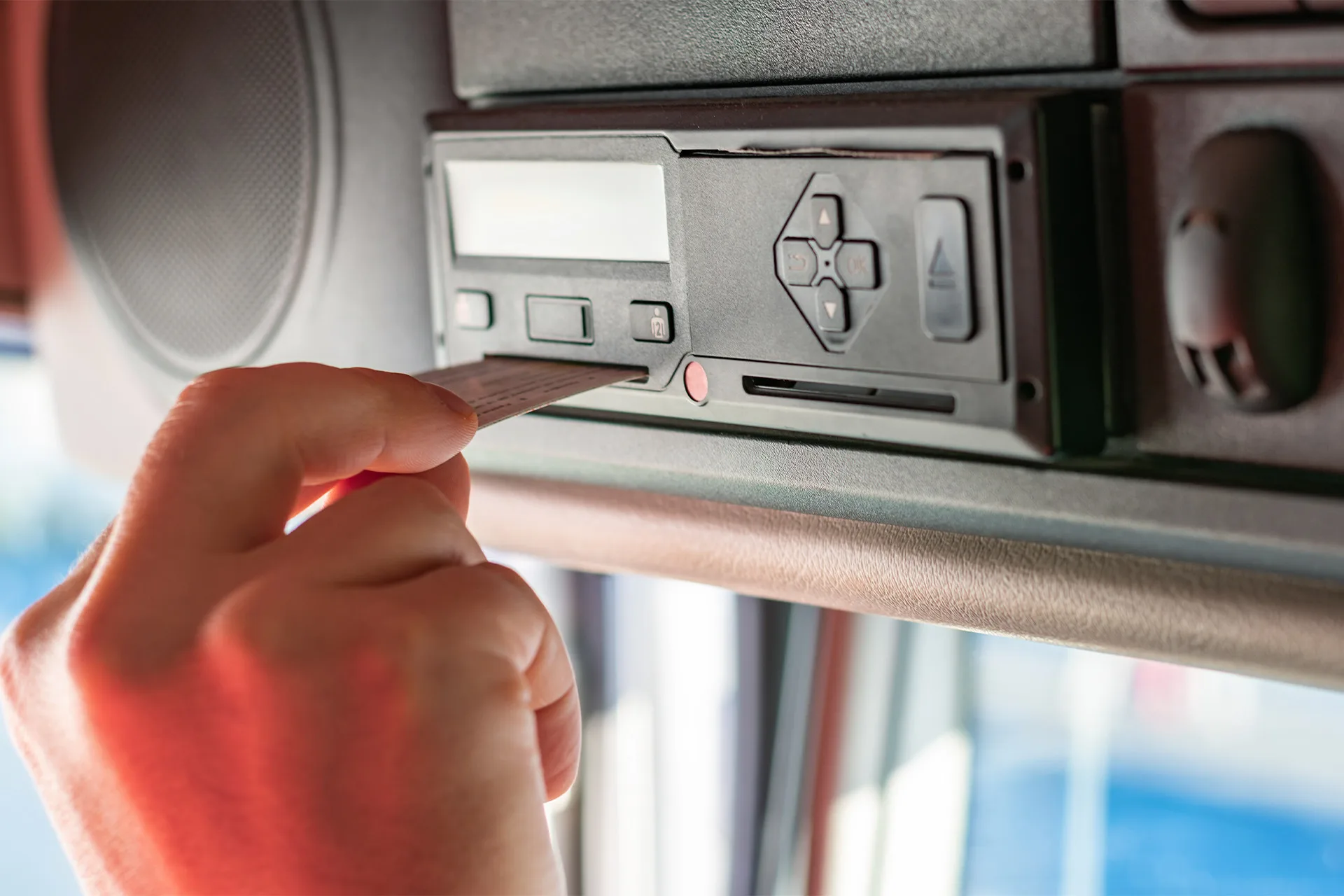
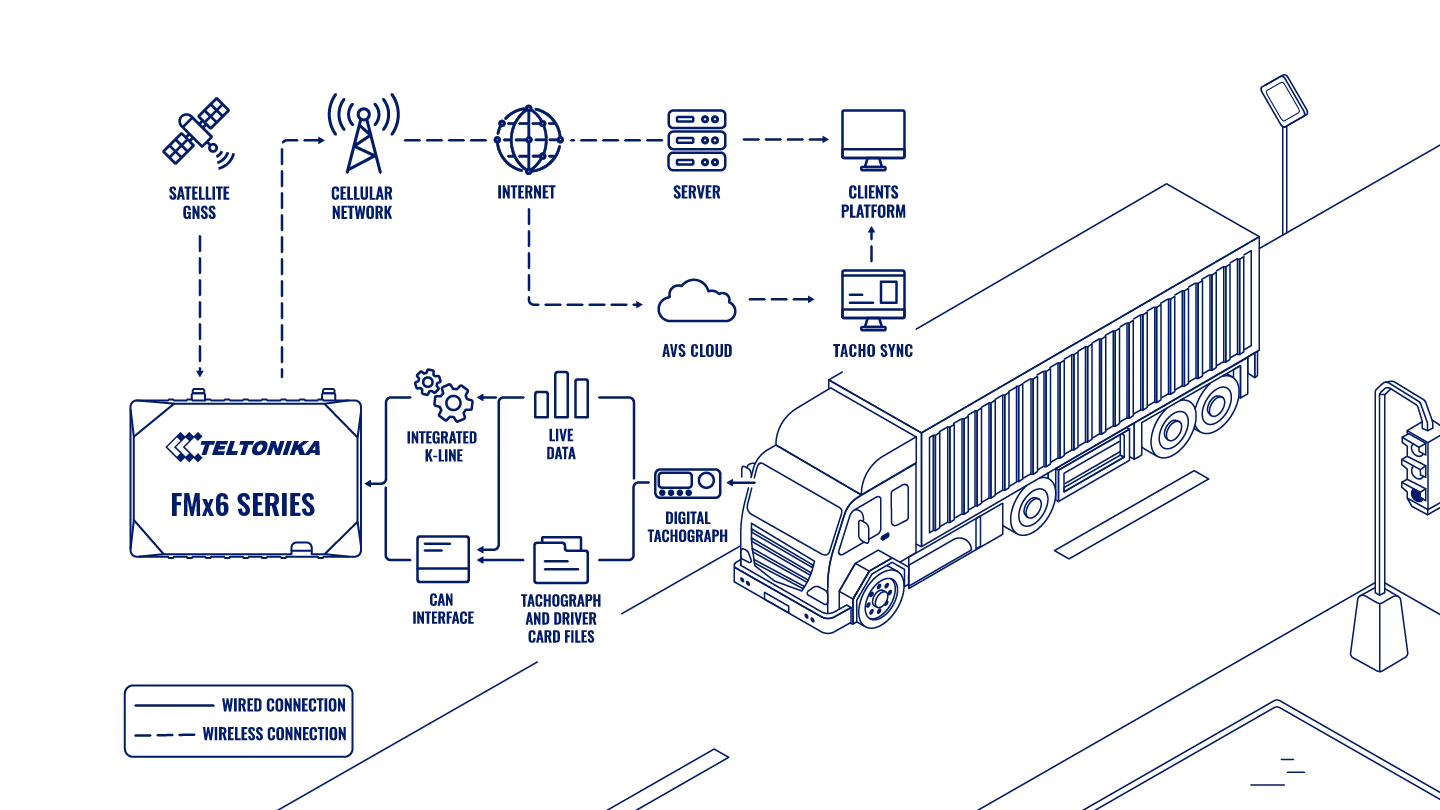
Part one — the tracker. The FMC650 (LTE Cat 1) and FMM650 (LTE Cat M1) connect to the tachograph over the CAN line. The same line gives the tracker:
• driver card and tachograph files in .DDD format, and in the regional .TGD (Spain) and .V1B/.C1B (France) formats;
• real-time tachograph data — driver status, driving time and rest time;
• extended tachograph and FMS data (TachoCAN).
All of it runs over a single line, which makes the fitting simpler. Real-time data can also be taken over K-line, if that suits a particular vehicle better.
There are ready-made cables for the fitting: a dedicated tachograph cable and an FMS cable. For minibuses with a 12-volt electrical system there is a cable that connects to the tachograph's front panel: activate the front-panel interface, plug the cable in, and it works.
Part two — the software. Here there are two routes. You can write your own: Teltonika publishes the exchange protocol your server uses to request files from the trackers. Or you can take the ready-made TachoSync service, which already works with the FMC650 and FMM650.
TachoSync is a cloud service that runs in a browser, with no server of your own to install. Once it has been set up, the user defines a schedule and the service requests the files from the relevant vehicles and driver cards by itself. Nobody reminds the driver to call in at the office, nobody runs around with a card reader. If the vehicle was out of network coverage when the request went out, that shows in the download log and the request can be repeated once the tracker is back online. It is worth looking through that log once a week so gaps do not pile up.
For integrators, TachoSync has a hierarchy: companies, their vehicles, users and driver cards. Each client sees only its own data. Downloaded files are kept in the cloud or passed through the API into another system — a monitoring platform or a tachograph analysis package.
What the company ends up with. First: tachograph files download by themselves and on time, ready to be produced for inspectors. Second: driving and rest time is visible in real time. If a driver is running over his hours, the dispatcher gets an alert before it becomes a violation. Plus everything else a PROFESSIONAL tracker gives: position, the vehicle's CAN data, fuel, mileage.
Where the files are kept. In the TachoSync cloud, or in your own system, to which they are passed through the API. How long files must be kept is set by the rules of the country the vehicle works in, and it is the haulier's duty rather than the service's, so it is worth setting up a copy for the company archive from the start.
Points to consider. For remote downloads, a company card has to be inserted in the tachograph, or a remote authentication arrangement supported by the service has to be used. The tachograph must support remote downloading — on current models that is standard, on older ones it varies.
What you get
No need to drive out to every vehicle
Tachograph and driver card files download remotely on a schedule, wherever the lorry happens to be.
A service in the browser
TachoSync opens on any device and needs no server of your own.
Your own software if you want it
The exchange protocol lets you build tachograph downloads into your own system.
Access for your people only
Files are held on a secure server, and the hierarchy of companies and users limits who sees what.
Different file formats
Besides the standard DDD, the Spanish TGD and French V1B/C1B are supported.
Driving and rest time in real time
The dispatcher sees how long a driver has worked and plans runs without risking excess hours.
Why this solution
The FMC650 and FMM650 were designed from the outset for goods vehicles and for working with tachographs. Everything needed — remote downloads, real-time data, FMS — runs over a single CAN connection, and the ready-made cables cut fitting time.
The ready-made TachoSync service settles the main question for small and mid-sized hauliers: who is going to write the software. If no software is needed, they take the service; if they want their own, the protocol is there. For an integrator serving many clients, the company hierarchy in TachoSync matters: each client can be managed separately.
The tracker is not limited to the tachograph either. The same box reports position, CAN bus data and fuel, and works with sensors and temperature recorders. For a haulier that means one device per vehicle instead of several.
How this works in Azerbaijan. EU tachograph requirements apply to Azerbaijani hauliers too when their vehicles work in Europe: on entering the EU, and on routes through Turkey and Georgia, the driver and the company must have their tachograph data in order. Many tractor units leave Baku for weeks at a time — through the Red Bridge, Sarpi and on into Europe — and bringing them back to the yard for a download is simply not possible. A remote download through the FMC650 solves that. The second benefit is driving and rest time in real time: the dispatcher in Baku sees that the driver is due a break and plans the stop before the Polish or German police find a violation. For transit along the Middle Corridor through the port of Alat and the ferries to Aktau and Turkmenbashi, it is important to check coverage along the route in advance: the tracker will hold the data in memory where there is no network. GPS.az fits the FMC650 to tractor units, connects the tachograph and Escort fuel level sensors and feeds the data into Wialon, and on tachograph file downloads we can advise which option suits your fleet better.
Related case studies
Related rollouts and equipment
Questions about the “Remote tachograph downloads through the FMC650” scenario
Request a call
A specialist will call back and match a solution to your fleet and your task.