
Driver identification with a BLE key fob
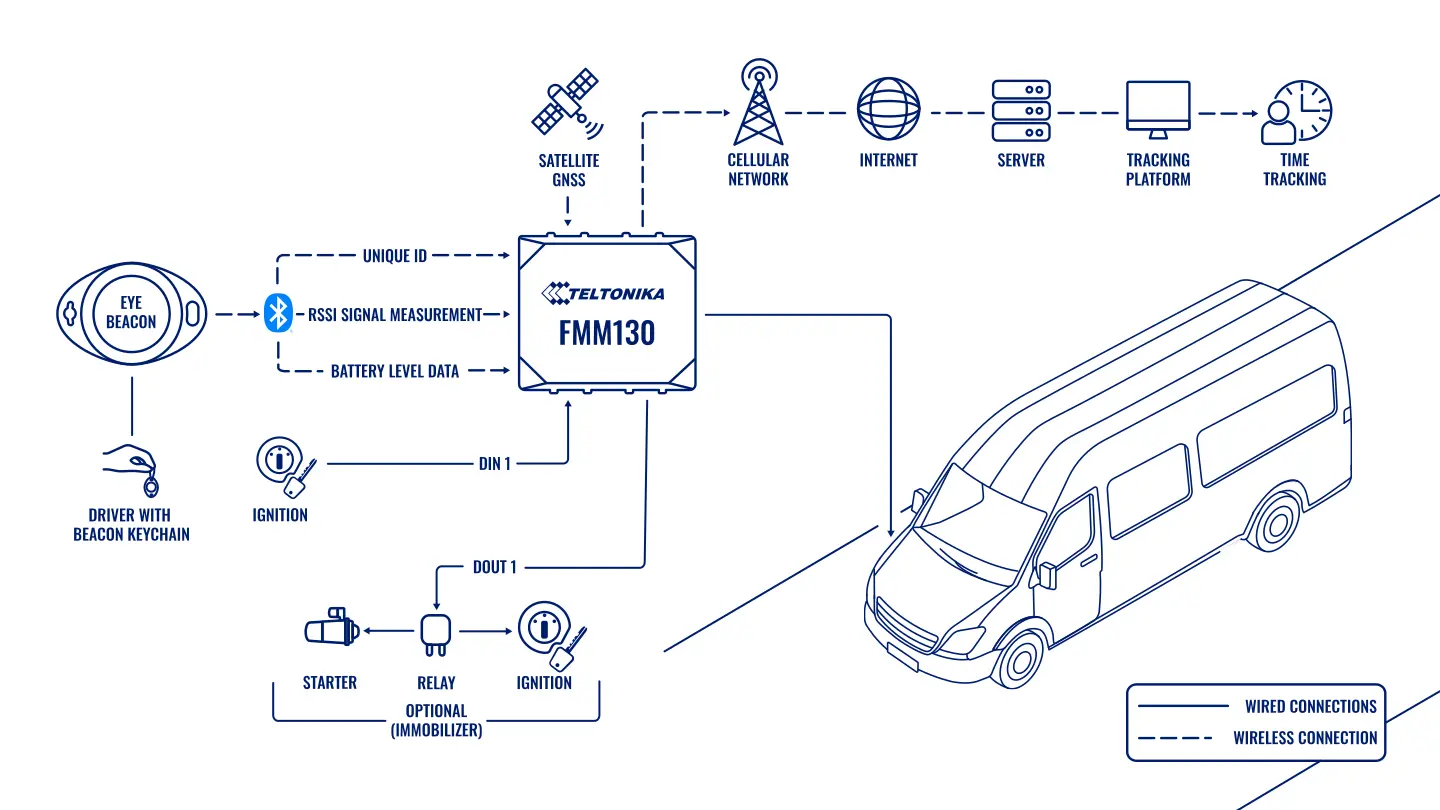
A Teltonika scenario for recording drivers' working time: an EYE Beacon fob on a keyring tells an FMM130 tracker by itself who has taken the wheel, and the shift is logged without cards, readers or paper timesheets.
A Teltonika scenario for recording drivers' working time: an EYE Beacon fob on a keyring tells an FMM130 tracker by itself who has taken the wheel, and the shift is logged without cards, readers or paper timesheets. In many fleets drivers' time is still counted from paper timesheets or from cards that have to be presented to a reader. A timesheet can be filled in to suit; a card can be left at home or handed to the next man on shift. The result is arguments about pay, muddled reports and the eternal question of who broke the mirror yesterday. A Bluetooth fob removes the manual step: the driver simply walks up to the vehicle with his keys.
What this scenario solves
A driver's time is one of the largest cost items in logistics, and good drivers are in short supply.
The fleet manager has to squeeze the most out of every working hour while keeping repair and maintenance costs under control.
Recording drivers' time is not only for hauliers.
Construction, forestry and farming, healthcare, retail and manufacturing all use it — anyone whose people work on company vehicles.
A driver's time is one of the largest cost items in logistics, and good drivers are in short supply. The fleet manager has to squeeze the most out of every working hour while keeping repair and maintenance costs under control.
Recording drivers' time is not only for hauliers. Construction, forestry and farming, healthcare, retail and manufacturing all use it — anyone whose people work on company vehicles.
A paper timesheet is easy to fill in wrongly or to pad. Checking it after the event is all but impossible.
A card and a reader on the 1-Wire bus are more honest, but it is a wired solution. The reader has to be cut into the panel, the cable chafes through in time and has to be repaired. A driver who forgets to present his card drops out of the record, and then come the arguments about pay and the corrections to reports.
The best system is one where the driver has to do nothing for the record to be made, and where fitting and upkeep cost almost nothing.
What Teltonika offers
Teltonika offers wireless identification: the driver is given a small EYE Beacon fob with its own number, he carries it on his keyring, and the tracker in the vehicle recognises the fob over Bluetooth Low Energy and records who started work and when.
Installation and setup
Fitting the device and configuring it for the fleet scenario at hand.
Data transfer
The device collects data and sends it to the monitoring platform; how often depends on the model and its settings.
Analysis and control
The person in charge gets reports and alerts and looks into what stands out.
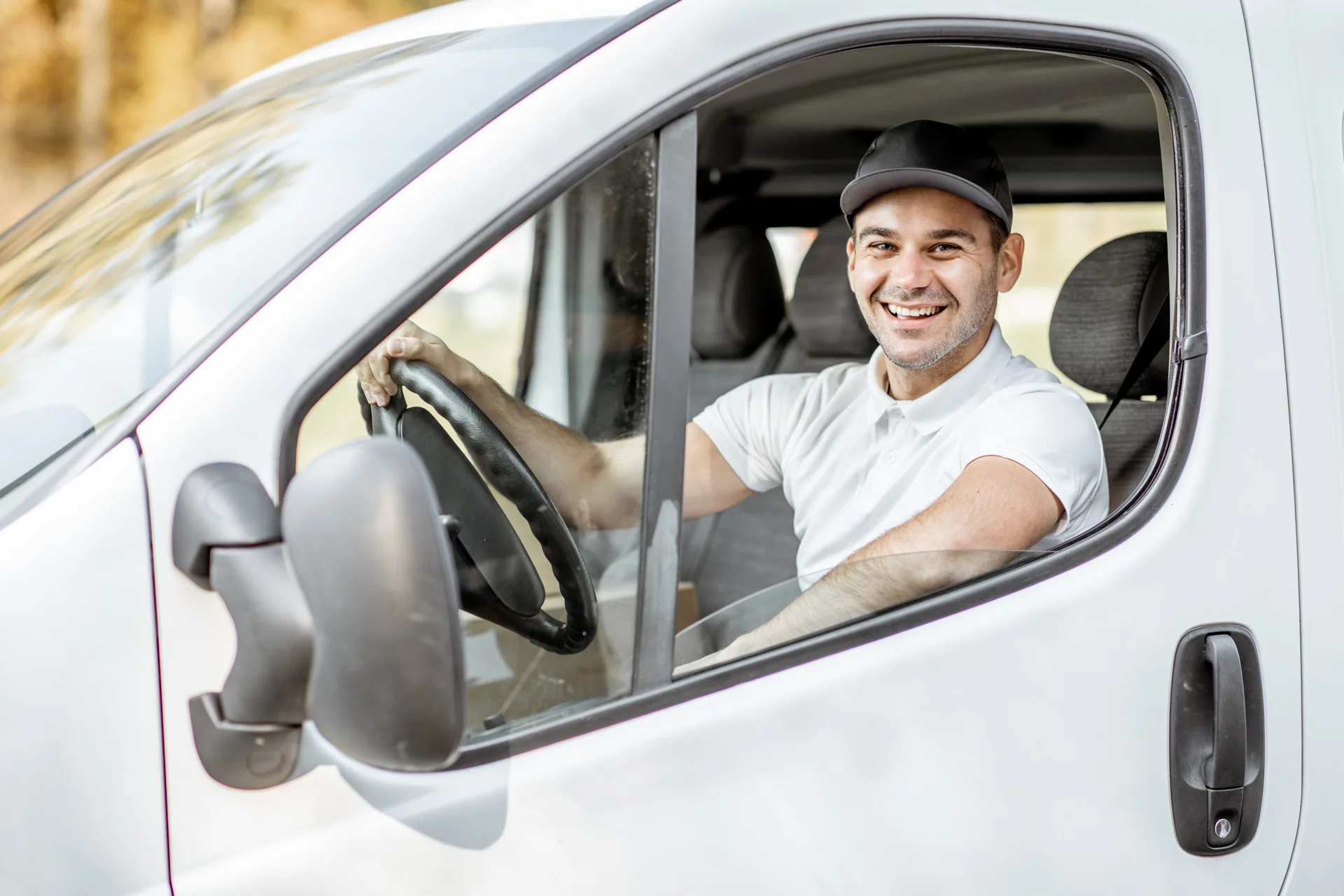
Each EYE Beacon has its own identification number. The tracker knows which driver it belongs to and, as soon as the man with the fob is in the vehicle, ties the trip to him with an exact date and time. The driver presents nothing and presses nothing. He gets in, starts up and drives off — and the shift is already in the report.
The Teltonika example uses the FMM130 tracker, but any Teltonika vehicle tracker supporting Bluetooth LE will do. If the fleet already has such trackers, the rollout comes down to handing out fobs and loading a new configuration. No readers, no cables, no holes in the dashboard.
The configuration is sent to the trackers remotely through FOTA WEB: the list of fobs and their assignment to drivers can be loaded in advance without going near the vehicles. When a new driver joins the company he gets a fob, and the trackers get an updated list.
The fobs stand up to real life: an IP67-rated housing and a battery lasting up to 10 years. They need no charging, and are only replaced if one is lost.
The arrangement suits very different vehicles: lorries and tractor units, buses, delivery vans, municipal machines, company cars.
The fob can be made the ignition key. Through its DOUT output the tracker controls an immobiliser: the engine will only start if a recognised fob is nearby. Research suggests that immobilisers cut the number of thefts by about 40%. For a company vehicle it is also protection against weekend joyriding the company knows nothing about.
How it looks for the dispatcher. Vehicle No. 12 went out on Monday morning with Rashad driving and was taken over by Elvin at midday — the system split the day into two shifts by itself. On Tuesday a dent appears on the vehicle, and the trip report shows straight away who was driving the previous evening. At the end of the month the accounts department receives hours worked for each person, with no timesheets to reconcile.
What the accounts department and the manager get. Time worked for each driver, the number of trips, mileage, idle time and speeding offences, all with a name attached rather than only a vehicle number. On that data you can build bonuses for careful driving, or work out why one driver's route takes an hour longer than another's.
What you get
The driver is logged without doing anything
The fob on his keys is recognised automatically, and shift data is available from a computer, a tablet and a phone.
No readers and no wiring
There is nothing to fit and nothing to repair, and rollout across a fleet with Teltonika trackers takes a day.
Up to 10 years without a battery change
The fob in its IP67 housing needs no servicing and no charging.
No minutes wasted at the start
Identification begins the moment the driver gets in, including when it is paired with an immobiliser.
Discipline and accountability
Every trip, every dent and every violation is tied to a specific person.
Electronic records instead of timesheets
Fewer payroll errors, less paperwork and fewer arguments.
Why this solution
The EYE Beacon is a standard Teltonika accessory that works with the company's vehicle trackers without additional hardware. Bluetooth driver identification is built into the firmware and switched on in the configurator, so the solution needs no development. Remote setup through FOTA WEB makes it convenient for large fleets whose vehicles are scattered across several depots.
The same beacons are used for other jobs as well: tagging trailers, tools, containers. One type of accessory covers several scenarios in a company.
Limitations worth knowing about. A fob identifies a fob, not a person. If a driver hands his keys to a colleague, the system will record the trip against the owner of the fob. For most companies that is not a problem, because the fob hangs on a personal keyring, but where substitution really matters it is backed up with a camera in the cab or other measures. The second point is range. If several vehicles stand side by side in a yard and drivers walk past, a tracker may hear somebody else's fob. That is solved by setting the signal level and by the rule that identification only counts with the ignition on.
One more practical piece of advice: keep spare fobs. If a driver loses his, he is given a new one and the old one is disabled in the configuration, so the record is not interrupted for even a day.
Common questions during rollout. Does the fob need mobile coverage to work? No, the tracker recognises the fob on its own and the shift data goes to the server when there is a network, so the record is not lost in the mountains or in a distant field. What if a driver gets in without his fob? The trip will still be recorded, but without a name, and it is convenient to put such nameless trips into a separate report or notification. Can fobs be combined with card readers that are already fitted? Yes, during a transition period part of the fleet works on cards and part on fobs, while the reports come together in one place.
How to prepare the drivers. Better to explain in advance why the fob is there: it protects the driver too, because an argument about who was driving is settled on facts rather than on the word of the shift supervisor.
How this works in Azerbaijan. Wireless identification is especially useful where vehicles run several shifts and pass from hand to hand: at delivery services and taxi fleets in Baku, at distributors with delivery vans, at construction companies on sites in Karabakh, and at farms in the Kur-Araz lowland, where different operators work the same machine during the season. In summer a fob left on the dashboard in the sun gets extremely hot, so we advise carrying it on the keyring rather than keeping it in the vehicle. GPS.az issues and registers the fobs, fits or reconfigures the Teltonika trackers, connects an immobiliser where required, and configures reports in Wialon on shifts, mileage and each driver's violations.
Related case studies
Related rollouts and equipment

Questions about the “Driver identification with a BLE key fob” scenario
Request a call
A specialist will call back and match a solution to your fleet and your task.