
Driver shift recording with an RFID card
The driver holds an RFID card against the reader on the dashboard, the Teltonika FMM130 tracker marks the start of the shift and allows the engine to be started, and at the end of the day it records the end of the shift in the same way: the paper timesheet is no longer needed.
The driver holds an RFID card against the reader on the dashboard, the Teltonika FMM130 tracker marks the start of the shift and allows the engine to be started, and at the end of the day it records the end of the shift in the same way: the paper timesheet is no longer needed. In many companies drivers' working hours are still counted from paper timesheets and waybills. They are filled in late, lost, written illegibly and sometimes embellished. At the end of the month the accounts department pulls it all together by hand, and arguments about overtime and idle time are inevitable. In this use case Teltonika shows two ways of taking paper out of time recording: driver identification by card over the 1-Wire bus, and a simpler option — counting time from the ignition counter.
What this scenario solves
Every company needs a record of working hours: wages are paid on it, overtime is calculated from it and discipline is checked against it.
The methods vary — timesheets, logbooks, HR software, records of vehicles entering and leaving the yard.
Drivers work away from the office.
Corporate fleets, construction, forestry and agriculture, healthcare, retail, manufacturing — wherever an employee spends the shift behind the wheel or on a machine, keeping track of their time is harder.
Every company needs a record of working hours: wages are paid on it, overtime is calculated from it and discipline is checked against it. The methods vary — timesheets, logbooks, HR software, records of vehicles entering and leaving the yard.
Drivers work away from the office. Corporate fleets, construction, forestry and agriculture, healthcare, retail, manufacturing — wherever an employee spends the shift behind the wheel or on a machine, keeping track of their time is harder. That is why paper timesheets have survived longest there.
Paper lets you down constantly. The timesheet is filled in after the event, several days after the shift, or forgotten altogether. Figures come out wrong, handwriting is unreadable. Sheets go missing or reach the accounts department after the period has closed.
Dishonesty happens too. An extra hour on the timesheet, overtime that never took place, a vehicle taken for personal errands at the weekend. None of this can be checked on paper, and comparing timesheets against tracker data by hand takes a long time.
If several people work on the same vehicle, it is harder still. A waybill does not always show who exactly was at the wheel in a particular hour, which means it is unclear who is answerable for a fine, for excess consumption or for damage.
Pulling all of this together costs the manager and the accountant hours every month, and errors in the records turn into disputes with staff and fines for inaccurate reporting.
What Teltonika offers
Each driver is issued an RFID card with a personal number. Touch the card to the reader and the tracker records the start of the shift and allows the engine to be started. Touch it at the end of the day and it records the end. All these stamps go to the server automatically, together with the route and the mileage.
Installation and setup
Fitting the device and configuring it for the fleet scenario at hand.
Data transfer
The device collects data and sends it to the monitoring platform; how often depends on the model and its settings.
Analysis and control
The person in charge gets reports and alerts and looks into what stands out.

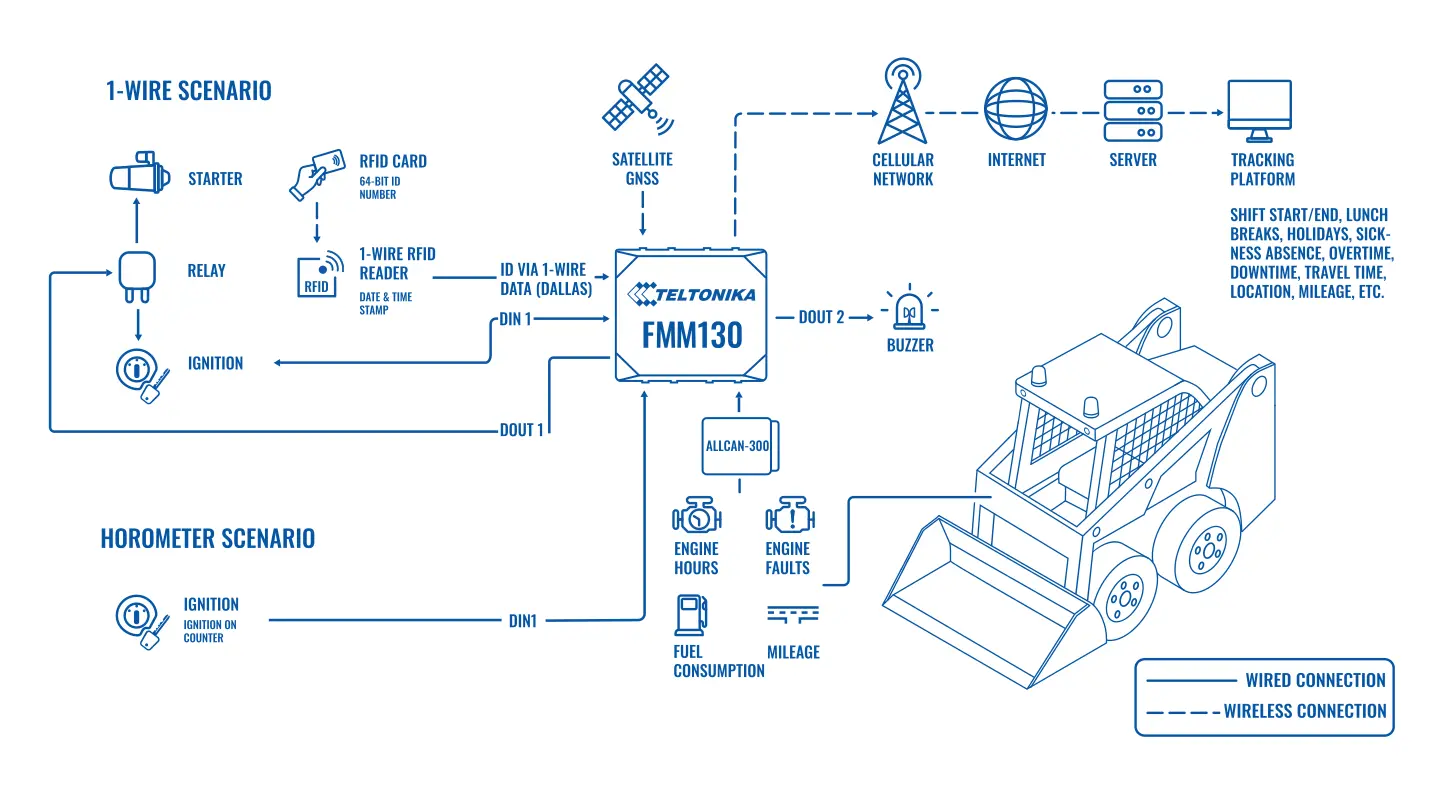
What the system is made of. A Teltonika FMM130 tracker, which supports the 1-Wire bus, a 1-Wire RFID reader on the dashboard and contactless cards. Every RFID card has its own 64-bit number written at the factory. The tracker recognises the driver by that number and puts an exact date and time stamp on the event. Instead of a card you can issue an iButton — a stainless steel key fob, also known as a Dallas Key. The principle is the same; this use case looks at cards.
Start of the shift. The driver gets into the vehicle and holds the card up to the reader. If the system knows the card, the tracker creates a start of shift event and, through a relay, allows the starter to engage. The driver can set off. If the card is unknown or absent, the starter stays blocked and the vehicle will not start.
End of the shift and breaks. At the end of the working day the driver touches the card again, the tracker records an end of shift event, and only then can the engine be switched off. Lunch, short breaks and any other pauses that have to be accounted for are marked in the same way.
Settings. Driver authorisation can be switched on or off in the tracker configuration, in the features section, depending on whether the company needs the starter blocked. A card read signal can be configured as well: the tracker switches on one of the outputs, DOUT 1 or DOUT 2, for a set length of time. An LED or a buzzer, say, is wired to that output, and the driver knows straight away that the card has been read and access granted.
The option without cards. There is a simpler way — the Ignition ON Counter feature. The tracker counts the time while the ignition is on, to the second, in the same way as engine hours. Combined with the tracker's other data — location, speed, geofences — that gives a reasonably accurate picture of working time for each vehicle. The feature is in the basic Teltonika firmware from version 03.27.XX onwards.
What is good about the option without cards. Fitting is simpler and cheaper: no accessories are needed, no drilling into the dashboard of every vehicle, and nobody loses a card. The drawback is just as plain: time is counted per vehicle rather than per person, so cards are better for vehicles with several drivers.
What the company gets. All the data — who worked, when the shift began and ended, where they were, how far they drove, at what speed, how much fuel went — reaches the server automatically. If several people drive one vehicle, the system counts each of them separately and shows the figures for each over the period you need.
Payroll. Together with third-party personnel software, this data makes it possible to calculate lunch break deductions, overtime, idle time, travel time to the site, holidays and sickness absence, allowances and expenses automatically. The manager sees all of it from a computer, a tablet or a smartphone.
Keeping personal trips in view. If the company forbids using the vehicle outside the shift, the system shows it at once: movement without a start of shift stamp, or a trip at the weekend, becomes an event in its own right. The manager gets a notification and sees who took the vehicle, where they went and how many kilometres they put on it. With the starter blocked, a trip like that simply will not happen without a card.
Issuing cards and keeping track of them. Cards are entered in the system and linked to employees in the driver list. If someone leaves or loses a card, its number is removed from the list of permitted cards and it stops opening access to vehicles. A new card is issued in a couple of minutes, with no need to reflash the trackers.
What to do if a card is left at home. A fallback is usually agreed in advance — a spare card held by the shift supervisor or the mechanic, for instance, issued against a signature. A shift worked on the spare card is recorded in the system too, and the frequency of such cases shows who forgets their card regularly. The main thing is that the fallback does not become ordinary practice, otherwise recording time per person loses its point.
What changes for drivers. The first few days feel unfamiliar; after that, touching the card in becomes as automatic as fastening the seat belt. In return, the driver no longer has to fill in a timesheet or prove that he was held up on site: it is all there in the system.
How it looks at the end of the month. The accountant used to spend a week pulling together the timesheets of twenty drivers and ringing round to establish who had been where. Now he exports a shift report from the system: for every driver, the start and end of each shift, the breaks and the total hours. If a driver disputes it, the particular day is opened with the route and the card stamps on it.
What you get
The timesheet fills itself in
The start and end of the shift, the breaks and the hours worked are recorded by a touch of the card, with no paper and no manual entry.
Only your own people at the wheel
Without a valid card the starter will not allow a start, so an outsider, or an employee outside working hours, cannot take the vehicle.
Every driver counted separately
If several people drive the vehicle, time, mileage and violations are counted for each of them, and there are fewer disputed cases.
Wages without arguments
Accurate figures on shifts and overtime can be passed to payroll software, and if there is a disagreement the particular day can be opened.
Reports for inspections in one click
The summaries you need on staff working time are produced from the system, with no manual preparation and no transcription errors.
Together with the rest of the telematics
Speeding, idling, tracker disconnection and towing appear in the same reports and are tied to a particular driver.
Why this solution
Identification over the 1-Wire bus is proven, inexpensive technology, and Teltonika trackers support it out of the box. The FMM130 works with RFID readers and with iButton alike, drives the starter blocking relay and the outputs for the card read signal. All of it is set up in the standard configurator, without extra modules.
There is a choice between accuracy and simplicity. If you need time recorded per person and protection against outsiders — cards and a reader. If recording per vehicle is enough and minimum cost matters — the ignition counter from the basic firmware. Both options can be mixed in one fleet: cards on the vehicles with several drivers, the counter on those assigned to one.
The data is open for integration. Start and end of shift events, together with the driver identifier, go to the server and from there into personnel or payroll software.
The limitations are worth bearing in mind. A card can be handed to someone else and the system will not notice it, so the rule of one card per driver has to be written into internal company documents. Starter blocking has to be configured so that it does not get in the way in an emergency. The ignition counter does not tell work apart from standing with the engine running, so without geofences and movement data it gives an inflated picture.
How this works in Azerbaijan. Card-based recording is most in demand at companies where vehicles and machines pass from hand to hand: construction contractors on sites in Karabakh and East Zangezur, where shifts are long and drivers change; oil and gas service companies in Absheron; delivery services in Baku; farms on the Kura-Aras lowland during the harvest season. Paper waybills are still widespread in the regions, and the move to cards makes life noticeably easier for the accounts department. On installation we issue the cards, link them to employees in the system, explain to the drivers how to clock in, and set up starter blocking only where the customer genuinely wants it. We choose SIM cards from Azercell, Bakcell or Nar according to coverage on the sites. GPS.az fits the FMM130 with an RFID reader and feeds shifts, drivers and routes into the Wialon platform: shift and driver reports are built there and can be exported to Excel for payroll.
Related case studies
Related rollouts and equipment

Questions about the “Driver shift recording with an RFID card” scenario
Request a call
A specialist will call back and match a solution to your fleet and your task.