
FMM130 trackers ready to work from the factory
Teltonika can supply GPS trackers already prepared for fitting: with the customer's firmware and settings, the SIM card inserted, the battery connected, the right cables and the branding applied — here with the FMM130 as the example.
Teltonika can supply GPS trackers already prepared for fitting: with the customer's firmware and settings, the SIM card inserted, the battery connected, the right cables and the branding applied — here with the FMM130 as the example. The case is addressed to integrators, telematics providers and large fleets launching projects across hundreds and thousands of vehicles. There the routine of preparing devices eats up weeks, and configuration mistakes come to light out on site. We look at what that routine consists of, what exactly Teltonika takes on and how to order a delivery like this.
What this scenario solves
Preparing a single tracker for fitting consists of a dozen small manual operations.
On a batch of a thousand devices even a one-minute operation turns into two working days for one person.
Monotonous work breeds mistakes: the wrong SIM, the wrong configuration file, a battery left unconnected.
The mistakes surface on site, when the vehicle is already in the bay and the fitter is standing there.
Preparing a single tracker for fitting consists of a dozen small manual operations. On a batch of a thousand devices even a one-minute operation turns into two working days for one person. Monotonous work breeds mistakes: the wrong SIM, the wrong configuration file, a battery left unconnected. The mistakes surface on site, when the vehicle is already in the bay and the fitter is standing there.
Take one operation — putting a SIM card into an FMM130. You have to unpack the tracker, open the housing, put the card into the tray the right way round and close it up. Say that is a minute. For 1,000 devices that is 1,000 minutes, or roughly 16.6 hours, two full working days.
And the SIM is only the start. After it comes connecting the battery, selecting cables and connectors, flashing the firmware and configuring through the Teltonika Configurator, labels with logos and serial numbers, repacking. On a large project a team of technicians and engineers spends days on this, and sometimes weeks.
In the case Teltonika cites a McKinsey Digital report: in roughly 60% of occupations automation can free up about 30% of working time. Preparing trackers is exactly the kind of task that automates well and comes hard to people.
The cost of a mistake is high. A tracker with the wrong APN will not reach the server. A device with the battery unconnected will not report a loss of power. The wrong profile and the data arrives in the wrong place, or the wrong data arrives. Every such case means another visit, a missed deadline, a complaint from the customer, sometimes a refund. For an integrator that is a direct blow to their reputation.
There is a human side to it as well. Repetitive manual work wears people down, tiredness and burnout build up, and the number of mistakes rises along with them.
What Teltonika offers
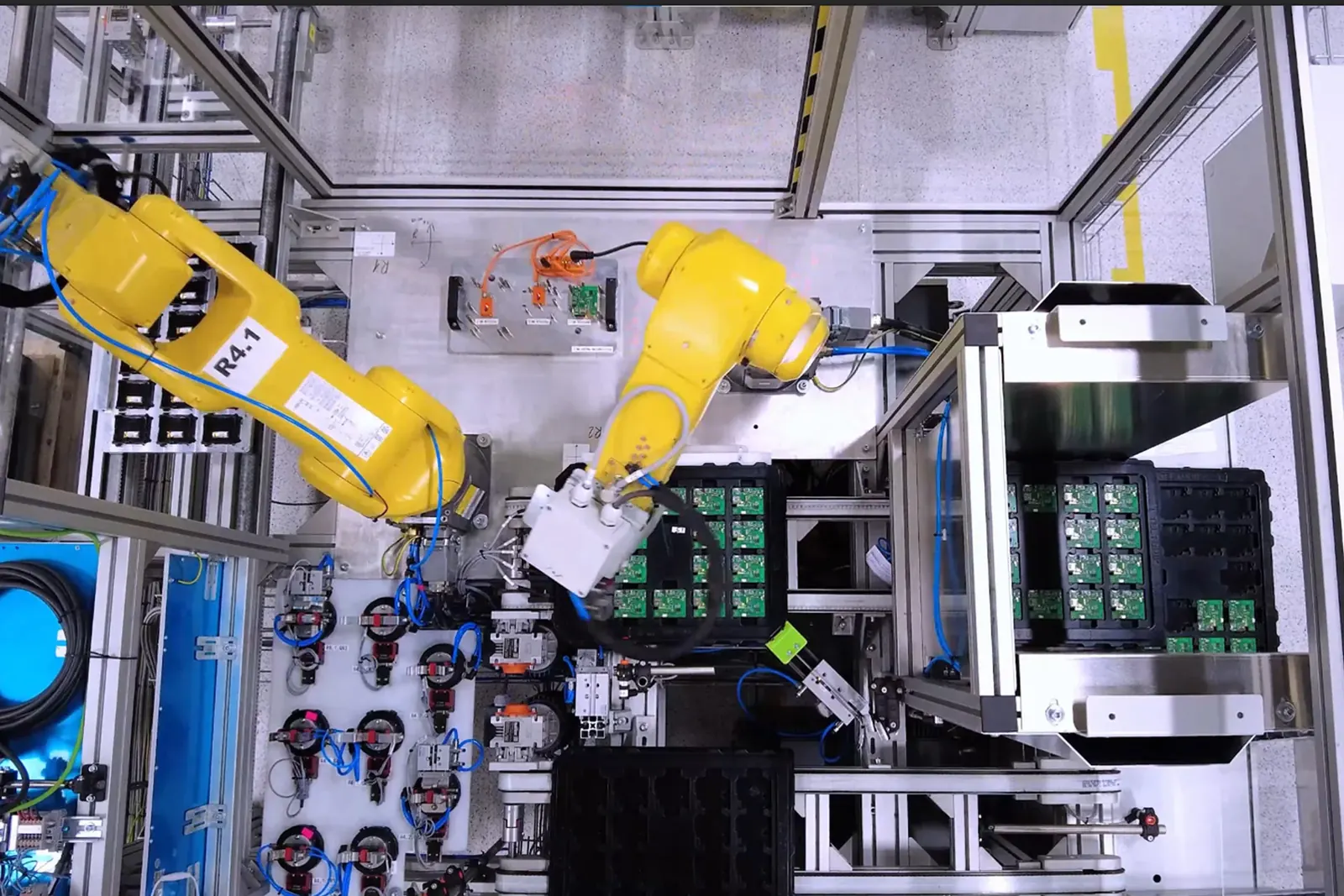
Teltonika offers a service that prepares trackers ready for use: part of the routine work is done at the factory — by robotic assembly lines and production staff — and the customer receives devices that need only to be fitted.
Installation and setup
Fitting the device and configuring it for the fleet scenario at hand.
Data transfer
The device collects data and sends it to the monitoring platform; how often depends on the model and its settings.
Analysis and control
The person in charge gets reports and alerts and looks into what stands out.
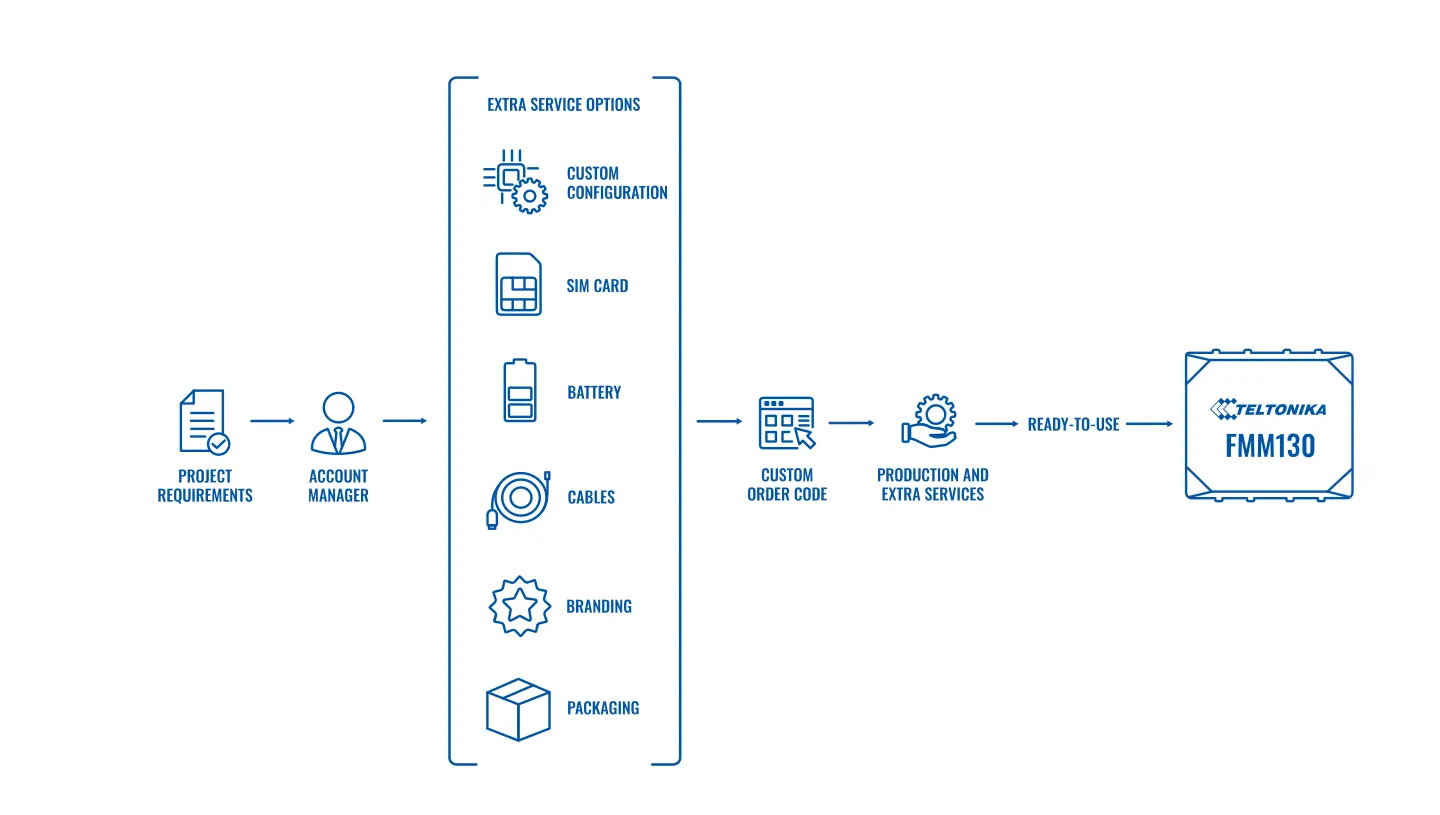
What the preparation covers is agreed for each order. It can include firmware and configuration agreed with the customer in advance; SIM cards; connected batteries; a choice of cables and connectors; branding on the device and the box; the number of trackers in one pack.
With SIM cards there are three options. The customer sends in their own cards and they are put into the devices in production. Trackers can be ordered with prepaid Teltonika SIM cards. For some models a soldered-in eSIM is available — in which case no tray is needed at all.
Connecting the battery to the circuit board is another operation that can be handed to the factory. On large batches that saves the customer thousands of hours of work. There is a caveat here: deliveries with the battery connected are restricted by the rules of carriers and logistics companies, so this option is not available on every route or in every quantity.
Branding is offered in several forms: a label with the customer's logo on the tracker and/or on the box, a label with a logo and a QR code, laser engraving of the logo on the housing. A completely neutral device can also be ordered, with no branding on the housing or the packaging. For integrators selling a solution under their own name that is an important point. A QR code on the housing can be useful to the fitter too: if the device's details are encoded in it, they can be scanned into the installation record instead of copying figures out by hand.
The ordering procedure runs like this. The customer contacts their Teltonika manager and discusses the project. The manager suggests the options available for the particular model and quantity. Once all the details are agreed, an individual order code is created and goes to production.
Every device goes through a quality check before it leaves, so a finished tracker matches the agreed configuration. What arrives on site is a box out of which you take the device, mount it and connect the power — and provided the parameters were agreed correctly and the SIM is active, it reaches the server with the right settings.
For factory preparation to work, several questions have to be answered before the order. Which server and port the tracker sends data to. What the operator's APN is and whether a username and password are needed. How often to write points while moving and while parked. Which inputs are in use — ignition, panic button, door sensor. What to do if external power is lost. If those parameters change halfway through the project, the benefit of ready-made devices is lost: the batch will have to be reconfigured anyway, even if remotely by SMS or through FOTA.
A hypothetical example. Suppose an integrator has to equip 800 delivery service vehicles in three weeks. With manual preparation two technicians spend the first week doing nothing but opening boxes, inserting SIMs, flashing firmware and applying labels, and fitting begins only in the second. With ready-made trackers the crews go out to fit from day one, and the engineer gets on with checking that the vehicles come online rather than running a production line at a bench.
The effect is most noticeable on long projects with tight deadlines and penalties for delay: when hundreds of vehicles have to be equipped within a short window, every day saved on preparation goes into fitting.
What the pre-configuration covers is best set down in writing. The model and firmware version, the configuration file with its version number, the type of SIM and the operator, whether the battery is connected, the set of cables, the branding option, the number of devices in a box. That document then serves as the reference when the batch is accepted.
Accepting a batch. At the warehouse the serial numbers and IMEIs from the packing list are checked against the order register, a few trackers are switched on as samples and checked to see that they reach the right server with the right configuration version. The IMEIs are entered on the platform in advance, so that during fitting a vehicle appears in the system with no manual entry. Discrepancies in numbers or configuration are recorded in a report before fitting begins, not out on site.
Updating after delivery. The factory configuration is a starting point. If the recording interval, the server or the APN changes during the project, the changes are sent out remotely, by SMS or through FOTA WEB, in groups of devices. Every such change is worth recording with a new configuration version, so that a year later it is clear which trackers are running which version.
What you get
Working days saved on preparation
Inserting the SIM, connecting the battery, flashing firmware and applying labels are done at the factory rather than by your technicians' hands.
Fewer mistakes on site
The configuration is agreed in advance and checked in production, so a tracker has to be reconfigured at the vehicle less often.
Easier to keep to the deadline
The team gets on with fitting rather than unpacking and configuring, and the project schedule does not depend on preparing the batch.
Fewer complaints and returns
When devices arrive configured identically, the number of repeat visits and disputes with the customer falls.
Your own brand on the device
A label, a QR code, engraving or a completely neutral housing for those who sell the solution under their own name.
Why this solution
Teltonika manufactures its own trackers, so it can build preparation straight into the production process rather than making it a separate manual operation at a distributor's warehouse. On large projects that gives the same quality across the whole batch.
The FMM130 suits this scenario well: it is a high-volume model supporting LTE Cat-M1/NB-IoT and 2G, fitted to cars and light commercial vehicles in large batches. It is at volumes like these that the difference between manual and factory preparation shows up most.
The set of options depends on the model and the size of the order. For small batches factory preparation is usually unnecessary: a dozen trackers are simpler to configure on the spot. The option with the battery connected is restricted by shipping conditions, and that is worth allowing for when planning timescales. A ready-made configuration is not for ever either: if the customer changes the server or the network operator, the trackers are reconfigured remotely, but that is better agreed before dispatch.
How this works in Azerbaijan. Large batches are most often needed here when equipping city buses and taxis in Baku, the corporate fleets of oilfield service contractors on Absheron, distributors' delivery vehicles, and machinery on the reconstruction sites in Karabakh. On projects like these the window for fitting is short: vehicles are released from their runs for a couple of hours, and every minute at the bay counts. For local projects it matters to settle the SIM question in advance: Azercell, Bakcell or Nar cards, multi-operator SIMs or eSIM, and to write the APN into the configuration accordingly. GPS.az, Teltonika's GOLD partner in Azerbaijan, prepares trackers for fitting, agrees the configuration profile for the customer's purpose, fits the devices and connects them to the Wialon platform, so that vehicles appear in the system as soon as they are fitted. The warranty on the trackers is 1 year.
Related case studies
Related rollouts and equipment



Questions about the “FMM130 trackers ready to work from the factory” scenario
Request a call
A specialist will call back and match a solution to your fleet and your task.