
Private and business trips in a company car
The Teltonika Private/Business Mode function lets the driver of a company car hide their coordinates in their own time, while the company keeps separate records of business and private trips.
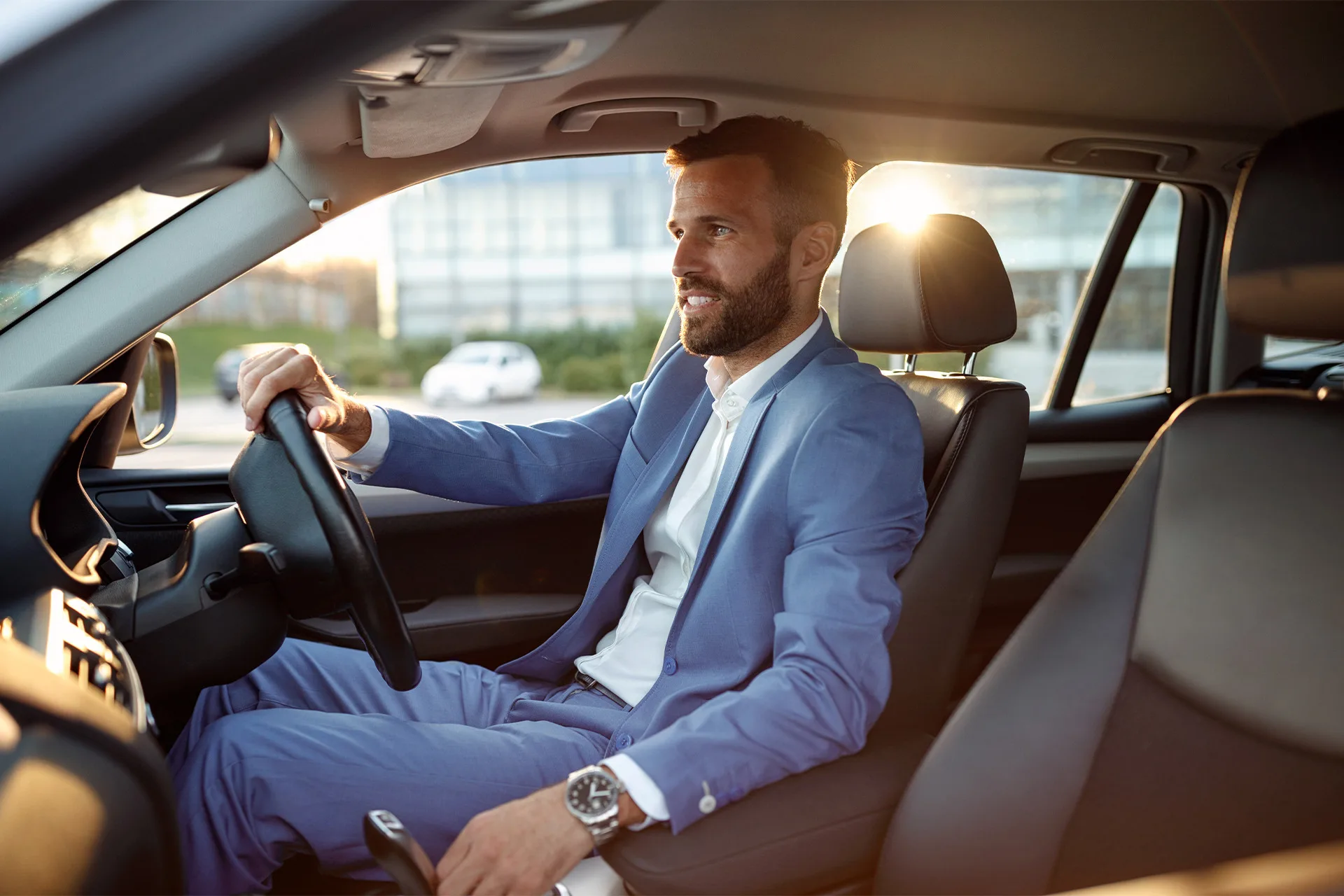
The Teltonika Private/Business Mode function lets the driver of a company car hide their coordinates in their own time, while the company keeps separate records of business and private trips. A company car that an employee also drives home and at weekends has long been an ordinary part of the benefits package. The trouble is that a tracker in such a car sees everything: the visit to a client and the Saturday trip to see relatives alike. Teltonika solved this in the tracker firmware: one button or one command, and the vehicle switches to private mode, where the coordinates are masked. This use case goes through how the mode is switched on, what options there are for hiding data, and what stays protected even in the employee's own time.
What this scenario solves
An employee uses a company car both for work and in their own time, and the tracker logs every trip without distinction.
The employer needs a record of business kilometres, while the employee does not want the company seeing where they go at weekends.
In a number of countries private use of a company car is taxed and has to be reported separately.
Without clear data, arguments about how many private kilometres are too many get settled by guesswork.
An employee uses a company car both for work and in their own time, and the tracker logs every trip without distinction. The employer needs a record of business kilometres, while the employee does not want the company seeing where they go at weekends. In a number of countries private use of a company car is taxed and has to be reported separately. Without clear data, arguments about how many private kilometres are too many get settled by guesswork.
The practice is extremely widespread, especially in small and medium-sized businesses. The car is provided for driving from home to work and back. The employee is allowed to call in at a hospital or a shop, to take the car on holiday, sometimes even to let a family member drive. For the employee this is a serious saving: no need to buy a car or take out a car loan. For the employer it is a way of keeping good people.
But the practice has two sides. On one, privacy. Being tracked constantly outside working hours annoys people, and in Europe it also runs up against GDPR requirements. On the other, control. The company pays for fuel, wear and insurance, and wants to understand where reasonable private use ends.
Two scenarios are usually encountered. The first is to track the vehicle only during working hours and put the tracker into private mode after the shift. The second is to switch tracking off in particular places, for example when the car enters the residential district where the employee lives.
The solution has to be one the driver can enable himself without extra fuss, while the company does not lose its protection against theft and still gets figures it can use in reports.
What Teltonika offers
The Teltonika tracker firmware includes a Private/Business Mode: in business mode the tracker logs everything as usual, while in private mode it masks the coordinates and, if required, stops counting mileage.
Installation and setup
Fitting the device and configuring it for the fleet scenario at hand.
Data transfer
The device collects data and sends it to the monitoring platform; how often depends on the model and its settings.
Analysis and control
The person in charge gets reports and alerts and looks into what stands out.
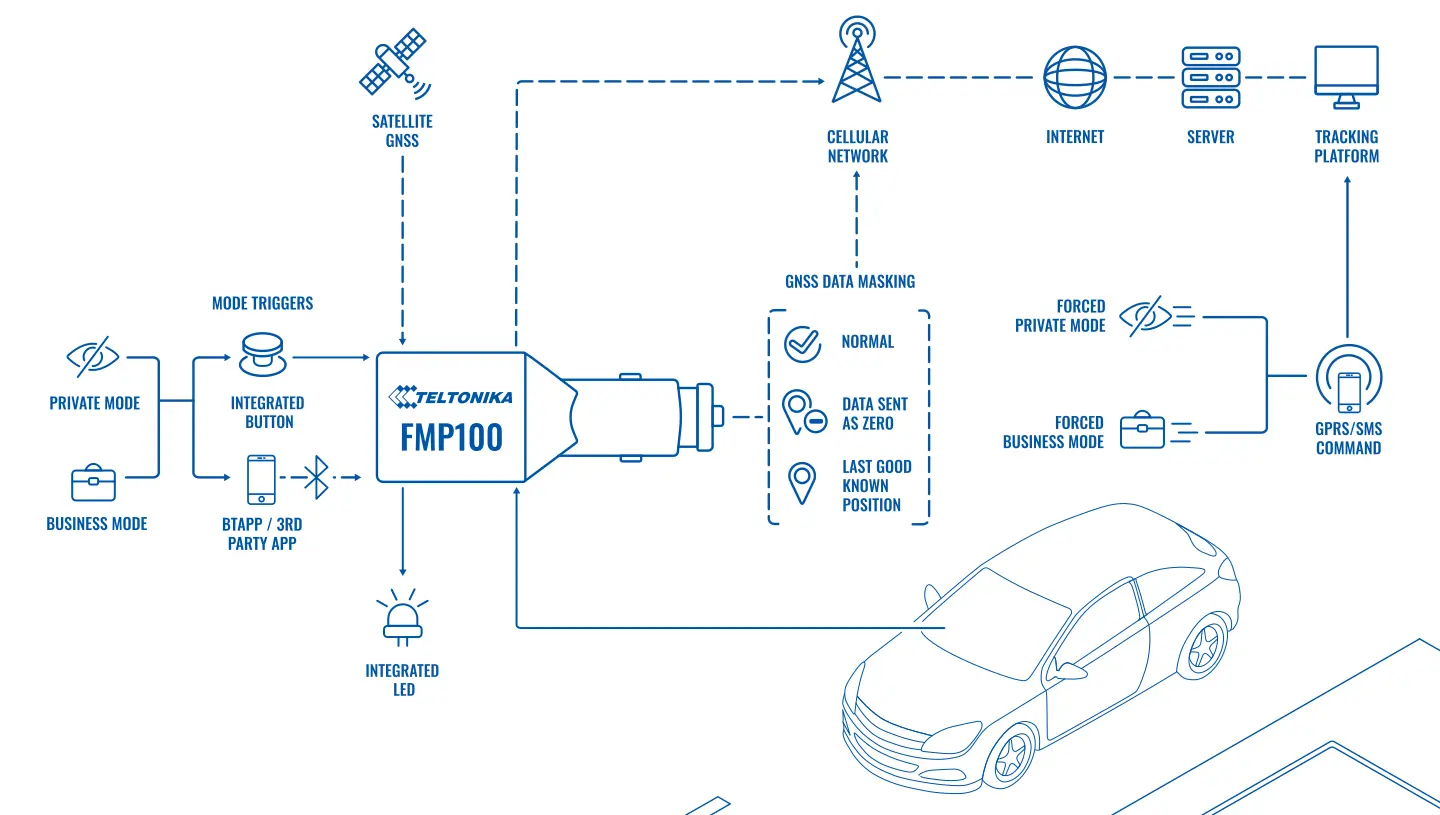
The logic is simple. In business mode the tracker records every configured event — trips, stops, mileage, ignition — and sends it to the server. In private mode some of that data is not registered. First of all the GPS coordinates, and if wanted the odometer calculation as well. In this way the mode addresses privacy and helps European companies meet GDPR requirements.
The FMP100 suits this scenario best of all. It has a private mode activation button right on the housing, which is a rarity in the Teltonika range. The driver presses the button and the mode switches. A built-in LED shows that private mode is on, so the driver does not have to guess. The FMP100 plugs into the cigarette lighter or a power socket and moves easily between vehicles.
The FMM130 is a compact 4G tracker for concealed fitting, wired into the vehicle's electrical system. On that device the mode is enabled in other ways. Teltonika trackers offer several in all: a command over GPRS or SMS, a command over Bluetooth LE, or the Teltonika BTAPP mobile application. This is convenient when the mode has to be switched from a phone or centrally from the office.
Exactly what the server sees in private mode is configurable. There are three options.
Normal — nothing is hidden. GPS and cellular network data are transmitted as always. This option is useful when the mode is needed only as a label for reports.
Zero data — instead of coordinates the tracker sends zeros: latitude, longitude, altitude, number of satellites, cell identifier and GSM location area code. On the map the vehicle simply disappears until it returns to business mode.
Last known position — in every record the tracker sends the coordinates where the vehicle was before it entered private mode, while the cell data is zeroed. The marker on the map freezes at the last business point and stays there until the mode is switched back.
So that the driver does not have to remember the button every time, the mode can be put on a weekly schedule. For instance, Monday to Friday from 9:00 to 18:00 is business, the rest of the time is private. The switching happens by itself.
The employer's main question is whether protection of the vehicle will be lost. It will not, provided this is configured in advance. On towing, loss of power to the tracker, crash detection or an auto geofence trigger, private mode can be lifted automatically on any Teltonika tracker. The coordinates then go to the server again and the vehicle can be found. To a thief, a car in private mode is exactly as uninteresting as one in business mode.
Reports on private and business trips — whether for tax or internal purposes — are built in the accounting software: on the telematics platform or in the company's own system. The tracker supplies the data needed for that: mode switching events and input-output parameters.
A real-life example. A sales manager finishes work at 18:30 after a meeting on the other side of town. He presses the button on the FMP100, the LED lights up, and the drive home and his evening errands are no longer visible on the map. On Friday evening somebody tries to take the car away from the yard on a recovery truck. The tracker detects the towing, lifts private mode and starts transmitting coordinates, and the person responsible at the company receives a notification.
What people usually ask at the start. "And what if the driver forgets to switch private mode off in the morning?" — the schedule will restore business mode by itself, and the report will show how much time the vehicle spent in private mode during working hours. "Can private mode be allowed only to some staff?" — yes, this is configured at the level of individual trackers. "Won't the driver just leave private mode on all the time?" — the switching report shows that straight away, and the question is settled by internal rules rather than by guesswork.
There is another option: private mode without full concealment. The company sees that a trip was private and counts its mileage, but does not see the route. This is a convenient middle ground for those who pay for fuel only on business kilometres. Technically it is the zero coordinates option with the odometer calculation left on.
Who sees what. Before launch it is worth setting out the access roles on the platform. The dispatcher sees only vehicles in business mode plus the current private status. The department head sees a report on mileage in private mode without routes. The security department receives coordinates only after the mode has been lifted automatically by an alert. These rights are configured through user accounts in Wialon, not by word of mouth.
The boundaries of working hours. A schedule defines working hours, but business trips, on-call duty and weekend call-outs do not fit into it. For those cases, agree who switches the mode manually and how, and how that is reflected in the report.
Handing the car over. If the vehicle passes to another employee, the schedule and the private mode rights have to be reconfigured on the tracker and on the driver record. Otherwise the new driver's private trips will be visible, or conversely his business trips will be hidden.
The alert procedure. Towing, loss of power or a crash while in private mode all mean that coordinates go to the server again. Decide in advance who receives the notification, who rings the employee and at what point the security department gets involved.
What you get
The employee's privacy is respected
Coordinates are hidden in their own time, and the person does not feel they are being watched at weekends.
A clear split between business and private kilometres
The company sees how far the car has been driven for work and can agree limits on private mileage based on figures.
Switching by button or by schedule
On the FMP100 the driver presses the button on the housing and watches the LED, while on other trackers the mode is changed by command or on a weekly schedule; which methods an employee is allowed is for the company to decide.
Theft protection is retained
On towing, loss of power or a crash, private mode is lifted and the vehicle is visible again.
Data for tax and internal reports
Mode events go to the server, and the private use report is built automatically, without paper logs.
Fewer conflicts and less abuse
The rules are clear in advance, each side has the data, and arguments about supposedly excessive trips are settled on the facts.
Why this solution
This function is built into the firmware rather than bolted on in software. That means the masking happens on the tracker itself: coordinates hidden in private mode never reach the server at all, and nobody in the office can see them by accident.
Flexibility is on Teltonika's side too. The mode is enabled by button, SMS, GPRS, Bluetooth, through the app or on a schedule. The masking method is chosen to suit the job: hide the vehicle completely, freeze it at the last point, or merely label the trips.
The FMP100 stands out for its physical button and indicator — which matters for people who do not want to get to grips with apps. The FMM130 is convenient for concealed fitting in vehicles where the mode is managed centrally.
And finally, the pairing of privacy with security. Automatic lifting of private mode on towing or a crash addresses the employer's main fear: with the lifting conditions correctly configured, the vehicle does not stay invisible during towing, a loss of power or an accident.
An honest limitation: the tracker does not itself produce tax reporting for any particular country. It supplies the raw data, and the report is assembled on the monitoring platform according to the company's rules.
How this works in Azerbaijan. Company cars with the right of private use are held here by sales representatives, regional managers, service engineers and executives in banks and oilfield services companies. The typical picture: the employee lives in Khirdalan or Sumgait, works in Baku and drives a company car every day. At the weekend that same car may head off to Guba, Gabala or to the sea at Nabran. Companies usually want to see business routes around the city and the regions, and in private time to limit themselves to monitoring mileage and fuel. Private mode with a schedule helps separate these interests, provided the rules are clear to both sides. We advise setting the rules out in advance in an internal company car policy and making sure drivers have read it. GPS.az fits the FMP100 and the FMM130, sets up the schedule, the masking option and the automatic lifting of the mode when the vehicle is at risk of theft, and delivers business and private trip reports to the Wialon platform.
Related case studies
Related rollouts and equipment

Questions about the “Private and business trips in a company car” scenario
Request a call
A specialist will call back and match a solution to your fleet and your task.