
A panic button in the cigarette lighter: FMP100
Teltonika's FMP100 is a tracker that plugs into the cigarette lighter socket and turns any car into one with a panic button, an audible speed warning and a private or business journey mode.
Teltonika's FMP100 is a tracker that plugs into the cigarette lighter socket and turns any car into one with a panic button, an audible speed warning and a private or business journey mode. The scenario is aimed at those who need to protect the driver without fitting work and wiring: private car owners, couriers, staff in company cars, and women drivers who often travel alone. Below: which risks this device covers, how its button is configured and where the limits of such an approach lie.
What this scenario solves
A driver on the road is often left alone with a threat: a robbery, an attempted theft of the vehicle, an assault in a car park.
At the critical moment the phone may be flat, lost or simply out of reach.
A sudden attack at the wheel — diabetes, the heart — leaves no time to look up a number and explain where you are.
Speeding remains one of the main causes of fatal road traffic accidents, and the driver does not always notice for themselves that they are going too fast.
A driver on the road is often left alone with a threat: a robbery, an attempted theft of the vehicle, an assault in a car park. At the critical moment the phone may be flat, lost or simply out of reach. A sudden attack at the wheel — diabetes, the heart — leaves no time to look up a number and explain where you are. Speeding remains one of the main causes of fatal road traffic accidents, and the driver does not always notice for themselves that they are going too fast.
In its description of the case Teltonika cites the Global Peace Index 2022: the economic damage from violence worldwide is put at 16.5 trillion dollars, and over the year it grew by more than 10%. The figure is an abstract one, but behind it are things that are easy to grasp. Couriers carrying takings get robbed. Insurers build vehicle theft into their premiums. In countries with a low safety index, business loses money and people more often.
An example from the same case is the South African Arrive Alive initiative. It makes a point of noting that women at the wheel have to be particularly careful: the risk of a hijacking with assault, and of abduction, is higher for them. Insurance will cover part of the loss on the vehicle, but it does not answer the main question — how to call for help in time.
It is a similar story with speed. According to the National Safety Council, speeding is linked to roughly 29% of road deaths. The driver knows the rules, but on an empty road the needle creeps up unnoticed.
A classic tracker under the dash handles these tasks poorly. A fitter installs it, it is tied to one vehicle, it has no button within the driver's reach and no way of giving a signal inside the cabin. For a private car, or one that is changed often, that option is inconvenient.
What Teltonika offers
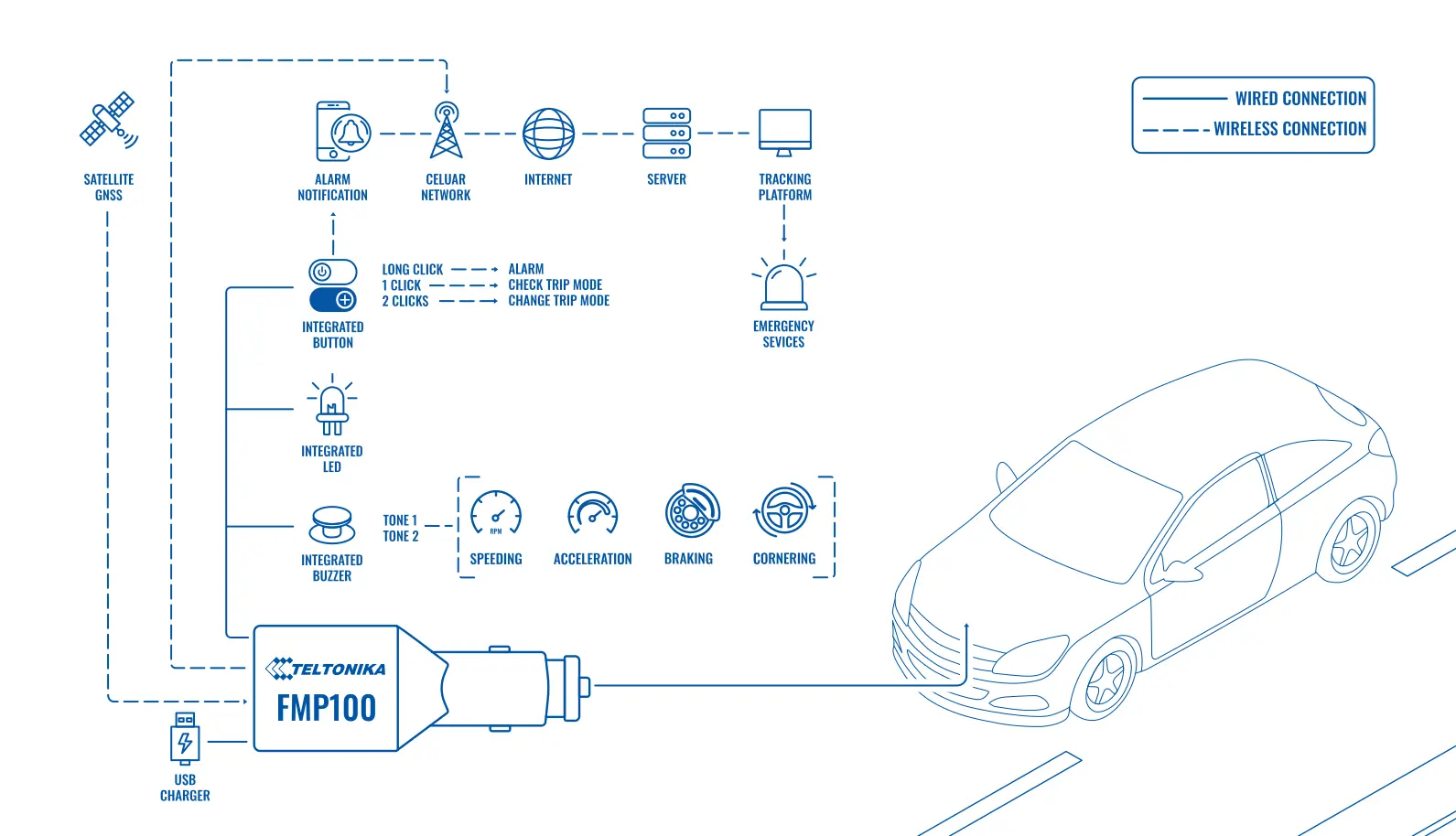
For these tasks Teltonika offers the FMP100 — a plug and play tracker that connects to the cigarette lighter in seconds and has a built-in programmable button, an RGB LED and a buzzer.
Installation and setup
Fitting the device and configuring it for the fleet scenario at hand.
Data transfer
The device collects data and sends it to the monitoring platform; how often depends on the model and its settings.
Analysis and control
The person in charge gets reports and alerts and looks into what stands out.
The key thing about the device is the button. In the Teltonika range a button right on the housing is a rarity, and it can be set up for a safety scenario. The button has three kinds of press, and each can be assigned one of four actions: do nothing, raise an alert, switch the journey mode or check the current mode.
In alert mode the tracker rings numbers set in advance and sends the vehicle's coordinates to the server. The numbers are entered in the Teltonika Configurator. For the driver it looks simple: press it in the agreed way and the dispatcher, a relative or a security firm sees the signal and the point on the map. No phone is needed for it.
The same button can be made an assistance button. A flat tyre at night, a dead battery, no fuel left, a recovery truck needed — the driver presses the button, and from there, under the company's or the breakdown service's rules, someone contacts them and drives to the coordinates received.
The button's second useful function is switching between private and business mode. In private mode the tracker does not transmit GNSS coordinates. That settles an argument that often arises over company cars: in the evening or at the weekend an employee drives on personal business and does not want their employer seeing the route. A separate press makes it possible to check which mode is currently on.
The RGB LED shines red, green or blue and shows the state of the GSM connection or GNSS satellite reception. The driver can see at once that the tracker is online. For paid services that depend on GNSS data that matters: losing the position there can turn into a heavy fine.
The buzzer works as an audible reminder. The most obvious scenario is speeding: the tracker beeps as soon as the vehicle goes past a set threshold. The sound can be tied to other events as well, depending on what the owner needs.
Over Bluetooth the FMP100 connects to an external speaker, a headset or the car's own hands-free system. On an emergency call the driver can talk to the operator without picking up a phone.
Fitting is not needed here in the usual sense. The tracker goes into the cigarette lighter socket and it works. It can be taken out and moved to another car in a couple of minutes, and the journey history is not lost in the process. That suits families with several cars, car-sharing drivers and companies where staff move from one vehicle to another.
In its description of the case Teltonika quotes research findings: about 20% of emergency medical calls from drivers are linked to diabetes, and another 11% to heart attacks. In a situation like that a person may not be able to reach a phone, while a button by the cigarette lighter is right beside their hand.
On the platform side an alert looks like an event with coordinates. The dispatcher sees the vehicle on the map, the time of the press and the type of event, and a notification can arrive by email, in the mobile app or in Telegram — however it has been set up.
The exact configuration. An FMP100 in the cigarette lighter socket, a SIM card with voice and data, and in the Configurator: which press of the button means an alert, which a call for assistance, which a change of journey mode; the numbers to ring; the speed threshold for the buzzer. On the platform: an alert notification with coordinates to those responsible, and an event log.
The response procedure matters more than the device. Decide in advance who takes an alert by day and by night, how they check that the press was not accidental (a call to the driver, an agreed word), and when security, an ambulance or the police are brought in. Without that order in place the signal will arrive but nobody will act on it in time.
What the result looks like. After a month of operation the log shows how many alerts and calls for assistance there were, how many of them turned out to be accidental presses, and how long it took from the press to the call by the person responsible. Those figures are what the button settings and the procedure are adjusted from.
The limits. The FMP100 does not replace a response service: it sends the signal and the coordinates, and help is organised by whoever receives them. If the cigarette lighter socket loses power with the ignition, operation while parked is limited by the capacity of the built-in battery.
What you get
Help without a phone
The panic button on the housing sends coordinates to the server and rings the numbers set, even if the smartphone is flat or has been taken away; all that is needed is a mobile connection at the tracker itself.
Breakdown assistance at one press
A puncture, a dead battery, an empty tank or a recovery truck needed: the signal goes with a point on the map, and there is no need to explain the address.
Fitted in seconds
The tracker goes into the cigarette lighter with no wiring, no fitter and no visit to a workshop; moving it to another car is just as simple.
A sound when the speed limit is passed
The buzzer reminds the driver of the threshold there in the cabin, rather than after the event in a report.
Private journeys stay private
The button switches the mode, and in personal time no coordinates are transmitted; that defuses the conflict around company cars.
You can see the tracker is online
The RGB LED shows GSM and GNSS status, so the driver is not left guessing whether the device is working.
Why this solution
In the Teltonika range the FMP100 stands out because the driver interacts with it themselves. An ordinary tracker works unnoticed and is there for the fleet owner rather than anyone else. Here the button, the sound and the LED all face the person at the wheel, and that is exactly why the model suits personal safety scenarios.
The device belongs to the FAST & EASY category: fitting it takes no special knowledge, no separate power supply and no dismantling of the dashboard. For the B2C segment that is the decisive point — a private car owner will not drive to a fitter for the sake of a panic button, but they can plug a device into the cigarette lighter themselves.
The button is programmed flexibly in the Teltonika Configurator. One and the same model can cover different tasks: for a courier service an alert when attacked, for a corporate fleet switching between private and business journeys, for a roadside assistance service calling out a recovery truck.
There are limitations worth knowing about in advance. A tracker in the cigarette lighter is easy to spot and pull out, so as an anti-theft measure it is weaker than a hidden installation under the dash. In vehicles where the cigarette lighter socket loses power along with the ignition, the device will run only from its own battery while parked. For finding a stolen vehicle a hidden wired tracker is a better fit, while the FMP100 is for protecting the person on the road.
How this works in Azerbaijan. The panic button scenario is most often needed here by couriers and delivery drivers carrying cash around Baku and Absheron, by sales representatives on the M-2 and M-4 roads, and by staff who travel alone to the regions — to Ganja, Sheki, Lankaran. A separate category is families where a teenager or an elderly parent uses the car: what matters to the relatives is getting a signal and a location if something has happened. When rolling it out we check whether the cigarette lighter socket stays live with the ignition off, and we agree in advance which numbers an alert goes to and who responds at night. In the mountain districts beyond Guba and Gusar the mobile connection drops in places: the tracker will save the points in memory and send them as soon as a network appears, but a call will not get through in a dead spot — that has to be understood. GPS.az, Teltonika's GOLD partner in Azerbaijan, sets up the button, the buzzer and the journey modes in the Configurator, connects the tracker to the Wialon platform and delivers alerts as notifications to a phone. The warranty on the device is 1 year.
Related case studies
Related rollouts and equipment



Questions about the “A panic button in the cigarette lighter: FMP100” scenario
Request a call
A specialist will call back and match a solution to your fleet and your task.