
A tracker for the season: the FMP100 in a lighter socket
Teltonika suggests that seasonal businesses should not buy fixed trackers for the whole fleet but rent the FMP100 instead: the device plugs into the cigarette lighter socket, works for the length of the harvest or the racing season and then moves to another vehicle.
Teltonika suggests that seasonal businesses should not buy fixed trackers for the whole fleet but rent the FMP100 instead: the device plugs into the cigarette lighter socket, works for the length of the harvest or the racing season and then moves to another vehicle. The logic is clear enough. A monitoring system pays for itself while the machines are working, and for a farmer, the organiser of winter races or a snow clearing contractor the machines work hard for two or three months a year. The rest of the time a tracker wired into the loom simply sits in the vehicle, while the connectivity and the platform still have to be paid for. With a plug-and-play tracker the sums change: you pay only for the season, fitting takes a minute, and after the season the device can be handed to another vehicle or returned to the service provider.
What this scenario solves
Fitting trackers properly across the whole fleet for the sake of two or three months of work looks far too expensive to a seasonal business.
Farmers give up on monitoring, even though sowing and harvest are exactly when they need it most.
Organisers of winter races cannot see where the competitors are on the course or what has happened to them.
Snow clearing contractors hire machines for the season and cannot fit permanent equipment into someone else's vehicles.
Fitting trackers properly across the whole fleet for the sake of two or three months of work looks far too expensive to a seasonal business.
Farmers give up on monitoring, even though sowing and harvest are exactly when they need it most.
Organisers of winter races cannot see where the competitors are on the course or what has happened to them.
Snow clearing contractors hire machines for the season and cannot fit permanent equipment into someone else's vehicles.
Vehicle monitoring proved its worth long ago. Teltonika cites a report according to which a fleet of 20 vehicles saves appreciable money every month with a fleet management system, and a Motorola study: GPS equipment saves about 54 minutes of working time a day on transport operations. But those calculations were made for vehicles that run all year round.
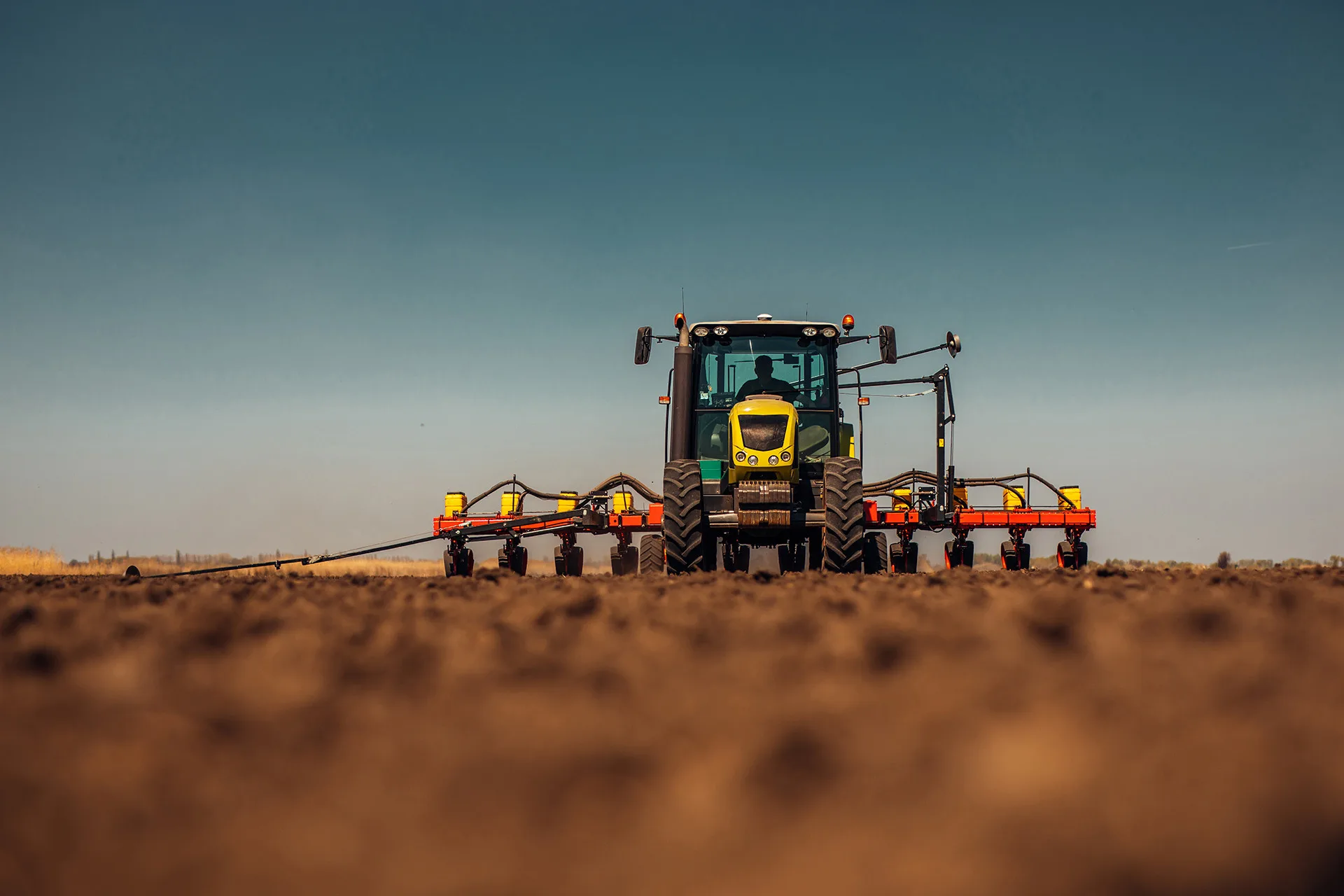
A seasonal business has different arithmetic. Take agriculture. Tractors, combines and lorries carrying the crop work at sowing and at harvest, a few months in total. That is precisely when it is useful to know which field has already been worked, where a vehicle is waiting to unload and why a lorry has not come back from the grain elevator for three hours. But a farmer usually will not commit to a fixed tracker wired into the loom for the sake of that window: the fitting, the subscription, and out of season the device is useless.
It is a similar story for the organisers of winter and snow races. A competition runs for a few days a year. Tracking competitors on the course, marking out the route, quickly finding someone who has gone off the track would all be very useful, but nobody wants to buy equipment for the sake of a single event.
And the third example is snow clearing. Contractors often work with hired or subcontracted machines. Taking someone else's dashboard apart to wire in a tracker is out of the question, yet routes and idle time still have to be kept under control.
In all three cases what is needed is a tracker that goes in without tools, works for exactly as long as it is needed and then moves to another vehicle.
What Teltonika offers
The Teltonika answer is renting plug-and-play trackers from the FAST & EASY range, in this use case the FMP100: it goes into the cigarette lighter socket, and a minute later the vehicle is on the map.
Installation and setup
Fitting the device and configuring it for the fleet scenario at hand.
Data transfer
The device collects data and sends it to the monitoring platform; how often depends on the model and its settings.
Analysis and control
The person in charge gets reports and alerts and looks into what stands out.
For telematics service providers this is a business model in its own right. They keep a pool of trackers, let them out for a season to farmers, event organisers and contractors, then take them back and let them out to the next customer. For the customer it is monitoring with no capital spending on equipment.
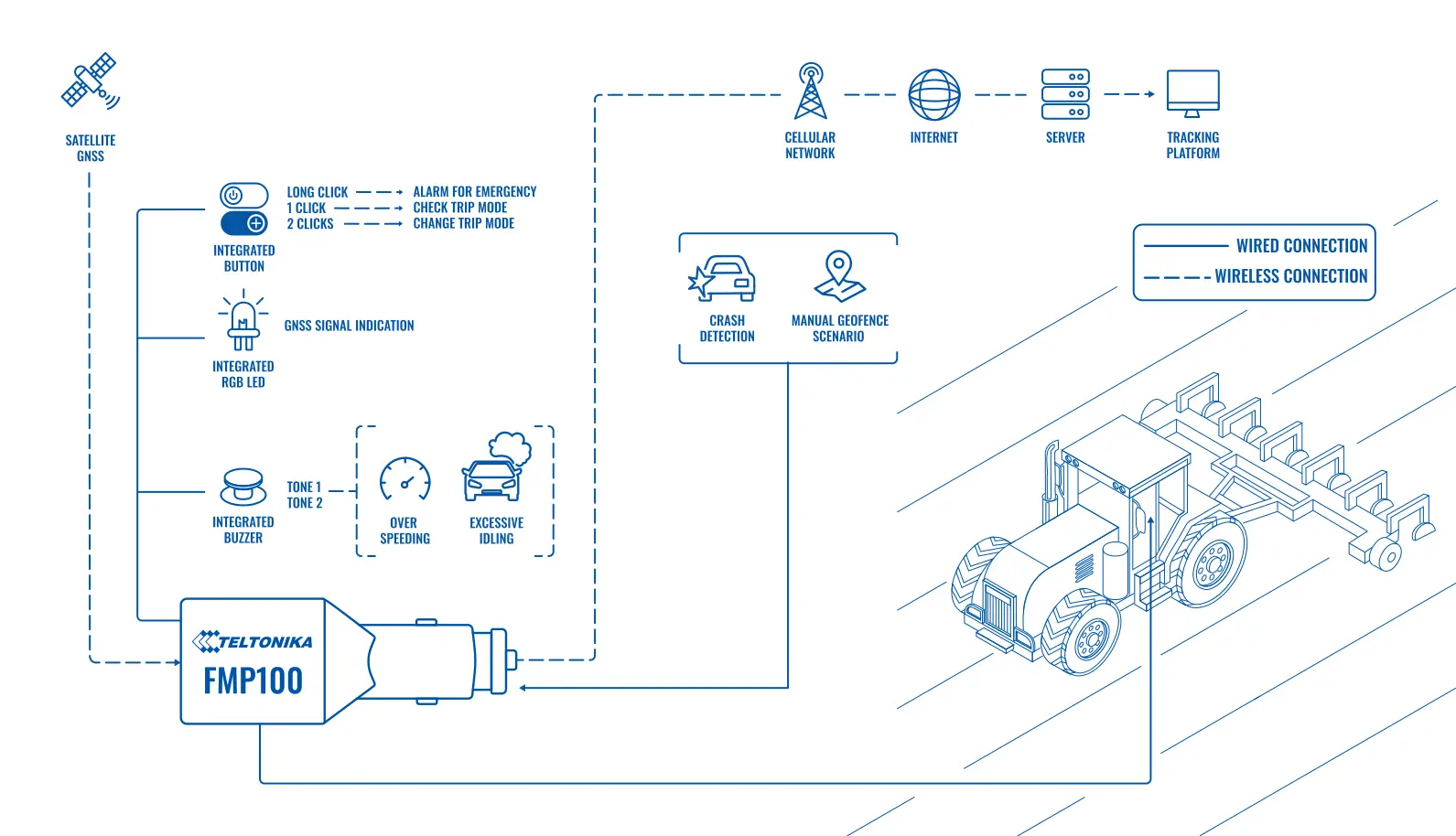
The FMP100 is built for exactly that. The housing plugs into the lighter socket and takes its power from there. There is no need to touch the wiring, and no special knowledge is needed either: the driver can plug the device in themselves. Inside there is a GNSS receiver, a modem, a configurable button, an RGB LED and a buzzer.
What the dispatcher sees. The vehicle's position in real time, its speed, the distance covered, changes in altitude. For an agricultural holding that is a map of machines in the fields; for a race organiser it is the position of each competitor on the course and their speed on different sections. After the event those data are useful for the debrief: where competitors lost time, which stretch of the course turned out to be dangerous.
Geofences. Virtual boundaries are drawn on the map: a field, a store, a depot, a section of the course. A notification arrives on entry and exit. A farmer learns that a lorry with grain has left the field heading away from the elevator rather than towards it. A race organiser sees that a competitor has gone outside the boundary of the course.
The button. It can be configured as a panic button. A competitor who has had a crash, or a tractor driver who has run into trouble in a field, presses the button and the dispatcher receives a signal with exact coordinates. Another option is switching the trip mode: the driver marks which trip is on business and which is private, and in the reports the two are kept apart.
The buzzer and the LED give the driver feedback: the tracker beeps or changes colour when the status changes, for instance on leaving a geofence or starting a trip in private mode.
Two more features earn their place specifically in season. Extended idling control shows where a vehicle stands for a long time with the engine running: that is fuel and wear for nothing. Crash detection reacts to a sharp impact or an unusual change in dynamics and sends an event so that help arrives sooner.
What a season with rented trackers looks like. A week before harvest the agricultural holding receives a box of twenty FMP100 units, already configured for its account. The foreman hands them out to the lorry drivers, and each one plugs the tracker into the socket of his own vehicle. Twenty markers appear on the map, and the geofences for the fields and the receiving station were set up in advance. A month later the dispatcher sees that one lorry consistently does one run fewer than the rest: it calls into a village for an hour along the way. The conversation with the driver now takes place with the track to hand. After the harvest the trackers are collected back into the box, and the provider reconfigures them for the next customer.
For the service provider the details matter: labelled boxes, serial numbers recorded against each customer, a check of the connector, the connection and the firmware version before hand-out. Then a pool of several hundred trackers works all year, moving from the farming season into winter and back again.
What a seasonal package includes. FMP100 units to match the number of vehicles, SIM cards for the length of the season, access to the monitoring platform with geofences for fields, depots and receiving stations set up in advance, and notifications for loss of power and for leaving a zone. Fuel consumption, the operation of mounted implements and CAN data are not part of such a package.
What the report after the season looks like. For each vehicle: mileage, the number of runs between field and receiving station, stops outside the geofences, extended idling and occasions when the tracker was pulled out of the socket. That is enough to reconcile the runs against the delivery notes and work out which vehicles performed worse than the rest.
Honestly about the limits. In some vehicles the lighter socket loses power along with the ignition, and then the tracker sends nothing while the vehicle is parked. In older tractors there may be no socket at all. And since the device is easy to pull out, an unscrupulous driver will pull it out just as easily, so the loss-of-power event is worth configuring as an alert from the start. For continuous fuel monitoring or recording the work of mounted implements, plug-and-play is not the right answer; a fixed tracker is needed there.
What you get
You pay only for the season
The tracker is rented for sowing, for a race or for the winter, and out of season you are not holding equipment or paying a subscription for vehicles standing still.
Fitting without tools
The FMP100 goes into the lighter socket in a minute, and the driver can manage it without an installer coming out.
One tracker for several vehicles across the year
After the harvest the device moves onto snow clearing or another machine with no wiring to remove.
A panic button for the driver
A press sends a signal with coordinates, which matters for race competitors and for anyone working alone in a field.
Geofences instead of phone calls
Notifications about entering and leaving a field, a depot or a course show what is happening without constantly ringing drivers.
Fewer stops with the engine running
Extended idling control shows where fuel is being burned for nothing.
Why this solution
Teltonika's FAST & EASY range was created specifically for quick fitting, and the FMP100 is one of its simplest trackers. Everything a season's work needs is already in the housing: connectivity, positioning, a button, audible and visual indication. No extra sensors or cables are required.
What matters for a telematics service provider is that Teltonika devices can be configured remotely. Before being let out to a new customer, a tracker is reconfigured over the air for their geofences and events, without being opened up or connected to a computer. That makes renting worthwhile for both the provider and the customer.
On top of that there is the manufacturer's technical support, the documentation and the Configurator with its clear interface. For a seasonal business with no IT department of its own, that lowers the barrier to entry appreciably.
How this works in Azerbaijan. Seasonal machinery here means agriculture above all. Cotton harvesting on the Kur-Araz lowland (Sabirabad, Saatly, Imishli, Beylagan), grain in Aghjabadi and Shamkir, the hazelnut harvest in Sheki, Gakh and Zagatala, grapes in Shamakhi and Goychay. For those weeks farmers bring in lorries and tractors, often other people's, and want to know where the crop goes between the field and the receiving station. The second scenario is summer tourism: transfers to Gabala, Nabran and Shahdag, which run for a few months of the year. What to allow for: older farm machinery often has no working lighter socket, and in the fields beyond Kurdamir and Ujar coverage is patchy in places, so the tracker has to buffer data in memory and the loss-of-power signal is best sent to the dispatcher immediately. If your machines work all year round, a fixed tracker with an Escort fuel sensor is the better buy. GPS.az picks the option to match the length of the season, sets up geofences for fields and depots and issues access to the Wialon platform.
Related case studies
Related rollouts and equipment

Questions about the “A tracker for the season: the FMP100 in a lighter socket” scenario
Request a call
A specialist will call back and match a solution to your fleet and your task.