
Waste container records from BLE beacons
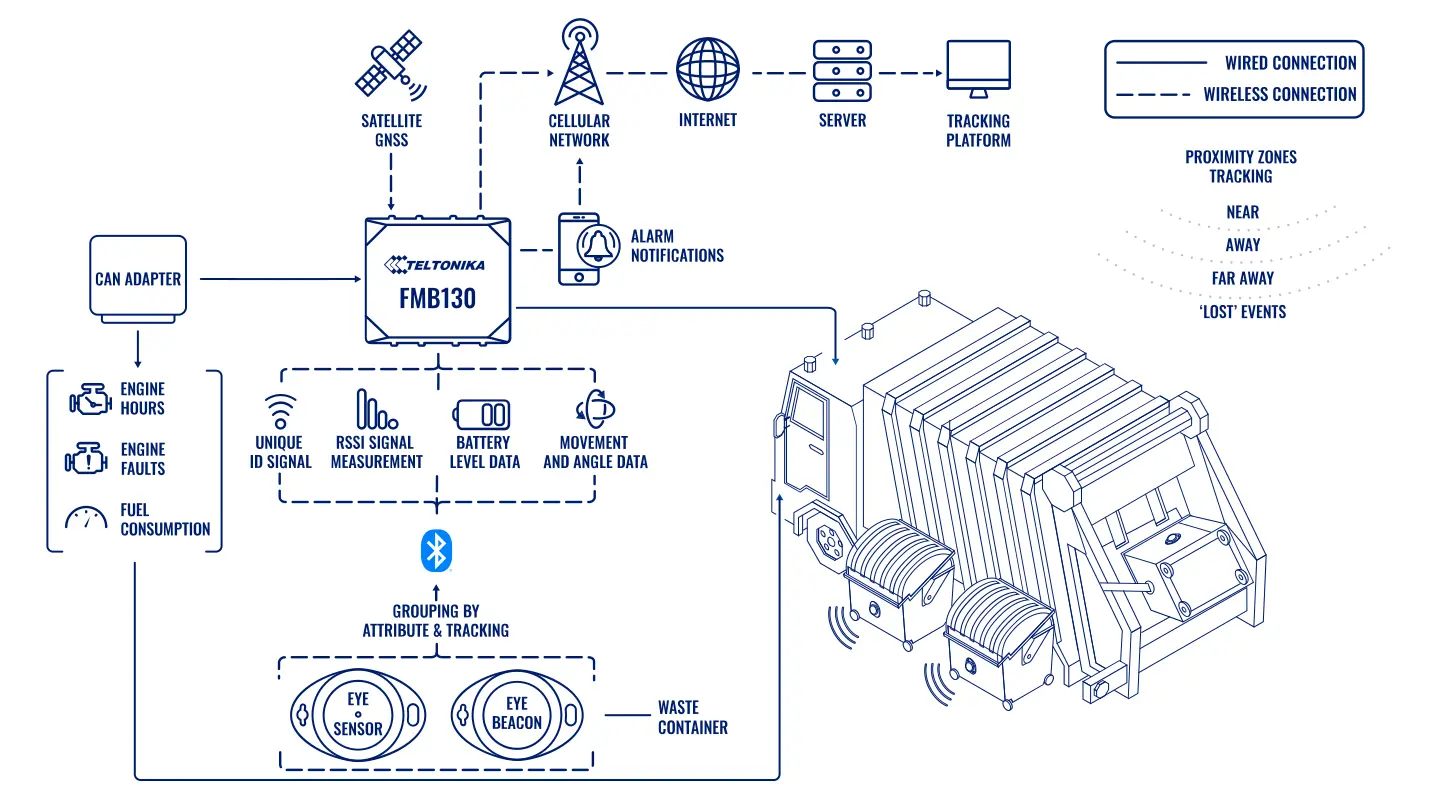
A Teltonika scenario for municipal services: EYE Beacon beacons or EYE Sensor devices go on the waste containers, and an FMB130 tracker in the refuse lorry records by itself which container the vehicle served, when, and whether it was lifted and emptied.
A Teltonika scenario for municipal services: EYE Beacon beacons or EYE Sensor devices go on the waste containers, and an FMB130 tracker in the refuse lorry records by itself which container the vehicle served, when, and whether it was lifted and emptied. Every waste hauler knows the argument that begins with you did not empty our bin. The residents say one thing, the driver says another, and neither side has any proof. Once every container has its own radio identifier and every vehicle a tracker that hears it, the answer comes from a report rather than from setting one account against the other.
What this scenario solves
According to the World Bank report "What a Waste 2.0", more than 2 billion tonnes of municipal solid waste is generated worldwide every year.
At least a third of it is disposed of in ways that are unsafe for the environment.
By 2050 the volume could rise to 3.4 billion tonnes, roughly 70% more, which is twice as fast as population growth.
Waste collection is an expensive, labour-intensive business.
According to the World Bank report "What a Waste 2.0", more than 2 billion tonnes of municipal solid waste is generated worldwide every year. At least a third of it is disposed of in ways that are unsafe for the environment. By 2050 the volume could rise to 3.4 billion tonnes, roughly 70% more, which is twice as fast as population growth.
Waste collection is an expensive, labour-intensive business. Transport alone costs 20–50 dollars a tonne, and every extra run or empty detour eats into the margin.
There are many containers and they vary: street bins, separate-collection bins, container bays beside blocks of flats, skips at business premises. The fleet manager needs to know precisely whether a particular container was tipped into a particular vehicle, at what time, and whether it was emptied.
Without that data it is hard to plan routes and collection schedules, to spot broken or missing bins and to answer for property the company services under contract.
What Teltonika offers
Teltonika offers a combination of Bluetooth beacons on the containers and an FMB130 tracker in the refuse lorry: the vehicle pulls up at the bay, the tracker hears the beacon, records its number together with coordinates and time and sends it to the server.
Installation and setup
Fitting the device and configuring it for the fleet scenario at hand.
Data transfer
The device collects data and sends it to the monitoring platform; how often depends on the model and its settings.
Analysis and control
The person in charge gets reports and alerts and looks into what stands out.
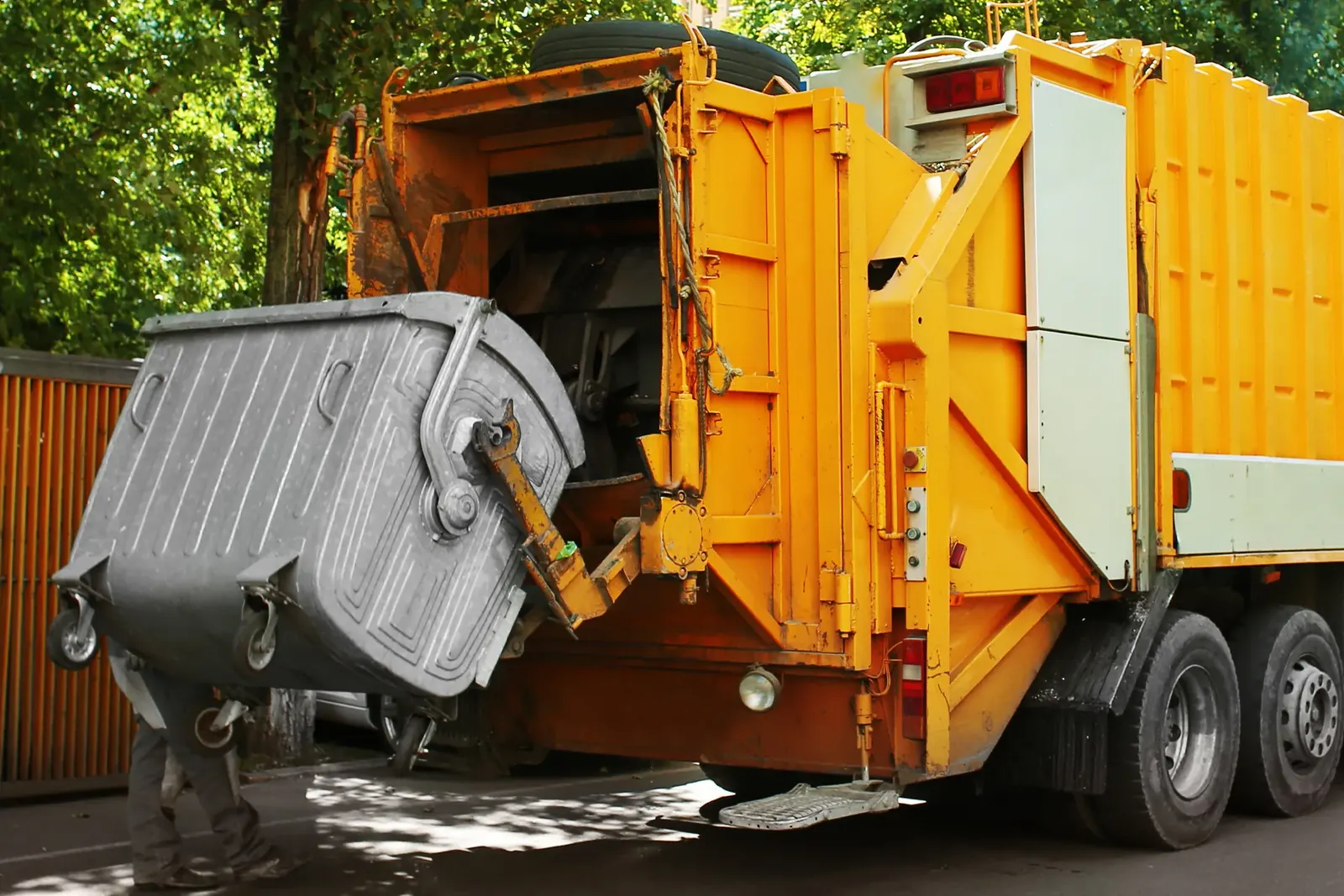
The EYE Beacon option. Each beacon broadcasts its own number continuously at a configurable interval. The tracker in the refuse lorry's cab reads those signals and sends the data in iBeacon or Eddystone format together with GNSS coordinates. On the server this builds a picture: where each tagged container stands (from the position of the tracker that saw it), when the vehicle came up to it and how long it stood alongside. The proximity events function allows containers to be grouped by their distance from the vehicle and filters out bins the tracker heard from the next street.
The EYE Sensor option. This device also broadcasts its number, but it has an accelerometer inside along with movement state and count and tilt angle functions. So it reports both that it is there and that it has been lifted and turned over. When the refuse lorry is nearby and the sensor is within Bluetooth range, the FMB130 records those events and passes them to the server. A container being lifted and tilted is precisely the confirmation that it was emptied rather than merely driven past.
How it looks for the dispatcher. In the morning a vehicle sets out on a route of 120 bays. By lunchtime the report shows that 112 containers were served with a lift recorded, that at six bays the vehicle was present but no bin was lifted, and that two containers were not seen at all. The driver is called about the six: blocked in by parked cars, could not get close. A supervisor is sent out to the two that are missing — one turned out to be tipped over and broken, the other had been dragged into the courtyard next door.
The container data sits on top of ordinary refuse lorry monitoring: the track, speed, stops, mileage. It is used to rebuild routes, to cut out empty detours, and to see which bins fill up faster and need collecting more often.
Where to start. Normally not with beacons on every bin in the city, but with one or two routes that attract the most complaints. Their containers are tagged, the list of the operator's own beacons is entered into the tracker configuration, and the data is watched for a month: are all the bins seen, do neighbouring bays get confused, is the transmission interval adequate. After that it is clear what scaling up will cost and what effect it has on runs and on complaints.
One more benefit that does not come to mind straight away is contracts with businesses and property managers. Where payment is for containers actually emptied, a report with lift records becomes the basis for the certificate of work, and disputed invoices become markedly rarer.
What you get
Every container on the books
The dispatcher sees when and by which vehicle any bin or group of bins was served, and answers complaints with facts.
Confirmation that the bin was emptied
An EYE Sensor records the lift and the tilt, so driving past is distinguishable from collecting.
Inexpensive and wireless
A beacon is fitted in minutes and configured from a mobile app for Android and iOS, and a broken or stolen one is quickly replaced.
Added to trackers already in service
If the refuse lorries carry Bluetooth-capable Teltonika trackers, it is enough to fit beacons to the bins and update the configuration.
Fewer needless runs and less lost property
Routes are built on real data, and missing containers are found quickly.
Why this solution
There is no expensive electronics on the containers themselves in this arrangement. An EYE Beacon or EYE Sensor costs little, runs on a battery for years and needs neither a SIM card nor a power supply. All communication with the server goes through the tracker in the vehicle, which is needed for monitoring anyway. That is why the economics work even for thousands of containers.
Beacons and sensors are configured from the Teltonika mobile app: you can change the transmission interval and check charge and signal at the bay itself. The FMB130 supports several Bluetooth devices and can filter them, so that only the operator's own containers reach the report.
Limitations. A beacon announces itself only when a vehicle with a tracker passes nearby. If nobody has come near a container for a week, all the system knows about it is that it has not been served for a long time. A beacon does not measure how full the bin is; separate fill-level sensors are needed for that. The beacon has to be mounted so that lifting does not tear it off and the grab does not damage it: most often it goes in a protected spot under the rim of the container.
How this works in Azerbaijan. The problem is a live one for municipal services and private waste contractors in Baku, Sumgait and Ganja, for the managers of residential complexes in Absheron, and for industrial zones and resort areas such as Gabala and the Nabran coast, where waste volumes rise sharply in summer. What we allow for when fitting: our containers stand in direct sun and heat up, so the beacon is tucked into the shade of the structure; bins are often washed down with pressurised water, and the mounting has to stand up to it; in the older districts of Baku the bays are hemmed in by parked cars, so proximity events must be configured so that neighbouring courtyards are not confused. GPS.az fits the trackers in the refuse lorries, helps tag the containers and configures reports in Wialon on bays served and bays missed, so that any complaint can be answered with a time and coordinates.
What to check on the pilot route. At several bays you look at the distance from which the tracker sees a beacon, whether it picks up bins from the courtyard next door, and how the beacon stands up to lifting and washing. For each container the report keeps the time it was last served, the vehicle and a lift flag, while containers that have not been within range of a vehicle for a long time go into a separate list.
Related case studies
Related rollouts and equipment

SECO: bringing a stolen vehicle safely to a halt
Car sharing and rental
Keeping track of trailers with EYE Bluetooth beacons
Logistics and delivery

Two trackers against the theft of leased vehicles
Car sharing and rental
Questions about the “Waste container records from BLE beacons” scenario
Request a call
A specialist will call back and match a solution to your fleet and your task.