
SECO: bringing a stolen vehicle safely to a halt
SECO is a function of Teltonika's FMB range of trackers that, on a command from the owner or the dispatcher, brings a stolen vehicle safely to a halt: first it forces the driver to slow down, and then it cuts the engine once the vehicle is almost stationary.
SECO is a function of Teltonika's FMB range of trackers that, on a command from the owner or the dispatcher, brings a stolen vehicle safely to a halt: first it forces the driver to slow down, and then it cuts the engine once the vehicle is almost stationary. The case uses the FMB130. The solution is for hire companies, car sharing, logistics, courier services, owners of expensive plant and of premium cars — everyone for whom a theft means a vehicle lost, and with it the load, the customer and time. We look at why simply cutting the engine is dangerous, how the SECO scenario is put together and what to bear in mind when connecting it.
What this scenario solves
Professional thieves take a vehicle away in a matter of seconds, including by getting round keyless entry systems.
More than half of stolen cars are never recovered by the police.
Hire cars are stolen particularly often: the customer receives the keys lawfully and simply does not bring the vehicle back.
You cannot cut the engine abruptly while the vehicle is moving — that is a direct route to a road traffic accident in the middle of the traffic.
Professional thieves take a vehicle away in a matter of seconds, including by getting round keyless entry systems. More than half of stolen cars are never recovered by the police. Hire cars are stolen particularly often: the customer receives the keys lawfully and simply does not bring the vehicle back. You cannot cut the engine abruptly while the vehicle is moving — that is a direct route to a road traffic accident in the middle of the traffic.
The scale is shown with figures in the Teltonika case: in 2018 the losses from vehicle theft exceeded 6 billion dollars. In Germany a car is stolen every 35 minutes, in Australia every 10 minutes, in the USA every 6.5 minutes. In Texas alone, between 2015 and 2018, 92,000 hire cars went missing.
The methods vary. Stealing a vehicle left unattended. A robbery with an assault on the driver. Fraud over a hire or a purchase. Taking a vehicle for a joyride. Breaking into Keyless-Go systems with a signal relay. For a criminal it is comparatively low-risk earnings, and a stolen vehicle is often broken up or taken out of the country before the owner has time to report it.
The second problem is the behaviour of drivers of hire cars. Aggressive driving speeds up wear on the engine, tyres and suspension, increases fuel consumption and the number of accidents. For a hire company that is a constant expense, and one that is hard to prove and to charge to the customer.
Many remote immobilising systems share one shortcoming: they cut the engine at once, without regard to speed. On a road the vehicle loses power steering and brake assistance, and the driver, thief though they may be, can lose control. Responsibility for an accident like that rests with whoever pressed the button.
What Teltonika offers
Teltonika answers the problem with SECO (Secure Engine Cut-Off): the tracker brings the vehicle to a halt gradually and under control, taking its speed into account, rather than cutting the engine's supply at once.
Installation and setup
Fitting the device and configuring it for the fleet scenario at hand.
Data transfer
The device collects data and sends it to the monitoring platform; how often depends on the model and its settings.
Analysis and control
The person in charge gets reports and alerts and looks into what stands out.
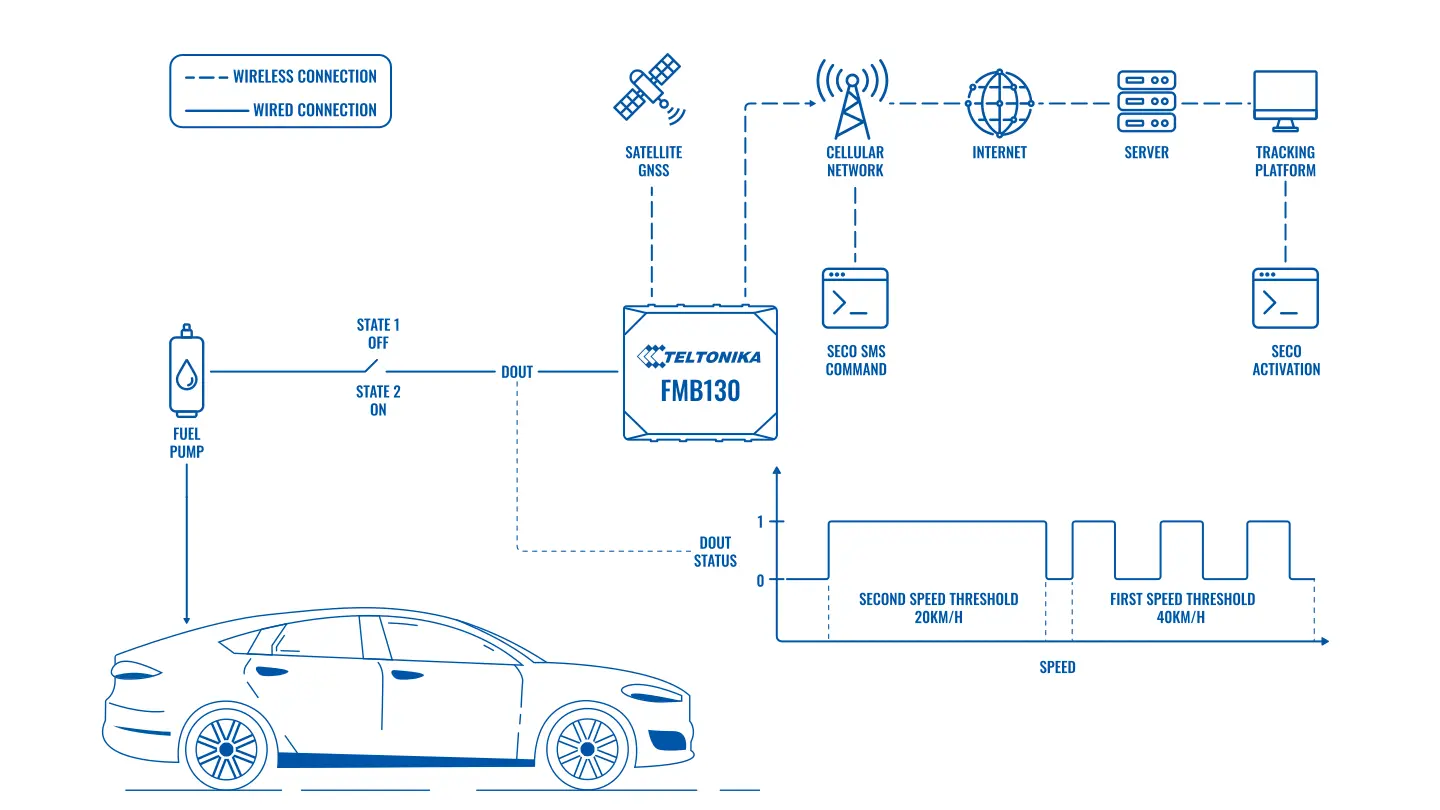
SECO is available in every tracker in the FMB range that has at least one digital output (DOUT), from firmware 03.28.02 onwards. The case uses the FMB130, a new-generation tracker with a flexible set of inputs and outputs. Setting the function up takes a few minutes in the Teltonika Configurator.
The wiring arrangement is simple: the tracker's digital output controls a relay in the fuel pump circuit. Open the circuit and the fuel stops flowing, and the engine stops. The whole point of SECO is when and how that happens.
The scenario looks like this. An authorised person — the owner, a dispatcher, a member of the security team — sends the command: with a button in the monitoring software, in the mobile app or by SMS. If at that moment the vehicle is travelling faster than a set threshold, the tracker switches into a mode that forces the driver to slow down: the fuel supply is restricted intermittently, and driving fast becomes impossible. As soon as the speed drops below the threshold, the tracker holds the DOUT on permanently, and the engine stops at low speed.
The result is that the vehicle comes to a halt gradually, with no sudden loss of drive at high speed. The thief will not get any further in this vehicle, and the risk of an accident is noticeably lower than with instant immobilising, although it cannot be ruled out altogether: the driver may stop in an awkward place.
Monitoring then comes into play. The stopped vehicle is visible on the map in the AVL software — from a smartphone, a tablet or a computer. Its location can be passed to the police or to a security firm, and the vehicle and its load are recovered faster.
SECO works in combination with the other security features of Teltonika trackers: the immobiliser, detection of a loss of power, towing detection, automatic and manual geofences. A vehicle will not start without the driver being authorised, for instance, and if someone tries to take it away on a recovery truck the owner will get a towing alert, as long as the tracker is online. The more such barriers there are, the less attractive a target the vehicle becomes.
Cutting the engine can be tied to other on-board systems as well: door and temperature sensors, electronic seals on the load, trailer coupling sensors. If the on-board computer records a seal being broken or a loss of communication, a pre-written immobilising protocol can be triggered.
SECO is used most often by courier services, logistics companies and freight forwarders, taxi fleets, owners of expensive construction plant, of collectors' and premium cars, and of executive corporate fleets. The function is even used on yachts and motor boats.
How it looks in practice. At night the dispatcher at a hire company sees that a vehicle which should be standing at a customer's address in town is travelling along a main road at 120 km/h towards the border, and the customer is not answering calls. They send the immobilise command. The tracker receives it and starts restricting the fuel supply: the vehicle loses drive, the driver is forced to slow down and pull over onto the verge. When the speed drops below the threshold the engine stops for good, and it cannot be restarted without the block being lifted. The dispatcher passes the point on the map to the police, and once the vehicle is back lifts the block with the same button.
When the command may be sent. The conditions are best written into internal rules: the theft or non-return is confirmed (the customer is not answering, the vehicle is outside the permitted area, a towing or power-loss alert has been triggered), the vehicle is not on a level crossing, in a tunnel or on a bridge as far as can be seen from the map, and the police or the security firm have been informed. SECO reduces the risk, but the decision to stop a vehicle is still taken by a person.
Who has the right. Sending the immobilise command in Wialon is opened up only to particular accounts, the senior dispatcher and the security team for instance. Other users see the vehicle but do not send the command. SMS commands are accepted only from permitted numbers entered in the tracker.
The log of actions. Every immobilise and release command goes into the platform log with the time, the user and the tracker's response. That log is needed when the situation is gone over with the insurer, the police or the customer.
What SECO does not guarantee. The function stops the vehicle but does not recover it: from there it is the police and the security firm who do the work. If the tracker has been found and disconnected before the command, or the vehicle is out of coverage, the block will not take effect until the command gets through.
What you get
A halt that takes speed into account
The engine stops only after the speed has dropped below the threshold, so the vehicle does not come to a dead stop in the middle of a main road.
A better chance of recovering the vehicle and the load
A stopped vehicle is visible on the map, and its position can be passed straight to the police or a security firm.
The command from any device
The block is triggered with a button in the monitoring software, from the mobile app or by SMS from an ordinary phone.
Works alongside the immobiliser and geofences
SECO adds to the detection of towing, loss of power and departure from the permitted area.
Set up in minutes
The function is already in FMB range trackers that have a digital output; all that is needed is firmware 03.28.02 or newer and a relay in the pump circuit.
Why this solution
SECO's chief merit is the safety of the immobilising process itself. Remote engine cut-off is offered by many manufacturers, but the logic of slowing the vehicle first and cutting the engine only at low speed removes the main risk of such a function — an accident caused by the person who triggered it.
The FMB130 suits this scenario for its set of interfaces: it has several digital inputs and outputs, so an immobiliser relay, a door sensor, a panic button and a driver identification reader can all be connected at once. The function is built into the firmware, and there is no separate module to buy.
The limitations are worth naming as well. SECO requires a relay to be physically fitted into the fuel pump circuit, and on vehicles under warranty that is better agreed with the dealer. On diesel machinery with a mechanical injection pump the arrangement differs and is worked out for the particular model. If a thief has found and torn out the tracker, the command will not get through — which is why the device is fitted out of sight and power-loss alerts are switched on.
How this works in Azerbaijan. The most frequent customers for remote immobilising here are hire companies in Baku renting vehicles to tourists and visitors, taxi fleets and car sharing, and owners of plant and heavy equipment working at remote sites: on the construction projects in Karabakh and East Zangezur, in quarries, in the oilfields of Absheron. The typical hire company story is a vehicle heading down the M-3 towards Astara or along the M-2 to the Georgian border, with the need to stop it before it crosses. When rolling this out we set the speed threshold in advance, agree who in the company has the right to send the command, and test the immobiliser on a yard rather than on the road. In the mountains beyond Guba the connection can be unsteady, so we back up the GPRS command with SMS. GPS.az, Teltonika's GOLD partner in Azerbaijan, fits the FMB130 with an immobiliser relay, sets up SECO, geofences and alerts and connects it all to the Wialon platform, where the dispatcher sees the vehicle and sends the command from one window. The warranty on the tracker is 1 year.
Related case studies
Related rollouts and equipment
Questions about the “SECO: bringing a stolen vehicle safely to a halt” scenario
Request a call
A specialist will call back and match a solution to your fleet and your task.