
DualCam while parked: power switched through DOUT
The Teltonika FMC125 tracker with the DualCam camera controls the camera's power through a digital output and a relay, so the camera can film and send frames even with the ignition off, and without flattening the vehicle battery overnight.
The Teltonika FMC125 tracker with the DualCam camera controls the camera's power through a digital output and a relay, so the camera can film and send frames even with the ignition off, and without flattening the vehicle battery overnight. A case for delivery services, logistics, passenger transport and insurance companies. They share one problem: most dash cameras go to sleep along with the engine, while minor collisions, vandalism and theft most often happen exactly where the vehicle is parked — at a depot or in a rest area. We look at which tasks this closes, how the power switching is arranged and what else the FMC125 and DualCam pairing can do.
What this scenario solves
Most vehicle cameras stop recording as soon as the driver switches the ignition off.
And it is in car parks, at depots and in overnight rest places that minor road traffic accidents, vandalism and theft most often happen.
A dispatcher cannot look at what is going on around the vehicle until the engine is running.
Connect the camera straight to the battery and by morning it may be flat, and the run is lost.
Most vehicle cameras stop recording as soon as the driver switches the ignition off. And it is in car parks, at depots and in overnight rest places that minor road traffic accidents, vandalism and theft most often happen. A dispatcher cannot look at what is going on around the vehicle until the engine is running. Connect the camera straight to the battery and by morning it may be flat, and the run is lost.
The first problem is that there is no data on request. Suppose the tracker registered harsh braking or a long spell of idling, and a minute later the driver shut the engine down. The dispatcher wants to understand what happened, but the camera is already asleep. Waiting until the morning start means losing time on the review and on the answer to the client.
The second is that the camera cannot be switched on at the moment it is needed. The tracker reports that the vehicle is being towed out of the car park, but there is no way to see who is loading it onto the recovery truck. In situations where minutes count, having no picture means reacting blind.
The third is power. The obvious move is to connect the camera to a permanent live feed from the battery. But a camera that runs all night can flatten it. A long-distance driver who has stopped for the night with the engine off simply will not start in the morning. On long routes that turns into a recovery truck, a delay and a penalty for a missed delivery.
The upshot is that the company either has no video while the vehicle is parked, or puts its batteries at risk. Neither will do if you want both to keep the vehicle safe and not to lose the run.
What Teltonika offers
Teltonika's answer to this is the FMC125 tracker from the PROFESSIONAL line paired with the DualCam two-camera recorder: the camera is powered through a relay controlled by the tracker's digital output (DOUT), so it can be switched on with the engine shut down exactly when it is needed and for exactly as long as it is needed.
Installation and setup
Fitting the device and configuring it for the fleet scenario at hand.
Data transfer
The device collects data and sends it to the monitoring platform; how often depends on the model and its settings.
Analysis and control
The person in charge gets reports and alerts and looks into what stands out.
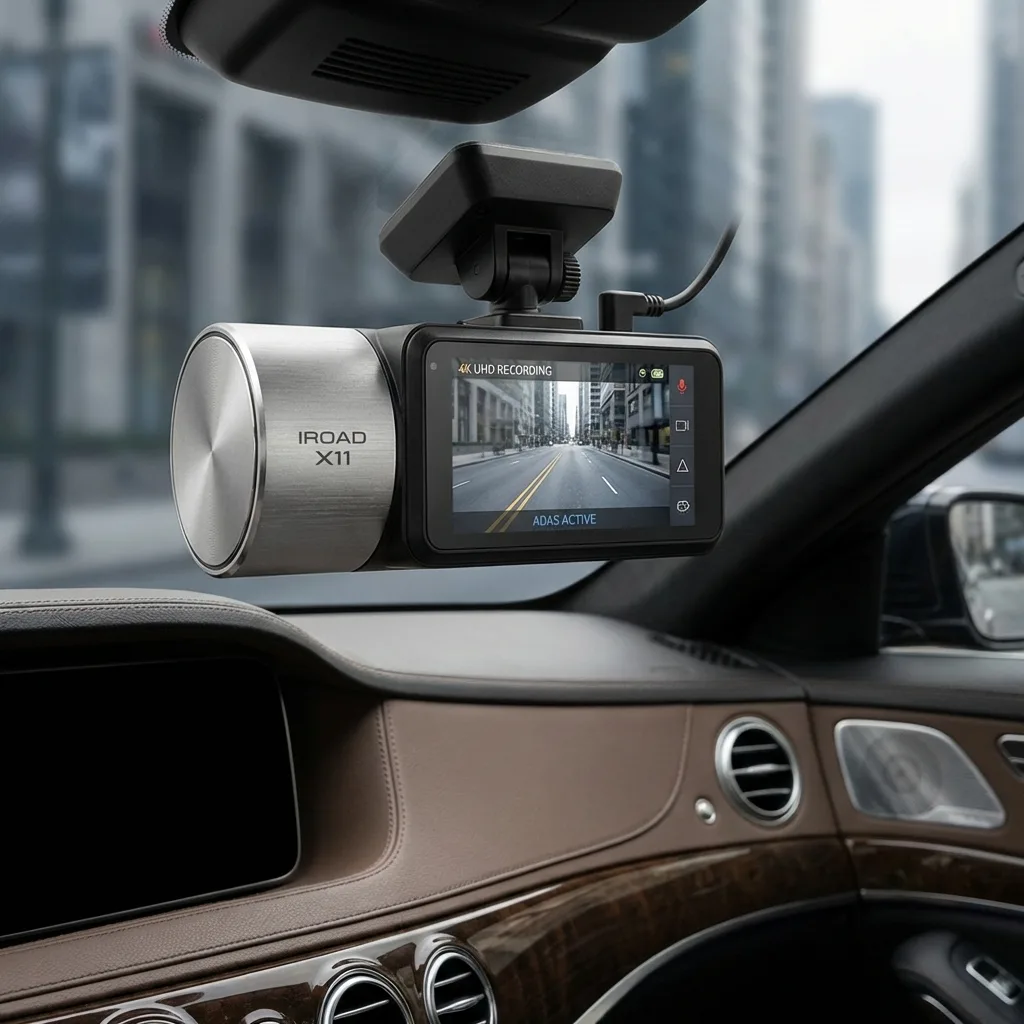
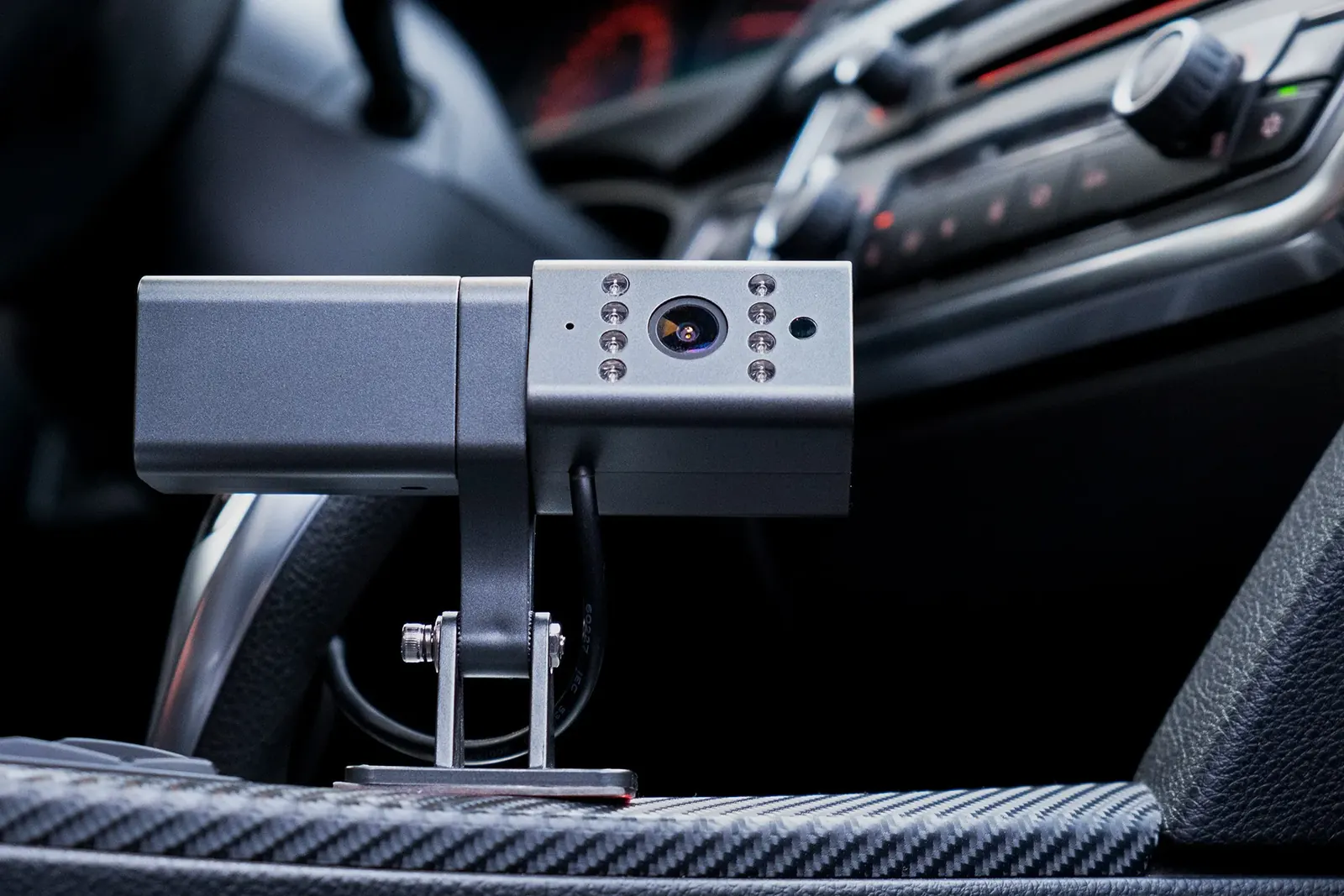
DualCam films in two directions at once — the road ahead and the cab with the driver. That gives two points of view on an event: what was in front of the vehicle and what the person at the wheel was doing.
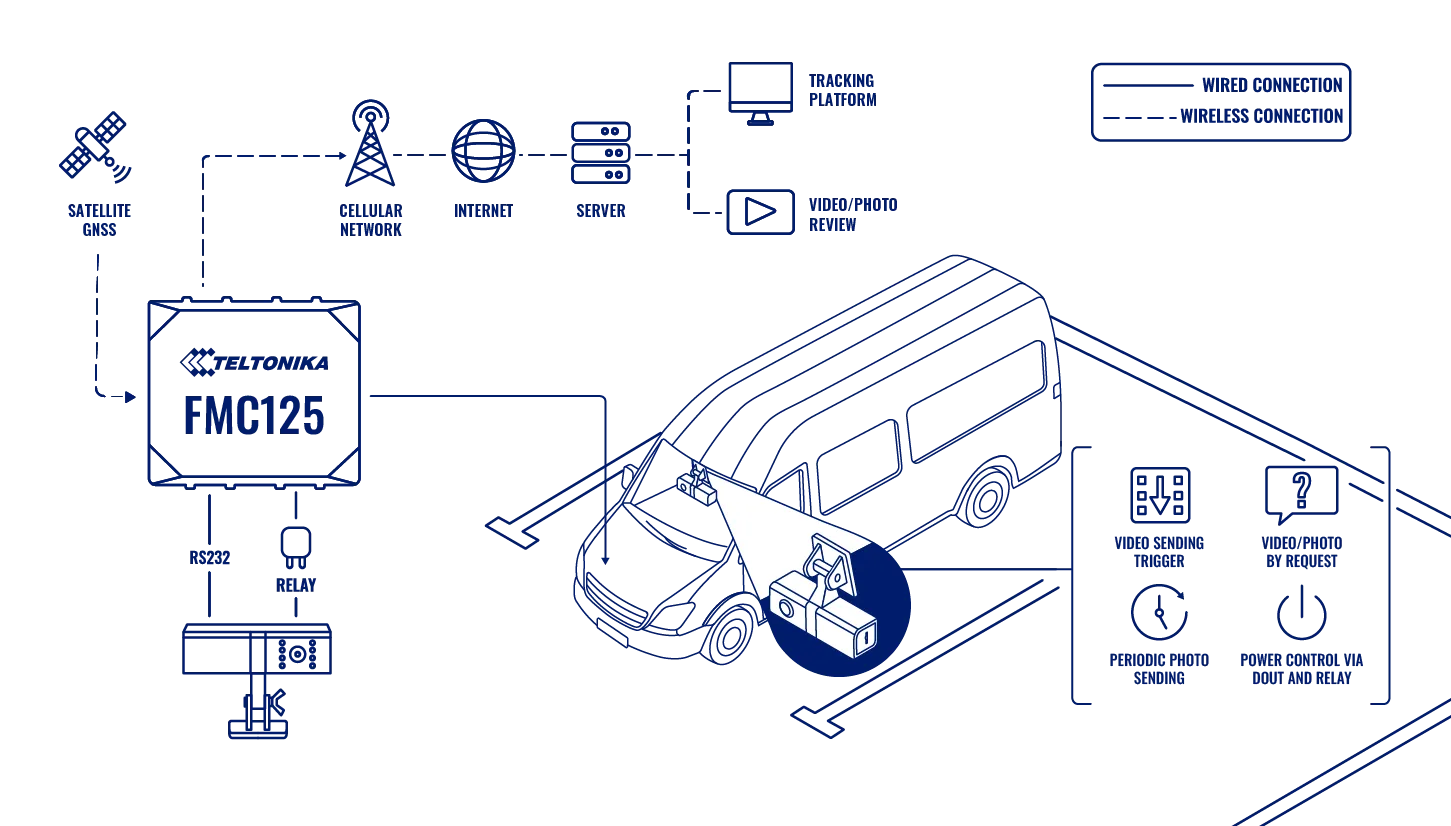
The heart of the solution is the power relay. It sits between the camera and the vehicle's electrical system, and the tracker controls it. With the ignition off, the camera has no power and uses no charge. But as soon as the tracker has a reason — an event, or a command from the dispatcher — it switches DOUT on, the relay closes, and the camera wakes, films and sends the frames. Then the power is switched off again.
That settles all three problems at once. Data on request is available while the vehicle is parked: where there is a connection, the dispatcher sends an SMS or GPRS command and gets a photograph or a video, even with the vehicle standing with the engine off. Reacting to events such as towing becomes possible: the tracker registers movement without the ignition and can switch the camera on. The load on the battery stays small, because the camera works in short sessions; if there are many requests over a night, though, the charge is used up more noticeably, and that is worth allowing for in the settings.
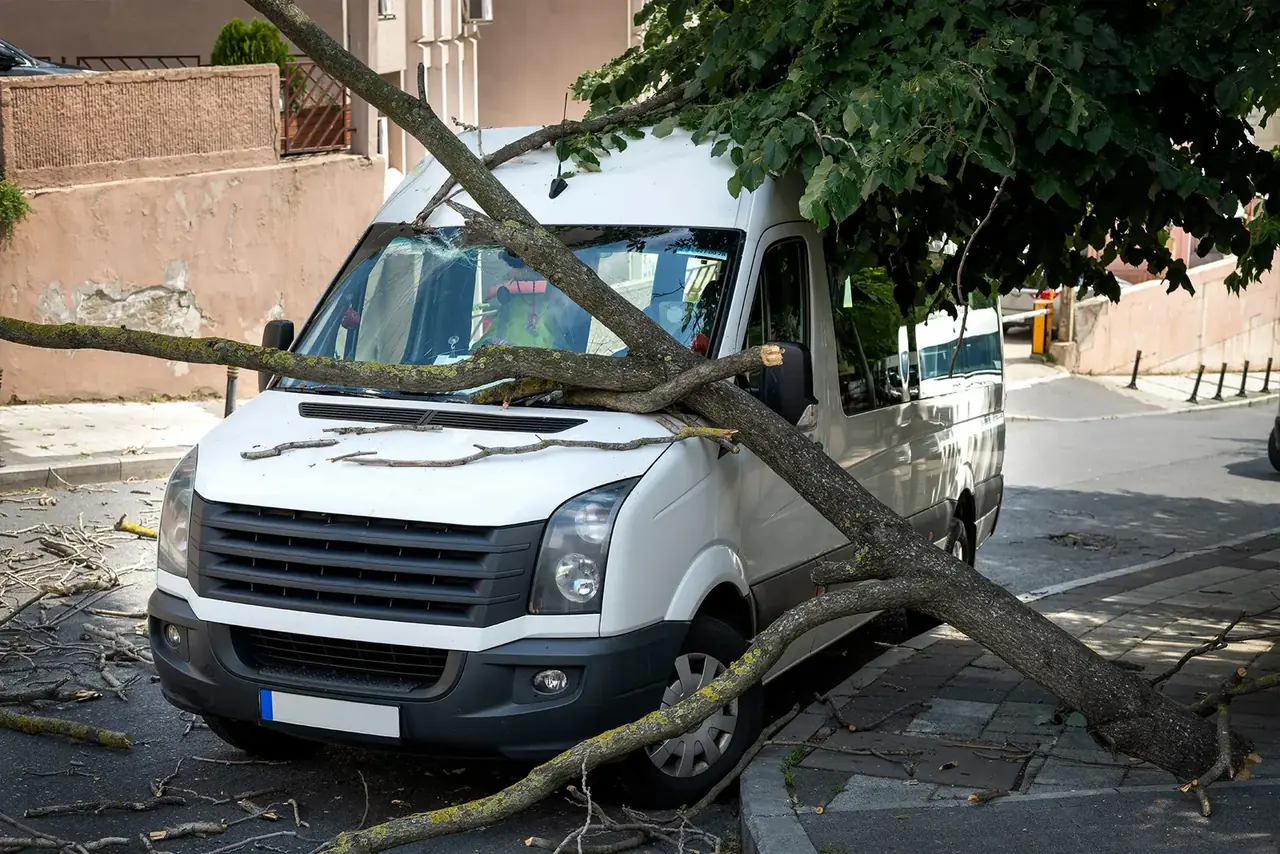
In an accident DualCam sends the recordings from both cameras, the forward-facing one and the one pointed into the cab, automatically. The manager sees how it happened and can decide immediately what to do: call for help, deal with the insurer, talk to the driver.
Photographs and video can also be had on a planned basis — periodically to a schedule, or on request using commands. For fleet management that is an extra stream of data: the state of the load, whether there are passengers, the situation on the route.
Technically the solution is flexible. The camera connects to the tracker over the RS232 interface. Video is recorded at 720p with the H.265 codec: it gives good quality at a small file size, so clips go out over the mobile network faster and use less data. The FMC125 supports Bluetooth LE for wireless sensors, RS485 for connecting external devices, the 1-Wire bus for temperature sensors, and driver identification with RFID cards or iButton keys.
The FMC125 has two SIM card slots. For vehicles that cross borders regularly, that makes it possible to keep a local SIM for each country and to cut roaming costs noticeably.
What to check before the start. The firmware versions of the FMC125 and DualCam have to support the events required and the power control mode through DOUT; these are checked while the kit is being prepared, not on the vehicle. After fitting, the camera angles are set: the forward camera should see the road without half the frame taken up by the bonnet, and the cab camera should see the driver and the door. Then a test is run: the ignition is switched off, a command for a still is sent, towing is simulated, and it is confirmed that the frames arrived on the platform and that the relay cut the camera's power after the session.
False events. The towing and impact sensor can fire during loading, on a ferry or in a strong wind on a high van. The sensitivity threshold is tuned over the first few weeks, and the number of camera activations by event while parked is capped, so that false triggers do not flatten the battery.
What the record looks like. In the event log it is one line: the vehicle, the time, the type of event (impact, towing, dispatcher request), the coordinates and a link to the stills or the clip from the forward and cab cameras.
The response procedure. A towing event at night — the dispatcher requests a still, rings the driver and, if the vehicle really is being taken away, informs security or the police. An impact while parked — request the frames and review it in the morning. Who is on duty at night and how quickly they respond is best written down in advance.
What you get
A picture from the car park
The camera switches on with the ignition off, on an event or a command, and the dispatcher sees what is happening around the vehicle.
Less risk of a flat battery
The relay powers the camera only in short sessions, and the number of sessions in a night can be capped in the settings.
Accident video without asking
In a road traffic accident DualCam sends the clips from both cameras, the forward one and the one in the cab, by itself.
Fewer arguments about driver behaviour
Recording the cab has a steadying effect on drivers and passengers alike and helps to get to the bottom of complaints.
Light files
The H.265 codec keeps 720p quality at a small size, so clips go out over the mobile network faster.
Cheaper roaming
Two SIM cards in the FMC125 make it possible to work through a local operator on international routes.
Why this solution
The strength of this pairing is that the camera and the tracker work as one. The tracker knows about the events — an impact, towing, harsh braking — and decides itself when to wake the camera. A stand-alone dash camera usually has no such logic: it either records all the time or sleeps.
The FMC125 suits this scenario well because of its set of interfaces: RS232 for DualCam, RS485, 1-Wire, Bluetooth LE and a digital output for the relay. One tracker can cover video, temperature in the load space, driver identification and power switching. The solution is wanted by delivery services and passenger carriers, by logistics firms and by insurers.
But the limits are worth understanding. DualCam is a camera for capturing events and stills on request, not a continuous video recording system with hours of archive on board. If round-the-clock surveillance with several cameras is needed, a proper MDVR is the direction to look. 720p resolution is enough to understand what happened, but a number plate at a distance may not be readable. Video over the mobile network uses data, and the frequency of requests has to be planned.
How this works in Azerbaijan. The arrangement is in demand with distribution and courier services in Baku, whose vehicles spend the night in courtyards and unguarded car parks; with haulage firms that park articulated lorries overnight in the lay-bys along the M-1 and M-2 routes or in the queue at the port of Alat; and with passenger carriers running intercity routes. Two SIM cards are especially useful on runs to Georgia, Turkey and Russia: an Azercell, Bakcell or Nar SIM works in Azerbaijan and a local one abroad. In summer at +40 °C a camera in the cab gets very hot in the sun, so we choose the mounting position with that in mind. GPS.az, a Teltonika GOLD partner in Azerbaijan, fits the FMC125 with DualCam, installs the power relay, configures the events on which the camera wakes and connects everything to the Wialon platform, where the dispatcher views the photographs and clips right on the map. The equipment warranty is 1 year.
Related case studies
Related rollouts and equipment
Questions about the “DualCam while parked: power switched through DOUT” scenario
Request a call
A specialist will call back and match a solution to your fleet and your task.