
ADAS: how to avoid hitting the vehicle in front
The Teltonika ADAS kit — a camera on the windscreen and an FMC125 tracker — works out the time to a collision with the vehicle ahead, warns the driver, and writes every unsafe approach into a report for the fleet.
The Teltonika ADAS kit — a camera on the windscreen and an FMC125 tracker — works out the time to a collision with the vehicle ahead, warns the driver, and writes every unsafe approach into a report for the fleet. The commonest crash in a commercial fleet is a mundane one: the driver was going too fast or following too closely, was distracted for a second, and ran into the back of the vehicle in front. The result is two vehicles to repair, downtime, a claim on the load and, if luck is against you, injuries. In this case study Teltonika shows how forward collision warning (FCW) helps tackle the three causes of such crashes: excessive speed, tailgating and distraction at the wheel.
What this scenario solves
According to the WHO, about 1.16 million people are killed on the world's roads every year, and crashes cost most countries roughly 3% of GDP.
Fines, penalty points and disqualification barely shift those figures.
The main causes are the same as ever: speed, alcohol, inattention and careless driving.
For a company, every such crash involving a company vehicle means money, downtime and a knock to its reputation.
According to the WHO, about 1.16 million people are killed on the world's roads every year, and crashes cost most countries roughly 3% of GDP. Fines, penalty points and disqualification barely shift those figures. The main causes are the same as ever: speed, alcohol, inattention and careless driving. For a company, every such crash involving a company vehicle means money, downtime and a knock to its reputation.
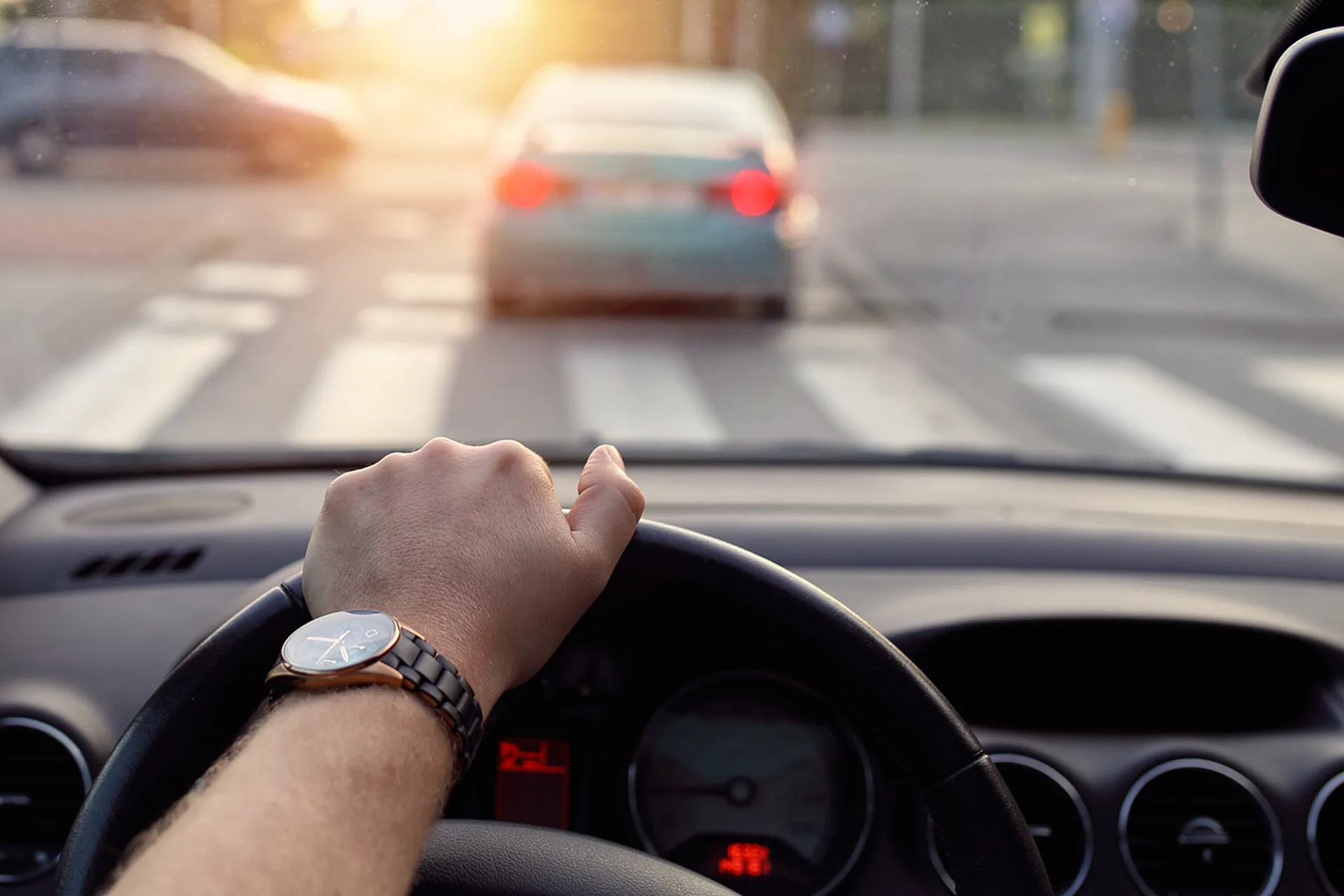
Excessive speed is dangerous for more than its own sake. The higher the speed, the longer the braking distance and the more severe the impact. For a loaded lorry a difference of 20 km/h means tens of metres of stopping distance. On top of that comes the extra fuel, which the manager only learns about from the reports.
Tailgating is the second classic cause. The driver sits right behind the vehicle in front and often does not regard it as a risk at all. Let the vehicle ahead brake sharply and there is no time left to react.
The third cause is distraction. According to a national survey in the United States, 52.5% of drivers eat at the wheel, 23.6% type messages, 11.7% take photographs, and on average at least 10% of time on the road goes on the phone. While the eyes are on the screen, the vehicle in front has time to stop.
The effect of FCW systems has been measured. The Insurance Institute for Highway Safety (IIHS) estimates that forward collision warning reduces the number of rear-end crashes by 27%.
Yet the fleet manager usually cannot see a dangerous driving style until the first accident. The tracker shows the speed but not the distance to the vehicle ahead, nor how many times in a day the driver was half a second away from an impact.
After a crash the investigation begins, and it is rarely straightforward. The driver says the vehicle ahead braked for no reason; the other party says he was hit at full speed. With no record of the events, the company is left either taking its own employee's word for it or paying out on somebody else's version. And the crash itself means repairs, a vehicle standing idle for a week or two, missed deliveries and a higher insurance premium next year.
What Teltonika offers
The ADAS camera watches the road ahead of the vehicle continuously, works out the time to a possible collision and warns the driver in good time, while the FMC125 tracker sends every such event to the server along with the coordinates and speed.
Installation and setup
Fitting the device and configuring it for the fleet scenario at hand.
Data transfer
The device collects data and sends it to the monitoring platform; how often depends on the model and its settings.
Analysis and control
The person in charge gets reports and alerts and looks into what stands out.
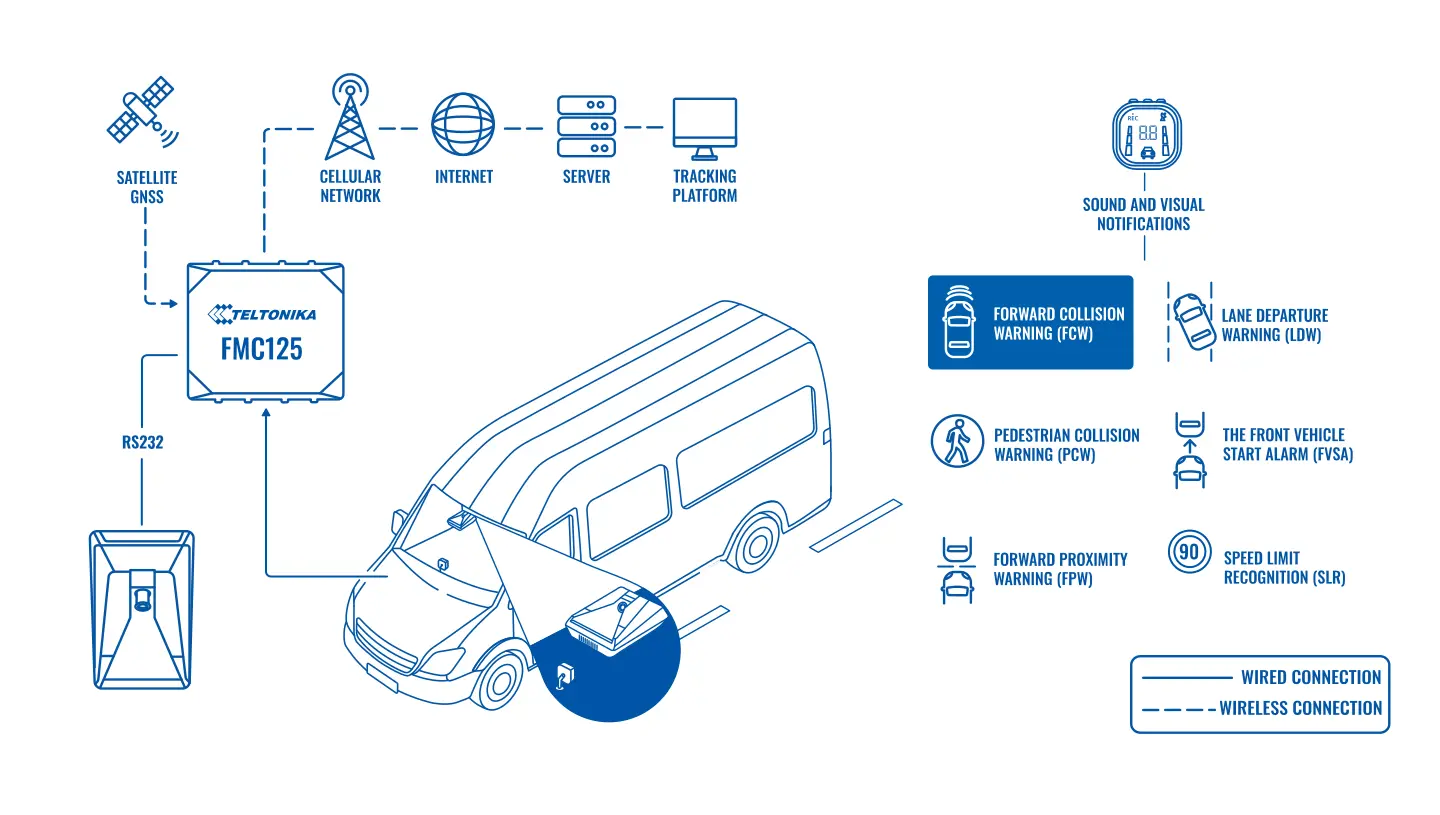
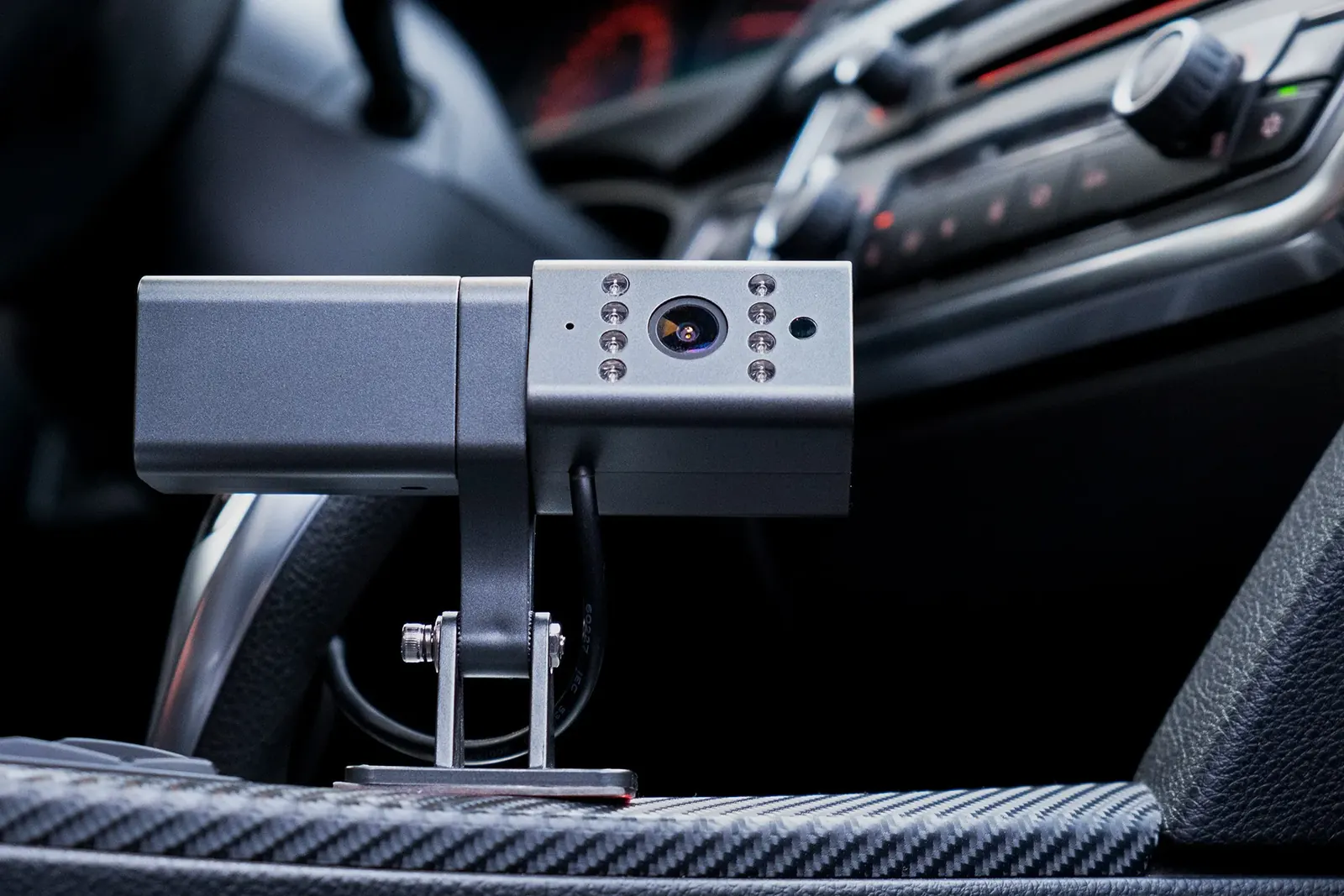
The kit. The Teltonika ADAS camera goes on the windscreen and connects to an FMC125 tracker from the professional range over an RS232 serial port. On the dashboard there is a compact display that gives the driver an audible and visual warning. His hands stay on the wheel; there is no need to look away at a screen.
The functions. Besides FCW, the camera can warn about a collision with a pedestrian, about too short a following distance, about leaving the lane without indicating, and about the vehicle in front moving off. The ADAS PLUS version additionally recognises speed limit signs.
Speed. The FCW algorithm takes account of how fast the vehicle is closing on an obstacle. If the driver is going too quickly and there is little time left before impact, a warning sounds and the event goes to the server. With ADAS PLUS the system also sees the limit sign and compares it with the actual speed, so an excess is recorded even where the maps hold no data about the limit.
Following distance. If the driver keeps close behind the vehicle in front for a sustained period, a safe distance warning triggers. For the manager this is more useful than one-off alerts: you can see who tailgates systematically and who simply found himself in dense traffic once.
Distraction. If the driver has buried himself in his phone and has not noticed that the traffic ahead has stopped, FCW will sound before the impact. If the vehicle has meanwhile left its lane without indicating, the lane departure warning will trigger as well.
What the fleet gets. All events arrive at the server with a time, a place and a speed. Reports are built from them for each driver: the number of unsafe approaches, speed excesses against signs, distance warnings. That is a concrete basis for a conversation with the driver, for training and for a bonus scheme, without subjective judgements. And if a crash does happen, the history of events in the minutes before it helps establish who did what wrong.
An episode from a typical day. A delivery van is moving along an urban main road in dense traffic; the driver is keeping about five metres behind and glancing at the navigation app on his phone at the same time. The traffic ahead brakes sharply. The camera sees the time to impact shrinking and sounds a warning an instant before the danger line. The driver looks up and manages to stop. There is no impact, but a record remains on the server: time, place, speed and event type. In the evening the manager sees that this driver has had three similar episodes in a day, and understands that it is not a matter of chance.
How work with the reports is organised. It makes sense to look at trends rather than individual alerts. How many FCW and distance triggers there are per 100 km of mileage for each driver, how that changes from week to week, on which sections of the route events keep recurring. If the figure falls for a driver after a conversation and some training, that shows up in the numbers. If it does not, management has grounds for firmer measures.
What to bear in mind at launch. In the first few weeks there will be more triggers than seems normal: the system honestly shows how people drive. There is no point in punishing everyone on the list straight away. It is more sensible to explain to drivers how the warnings work, give them time to get used to them, and only then bring in bonuses and penalties. Experience shows that after such a settling-in period drivers start keeping a greater distance of their own accord, so that the display does not beep.
Calibration. The camera is mounted on the centre line of the windscreen and set up for the height and width of the specific vehicle. How correctly the system judges the distance to an obstacle depends on the accuracy of the fitting, so the installation is best left to people who have done it many times.
What you get
A warning before the impact, not after
The algorithm works out the time to collision and sounds a warning while the driver can still brake in time.
The warning does not draw attention off the road
A short sound and an indication on a small display in front of the driver, with no need to look at a screen or take his hands off the wheel.
Tailgating becomes visible
A sustained close approach to the vehicle in front is recorded as a separate event, and the persistent offenders stand out in the reports.
Speed against real signs
The ADAS PLUS version recognises limit signs and flags an excess where a tracker with coordinates alone would see nothing.
Fewer repairs and fewer claims
Every rear-end collision avoided saves on bodywork repairs, vehicle downtime, damaged loads and insurance.
An objective basis for working with drivers
Specific episodes with a place and a time let you build training and incentives on facts rather than on complaints.
Why this solution
The Teltonika camera and tracker were designed as one system from the start. The FMC125 understands ADAS events directly over RS232, adds its own telematics to them and sends them to the server with no intermediate devices. For the fleet that means one installation instead of two different systems with different interfaces.
The FMC125 is a tracker from the professional range with ports for external equipment. Driver identification, sensors and other accessories connect to the same unit, so safety, run records and driver monitoring all live on one device. Firmware and configuration are updated remotely through FOTA WEB.
The set of warnings is configured to suit the fleet. For long-haul tractor units what matters most is FCW, following distance and speed against signs. For city vans and buses pedestrians and the vehicle in front moving off come to the fore.
Importantly, the camera's events do not live apart from the rest of the telematics. On the server an unsafe approach is visible alongside the route, the speed, the driver's working hours and the stops. That makes it possible to understand the context: was the driver pushing on because he was late after a traffic jam, or does he always drive like that? For sound conclusions that context is needed almost every time, especially where a bonus or a penalty is at stake.
The limitations are worth knowing too. The camera does not replace the driver's own attention and does not brake for him: it is a warning system. In a heavy downpour, a dust storm or with a dirty windscreen recognition quality drops, and with ADAS PLUS sign recognition depends on the condition of the signs on the particular road.
How this works in Azerbaijan. Rear-end collisions happen most often in the dense traffic of Baku and on its approaches: the Baku ring road, the road to Sumgait, the slip roads onto the M-1 and M-2 at rush hour, where the traffic alternately speeds up and stops. For articulated lorries running from Alat along the M-2 to Ganja and on to the Georgian border, speed and fatigue on the long straights are the greater danger. There FCW and the distance warning are of most use. For companies delivering around Absheron the main events are tailgating and distraction by the phone in traffic. When fitting the system we first enable the warnings for a couple of weeks in a quiet mode visible only to the manager, look at the real picture driver by driver, and only then decide which warnings to leave for the driver so that he does not start ignoring them. GPS.az fits the FMC125 with the ADAS camera, configures the events and feeds them to the Wialon platform: alerts reach the dispatcher, and the reports show who most often gets into dangerous situations and where.
Related case studies
Related rollouts and equipment
Questions about the “ADAS: how to avoid hitting the vehicle in front” scenario
Request a call
A specialist will call back and match a solution to your fleet and your task.