
Alcohol interlock: breathalyser and GPS tracker
A Teltonika scenario for corporate fleets: the engine will only start once the driver has presented his RFID card and passed a test on a breathalyser connected to an FMC125 tracker.
A Teltonika scenario for corporate fleets: the engine will only start once the driver has presented his RFID card and passed a test on a breathalyser connected to an FMC125 tracker. A drunk driver in a company vehicle is a risk to more than himself. The company answers for the road traffic accident, for the injured, for the wrecked vehicle and its load, and then pays a higher insurance premium for years afterwards. A pre-trip medical check helps, but it happens in the morning at the depot, while the vehicle may be parked outside the driver's house. An alcohol interlock tests the person in the cab itself, before every journey, and writes the result into the monitoring system.
What this scenario solves
According to figures cited by forbes.com, more than a quarter of all road deaths involve alcohol.
In the United States alone, road traffic accidents with drunk drivers kill about 37 people every day.
The economic damage from such crashes there is put at more than 132 billion dollars a year.
Alcohol slows reactions, upsets coordination, narrows attention and impairs vision.
According to figures cited by forbes.com, more than a quarter of all road deaths involve alcohol. In the United States alone, road traffic accidents with drunk drivers kill about 37 people every day. The economic damage from such crashes there is put at more than 132 billion dollars a year.
Alcohol slows reactions, upsets coordination, narrows attention and impairs vision. And the person concerned is often sure he is fine and will make it there.
For the company the consequences drag on: repairs and the vehicle standing idle, compensation to the injured, rising insurance premiums, inspections. Sometimes a criminal case in which both the driver and whoever let him out on the road are named.
A corporate fleet has its own particulars. Vehicles are often assigned to individual drivers and parked overnight at their homes. A morning check at the depot does not work here, and relying on the conscience of each of dozens of employees is a poor strategy.
The check has to be compulsory and independent of whether anyone is watching the driver at that moment. It must not be possible to take it on a colleague's behalf, and the result of every check must be stored with the date, the time and the vehicle number.
What Teltonika offers
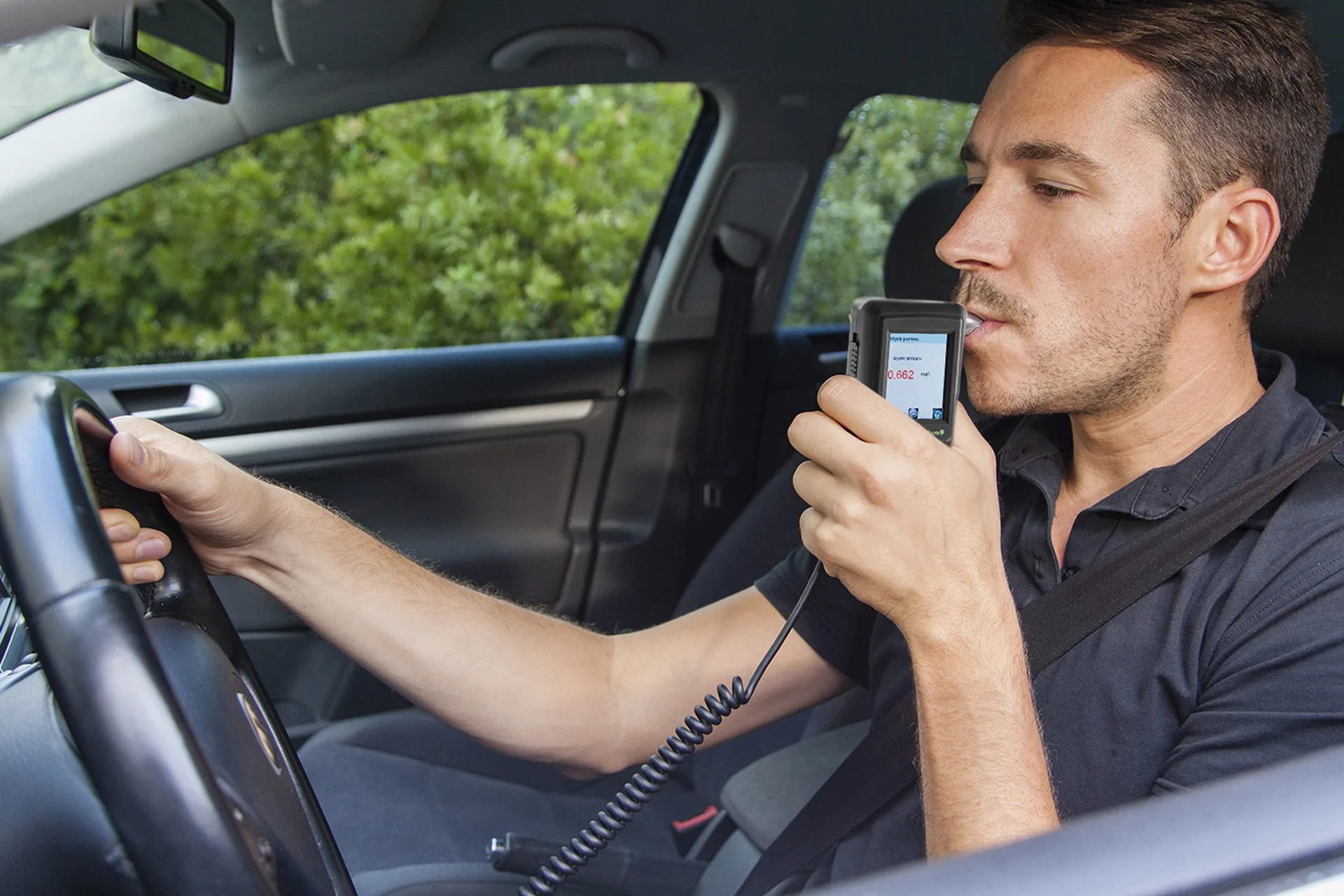
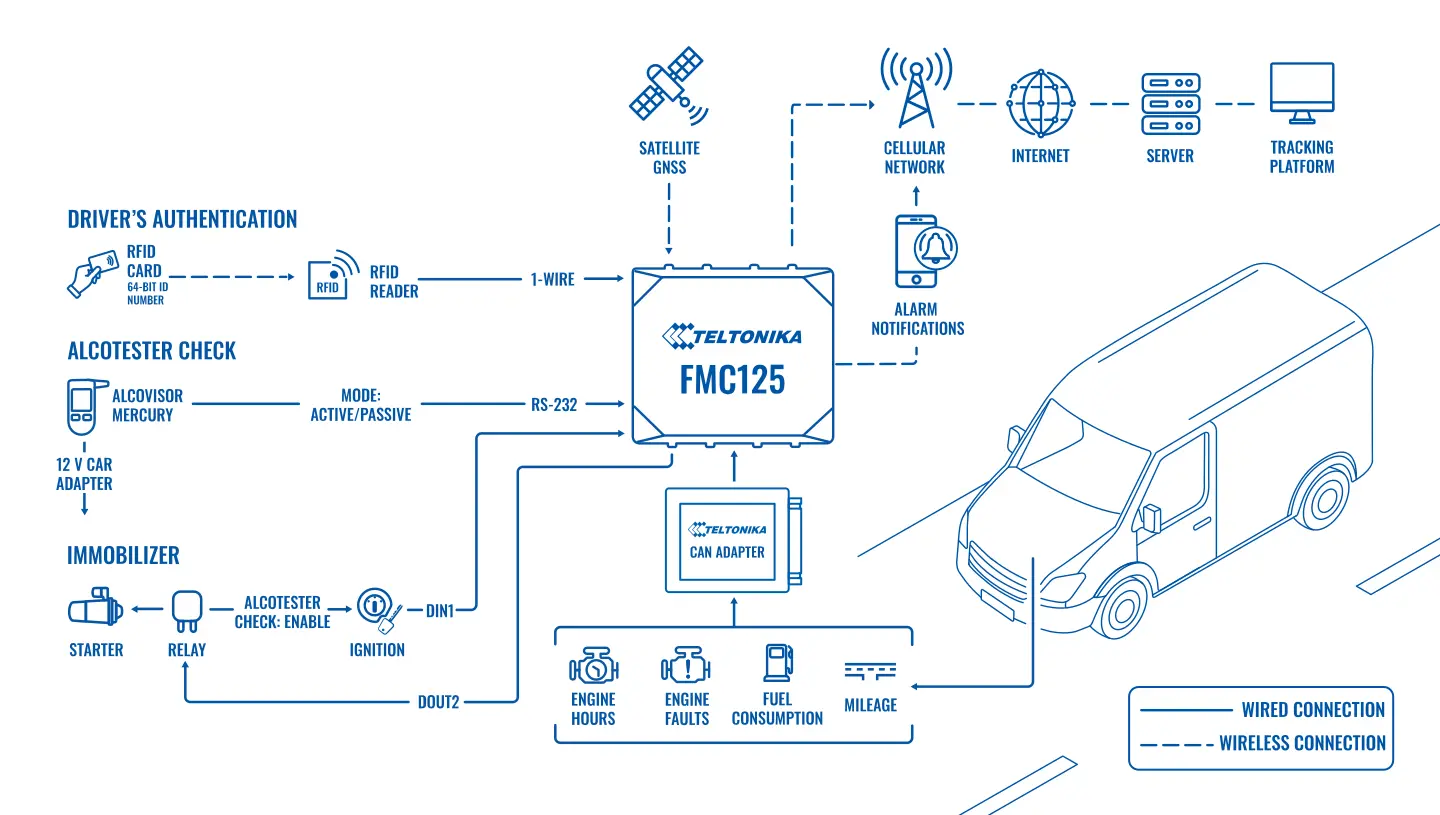
Teltonika assembles the interlock from an FMC125 tracker, an RFID card reader on the 1-Wire bus and an Alcovisor Mercury breathalyser connected to the tracker over RS232: the tracker takes the card and the test result from the driver and decides for itself whether to allow the engine to start.
Installation and setup
Fitting the device and configuring it for the fleet scenario at hand.
Data transfer
The device collects data and sends it to the monitoring platform; how often depends on the model and its settings.
Analysis and control
The person in charge gets reports and alerts and looks into what stands out.
Each driver is issued his own RFID card with a factory 64-bit number. The 1-Wire reader is fitted in the cab and the breathalyser next to it, within easy reach from the driver's seat. The breathalyser can be powered from a cigarette lighter adapter. The starter circuit is routed through an output of the tracker and works on the immobiliser scenario.
How the driver's morning goes. He gets into the vehicle and presents his card to the reader. The tracker recognises who it is. If the card is his own and permitted, the next step is the breathalyser: the driver blows into a reusable mouthpiece and the instrument returns a result within seconds. No alcohol found, and the tracker releases the starter, logs a start-of-shift event with the date and time, and the vehicle starts. Alcohol found, and the starter stays locked while an alert goes to the server. From there the driver follows the company's internal procedure: rings his manager, waits for a replacement, goes for a medical examination.
If even one step fails — someone else's card, or a positive test — the vehicle will not move. The manager or the person responsible for safety sees all these events in the monitoring system in real time and in reports.
At the end of the shift the driver presents his card again. The tracker logs an end-of-shift event and the ignition can be switched off. So the interlock turns into working-time recording of its own accord: who worked, on which vehicle, and from when to when.
About the breathalyser itself. The Alcovisor Mercury uses an electrochemical fuel cell: alcohol in the breath sample produces a voltage across the cell in proportion to its concentration, and the instrument converts that into blood alcohol content. The model has two modes. The screening, or passive, mode answers the question of whether there is alcohol or not and works with a reusable mouthpiece. The standard, or active, mode gives an exact figure and requires a disposable mouthpiece. For a daily interlock the Teltonika example uses the screening test: it is faster and does not need a consumable for every check.
Configuration. In the Teltonika configurator the breathalyser check function is enabled on the FMC125 in the immobiliser section. The RS232 port mode is then set for working with the Mercury breathalyser. Electrically, the TXD and GND pins of the breathalyser's USB connector are joined to the RXD and GND pins of the tracker's RS232 port. Before going live the breathalyser is calibrated to the manufacturer's instructions, and calibration is then repeated at the interval the manufacturer specifies.
Who this suits. Almost any fleet of cars and light commercial vehicles where the driver works unsupervised: internet and cable providers, utilities, the postal service, sanitation services, construction, manufacturing, retail and wholesale trade.
The interlock does not replace the rest of the monitoring. With an LV-CAN200 adapter the FMC125 reads CAN bus data, and built-in scenarios log driving style, speeding, long idling, towing, crashes, trips and automatic geofences. From mileage and engine hours the system gives service reminders, so vehicles do not go out with maintenance overdue.
Tracker firmware and configuration are updated remotely through FOTA WEB. If the company changes the rules — adding new drivers, say, or altering how the lockout works — there is no need to go round the vehicles.
An episode from the life of such a fleet. Friday, 7:40, and a provider's service engineer gets into the vehicle assigned to him outside his house. The card is accepted, the test finds alcohol — a friend's birthday the evening before. The starter does not engage, and the safety officer receives a notification with the driver's name, the vehicle number and the address. He rings the engineer, the morning's jobs are handed to a colleague, and the engineer himself starts work later, after a second test. Without the interlock this man would have driven right across town to his first call, and most likely nobody would ever have known. Or they would have known — but only after a crash.
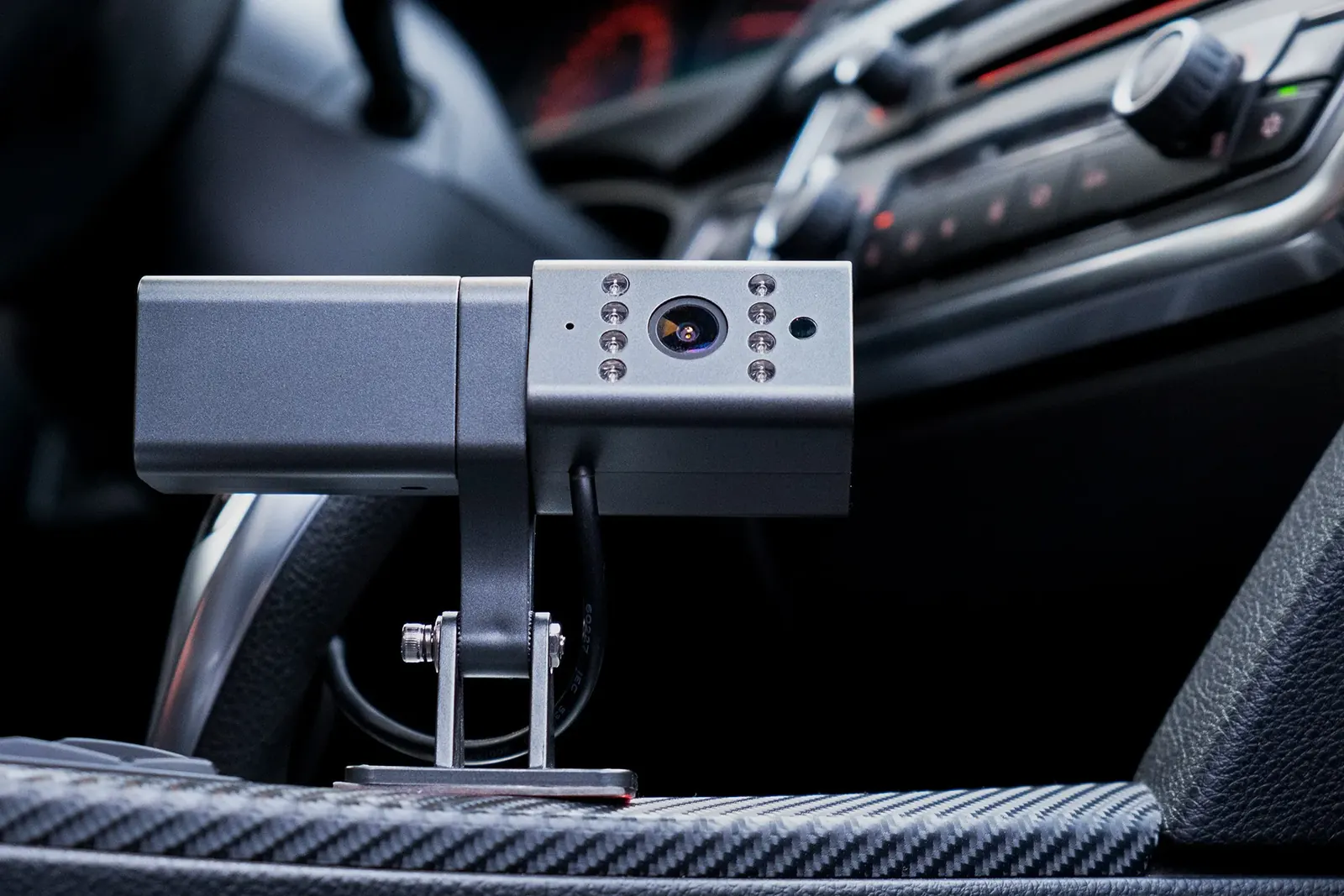
Common questions. Can the instrument be fooled by somebody blowing on the driver's behalf? The card is tied to a person, but physically a passenger can blow into it too; that is why some companies also fit a camera in the cab that takes a still at the moment of the test. What if the driver drinks in the middle of the shift? The arrangement in the example tests the person at engine start, so rules for retesting — after a long stop, for instance — are set separately in the configuration and in the internal procedure. Does the interlock work with no mobile coverage? Yes: the decision to allow starting is taken by the tracker in the vehicle, and the events go to the server once the network appears.
Why not simply a pre-trip medical check. The medical check stays where it is required, but it happens once, in one place. The interlock tests the driver where the vehicle actually starts, and every time, not only on a Monday morning when the medic is on site.
What you get
A drunk driver will not start the vehicle
The starter stays locked until both the card and the test have been passed, and the company learns of the attempt at once.
Fewer crashes and fewer serious consequences
The main risk factor is removed before the journey begins rather than examined after an accident.
Savings on repairs, insurance and downtime
Fewer crashes mean less spent on putting vehicles right, on compensation and on premiums.
Nobody can take the test for a colleague
The RFID card ties the result to a specific person, and every check is recorded with its time.
Shift records without paper logbooks
The start and end of a shift are logged by card, and the data is available from a computer, a tablet and a phone.
One tracker for the whole range of jobs
The same FMC125 handles monitoring, driving behaviour and servicing.
Why this solution
There is no home-made electronics in this arrangement. The breathalyser check function is built into the tracker firmware and switched on in the configurator, working with the Alcovisor Mercury over RS232 is documented by the manufacturer, and the 1-Wire reader and RFID cards are standard accessories. For the integrator that means predictable fitting and support you can follow.
The FMC125 is a professional-range tracker with RS232, 1-Wire and CAN reading through the LV-CAN200. The interlock goes onto a vehicle where monitoring, fuel control and driving behaviour are already running, with no second box in the dashboard.
What to understand before rolling this out. A screening test answers yes or no; it does not replace a medical examination and does not produce a legally significant figure. Any lockout system needs a fallback procedure: what to do when the vehicle is needed urgently and the breathalyser has failed, or the driver has a cold and the instrument reacts to a medicine containing alcohol. Those rules are worth writing down in advance, along with naming a person who can unlock a vehicle remotely and who answers for that decision.
Another point is people. Rolling this out without explanation looks like mistrust. Better to tell drivers in advance how the interlock works, what happens on a positive test, and that the records are used for safety rather than to hunt down staff. Then sabotage is rare, and many drivers come in time to see the interlock as protection for themselves.
Reporting is worth thinking through as well. Individual alerts are not enough for a manager; it is more useful to look at a weekly summary: how many checks there were, how many refusals to start, which drivers see them repeatedly, and whether there were attempts to start a vehicle with somebody else's card or with no card at all. Repeated cases with one person are a reason to talk to him, not only to lock him out. And a sharp rise in the number of empty attempts on one vehicle often means somebody is trying to get round the interlock, and it is worth inspecting.
The instrument needs servicing: mouthpieces are washed and replaced, and the fuel cell is calibrated to the manufacturer's schedule. Let that slip and false readings appear within months, and drivers start demanding the interlock be switched off.
How this works in Azerbaijan. Alcohol interlocks are asked for most often by companies with strict occupational safety requirements: oilfield service contractors in Absheron and at Sangachal, operators of crew buses, carriers of dangerous goods, and construction companies in Karabakh and East Zangezur, where vehicles go out to sites for a whole week and nobody is watching the driver. For fleets like these, a record of every check with its date and time is also an argument in a client's audit. When fitting we allow for the summer heat: the breathalyser is not left on the dashboard in the sun, a shaded position is chosen, and the wiring is run so that the instrument is ready for a test as soon as the driver sits down. We choose the breathalyser model for each project together with the client, guided by compatibility with the tracker. GPS.az fits the FMC125, the RFID reader and the starter lockout, issues cards to the drivers, and configures shift reports in Wialon along with notifications of positive tests and of attempts to start a vehicle with somebody else's card.
Checking the combination before fitting. We verify against Teltonika documentation, before installation, that the breathalyser check function works with the particular FMC125 firmware version and breathalyser model. Every event in the system holds the driver from the card, the vehicle, the time, the test result and whether starting was allowed.
Related case studies
Related rollouts and equipment
Questions about the “Alcohol interlock: breathalyser and GPS tracker” scenario
Request a call
A specialist will call back and match a solution to your fleet and your task.