
Remote reading of DTC faults on lorries
A Teltonika solution for heavy lorries: the FMC650 tracker reads DTC fault codes over the J1939 protocol and sends them to the server, so that a fault is seen before the Check Engine light comes on.
A Teltonika solution for heavy lorries: the FMC650 tracker reads DTC fault codes over the J1939 protocol and sends them to the server, so that a fault is seen before the Check Engine light comes on. A fault code is a message from an electronic control unit about what has gone wrong and where. Once it could only be read with a scanner at a workshop. A tracker from the PROFESSIONAL range does it remotely, while the vehicle is out on a run. In this use case Teltonika sets out exactly which diagnostic data the tracker transmits, how it is put together and why it changes the approach to maintaining a long-haul fleet.
What this scenario solves
Most operators learn about a fault only when the Check Engine light comes on in the dash.
The first symptoms — a slight loss of power, an uneven idle, an odd knock — the driver describes to the dispatcher in words.
Without diagnostic data nobody can say whether the run can continue or whether the vehicle needs to get to a workshop urgently.
A sudden breakdown on the road means a recovery truck, an expensive emergency repair at an unfamiliar workshop and a delivery that falls through.
Most operators learn about a fault only when the Check Engine light comes on in the dash. The first symptoms — a slight loss of power, an uneven idle, an odd knock — the driver describes to the dispatcher in words. Without diagnostic data nobody can say whether the run can continue or whether the vehicle needs to get to a workshop urgently. A sudden breakdown on the road means a recovery truck, an expensive emergency repair at an unfamiliar workshop and a delivery that falls through.
The typical story looks like this. An injector on a long-haul tractor unit starts to wear. Combustion gets worse gradually: consumption creeps up, power drops a little, the cylinders wear faster. There is no warning on the dash yet; the driver hears a knock and rings the dispatcher. The dispatcher is guessing too.
After a while the light does come on, and the lorry stops. Sometimes it reaches the nearest workshop, sometimes it has to be taken there on a recovery truck. The price of an emergency repair in someone else's region is unpredictable: there are no agreements in place, no confidence in the mechanics' competence, and parts are hunted down on the spot.
Downtime is expensive. A long-distance lorry covers between 273 and 411 km a day, and freight rates in Europe run from 1.10 to 2.30 euros a kilometre. One lost day can cost as much as 945 euros of revenue, and that is before penalties for missed deadlines and damaged relations with the customer.
The real problem is not the fault itself but the fact that it cannot be seen in advance. Without data you cannot tell a minor deviation from a serious breakdown in the making, and decisions get taken when there is no longer any choice.
What Teltonika offers
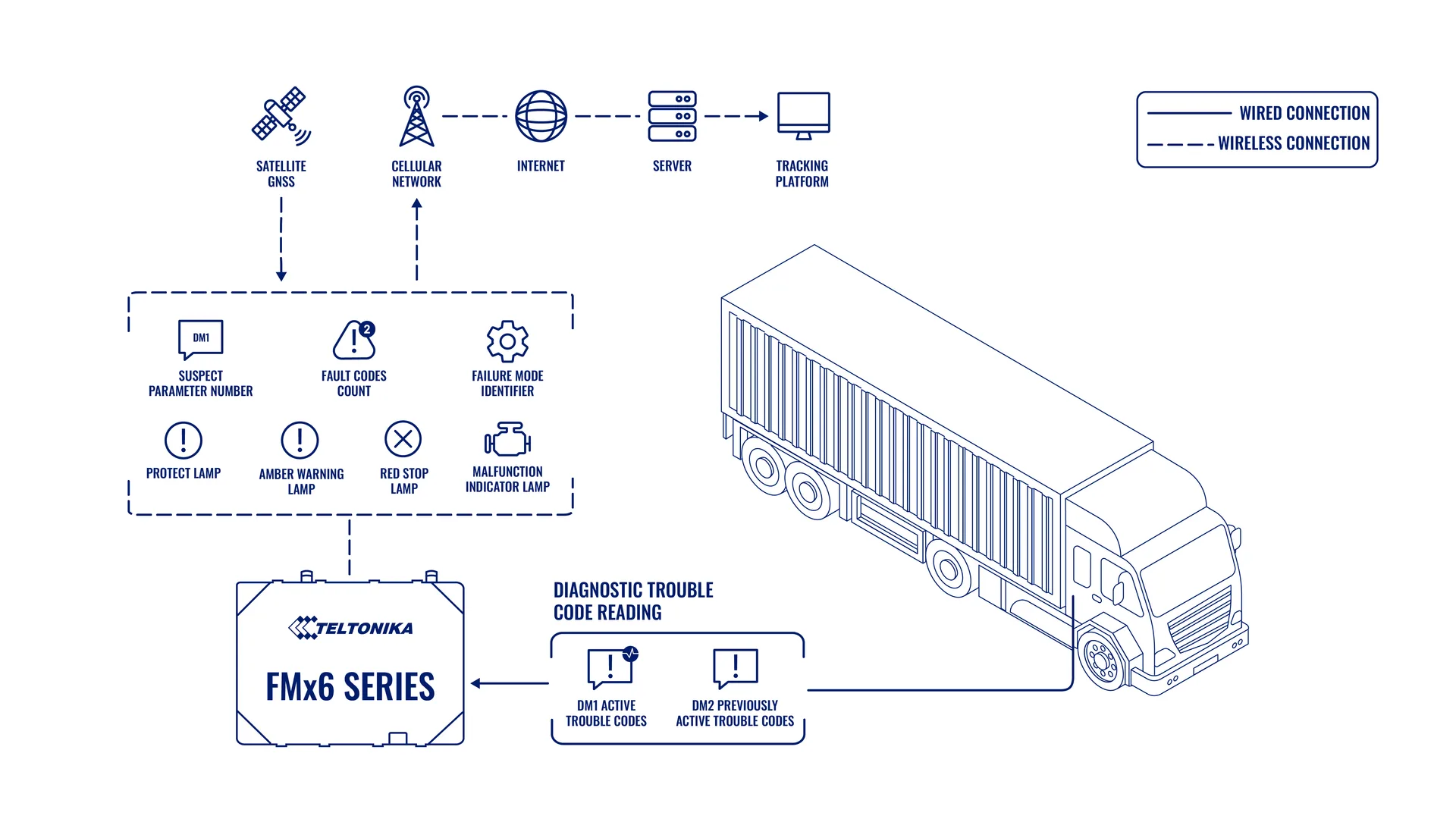
The FMC650 tracker connects to the lorry's CAN bus, reads the J1939 DM1 and DM2 diagnostic messages and sends the fault codes to the server, where the fleet manager sees them.
Installation and setup
Fitting the device and configuring it for the fleet scenario at hand.
Data transfer
The device collects data and sends it to the monitoring platform; how often depends on the model and its settings.
Analysis and control
The person in charge gets reports and alerts and looks into what stands out.
SAE J1939 is the standard protocol for exchanging data between control units in heavy machinery. Besides ordinary parameters such as engine revolutions and consumption, it also describes diagnostic messages. The most important of them for maintenance is DM1, active faults in real time.
What is inside DM1. The first part is the state of the lamps on the instrument panel. From it you can see whether the warning indicators are lit and how serious the fault is, that is, whether the vehicle has to be stopped at once or can reach base.
The second part is the DTC codes themselves. Each code consists of several fields. The SPN (Suspect Parameter Number) says which assembly or system is at fault. The FMI (Failure Mode Identifier) describes the type and degree of the failure. The OC (Occurrence Count) shows how many times the fault has recurred. The conversion method says whether this is a standard SPN or a manufacturer's proprietary code.
To put it by way of comparison, a lorry's control units are constantly broadcasting their condition, and the tracker is a receiver that listens to that transmission and passes it to the office. Without it the operator has nothing but a lamp on the dash, which tells them neither the cause nor the severity.
Besides DM1 the tracker reads DM2, previously active faults. These reveal chronic problems: a fault that appears and disappears once a week may turn out to be the first sign of a serious breakdown.
How the data is sent. The FMC650 sends the diagnostic messages as they are, as hexadecimal strings, without interpreting them itself. This is the same data a service scanner shows. An integrator can build their own decoding logic, and an operator with a diagnostic department of their own can receive the codes in the form they are used to.
Two CAN lines. The FMC650 connects to two buses at once and takes data from different sources. From the tachograph, for instance, the driver's remaining driving time, so as to choose a workshop they can reach before the compulsory rest. From the trailer's EBS module, tyre pressures. Together with the fault codes that gives the mechanic a noticeably fuller picture of the vehicle's condition than a phone call from the driver.
How the work changes. Let us go back to the tractor unit with the worn injector. As soon as the engine unit records a deviation, the code arrives at the server. The mechanic in the office sees which assembly and which type of failure, and decides: the vehicle will finish its run, and at base the parts and a free ramp will already be waiting for it. The chances of managing without a recovery truck and a repair at a random price on the road improve, although a code will not predict a sudden mechanical failure.
Which data you will get on a particular vehicle. Not every tractor unit transmits DM1 and DM2: it depends on the make, the model, the year and which units are connected to the available bus. Before fitting out a fleet you take one vehicle of each model, connect an FMC650 and see whether DM1 arrives, whether the dash lamps are in the message and which SPNs appear. The result is written into a fleet compatibility table.
How a code is matched to a service event. When a code has arrived at the server, the mechanic compares the SPN and the FMI with the service scanner readings when the vehicle comes in. If the codes agree, the arrangement can be trusted. From then on the maintenance log records the link: the date of the code, the assembly, the work carried out and the date it was cleared. After a few months the log shows which codes really did precede a repair and which turned out to be noise, and the notifications are re-tuned to the important ones only.
The limit of the scenario. The tracker sends codes without decoding them. Turning a particular manufacturer's proprietary SPNs into readable text is a job for the workshop or the platform, and for some makes the manufacturer's documentation is needed.
What you get
The code is visible in the office, not only on the dash
A fault arrives at the server as soon as the control unit records it; some codes appear before the driver notices any symptoms.
Repairs to a plan, not on the hard shoulder
Early signals make it possible to finish the run and book the vehicle in at a convenient time.
Parts ready in advance
The mechanic knows the assembly and the type of failure before the lorry arrives, and shortens the time it spends in the workshop bay.
Chronic problems out in the open
DM2 shows recurring faults that the driver may never have noticed.
Less wasted fuel and wear
A fault put right in time does not drag excess fuel consumption and wear on neighbouring assemblies along with it.
One tracker instead of several devices
The FMC650 combines diagnostics, tachograph data and FMS, which simplifies fitting and cuts costs.
Why this solution
The FMC650 covers several tasks at once for which different equipment used to be fitted: monitoring, reading DTCs, remote downloading of tachograph files, driving style analysis, trailer EBS data. For the operator that is one installation and one point of service.
Two CAN lines is an important detail. On many tractor units the engine, tachograph and trailer data run on different buses, and a tracker with one line sees only part of the picture.
Sending the codes raw is a deliberate decision. The tracker does not try to guess what a particular manufacturer's code means; it passes it on undistorted to whoever knows how to decode it.
Teltonika updates the firmware of the PROFESSIONAL range regularly and adds new ways of working with the data, and the update reaches the trackers remotely.
An honest limitation: reading DTCs over J1939 works on lorries and buses that use this protocol. On older machinery with no electronic engine management there simply are no codes, and there condition monitoring is built on other data — engine hours, temperature, fuel consumption from a fuel level sensor.
How this works in Azerbaijan. This solution brings most benefit to operators carrying freight along the Middle Corridor and through the port of Alat, running to Georgia and Turkey on the M-2 and to Iran on the M-3. A tractor unit breaking down in another country is the most expensive outcome of all: a recovery truck, an unfamiliar workshop, parts on order. Here early warning from DTCs pays back fastest. In summer, at +40 °C, overheating and cooling system trouble happen more often on climbs, and codes for those assemblies are worth putting into separate notifications. Fleets often mix European tractor units with J1939 and older machinery, so at the survey stage we check which vehicles really do give up codes. GPS.az fits the FMC650, connects both CAN lines and sets up fault notifications, code reports and a link to the servicing plan on the Wialon platform.
Related case studies
Related rollouts and equipment
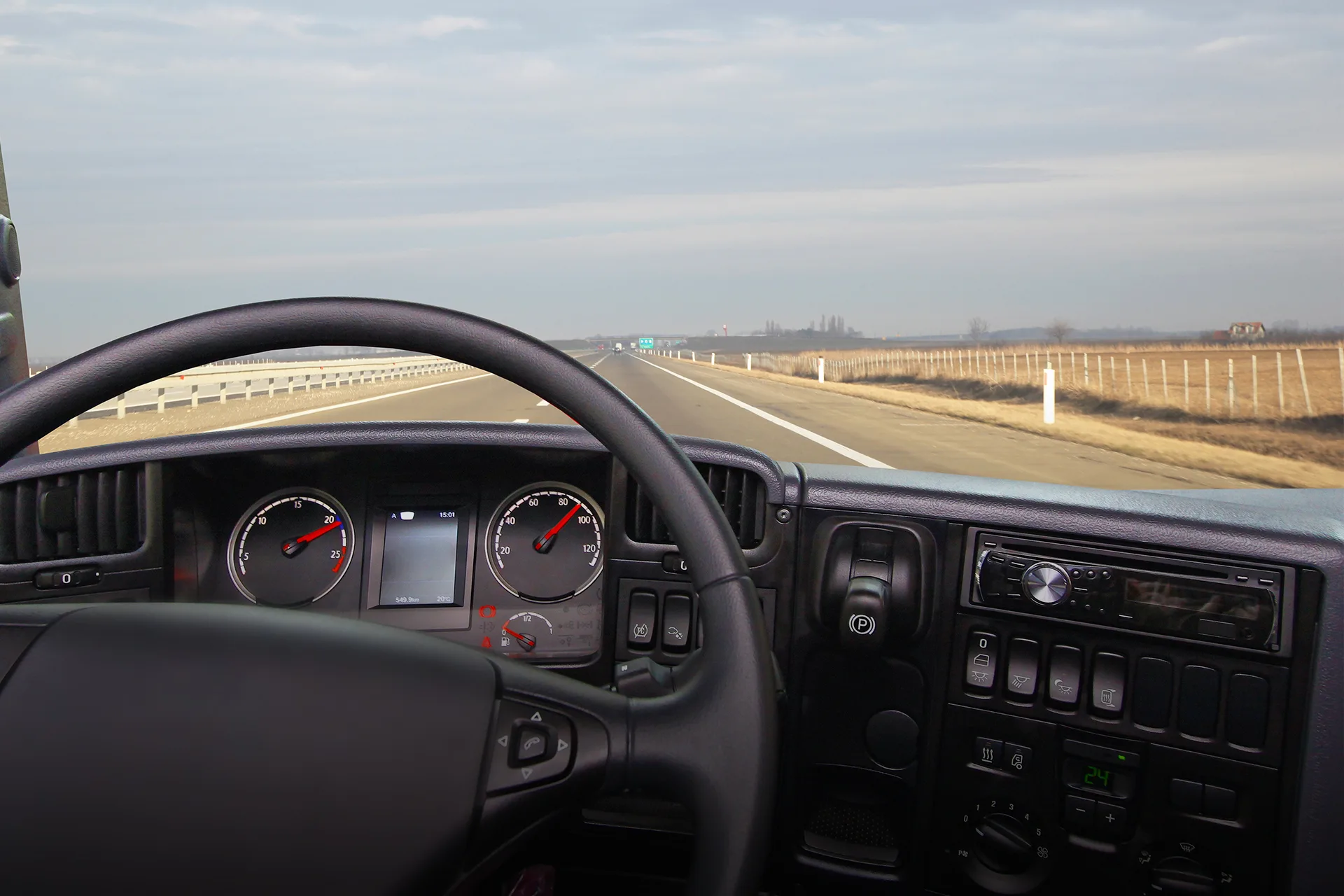
A lorry's warning lights in the control room
Logistics and delivery
Keeping track of trailers with EYE Bluetooth beacons
Logistics and delivery
Trailer data over EBS with no extra sensors
Logistics and delivery
Questions about the “Remote reading of DTC faults on lorries” scenario
Request a call
A specialist will call back and match a solution to your fleet and your task.