
A DSM camera against driver fatigue
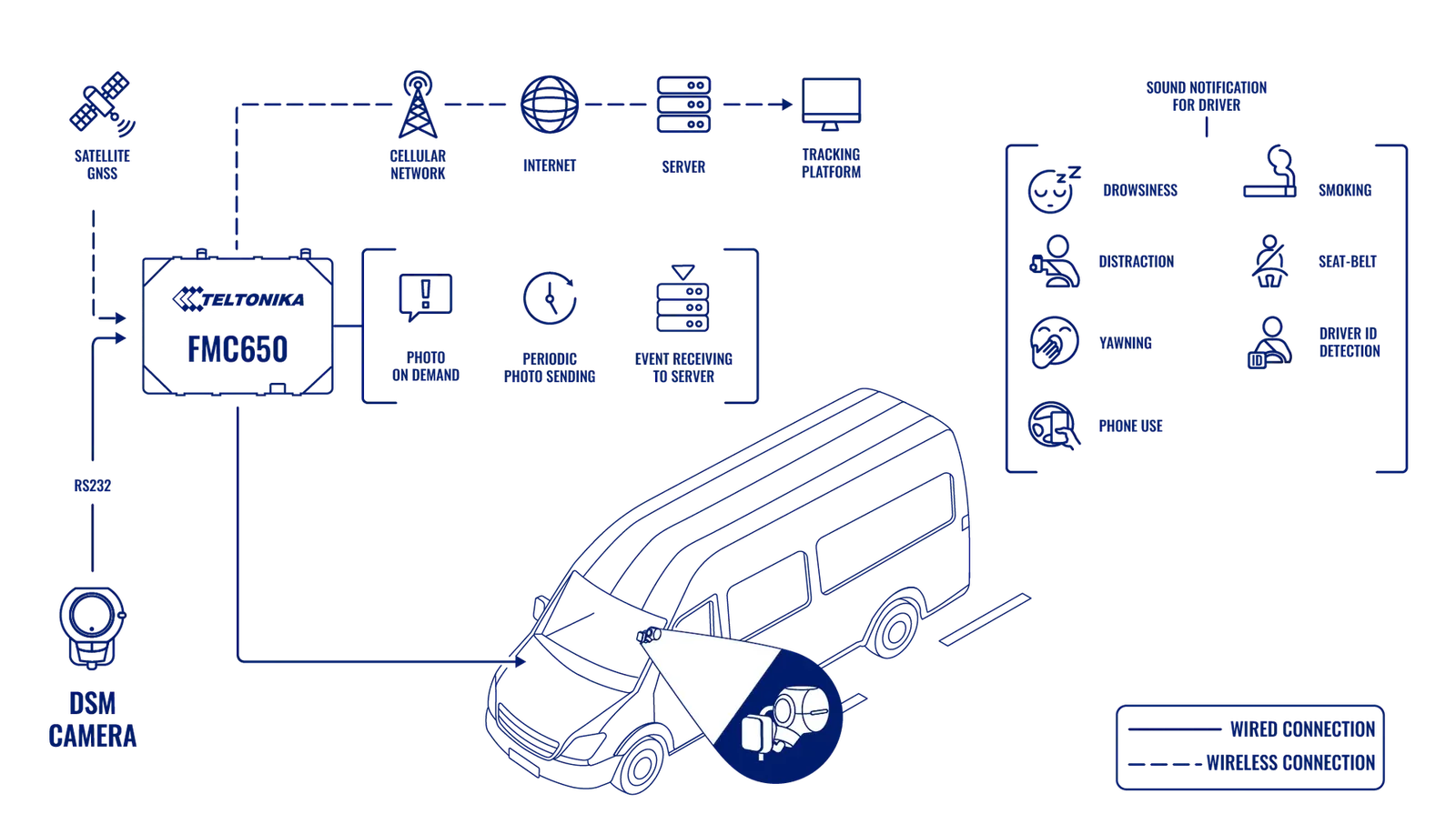
The Teltonika DSM solution: a camera in the cab watches the driver's face, catches drowsiness, phone use, smoking and an unfastened seat belt, while the FMC650 tracker sends the events to the server.
The Teltonika DSM solution: a camera in the cab watches the driver's face, catches drowsiness, phone use, smoking and an unfastened seat belt, while the FMC650 tracker sends the events to the server. Most accidents begin not with a mechanical fault but with a person. The driver was tired, was distracted by a message, reached for a cigarette — and missed the moment when the vehicle in front braked. The DSM (Driver Status Monitoring) camera works right there in the cab: it warns the driver by voice immediately and sends the fleet manager an event with a photo or video. In this use case Teltonika goes through the situations the system recognises and how it is paired with a PROFESSIONAL series tracker.
What this scenario solves
Fatigue behind the wheel is treated as an everyday matter, although it noticeably slows reactions and spoils a driver's judgement of the traffic situation.
According to a 2021 European study of driver fatigue, 24% of bus drivers and 30% of lorry drivers had fallen asleep at the wheel at least once during the year.
A phone or a cigarette in the hand takes attention away from the road in exactly those seconds when it is needed most.
An unfastened seat belt remains one of the leading causes of death in road traffic accidents, alongside speeding.
Fatigue behind the wheel is treated as an everyday matter, although it noticeably slows reactions and spoils a driver's judgement of the traffic situation. According to a 2021 European study of driver fatigue, 24% of bus drivers and 30% of lorry drivers had fallen asleep at the wheel at least once during the year. A phone or a cigarette in the hand takes attention away from the road in exactly those seconds when it is needed most. An unfastened seat belt remains one of the leading causes of death in road traffic accidents, alongside speeding.
Falling asleep for long is not required. A couple of seconds with the eyes closed on a main road is enough for the vehicle to drift into the oncoming lane. From the same study: 8% of bus drivers and 11% of lorry drivers had fallen asleep at the wheel more than three times in a year. Those are the ones who admitted it.
The scale of the problem is clear from European Union statistics: in 2021 alone, 19,800 people died on EU roads. On the estimates of European road safety research, wider use of seat belts could save up to 7,300 lives a year.
For a fleet owner there are two quite different troubles here. The first is what the driver does not control: drowsiness, microsleep, fatigue accumulated over a long shift. The second is what he does deliberately: talking on the phone, smoking, not fastening the belt. Only a timely warning helps with the first. The second needs a warning plus clear rules and evidence you can work with.
Without a camera the manager learns about all of this, in the worst case, from an accident report. A tracker will show speed and harsh braking, but it will not explain why the driver did not brake earlier.
What Teltonika offers
The Teltonika DSM camera is mounted on the windscreen in front of the driver and connected to an FMC650 tracker over RS232: the camera warns the driver by voice, and the tracker sends the event with a photo or video to the server.
Installation and setup
Fitting the device and configuring it for the fleet scenario at hand.
Data transfer
The device collects data and sends it to the monitoring platform; how often depends on the model and its settings.
Analysis and control
The person in charge gets reports and alerts and looks into what stands out.
This pairing divides the roles. The camera looks at the face and decides for itself what has happened. The FMC650, a PROFESSIONAL series tracker, adds coordinates, speed and time to the event and sends it all to a dedicated fleet management server. The manager sees not an abstract breach of the rules but a specific point on the map, a moment in time and the evidence.
What the camera recognises. The built-in warning scenarios are drowsiness, yawning, the eyes leaving the road, smoking, talking on the phone and an unfastened seat belt. In addition, DSM recognises the driver's face: up to 990 profiles fit in its memory, so the system knows exactly who has taken the wheel, with no cards or keys.
Recognition is built on deep learning algorithms. The camera is designed to work by day and by night and can recognise a face in a mask or a hat, but the quality of recognition depends on the mounting angle, on glare and on dark glasses, so it should be tested on your own drivers. It tracks the position of the head in space, the direction of gaze and how far the eyes and mouth are open. Its conclusions about drowsiness or distraction are drawn from that data.
Fatigue. The most dangerous part is that the driver often does not notice how tired he is. The camera triggers if the eyes stay closed longer than a set time or close repeatedly within 30 seconds. Yawning is tracked separately: if the driver yawns several times in a row within a minute, a voice warning sounds. That is a signal to stop and rest before something worse happens.
The belt. If the vehicle is travelling faster than 10 km/h and the driver is not belted in, the camera warns by voice. The signal repeats until the belt is fastened.
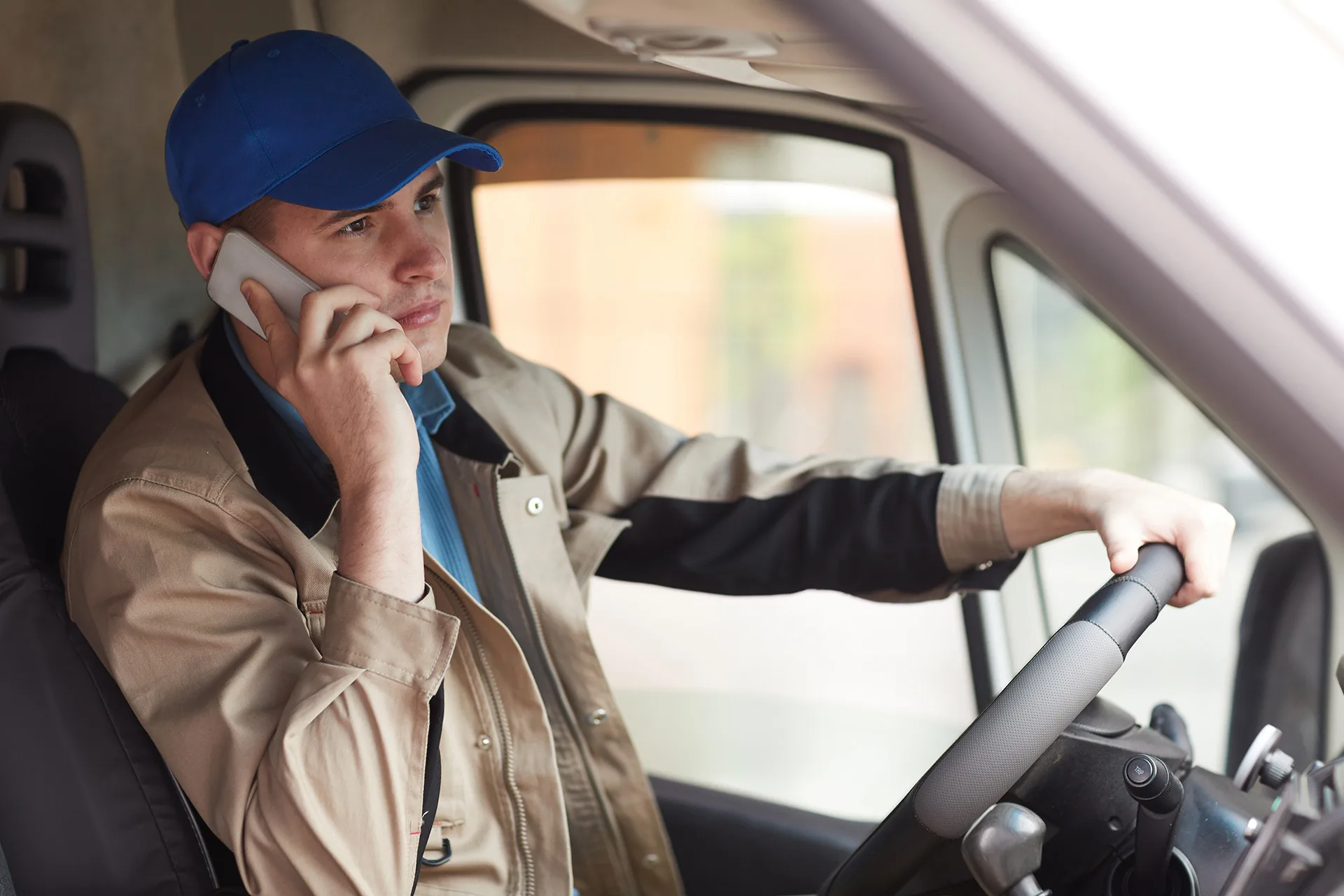
The phone. A conversation with the phone held to the ear is one of the most frequent causes of distraction. While the driver keeps talking, the camera reminds him every 30 seconds.
Smoking. Smoking at the wheel is not usually forbidden by law, but many companies ban it in their vehicles: it is a distraction, it leaves a smell in the cab and it puts the load at risk. The camera notices a cigarette and reacts after a short interval, about 2 to 4 seconds.
What the fleet manager sees. Every event goes to the server: the type of breach, the driver, the place, the speed, a still or a clip. From these, reports are built for each driver and for the fleet as a whole: who is distracted by a phone most often, who shows repeated signs of fatigue, on which runs and at which time of day. This data can be used in an incentive scheme, in accident investigations and in driver training.
The camera gives the voice warning itself, in the cab, with no dispatcher involved. There is one condition: DSM has to be calibrated to the driver's seating position, and the thresholds and volume set so that the signal can be heard with the engine and the air conditioning running. The driver does not need to look at a screen, he only needs to hear the phrase. There is a limitation too: the signal does not stop the vehicle and does not guarantee a reaction, so repeated fatigue events within a shift should reach the dispatcher as an alert rather than only appearing in the evening report.
An example from real life. A bus driver starts his third run of the day after lunch. On a straight stretch of main road the camera detects that his eyes are closing for longer and longer and gives a voice signal twice. The driver pulls into the nearest lay-by. That evening the manager sees two fatigue events on the same stretch in the report and reworks the roster so that this driver does not have three long runs in a row.
How to launch DSM in a fleet without the drivers going to war with the camera. For the first two or three weeks it makes sense to work in observation mode: the camera warns the drivers, events accumulate on the server, but nobody is penalised. During that time it becomes clear which thresholds are too sensitive and produce false triggers, and which breaches are genuinely widespread. Then a short meeting is held with the drivers, the statistics are shown without names and the rules are explained: what will lead to a review and what will earn a bonus.
After that the work becomes routine. Once a week the manager looks at the report, picks out the few most frequent offenders and goes through specific clips with them. Experience of in-cab camera rollouts usually shows the same thing: the number of events falls noticeably in the first months, once drivers understand that the system really works and that its data is used.
Combining this with tracker data broadens the picture. The FMC650 itself records harsh acceleration, braking and cornering, speeding and engine operation. If a phone event sits next to an episode of harsh braking, that is no longer a formal breach of the rules but a dangerous situation worth reviewing first.
A word about night runs. Most fatigue episodes fall in the early morning and the second half of the night, when the body wants to sleep regardless of how much rest the person had during the day. DSM reports by time of day help you see this in your own fleet and rework rosters so that the longest stretches do not fall in those hours.
Fitting and calibration. Before launch, the firmware version of the camera and the tracker and the RS232 port configuration are checked: they determine which events are transmitted and with what attachment. After fitting, the camera is calibrated on a real driver in his usual seating position, and then a short test drive is made in which each event is triggered deliberately: phone to the ear, head turned away, belt unfastened. Acceptance counts as passed when every event tested has arrived on the platform with a photo or video, coordinates and a time.
What an event record looks like. In the report it is one row: event type, driver, date and time, speed, address or point on the map, a link to a still or a short clip. Next to it you can see the tracker events for the same seconds, harsh braking for instance.
The response procedure is best written down in advance. A single phone event — a review at the weekly meeting. Two or more fatigue events within an hour — the dispatcher rings the driver and a decision is taken about stopping. A camera taped over, or events going missing — a check the same day. The specific thresholds are chosen by each fleet after the observation period.
What you get
The driver hears the warning immediately
The voice signal sounds in the cab at the moment of the breach, with no need to look at a screen or wait for a call from the dispatcher.
Drowsiness is caught before an accident
Closed eyes and frequent yawning trigger a warning before the driver himself realises he is falling asleep.
Phone and cigarette under control
Deliberate breaches are recorded with a photo or video, and the conversation with the driver rests on facts.
You know who is at the wheel
Face recognition holds up to 990 profiles and ties every event to a particular person, with no cards or keys.
Reports for incentives and training
Driver statistics show who to reward and who to sit down with, and help build a fair bonus scheme.
Fewer accidents and lower costs afterwards
When accidents happen less often, spending on repairs, fines, insurance and medical treatment falls, although the size of the effect depends on how the fleet works with the events.
Why this solution
The strength of this solution is having the camera and the tracker from a single source. DSM and the FMC650 were designed from the start to work together over RS232, event configuration is done with the standard tools, and there is no need to make equipment from different manufacturers talk to each other.
The FMC650 was not chosen by chance. It is a tracker from the PROFESSIONAL range with a large number of inputs and outputs, CAN support and external interfaces. Not only DSM can be connected to it, but also fuel level sensors, readers and additional cameras, so the safety system grows along with the fleet's needs.
The camera processes the image itself and does not stream video to the server continuously. Only events with short clips or stills go over the link, so data usage stays reasonable even on a large fleet.
Flexible settings matter too. The thresholds, intervals and the set of active warnings can be tuned to a particular business: for intercity coaches fatigue is what counts, for city couriers the phone, for hazardous goods carriers everything at once.
In practice the most common question is whether the camera will trigger on everything in sight. It will, if you leave the default thresholds in place and never look at the first weeks of operation. For instance, a driver who often glances in the wing mirror on narrow streets may collect distraction warnings. That is why the settings are better adjusted against the real events of the particular fleet, rather than set to maximum sensitivity straight away.
The second frequent question is what happens if a driver tapes the camera over. That shows up too: a driver who used to collect warnings regularly suddenly produces no events at all, and the stills show darkness instead of a face. A report like that is a direct reason for a conversation with the driver.
And a word about honest limitations. The camera is no substitute for proper working and rest hours: if a driver works 14-hour days, it will warn him constantly but it cannot get his sleep for him. DSM works best where its events really are reviewed and rosters and rules are changed, rather than simply piling up in an archive. One more point: staff should be told about the camera in the cab in advance, and this should be set out in the company's internal documents.
How this works in Azerbaijan. DSM brings the most benefit on long routes: lorries on the M-2 from Baku to Ganja and on towards the Georgian border, hauliers working through the port of Alat and along the Middle Corridor, intercity coaches from Baku to Sheki, Lankaran and Guba. On the M-3 towards Astara and the M-1 towards the Russian border there are many monotonous straight stretches where fatigue builds up unnoticed, especially in the summer heat and after night runs. In town the camera is useful for taxis, couriers and company drivers who are used to holding a phone in traffic. When fitting it we take the sun into account: in Azerbaijan it is bright for most of the year, so we position the camera where it will not be dazzled and we test recognition with sunglasses on. GPS.az supplies and fits DSM with an FMC650 tracker, sets the thresholds to suit your type of transport operation and delivers events with photos and video to the Wialon platform, where they are convenient to review by driver and by run.
Related case studies
Related rollouts and equipment
Questions about the “A DSM camera against driver fatigue” scenario
Request a call
A specialist will call back and match a solution to your fleet and your task.