
Protecting an ATM with the FMC650 tracker
An FMC650 tracker inside the ATM, together with EYE Sensor devices, reports a door being opened, the machine being tilted and the machine being moved, and if the ATM is carried off after all, it shows where it is.
An FMC650 tracker inside the ATM, together with EYE Sensor devices, reports a door being opened, the machine being tilted and the machine being moved, and if the ATM is carried off after all, it shows where it is. Attacks on ATMs have become a visible problem for banks. According to figures cited by Teltonika, the number of physical attacks on ATMs in the EU rose by 24% in 2023, and in the United States by 165% between 2021 and 2022. Criminals cut through casings, blow safes open and pull whole machines out by hitching them to a vehicle. In this case study Teltonika proposes putting a professional tracker inside the ATM and adding wireless sensors to it, so that security learns of an attempted break-in within the first seconds rather than in the morning from the cash-in-transit crew.
What this scenario solves
An ATM is accessible to any passer-by and holds a large sum of cash inside.
For a criminal it is an obvious target: the value is high and there is usually no guard nearby.
The more conveniently an ATM is placed for customers, the easier it is for an offender to get at it too.
The casing is strong but not invulnerable.
An ATM is accessible to any passer-by and holds a large sum of cash inside. For a criminal it is an obvious target: the value is high and there is usually no guard nearby. The more conveniently an ATM is placed for customers, the easier it is for an offender to get at it too.
The casing is strong but not invulnerable. Against an angle grinder, a gas explosion or a cable tied to a four-by-four, steel buys only time. If nobody learns of the attack during those minutes, the machine is opened or driven away.
The most vulnerable are the ATMs out on their own. A filling station on a trunk road, a retail unit in the suburbs, a poorly lit corner beside a shop. There are fewer witnesses there, and an alarm from the built-in system may never reach security if the signal cannot get through walls and steel.
Once the machine has been taken away, finding it without a tracker is all but impossible. All the bank is left with is camera footage, if there was any, and a report to the police.
For the bank this is not only the stolen money. It is repairing or replacing the machine, the loss of a service point, and questions from the insurer about how the ATM was protected.
What Teltonika offers
An FMC650 tracker is fitted inside the ATM. Its accelerometer tracks tilting and shifting of the machine, wireless EYE Sensor devices report doors being opened, and an alert with coordinates goes to the monitoring system as soon as the tracker gets a connection. How quickly it reaches the duty officer depends on the signal at the particular site and on how the events are configured, which is why this is tested at handover.
Installation and setup
Fitting the device and configuring it for the fleet scenario at hand.
Data transfer
The device collects data and sends it to the monitoring platform; how often depends on the model and its settings.
Analysis and control
The person in charge gets reports and alerts and looks into what stands out.
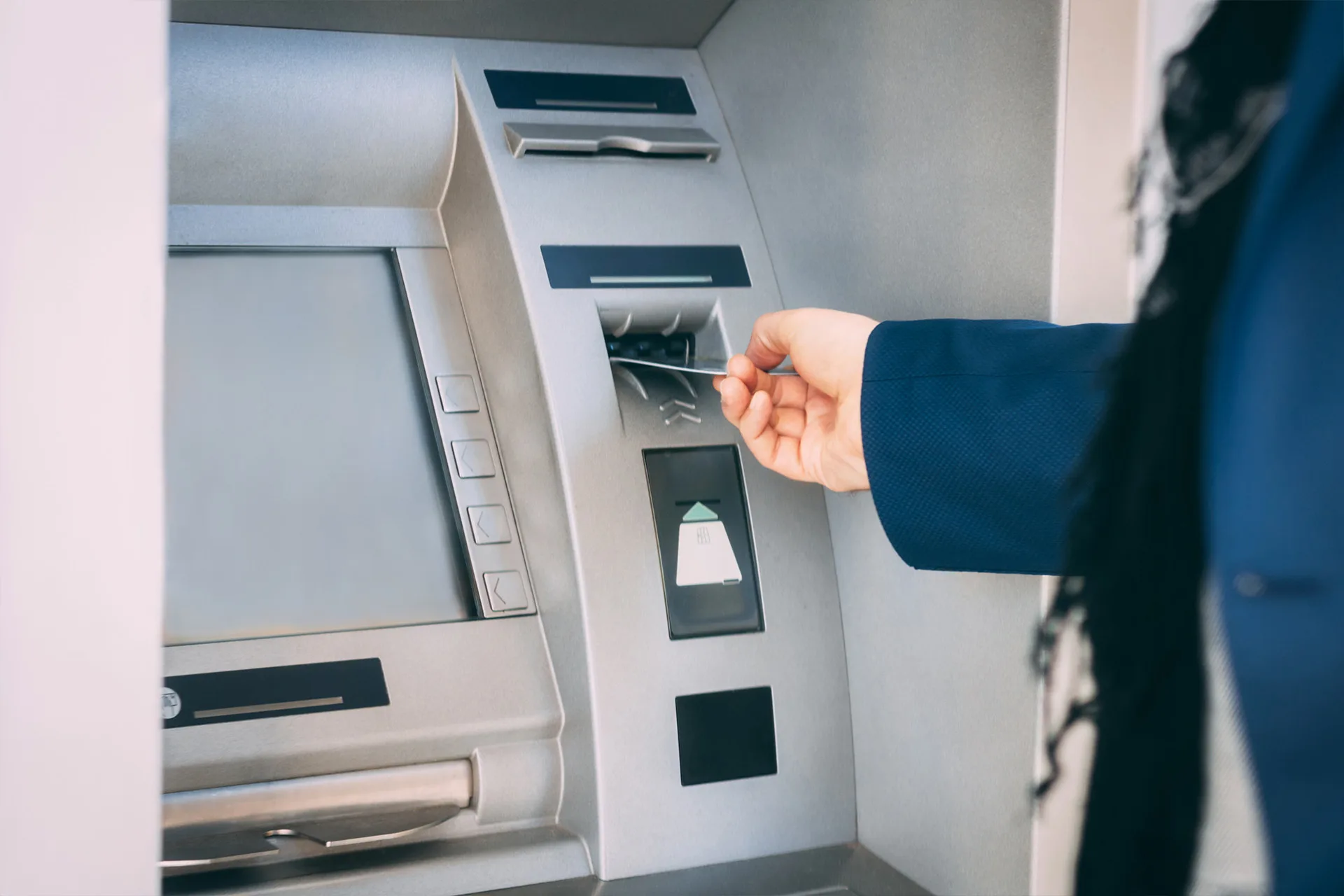
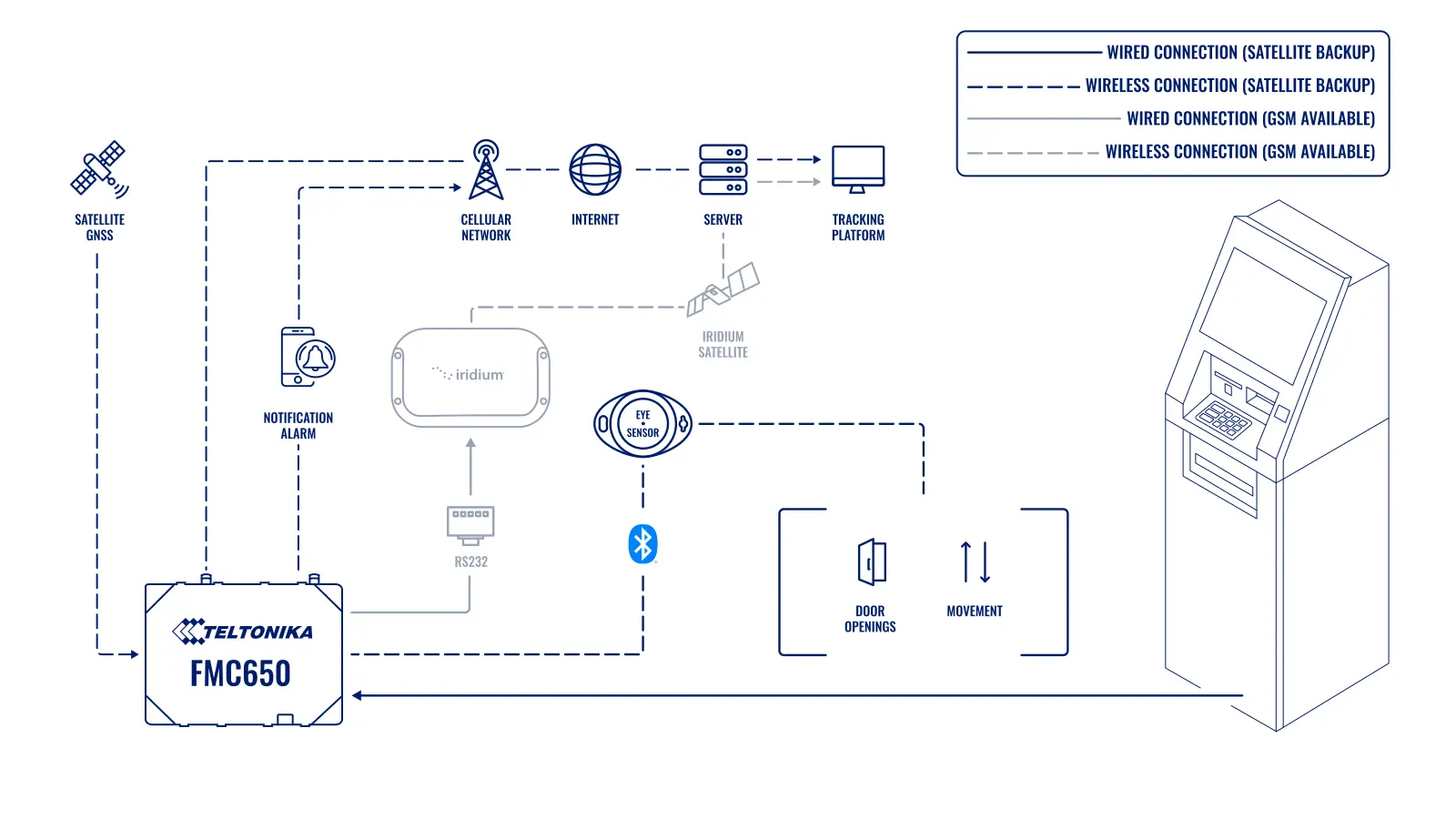
Installation. The FMC650 from the Teltonika professional range is mounted inside the ATM casing and powered from its mains supply. So that the signal gets out through the steel safe reliably, the tracker is connected to an external cellular aerial brought outside the casing. The tracker is also connected to the machine's communication systems, so monitoring runs continuously.
Door sensors. Compact wireless EYE Sensor units go on the doors and service compartments and talk to the tracker over Bluetooth. The sensor picks up opening and movement. If a door opens outside the servicing schedule, the EYE Sensor tells the tracker immediately and the tracker sends an alert to the monitoring system.
Tilt and movement. The FMC650's built-in accelerometer tracks the position of the ATM. In ordinary life the machine stands still, so a noticeable change of angle is a sign that someone is trying to wrench it out, tip it over or load it up. The tracker runs angle monitoring in the mode used when the ignition signal is off, and raises an alert when a set threshold is exceeded.
If the machine is taken away. The tracker goes on transmitting coordinates and security sees the route in real time. That gives the police a chance to intercept the vehicle, and the bank a chance to get the machine and some of its contents back.
Back-up connectivity. The FMC650 has two SIM card slots, so if one operator has problems the tracker switches to the other. For remote sites with a weak cellular network a satellite modem can be connected to the tracker, and the alert will go out over the satellite channel.
What an alert looks like. At night the duty officer at the security service receives a notification: on the ATM at a filling station outside town the service compartment door has opened, and no cash replenishment is scheduled. A minute later a second event arrives — the machine's angle of tilt has changed. The duty officer sends a crew at once and informs the police, while the map shows the exact place. If the machine has already been moved, the screen shows which way it is being taken.
Separating the events. So that security does not drown in alerts, events are graded by importance. A door opening inside the servicing window is written to the log without an alert. The same opening at night is an alert. Tilting or movement of the machine is always an alert, because an ATM does not move in normal operation. Loss of power is worth separating out as well: it can be caused by a fault in the mains or by an offender cutting the power before breaking in.
If the power is cut. The tracker is powered from the ATM's supply, and in case of a power cut the FMC650 has a built-in back-up battery: it is enough to send the power loss event and to transmit coordinates for a while. How long exactly depends on the reporting frequency, so the mode used after a power cut is configured separately.
Link to the security service. Alerts reach the duty officer in the monitoring platform and as notifications. If the bank or the security company has its own control room, events can be passed to it through the platform API, with the format agreed separately with the owner of the control room.
Handover at the site. After fitting, every site is checked against a short list: open a door outside the servicing window and confirm that the alert reached the duty officer; open one inside the servicing window and confirm that there is no alert; simulate a tilt; cut the power; check connectivity through both SIM cards. Until all five points have passed, the site does not count as protected.
Maintenance. The tracker's data also helps to keep an eye on technical condition: power cuts and abnormal events are visible immediately, which reduces ATM downtime.
What you get
An alert immediately after the event
A door opening or the machine being tilted or shifted turns into a signal for security while the offenders are still on site; how fast it is delivered depends on connectivity at that site.
A stolen machine can be found
The tracker keeps transmitting coordinates even after the ATM has been driven off, which gives you a chance to intercept the vehicle and recover the equipment.
The signal gets out of the safe
An external aerial and two SIM cards from different operators help the signal out of the steel casing.
Arguments for the insurer
Demonstrable protection of ATMs by tracking and sensors helps meet insurers' requirements and may affect the terms of cover.
From one machine to a whole network
The solution goes onto a single ATM at a filling station just as readily as onto hundreds of machines with a shared monitoring panel.
Why this solution
An ATM needs a tracker that withstands continuous mains operation, is not defeated by shielding and can take external sensors. The FMC650 covers those requirements: an external aerial, two SIM card slots, a built-in accelerometer, Bluetooth for wireless EYE Sensor units, and the option of connecting a satellite modem for sites with no cellular coverage.
EYE Sensor is a Teltonika product too, so the sensors work with the tracker without adapters or third-party gateways. They are easy to move or add to, and there is no need to run cables to the doors.
The limitation is an honest one: the tracker does not physically stop a break-in. It shortens the time before security reacts and helps find the machine. So the solution works alongside alarms, cameras and a contract with a security company, not instead of them.
How this works in Azerbaijan. ATMs in Baku stand mostly in busy places, but the banks' networks moved out into the regions long ago: filling stations on the M-1, M-2 and M-3, shopping centres in Sumgait, Ganja, Lankaran and Mingachevir, small branches in district centres. It is precisely the remote sites by the roads and in the villages that are the most vulnerable. For those we fit two SIM cards from different operators (usually Azercell and Bakcell, or Nar, depending on whose signal is better at the particular site) and bring the aerial outside the casing. Where there is no cellular network at all, or it is unstable, satellite connectivity can be added. When fitting the system it is important to agree the cash replenishment and servicing schedules with the bank, so that a planned door opening does not raise a false alarm. GPS.az fits the FMC650 and the EYE Sensor units, sets the tilt thresholds and the events, and brings the whole ATM network onto the Wialon platform: alerts reach the duty officer at once, and the event history for each machine is kept for investigation and for the insurer.
Related case studies
Related rollouts and equipment

Drivers’ hours from VDO Counter data
Logistics and delivery

FMS Eco Driving: a driving style report for articulated lorries
Logistics and delivery

Trailer data over EBS with no extra sensors
Logistics and delivery
Questions about the “Protecting an ATM with the FMC650 tracker” scenario
Request a call
A specialist will call back and match a solution to your fleet and your task.