
Battery swapping stations for electric scooters
A Teltonika use case about battery swapping stations for electric scooters and electric motorcycles: an FTC305 tracker inside each battery reports its charge, temperature, faults and coordinates, while an EYE Beacon helps find a battery even when it is completely flat.
A Teltonika use case about battery swapping stations for electric scooters and electric motorcycles: an FTC305 tracker inside each battery reports its charge, temperature, faults and coordinates, while an EYE Beacon helps find a battery even when it is completely flat. Electric two-wheelers (E2W) have become ordinary city transport: they are quiet, they do not smoke and they cost less to run than petrol mopeds. There is one weak point — the battery. It is small, it has to be charged often, and a courier or a scooter taxi rider has no time to wait for a charge. Hence the idea of swapping stations: pull up, take out the empty battery, put in a full one and ride on. But as soon as batteries become shared and start moving between stations and people, the owner of the network is left with plenty of questions that cannot be answered without telematics.
What this scenario solves
An automated station has no staff, and nobody can see which battery is faulty.
Checking every battery by hand is slow and expensive and gets in the way of the stations working.
Overheating or improper use of a battery can end in a fire.
Batteries get stolen, and a flat battery with no power cannot be found afterwards.
An automated station has no staff, and nobody can see which battery is faulty.
Checking every battery by hand is slow and expensive and gets in the way of the stations working.
Overheating or improper use of a battery can end in a fire.
Batteries get stolen, and a flat battery with no power cannot be found afterwards.
An electric scooter rider is held up by everything that holds up other road users: traffic, lights, roadworks. But they also have a problem of their own — charge. An E2W battery is appreciably smaller than an electric car's, and a courier or a rider may need several charges in a day. If each one takes a couple of hours, the work stops.
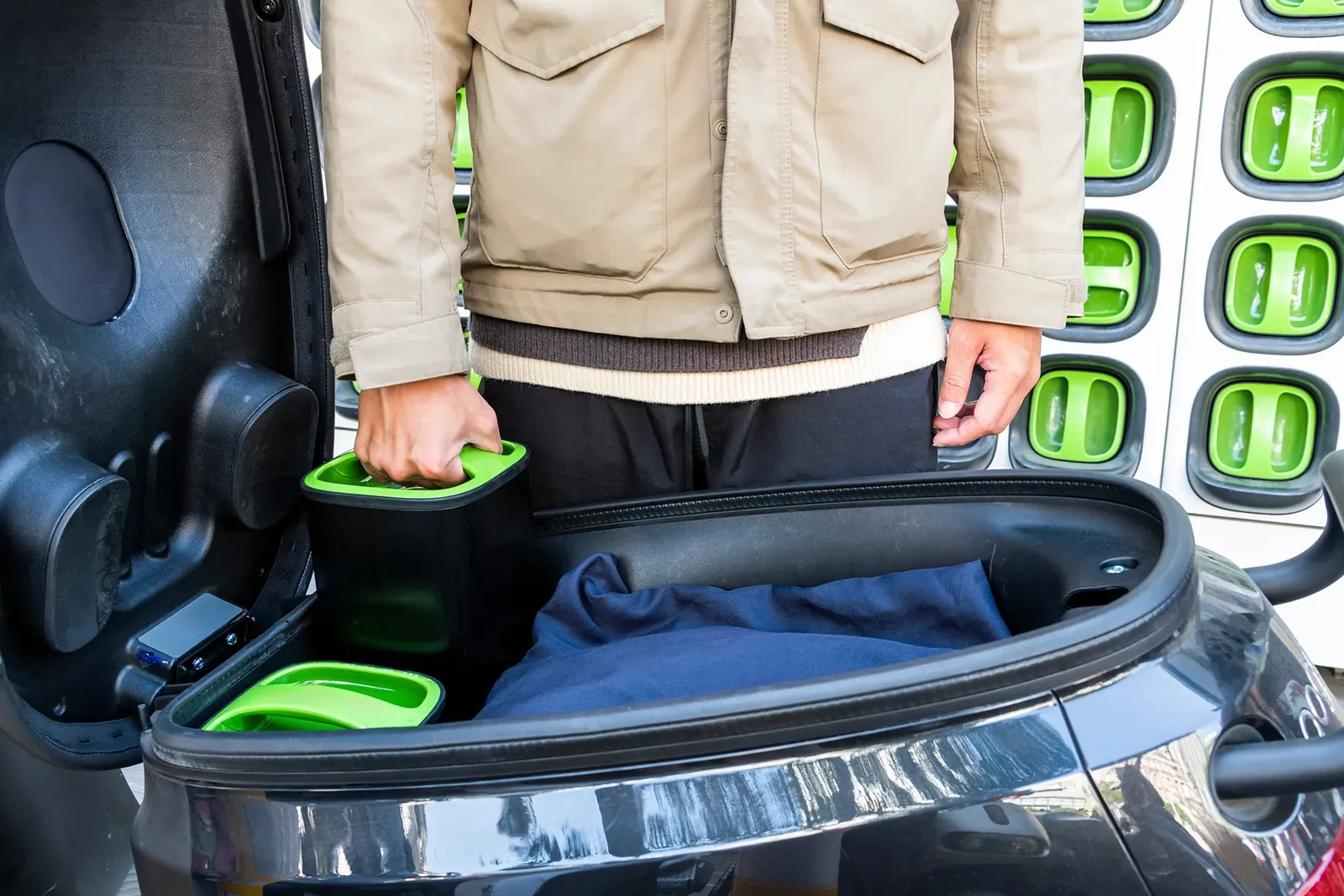
Swapping stations take that problem away. They are conceived as fully automated: there is no member of staff on site, and the user swaps an empty battery for a full one themselves. A person only comes to the station if there is a problem with one of the batteries: it is taken away for diagnosis or repair.
And this is where the difficulties start. How is the owner of the network to learn which of hundreds of batteries is degrading, which has a controller fault, which is overheating on charge? Taking out and testing every one means keeping an army of technicians and putting stations out of service.
There is also the question of liability. A battery is rented out, and if the user treats it improperly it may fail, catch fire or even explode. To settle warranty disputes fairly between the network, the battery manufacturer and the customer, you need data on how the battery was used: temperature, current, charging modes.
And finally, stock records. How many batteries are at the stations right now, how many are in users' hands, which have gone missing? When a battery is completely flat, the tracker inside it may be left without power too, and finding it becomes all but impossible.
What Teltonika offers
An FTC305 tracker from the FTx305 series for electric mobility is built into each swappable battery: over CAN it reads the battery controller's data and sends it along with coordinates, while an EYE Beacon stays audible even when both the battery and the tracker are flat.
Installation and setup
Fitting the device and configuring it for the fleet scenario at hand.
Data transfer
The device collects data and sends it to the monitoring platform; how often depends on the model and its settings.
Analysis and control
The person in charge gets reports and alerts and looks into what stands out.
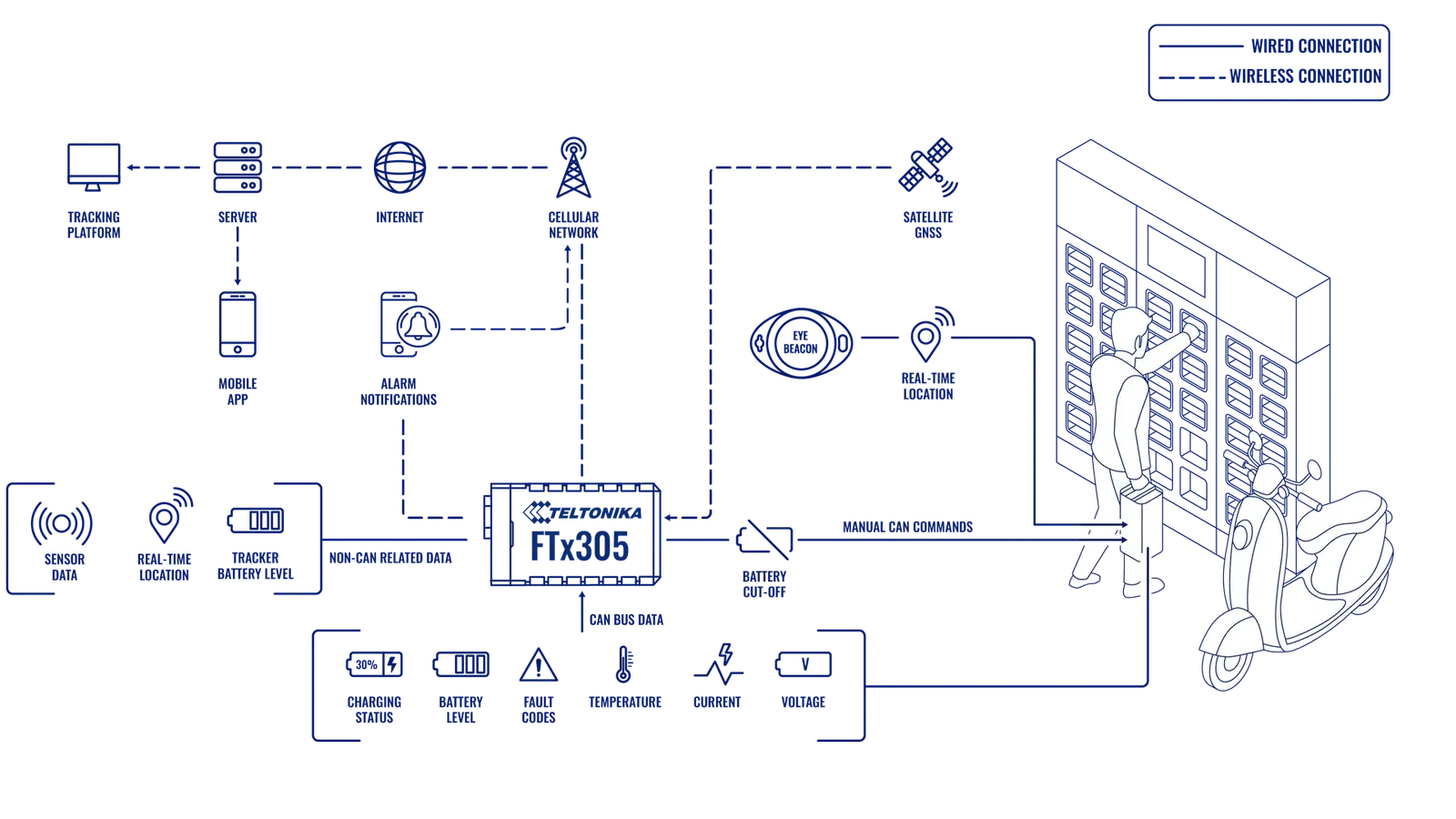
The FTC305 connects to the CAN interface of the battery management system (BMS). From there it gets everything the BMS knows about the battery: voltage, current, charge level, charging status, temperature, fault codes. Those data go to the server, and the owner of the network sees the condition of every battery wherever it happens to be: at a station, with a user or on the move.
That changes the technicians' work at once. Instead of a scheduled round of the stations they get a list of the batteries that genuinely need collecting: with a fault code, with falling capacity, overheating on charge. The rest carry on working.
The second feature is Manual CAN Commands. Up to 10 commands in the protocol of a particular BMS can be programmed into the FTx305 and sent remotely: once at power-up, again on demand, or periodically. If a battery is overheating, the server sends a command to shut it down. The user receives an SMS or an app notification asking them to stop and swap the battery at a station. That way an unpleasant incident can be stopped before it turns into a fire.
The third is data for warranty purposes. The tracker writes a usage history: what currents the battery was charged and discharged at, at what temperature, whether it went outside permitted modes. If a user claims the battery failed by itself, but it had been running in a prohibited mode for a week, the battery manufacturer (OEM) and the station network can show it. And the other way round: if the battery failed under normal use, that is visible too, and the dispute is settled fairly.
The fourth is protection against theft. Alongside the FTC305 an EYE Beacon Bluetooth beacon goes into the battery. The beacon has its own cell, good for years of operation. If a stolen battery is completely flat and the tracker inside it has switched off, the beacon carries on transmitting, and gateways hear it: stations, trackers in other scooters, staff smartphones. The battery can be found and recovered.
The same beacon helps with stock records. The system knows how many batteries are standing at each station, how many are on charge, how many are with users and how many are temporarily unavailable. Planning purchases and redistributing batteries between stations becomes easier. If by the evening one station has nothing but empty batteries left while full ones stand unused at the next one, that is visible on the map, and the service vehicle takes them to where demand is higher.
The equipment list for the use case also includes the TFT100 — Teltonika's tracker for the electric scooters and mopeds themselves. It goes on the vehicle if the network rents out not only batteries but the machines as well: then both the scooter and the battery in it are visible.
What is needed from the battery manufacturer. The CAN protocol of the particular BMS, a place inside the casing for the tracker and, if necessary, a way of bringing out antennas where the battery casing is metal. The tracker takes its power from the battery itself, so the charge level at which it goes into economy mode is set in advance. Coverage is checked separately wherever the batteries will stand: stations in underground car parks and enclosed spaces may send data with a delay. All of this is checked on a sample battery before a batch is bought.
Safe conditions for the command. Shutting a battery down while the scooter is moving would stop it in the middle of the road, so the command is configured in stages: first a warning to the user, with the shutdown coming after the scooter has stopped or on a confirmed dangerous overheat. Who can send the command manually is decided in advance, and every command stays in the battery's history.
An honest limitation: the arrangement works if the battery has a BMS with a CAN interface and the protocol is known. For cheap batteries with no digital interface, much of what is described here is not available.
What you get
A faulty battery is visible at once
Fault codes, voltage and temperature from the BMS arrive at the server, and the technician goes out for a specific battery rather than testing them all in turn.
Shutdown on overheating
A manual CAN command switches the battery off remotely, and the user gets a warning in the app or by SMS.
Fair warranty disputes
A history of currents, temperatures and modes shows how the battery was used and protects both the network and the customer.
A flat battery can still be found
The EYE Beacon runs off its own cell and stays audible even when the tracker has switched off.
Accurate stock records per station
It is visible how many batteries are charged, how many are out with users and how many are unavailable.
Fewer technician visits
The service team works to a list of problem batteries instead of a scheduled round of the stations.
Why this solution
The FTx305 series was created specifically for electric transport: the compact housing fits inside a battery pack, while the CAN interface and manual CAN commands make it possible to work with BMS units from different manufacturers. This is not a vehicle tracker adapted to a battery but a device designed for this job.
The pairing with the EYE Beacon closes the main hole in theft protection: any GPS tracker goes silent without power, whereas a beacon keeps working for years. All the equipment comes from one manufacturer and is configured in one Configurator.
Remote updating of firmware and settings makes it possible to change the operating logic across thousands of batteries at once, without gathering them in a warehouse.
How this works in Azerbaijan. In Baku electric scooters and e-bikes have become the main transport for the couriers of food and goods delivery services, while e-scooter rental operations work along the seafront, in Yasamal and in Nasimi. Battery swapping networks are only just appearing in Azerbaijan, but anyone running a fleet of electric scooters already has the same problems: batteries are stolen, they overheat in summer at +40 °C, and couriers complain that they go flat quickly. What to allow for: heat speeds up battery degradation, so the temperature thresholds for alerts are worth setting to suit the local climate, and the tracker's compatibility with the BMS is worth checking on a sample before buying. GPS.az selects Teltonika trackers for electric transport and beacons, helps with the CAN integration and puts batteries and scooters onto the map of the Wialon platform.
Related case studies
Related rollouts and equipment
Questions about the “Battery swapping stations for electric scooters” scenario
Request a call
A specialist will call back and match a solution to your fleet and your task.