
BMS monitoring for electric scooters in India
The FTC305 tracker connects to the battery management system (BMS) of an electric scooter, reads its data over CAN and can shut the battery down remotely on overheating or when the hire payment is missed.
The FTC305 tracker connects to the battery management system (BMS) of an electric scooter, reads its data over CAN and can shut the battery down remotely on overheating or when the hire payment is missed. The scenario was born in India, where the market for electric two- and three-wheelers is growing faster than the safety rules can keep up. After a run of battery fires in 2022 the state brought in mandatory requirements for the BMS, and manufacturers and hire companies alike needed a way to see every battery in the fleet. Below we look at how Teltonika solves this, exactly what the tracker takes out of the BMS, and where a similar arrangement is useful in Azerbaijan.
What this scenario solves
The lithium-ion battery of an electric scooter can catch fire if it overheats, is overcharged or short-circuits.
In India in 2022 such cases came in runs and made the news.
It is hard for a manufacturer to prove who is at fault for a battery failure with no log of how the battery was used.
A hire company cannot see where its scooters are or what condition the batteries are in.
The lithium-ion battery of an electric scooter can catch fire if it overheats, is overcharged or short-circuits. In India in 2022 such cases came in runs and made the news. It is hard for a manufacturer to prove who is at fault for a battery failure with no log of how the battery was used. A hire company cannot see where its scooters are or what condition the batteries are in.
The authorities reacted firmly. Since 31 March 2023 the second phase of the AIS 156 standard has been in force in India: electric two- and three-wheelers and quadricycles must have a smart BMS with additional safety functions. The regulator wants a dangerous battery condition to be spotted before it turns into a fire.
The manufacturer (OEM) has a pain of its own — the warranty. When a customer brings in a swollen battery, someone has to work out what was done to it: charged with the wrong charger, ridden hard in the heat at full current, or faulty from the start. With no log of parameters the argument is settled by guesswork, and most often in the customer's favour.
Hire and courier companies have a broader problem. They need to know where each scooter is, how much charge is left, whether there are fault codes, and to be able to switch a machine off if the renter has stopped paying. Sending someone out to every scooter for that is expensive and slow, and when the fleet runs into thousands of machines across a city it is simply impossible.
What Teltonika offers
Teltonika proposes fitting each machine with a tracker from the FTx305 series (the FTC305 in this use case), which reads the BMS directly over CAN and can send commands into it — up to and including switching the battery off.
Installation and setup
Fitting the device and configuring it for the fleet scenario at hand.
Data transfer
The device collects data and sends it to the monitoring platform; how often depends on the model and its settings.
Analysis and control
The person in charge gets reports and alerts and looks into what stands out.
Why this series in particular. The tracker runs on anything from 10 to 97 V, which means it can be connected to almost any traction battery: from a 36 V bicycle to a 72 V three-wheeled rickshaw. No separate voltage converter is needed.
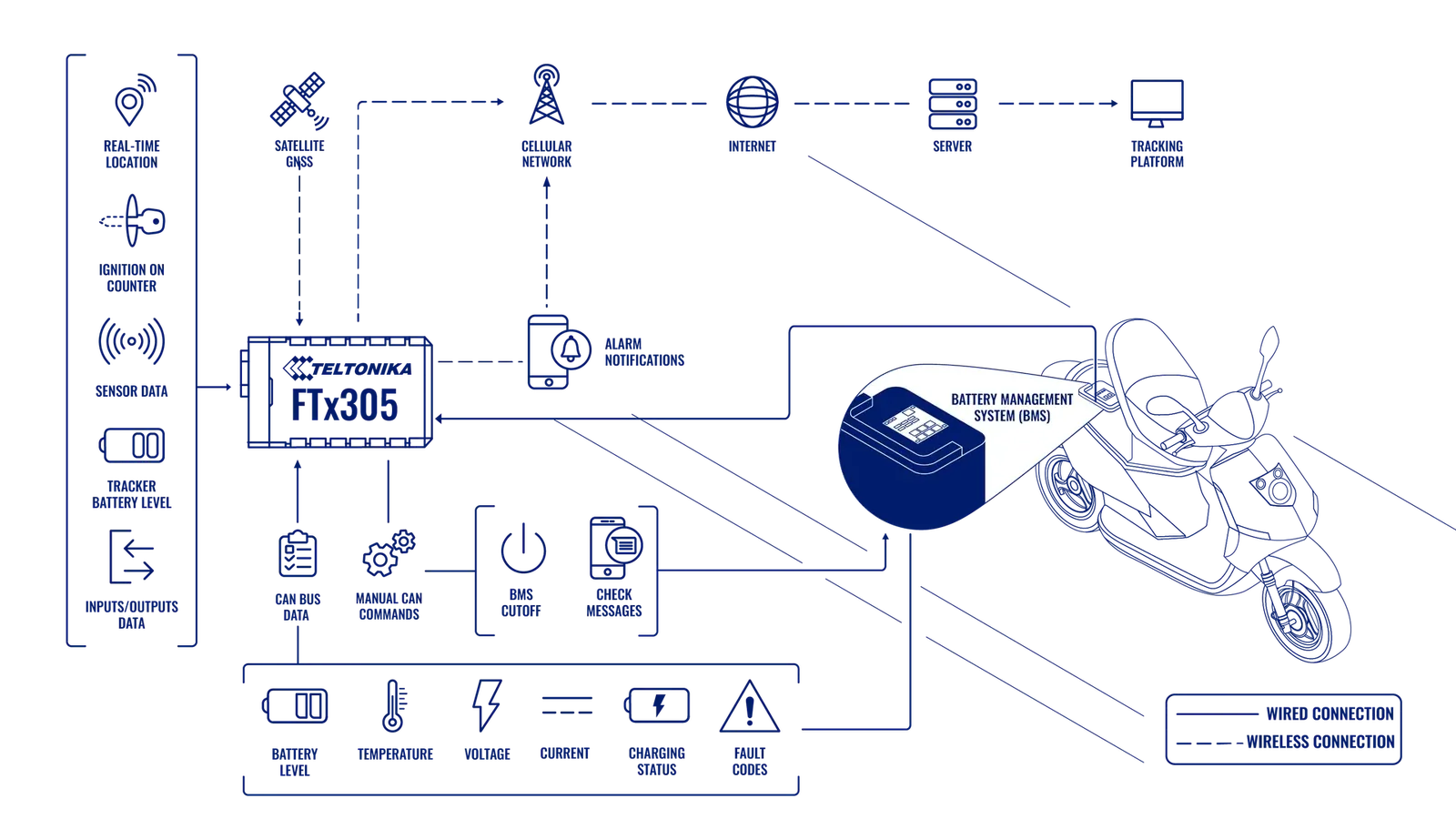
The key thing here is the Manual CAN feature. Normally, for a tracker to understand a particular manufacturer's CAN, a separate protocol has to be written. Manual CAN does without that: the necessary identifiers are entered into the tracker from the battery manufacturer's documentation, and it starts pulling in the raw data. In all, up to 70 periodic or polled CAN IDs can be defined.
What ends up arriving at the platform:
• location and speed;
• traction battery state of charge, current, voltage;
• charging status;
• BMS fault codes, including overheating;
• the state of the tracker's inputs and outputs, its own charge, the ignition state.
The data goes over the mobile network (GPRS) to the monitoring server. The fleet manager sees each battery as a separate unit: where it is, how it is working, whether the operating rules are being broken. The history of the parameters shows straight away which battery is starting to degrade and is due to come off for diagnosis.
The other half of the solution is commands. The Manual CAN Commands feature gives two-way communication: up to 10 CAN commands can be configured in the tracker for it to send into the BMS. A typical example — the BMS reports overheating, the platform reacts, the tracker issues a shutdown command, the battery stops delivering current and goes into sleep mode until the alert is cleared.
That same command settles the hire question. If a renter is late with a payment, the battery's owner switches it off remotely and the scooter goes nowhere. For a hire business this is the key lever: the battery, and the ability to switch it on, stay with the owner.
If a particular BMS has no built-in shutdown function, the tracker's digital output (DOUT) helps out. It is wired to an external shutdown circuit and triggered on a condition, for example when the voltage moves outside the set thresholds. The arrangement is simpler, but it does the job.
How this looks in real life. A courier leaves a scooter in the sun outside a cafe and goes off with an order. 20 minutes later the BMS registers cell temperature rising above the threshold and issues a fault code. The tracker passes the event to the server, the dispatcher gets a notification, and a rule on the platform sends the shutdown command by itself. The battery cools down in sleep mode, and a record stays in the log: when the overheating began, what the current and the charge were, and who was renting the machine at the time. If the battery does fail later, the manufacturer has the data to work through a warranty claim.
The rules themselves are defined on the platform and in the tracker: voltage, temperature and state of charge thresholds, shutdown conditions. They can be changed remotely, without removing the device — tightening the temperature thresholds for a hot summer and easing them off for winter, for instance.
For the TFT100 the logic is the same — it is another model for electric transport, chosen to suit the particular machine and the way it is fitted.
What you get
A fire risk is visible in advance
Overheating, overcharging and deep discharge arrive at the platform as events, and you can react to them before the battery fails.
Servicing by data rather than by the calendar
The history of current, voltage and fault codes shows which battery is weakening, and it comes off for checking while the scooter is still running.
An honest look at warranty cases
The manufacturer has a log of how the battery was used, and the argument about who ruined it is settled on the facts.
Compliance with AIS 156
For the Indian market this is a mandatory requirement, and BMS monitoring helps to meet it without fines or product recalls.
Control over hire
An unpaid scooter is switched off remotely, with no need to send anyone out.
One tracker for any battery
The 10–97 V range covers almost every model of light electric vehicle in the fleet.
Why this solution
The strong point of the FTx305 is Manual CAN. Most trackers can only read the CAN of machines whose protocol is built into the firmware in advance. With electric scooters that does not work: there are hundreds of battery manufacturers, each with its own set of messages. Being able to enter the identifiers by hand from the documentation saves months of integration work.
Two-way communication with the BMS is the second reason. The tracker does not merely watch; it acts, switching the battery off on a command from the server or on a condition of its own. For hire arrangements that matters more than the map itself.
Teltonika has long experience in telematics for light electric vehicles, and trackers in this series work in hire and courier fleets in a number of countries. The device is small, runs straight off the traction battery and fits inside the scooter's body.
An honest limitation: without documentation for the BMS CAN protocol, Manual CAN cannot be set up. If the battery manufacturer does not supply it, what remains is the basics — location, input voltage, a digital output for shutdown. And one more point: the shutdown command has to be thought through so that it cannot fire while the machine is moving in traffic — usually it is only permitted at zero speed.
How this works in Azerbaijan. We have no requirements like India's AIS 156, but the problem itself is familiar. In Baku the number of couriers on electric bicycles and scooters is growing fast — food and grocery delivery services work all across the centre, Yasamal and the Narimanov district. Scooter hire is appearing on the boulevard and in residential developments, and in the regions there are electric three-wheeled load carriers at the markets. In summer it reaches +40 °C in Baku and in Absheron, a battery in the sun outside a restaurant heats up quickly, so temperature monitoring through the BMS is no formality here. When rolling this out, the first thing we ask for is the documentation for the battery's CAN protocol: how many parameters can be read depends on it. In the city the connection is usually trouble-free through Azercell, Bakcell or Nar, but in underground car parks the tracker builds up points in memory and sends them on the way out. GPS.az, as Teltonika's GOLD partner in Azerbaijan, selects the model to suit the particular battery, enters the CAN IDs, configures the shutdown and brings all the BMS parameters into Wialon with notifications for overheating and low charge.
Related case studies
Related rollouts and equipment

Questions about the “BMS monitoring for electric scooters in India” scenario
Request a call
A specialist will call back and match a solution to your fleet and your task.