
Tracking couriers' e-bikes: the FTC305
The FTC305 tracker in its IP67 housing is fitted to couriers' e-bikes and e-scooters: it takes power straight from the traction battery, shows the route, speed and charge, catches falls and thefts, and lets you immobilise the vehicle remotely.
The FTC305 tracker in its IP67 housing is fitted to couriers' e-bikes and e-scooters: it takes power straight from the traction battery, shows the route, speed and charge, catches falls and thefts, and lets you immobilise the vehicle remotely. Courier services are moving off cars and petrol mopeds onto electric vehicles en masse. They are cheaper to maintain, need no fuel and get through traffic more easily. McKinsey estimates that the global micromobility market will grow from $175 billion in 2022 to $360 billion by 2030, with e-bikes making the largest contribution. But a two-wheeled electric fleet has problems of its own: range, charging, batteries that can catch fire, and theft. Here is how Teltonika proposes to handle them and what it looks like for a delivery service in Baku.
What this scenario solves
An e-bike's range is limited and charging points are not everywhere.
Lithium-ion batteries occasionally burn and even explode.
E-bikes cost more than ordinary ones and are stolen about three times as often.
Without a tracker, a delivery service does not know where its vehicles are, how much charge is in them or who is riding them at the moment.
An e-bike's range is limited and charging points are not everywhere. Lithium-ion batteries occasionally burn and even explode. E-bikes cost more than ordinary ones and are stolen about three times as often. Without a tracker, a delivery service does not know where its vehicles are, how much charge is in them or who is riding them at the moment.
The switch to electric vehicles has backing from cities and national governments alike. Delivery services are moving part of their fleet across: in some places because of urban environmental programmes, in others simply to save on fuel and servicing. It works on two conditions — there is somewhere to charge along the routes, and somebody is keeping an eye on the state of the batteries. Without that, an electric fleet quickly runs up against range limits and downtime.
But a courier on an e-bike faces real constraints. The range is a few tens of kilometres, and less again in the cold and with a heavy backpack. Charging infrastructure is not in every district. A long delivery to the outskirts or a suburb may simply not fit into one battery, and the courier will be stranded with a flat bike and a cooling order.
Batteries are a risk in themselves. Overheating, a damaged casing after a fall, poor-quality charging — and a battery can catch fire. For a service with dozens or hundreds of bikes, keeping track of battery condition becomes one of the main tasks.
Theft. An e-bike is expensive, and thieves pick it out precisely for that: research puts the likelihood of an e-bike being stolen at around three times that of an ordinary one. The courier left the bike by a doorway for three minutes — came back, and it was gone.
And finally, managing people. Where the courier is right now, why an order has been forty minutes on the road, whether a member of staff is riding a company bike on his own errands in the evening — without data there are no answers to these questions.
What Teltonika offers
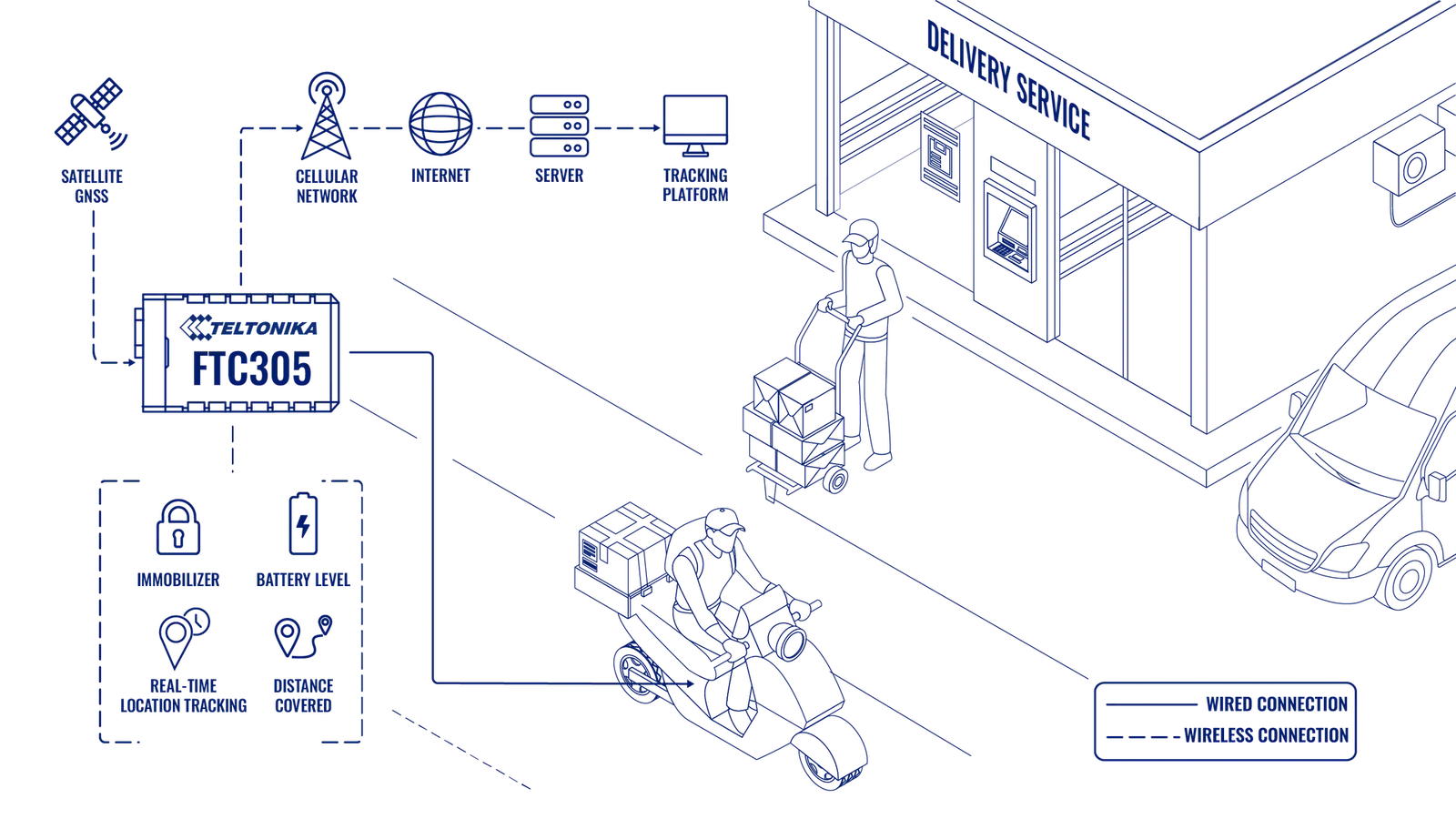
For a delivery service's electric fleet Teltonika offers the FTC305 — a compact tracker for electromobility that is fitted to each bike or scooter, takes power from its battery and reports location, mileage, speed, charge and safety events to the server.
Installation and setup
Fitting the device and configuring it for the fleet scenario at hand.
Data transfer
The device collects data and sends it to the monitoring platform; how often depends on the model and its settings.
Analysis and control
The person in charge gets reports and alerts and looks into what stands out.
What the device is. An IP67 housing — dust, rain and washing hold no terror for it. The GNSS and GSM antennas are inside the housing and high-gain, so nothing protrudes or snags on the outside. A 10–97 V supply suits almost any traction battery, from a light bicycle to a cargo trike. A built-in 380 mAh cell keeps the tracker online if the main battery has been removed or has gone flat. It reads CAN data where the bike's controller or BMS makes it available.
Which vehicles. E-bikes, cargo e-bikes, e-scooters. The tracker collects distance covered, speed, precise location and operating time, and all of it is visible in real time in the fleet monitoring software.
Accuracy in town. The FTC305 is built on the FT platform and can work with 41 satellites at once. Among dense buildings, where the signal bounces off walls, that gives a cleaner track: the courier's route does not jump through buildings or cut corners off blocks.
Scenarios in the firmware. Out of the box the tracker can detect:
• riding style (eco-driving) and speeding;
• the vehicle falling over, and a crash;
• towing — when the bike moves without being switched on, meaning it is being carried or wheeled away;
• jamming;
• prolonged idling with the power on.
To that are added geofences, a mileage counter, motor immobilisation, last known location and the storing of time-stamped data if the connection drops.
What it looks like for the dispatcher. Every courier on the map. Each with his current battery charge. A courier picks up a distant order, the dispatcher sees that the charge may not be enough and gives the order to someone else. A bike has fallen over — an alert arrives, the dispatcher rings the courier and asks whether everything is all right. A bike has started moving at night without being switched on — that is a theft, and the position is there already. The motor can be immobilised, and from then on the thief has to push a heavy bike by hand.
Reports. Daily and weekly reports show charge and the need to recharge, problems that need servicing, courier behaviour, missed deliveries, breakdowns and long stops. They show where the delivery process slows down: some couriers spend half an hour at every drop, others take detours, others recharge the bike in the middle of a shift as a matter of routine.
A real episode. Friday evening, the peak of the orders. A courier on an e-bike is taking an order to the outskirts with 18% charge. The dispatcher sees that there are still seven kilometres to the address and as many back again, and asks the courier to call at the nearest charging point after the drop instead of taking the next order. An hour later the courier is back in service rather than standing in a suburb with a dead battery, waiting for a van to come and fetch him.
Remote servicing. The FTC305's firmware and settings are changed through FOTA WEB, which has a web version of TCT — the configurator for the FT platform — built into it. When a fleet runs to hundreds of bikes that are almost never at the depot, being able to reconfigure all of them from the office saves days of work.
Points to consider when fitting. The tracker is connected to the battery through a fuse and hidden inside the frame or body so it cannot be seen. If the battery is removable and the courier takes it home to charge, the tracker falls back on its internal cell — enough to report the loss, but not for weeks of operation. So for services with removable batteries it matters to agree the rules: where the bike spends the night and where the battery is charged.
Compatibility with the BMS. The tracker reads battery data over CAN only where the particular model's controller or BMS makes it available and the protocol is known. On some bikes charge, voltage and fault codes are available; on others, only the voltage at the tracker's power input. So before purchase we test one unit of each model in the fleet and record which parameters actually come through.
Power and connectivity. The tracker is connected to the traction battery through a fuse within the 10–97 V range. If the BMS cuts the output on deep discharge, the tracker falls back on its internal cell. Communication goes over the mobile network, so in underground car parks the positions build up in memory and go out on the way out.
What you get
Where the courier and his bike are
The dispatcher sees the whole fleet on the map in real time and can reassign an order if someone is stuck in traffic or has gone the wrong way.
Orders assigned on actual charge
The battery level shows who can take a long delivery and who is due at a charging point.
An honest picture of the delivery
The track shows where each courier has been and how long the journey took, and company vehicles do not drift into private use.
The customer knows when the order will arrive
Precise courier positions make it possible to show a realistic arrival time.
Theft is spotted at once
Movement without the power on, leaving a geofence and motor immobilisation all cut a thief's chances.
Courier safety
An alert about a fall or a crash reaches the dispatcher, and the courier gets a call straight away rather than whenever he makes contact himself.
Why this solution
The FTC305 is made specifically for electromobility: a high supply voltage with no converters, a protected housing with the antennas hidden inside, CAN for reading controller and BMS data, and a set of safety scenarios right there in the firmware. The same range includes the TFT100 for other form factors, so a fleet with different vehicle types can be run on one platform.
Prevention instead of repair. Data on charge, fault codes and mileage helps plan servicing: change pads and tyres by mileage, take a battery out for checking if it is going flat quickly. That extends the life of the fleet and reduces the number of unplanned stoppages mid-shift.
Integration. Data from Teltonika trackers is accepted by the popular monitoring platforms, so a delivery service can link it to its own order system through an API.
What the tracker will not do. It is no substitute for proper charging infrastructure and discipline: if batteries are charged with unsuitable chargers in a cramped back room, the tracker will warn about overheating but will not remove the cause.
How this works in Azerbaijan. In Baku, food, grocery and pharmacy delivery services make heavy use of e-bikes and scooters: the centre, the Yasamal, Narimanov and Nasimi districts, the new housing estates, couriers outside shopping centres. The bikes work all day and at night are left at the outlets or taken home. In summer, at +40 °C, a battery in the sun outside a restaurant overheats quickly, so monitoring charge and BMS fault codes is particularly useful here. In winter the windy, damp weather on the Absheron peninsula cuts the range noticeably — low-charge alert thresholds are worth raising for the winter. Bikes stolen from doorways are a real problem, so we advise switching on motor immobilisation and geofences from the start. In underground car parks and among dense buildings the Azercell, Bakcell or Nar signal sometimes drops out, and the tracker sends its stored positions on the way out. GPS.az fits the FTC305 and TFT100 to courier services' electric vehicles, configures the fall, towing and immobilisation scenarios, and brings the whole fleet into Wialon with per-courier reports and charge levels on the map.
Related case studies
Related rollouts and equipment
Questions about the “Tracking couriers' e-bikes: the FTC305” scenario
Request a call
A specialist will call back and match a solution to your fleet and your task.