
Finding medical equipment in a hospital with beacons
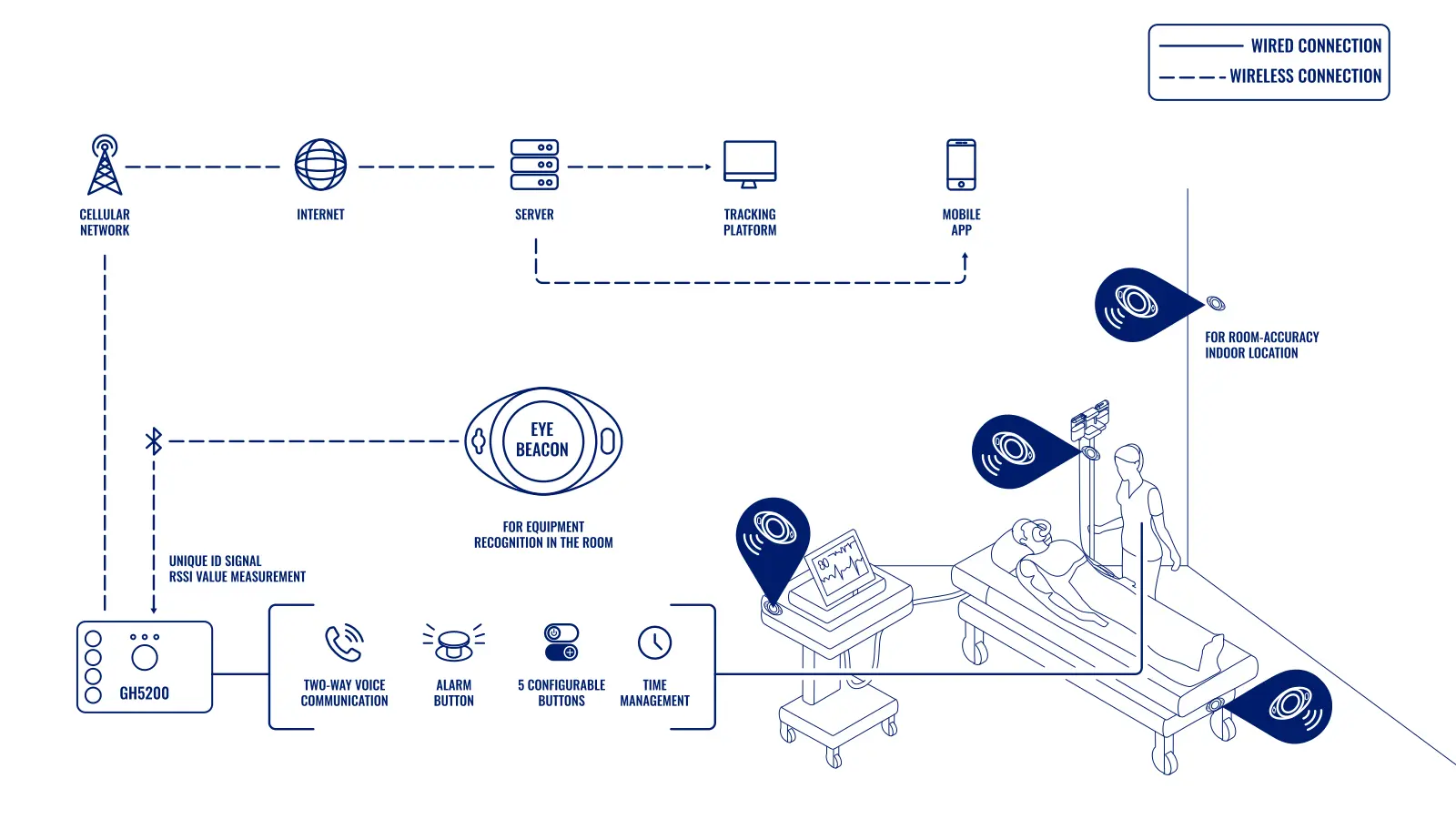
A Teltonika use case about hospitals: EYE Beacon beacons are attached to beds, pumps and ventilators, while a GH5200 personal tracker carried by a nurse scans them and shows which room a particular piece of equipment is in.
A Teltonika use case about hospitals: EYE Beacon beacons are attached to beds, pumps and ventilators, while a GH5200 personal tracker carried by a nurse scans them and shows which room a particular piece of equipment is in. The medical equipment market is huge and growing: on the figures Teltonika cites, in 2022 it was valued at 512 billion dollars, and by 2030 it should reach 800 billion. The more expensive and the more numerous the equipment, the more galling it is when nobody can find it inside their own building. The arrangement is built from two components: beacons on the equipment and a gateway that hears them. The gateway can be a GH5200 in a member of staff's pocket, a smartphone with an app, or a fixed Teltonika Networks router.
What this scenario solves
Nurses spend up to an hour a shift looking for pumps, trolleys, wheelchairs and beds.
Other studies put the time spent looking for equipment at up to 34% of staff working time.
Between 10 and 20% of a hospital's mobile equipment is stolen or lost.
The hospital does not know how many free beds and machines it actually has right now.
Nurses spend up to an hour a shift looking for pumps, trolleys, wheelchairs and beds.
Other studies put the time spent looking for equipment at up to 34% of staff working time.
Between 10 and 20% of a hospital's mobile equipment is stolen or lost.
The hospital does not know how many free beds and machines it actually has right now.
In a hospital, equipment is constantly on the move. An infusion pump went off to intensive care with a patient, a wheelchair was left by the lift, a portable ultrasound machine was taken to the next ward and never brought back. An hour later it is needed again, and a nurse walks the floors looking into every room.
This is not a trifle. A nurse's time is the scarcest resource on a ward, and in an emergency every minute spent looking for a defibrillator or a ventilator can cost a patient their health.
The second side of it is losses. What goes missing most often is medical computers, trolleys, defibrillators, portable diagnostic equipment, ventilators and infusion pumps. On the estimate Teltonika cites, that is between 10 and 20% of the whole mobile fleet, and every item costs a hospital a good deal.
The third side is unnecessary purchasing. When nobody knows how many pumps there are in the building or how heavily they are used, it is easier to buy more. Teltonika quotes an estimate that around 30% of healthcare spending in the United States goes to waste, and overspending on equipment and inefficient use of machines are part of that sum.
What Teltonika offers
An EYE Beacon is attached to every piece of portable equipment, one more fixed beacon hangs in each room, and a gateway — a GH5200 tracker carried by staff, a smartphone or a router — hears them and reports to the platform where everything is.
Installation and setup
Fitting the device and configuring it for the fleet scenario at hand.
Data transfer
The device collects data and sends it to the monitoring platform; how often depends on the model and its settings.
Analysis and control
The person in charge gets reports and alerts and looks into what stands out.
The EYE Beacon is a small Bluetooth device that transmits its identifier at regular intervals. In the system each beacon is tied to a specific item: bed no. 14, a pump with an inventory number, a laptop on a trolley. The beacon itself determines nothing; it simply broadcasts.
The gateways are what listen to it. The most flexible option is the GH5200 personal tracker. A nurse carries it, and when she walks into a room the tracker scans the beacons around her. From the signal strength (RSSI) the platform works out which devices are nearby, and from the fixed beacon in the room, which room she is in. So every visit to a room refreshes the picture: pump no. 7 in room 312, bed no. 14 in the corridor by room 305.
The other gateway options are a smartphone with a third-party app, or a Teltonika Networks router installed permanently on the ward. Routers listen to their area continuously, with no involvement from staff, but each one needs power and a place on the ward. The GH5200 does not require fixed receivers in every area: it scans beacons wherever a member of staff goes, so data about rarely visited rooms are refreshed less often. In practice the options are combined: fixed gateways go into intensive care and the equipment store, while the other wards rely on the GH5200.
The EYE Beacon has an omnidirectional antenna: the signal spreads in every direction rather than in a narrow beam. For hospital rooms, where the beacon may hang on a wall and the equipment stands at any angle, that gives more even coverage.
What the staff get. Opening the app, a nurse sees where the nearest free pump is and goes straight to it. Before admitting a patient you can check whether there is a bed in the room. The ward's logistics coordinator sees how many beds there are in each ward and how many more patients can be admitted. If equipment leaves the building or the ward, the system notes it, and the loss is spotted the same day rather than at the annual stocktake.
Over time the movement history turns into data for purchasing: which machines are in constant use and which have stood in a store room for months. The decision to buy the next batch of pumps is then made on actual utilisation.
The GH5200 also works for the safety of the staff themselves. It has a panic button: a nurse can call a doctor or report an incident, and the system will show the approximate location. Two-way voice is supported, so you can speak to a colleague without hunting for a telephone. A separate feature is time recording: it is visible when a member of staff visited a particular patient and how long they spent in different rooms.
The limits are worth understanding in advance. The accuracy is at room level, not centimetres. If staff with a GH5200 have not been into some part of the building for a long time, the data about it go stale, and fixed gateways are better there. And thick walls and metal structures weaken Bluetooth, so fixed beacons are positioned only after checking on site.
Last detection and acceptance. For every device the system shows the time it was last heard by a gateway. If a pump is listed as being in room 312 but the last detection was six hours ago, that does not mean it is there now: staff can see how old the data are and decide whether to go and check. The acceptance criterion for a pilot: a device placed in a known room shows up in that very room after a round with the GH5200 or from a fixed gateway's data. The GH5200 is charged every shift, and that rule goes into the ward procedure, while beacon batteries are checked from the system's own data.
What you get
A search in minutes rather than half a shift
The nurse sees in the app which room the nearest free pump or bed is in and goes straight there.
Losses spotted at once
Equipment leaving the ward or the building is recorded, and a missing item is looked for the same day rather than at the stocktake.
Free beds visible in advance
The ward's logistics coordinator knows how many beds there are and how many more patients can be admitted.
Purchasing based on actual use
The movement history shows which machines are working all the time and which stand idle.
A panic button and voice for staff
The GH5200 makes it possible to call for help with a location and speak to a colleague without a telephone.
The gateway walks itself
The personal tracker carried by the nurse scans beacons along the way, so there is no need to blanket the building with fixed receivers.
Why this solution
The EYE Beacon is built as a device you can fit and forget. A battery life of up to 10 years, an IP67 housing, several mounting options, an omnidirectional antenna. In a hospital, where equipment is washed and disinfected, water protection has a direct practical value.
The second advantage is one manufacturer for both the beacons and the gateways. The GH5200, Teltonika Networks routers and the EYE Beacon were designed to work together, so the integration does not turn into a project of its own.
Teltonika works with partners in more than 160 countries and has been awarded a silver medal in the EcoVadis environmental responsibility rating. For hospitals that run supplier audits, that may also turn out to be a weighty argument.
How this works in Azerbaijan. The problem is a live one for the large hospitals of Baku: republican clinics, private medical centres and the new hospital complexes being built in the regions, including Ganja, Sheki and the liberated districts. There is a great deal of equipment in them, the buildings are large, and in many places stocktaking is still done in paper ledgers. What to allow for when rolling out: start with a pilot on the one ward where equipment moves the most (intensive care, surgery); check Bluetooth coverage in the rooms before buying beacons; agree with the administration the rules under which staff movements are visible. GPS.az supplies EYE Beacon beacons and GH5200 trackers, configures them and puts equipment and staff onto the map of the Wialon platform.
Related case studies
Related rollouts and equipment

Hard hat and PPE monitoring with the GH5200 tracker
Assets and workforce

Protecting lone workers with the GH5200 tracker
Assets and workforce

The GH5200 personal tracker for workers
Agriculture, construction and mining
Questions about the “Finding medical equipment in a hospital with beacons” scenario
Request a call
A specialist will call back and match a solution to your fleet and your task.