
Hard hat and PPE monitoring with the GH5200 tracker
The Teltonika GH5200 personal tracker, paired with EYE Beacon Bluetooth beacons fixed to a hard hat, a vest or another piece of protective kit, checks whether a worker is wearing the PPE required of them and tells the supervisor when something is missing.
The Teltonika GH5200 personal tracker, paired with EYE Beacon Bluetooth beacons fixed to a hard hat, a vest or another piece of protective kit, checks whether a worker is wearing the PPE required of them and tells the supervisor when something is missing. The scenario is aimed at construction sites, road works, manufacturing and heavy industry — anywhere the rules call for a hard hat and protective clothing and the only way to check is by eye. Below: how the tracker and the beacons work together, what the site manager sees and where this kind of monitoring has its limits.
What this scenario solves
On most sites the wearing of PPE is checked only by eye, and not even continuously.
A supervisor cannot see every worker on a large site at once.
If an injury happened with no hard hat on, it is hard to establish afterwards how things actually were.
A worker who falls or loses consciousness in a far corner of the site can be left without help for many minutes.
On most sites the wearing of PPE is checked only by eye, and not even continuously. A supervisor cannot see every worker on a large site at once. If an injury happened with no hard hat on, it is hard to establish afterwards how things actually were. A worker who falls or loses consciousness in a far corner of the site can be left without help for many minutes.
The International Labour Organization puts the global cost of accidents and occupational disease at roughly 1.25 trillion dollars a year. The same report notes that the recorded statistics understate the real picture, so the scale of the problem is in fact larger.
PPE means hard hats, safety glasses, face shields, hi-vis vests, protective clothing and other kit that guards against specific hazards: falling objects, sparks, chemicals, being struck by plant. On construction sites, in road repairs, in workshops and on large industrial sites, wearing it is mandatory under the safety rules.
But the rule only holds while somebody is watching. In the heat a hard hat comes off for a moment, the vest stays in the site hut and the glasses stay in a pocket. The shift supervisor walks the site once an hour, and between those rounds there is no data at all. After an accident the company often cannot show that the worker was briefed and issued with the kit, and simply did not put it on.
What Teltonika offers
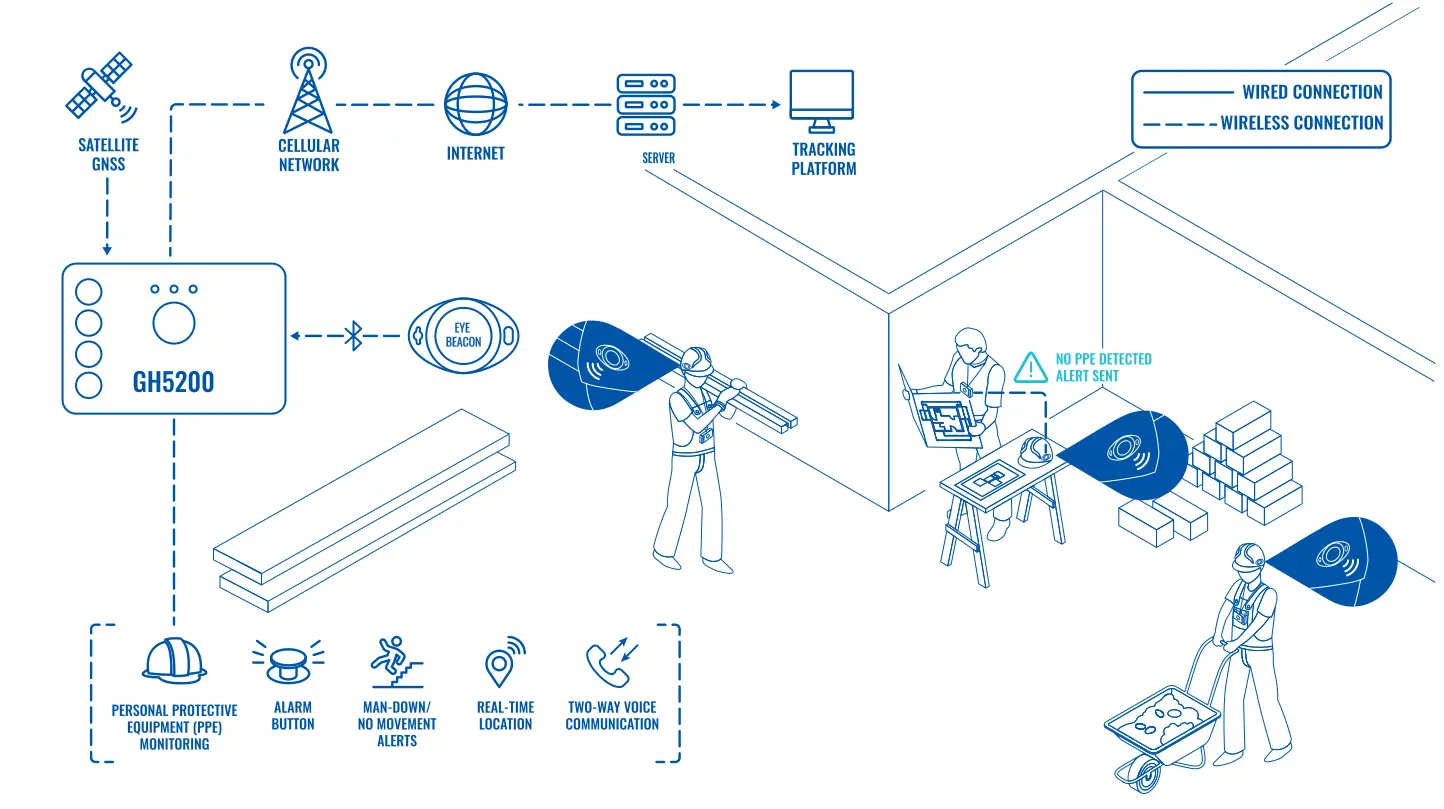
Teltonika's answer to this comes in two parts: the GH5200 personal tracker carried by every worker, and EYE Beacon Bluetooth beacons fixed to their protective kit; the tracker looks for the beacons assigned to it at regular intervals and raises an alert if one of them is not nearby.
Installation and setup
Fitting the device and configuring it for the fleet scenario at hand.
Data transfer
The device collects data and sends it to the monitoring platform; how often depends on the model and its settings.
Analysis and control
The person in charge gets reports and alerts and looks into what stands out.
The GH5200 is a self-contained personal tracker with GPS and GSM. It has a generous battery reserve, five programmable buttons, two-way voice communication and LED indicators. It is used for managing staff and for protecting employees who work alone.
The EYE Beacon is a compact beacon in a tough housing with a long-life battery. It is fixed to a hard hat, a vest, a belt or another item of PPE. The beacons are quick to configure and inexpensive, so one can go on every set of kit.
The working routine looks like this. The site or shift manager issues each worker a GH5200 tracker linked to that worker's set of beacons. The tracker scans its surroundings periodically and checks whether it can see all the EYE Beacon units assigned to it. If the beacon from the hard hat is not nearby, the hat has been left in the site hut or on the ground. The tracker warns the worker and sends a notification to the supervisor.
At the same time the GH5200 reports the worker's location. The supervisor sees on the map who is where, and does not spend time searching for people across the site or making checks in person.
The second important function is the response to a fall and to stillness. If a worker falls, or does not move for longer than a set time, the tracker raises an alert immediately. Those responsible on site see where it happened and can get to the person quickly. Two-way voice communication makes it possible to talk to the worker without running the length of the site to reach them.
If an injury does happen, the company still has the data: whether the kit was on the person at the moment of the incident, where they were and when the alert was raised. That helps to review the case honestly.
There is an important caveat from the manufacturer. The accuracy with which the distance between tracker and beacon is measured depends on the surroundings: steelwork, concrete, the person's own body and other conditions all affect the Bluetooth signal. That is why the trigger thresholds are tuned on the particular site.
The firmware and configuration of the GH5200 can be updated remotely through the FOTA WEB cloud platform, which supports all current Teltonika devices. Changing settings on a hundred trackers by hand will not be necessary.
What an ordinary shift looks like with this system. In the morning the worker collects a tracker from the issue point, and it immediately picks up the beacons on his hard hat and vest. During the day the gang moves to another block, and the supervisor follows on the map who is where. Around midday one of the men takes his hard hat off, leaves it by the site cabin and goes up onto the scaffolding. A few minutes later the tracker stops seeing the beacon, beeps and flashes, and the supervisor gets a notification with the name and the place. He rings the foreman, and the hat goes back on. In the evening the trackers are handed in for charging, and the system keeps a report of the breaches during the shift.
Who the customer is and who sees what. The main user of this scenario is the health and safety team and the personnel manager, not the transport department. Roles on the platform are best kept separate: the supervisor sees his own gang and gets alerts in real time, the health and safety specialist gets reports on breaches and falls across the whole site, and HR sees only the fact that a tracker was issued and returned. Access to the movement history of a particular person is worth restricting to a narrow circle.
The boundaries of working time. The tracker follows a person only during the shift: from issue to return. If a worker takes the tracker home, monitoring outside the shift runs against both the purpose of the system and people's trust, so the procedure for issuing and storing the devices is written into an internal document.
Passing beacons on. A hard hat and a vest can move from one worker to another. Each time the owner changes, the beacons are re-linked to the new tracker on the platform, otherwise the alert will arrive under the wrong name. It is convenient to keep the PPE issue log together with the log of beacon assignments.
The alert procedure. On a fall or stillness signal: the supervisor calls over the tracker's voice link and, if there is no answer, goes to the point on the map or sends the nearest person. On a missing hard hat signal: a reminder to the worker, and on a repeat a word with the foreman. The health and safety team sets the actual response times.
What you get
It is visible who has walked away from their hard hat
The tracker notices that the beacon from the PPE is not nearby and tells both the worker and the supervisor.
The supervisor knows where people are
Every worker's location is visible on the map, with no site rounds or roll-calls over the radio.
Help after a fall
The alert fires if a person falls or does not move for a long time, and points to the spot on the site.
Voice contact
Two-way voice communication makes it possible to speak at once to the worker who raised the signal.
Data for incident reviews
The history shows whether the kit was on the person and where they were, if something happens.
Why this solution
The GH5200 suits this job because it works on its own: it scans the Bluetooth surroundings itself, fixes its own position and sends the alert itself. For the basic scenario there is no need for separate gateways around the perimeter of the site.
The pairing with EYE Beacon is flexible. One worker can be assigned a single beacon on the hard hat, or several — on the hat, the vest and the belt. The beacons are inexpensive and easy to move when the kit changes.
The limits need to be understood before the start. The system checks one thing: whether the beacon from the hard hat is within a set distance of the tracker. That works if the tracker is worn on the body and the distance threshold has been tuned on site. The system cannot tell a hat carried in the hand, or hooked on a belt next to the tracker, from one that is being worn, so it flags a hat left by the site cabin rather than replacing the supervisor. The Bluetooth signal depends on steelwork and concrete, so the thresholds will have to be tuned in place. The tracker needs charging, which means a routine for issuing and collecting the devices at the start and end of a shift. And monitoring of this kind is worth introducing openly: workers should understand what is being tracked and why.
How this works in Azerbaijan. There is demand for this kind of monitoring on the reconstruction sites in Karabakh and East Zangezur, on major projects in Baku, on oil and gas sites and with the service contractors on Absheron, where health and safety requirements are especially strict, and also on road works along the M-2 and M-3 routes. In summer at +40 °C hard hats come off more often than at any other time, and that is exactly when the monitoring earns its keep. On remote sites in the mountains the network can be weak: the tracker stores events and sends them once the network appears, but for sites with no Azercell, Bakcell or Nar coverage this needs checking in advance. GPS.az fits and configures the GH5200 and the EYE Beacon units, tunes the thresholds for the particular site and connects the trackers to the Wialon platform, where the supervisor sees people on the map and gets alerts on the phone. The tracker warranty is 1 year.
Related case studies
Related rollouts and equipment

Finding medical equipment in a hospital with beacons
Assets and workforce

Protecting lone workers with the GH5200 tracker
Assets and workforce

The GH5200 personal tracker for workers
Agriculture, construction and mining
Questions about the “Hard hat and PPE monitoring with the GH5200 tracker” scenario
Request a call
A specialist will call back and match a solution to your fleet and your task.