
The FTC305 tracker for e-bike sharing
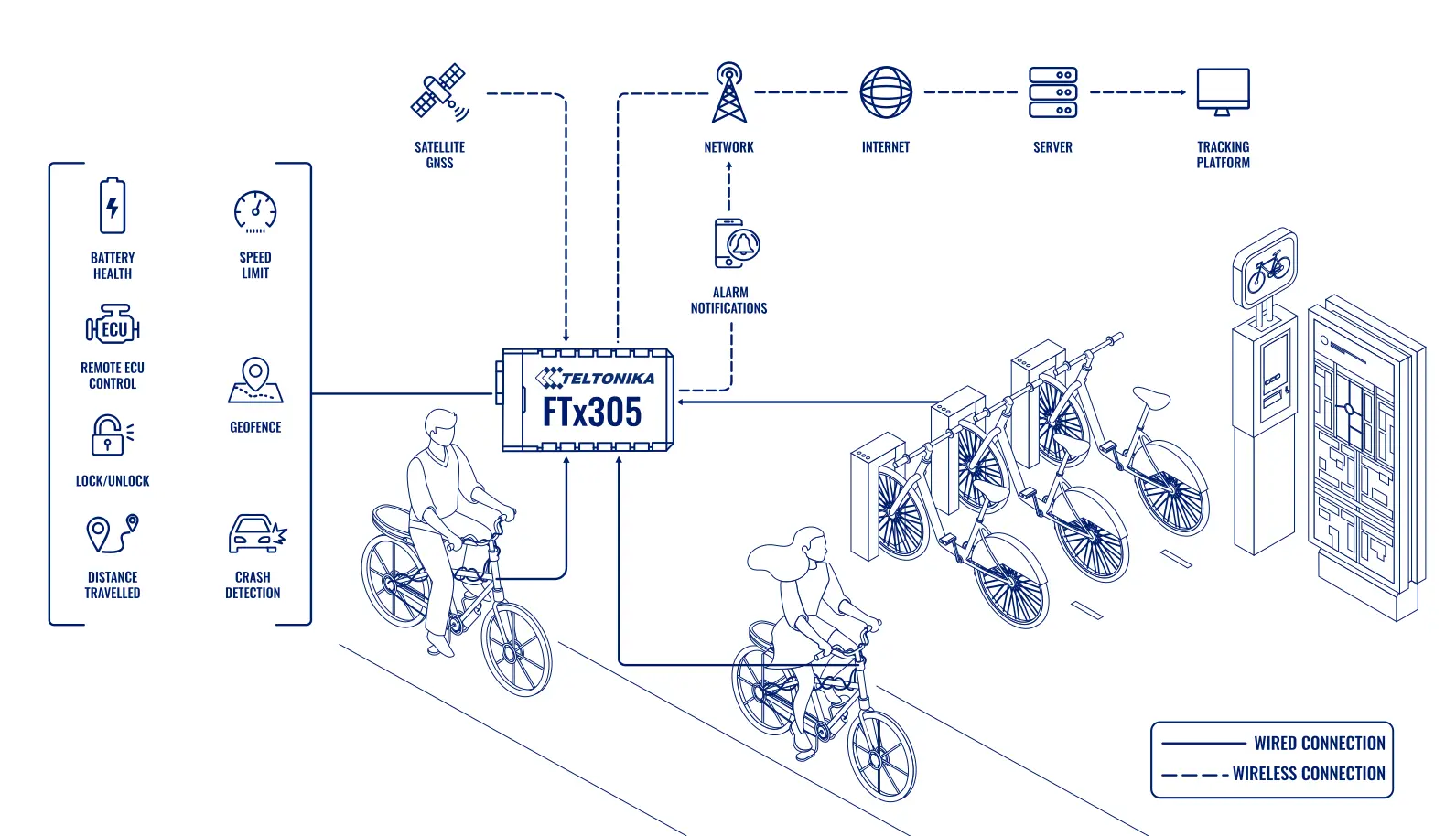
A Teltonika use case: a sharing operator fits its e-bikes and e-mopeds with the FTC305 tracker, which reports coordinates, speed and battery charge and reads the CAN bus of vehicles from different manufacturers.
A Teltonika use case: a sharing operator fits its e-bikes and e-mopeds with the FTC305 tracker, which reports coordinates, speed and battery charge and reads the CAN bus of vehicles from different manufacturers. Rental e-bikes and mopeds have become an ordinary part of the city. People take them to reach the metro, the office or the park, to stay out of the traffic and avoid hunting for a parking space. For the operator, though, every one of those bikes is an asset that stands on the street unattended, rides off with strangers and has to be charged by morning. The FTC305 in this use case is a compact tracker for light electric vehicles that covers the operator's main questions: where the vehicle is, what condition it is in and what users are doing with it.
What this scenario solves
Demand for e-bike and e-moped sharing is growing fast, and with it the demands placed on looking after the fleet.
The operator needs to know where each bike is, how much charge it has and whether it needs repair.
Vehicles from different brands speak different protocols, and a single tracker often does not fit them all.
A tracker on a two-wheeler works in the rain, in the heat and in the frost, and it has to stand up to that.
Demand for e-bike and e-moped sharing is growing fast, and with it the demands placed on looking after the fleet. The operator needs to know where each bike is, how much charge it has and whether it needs repair. Vehicles from different brands speak different protocols, and a single tracker often does not fit them all. A tracker on a two-wheeler works in the rain, in the heat and in the frost, and it has to stand up to that.
A little about the market. On the forecast Teltonika cites, the global e-bike market will grow from 49.7 billion dollars in 2022 to 80.6 billion in 2027, and a noticeable share of that growth will come from sharing. People increasingly choose light personal transport over public transport: it is convenient, inexpensive and clean, and cities back electric mobility with programmes of their own.
What this means for the operator. The fleet grows, there are more parking points and more users. The familiar problems appear: a bike left where it should not be, out of charge halfway through a ride, damaged after a fall, stolen. Without telematics the operator hears about it from customer complaints, once the money has already been lost.
One more question is the choice of vehicle supplier. If the tracker works with only one brand of bike, the operator is tied to that brand. It is better to be free to buy in machines from different manufacturers without rebuilding the system.
What Teltonika offers
For sharing services Teltonika offers the FTC305 tracker: a compact device with 4G LTE Cat 1 networking, CAN bus data reading and flexible fitting options. The tracker sends location, speed, battery charge level and other vehicle data to a cloud platform.
Installation and setup
Fitting the device and configuring it for the fleet scenario at hand.
Data transfer
The device collects data and sends it to the monitoring platform; how often depends on the model and its settings.
Analysis and control
The person in charge gets reports and alerts and looks into what stands out.
What the operator sees. The whole fleet of e-bikes and e-mopeds on a map, each with its charge, its status and its last ride. The system sends notifications: battery almost flat, vehicle has left the service area, an impact or a speeding event recorded. Those data are what the service team's rounds are planned from: which machine to charge, which to take in for repair, which to move to where demand is higher.
Working with different brands. The FTC305 supports several communication protocols, so it suits two-wheelers from different manufacturers. For the operator that is freedom: you can launch on one model of bike and, as you expand, add mopeds of another brand without changing the tracker.
Manual CAN configuration. The tracker has Manual CAN scenarios and Manual CAN commands built in. With them the user sets for themselves which CAN bus data to read from the vehicle and which commands the tracker sends back, for instance to carry out a particular action on the vehicle itself. Separate firmware development for each brand is not needed: everything is configured from the CAN protocol of the specific model.
Two versions.
• In a housing with IP67 protection. The tracker stands up to severe cold, heat and pouring rain. This version is fitted to vehicles already in service.
• Without a housing. This version is meant for embedding at the manufacturing stage: external GNSS and cellular antennas and an external backup battery are connected to it. The board is hidden in the frame or in internal compartments, while the external antennas keep the connection stable.
What to check before a pilot. First, the CAN and BMS protocol of the specific model: you get it from the vehicle manufacturer, and without it the tracker will give coordinates and speed but no battery data. Second, which battery parameters are actually available: charge level is there almost always, while voltage, temperature and fault codes depend on the BMS. Third, power: the tracker lives off the vehicle battery, so what it does on a deep discharge is set in advance, and the housing-free version is given an external backup battery. Fourth, coverage at the real parking spots: in courtyards and open areas LTE is usually there, while in the underground car parks of shopping centres data may arrive with a delay.
An episode. In the morning the service team gets a list: twelve mopeds below 20% charge, three e-bikes standing outside the zone, one machine that recorded an impact after a night ride. The round is planned on the map, and by the rush hour the whole fleet is charged and placed by the metro stations and the business districts. The bike with the impact is taken in for a check, and the ride history shows who rode it last.
What you get
The fleet is always ready for work
The operator sees low charge, departure from the zone and signs of a fault, and sends the service team out in advance rather than after customer complaints.
Data on user behaviour
Speeding, impacts and breaches of the rental rules are recorded, and tariffs, rules and ride safety are set from them.
Freedom in choosing vehicles
Support for different protocols and manual CAN configuration make it possible to work with bikes and mopeds from different manufacturers.
Reliability in any weather
The IP67 housing version is protected from water and dust and works in rain, heat and cold.
Flexible fitting
The housing-free version is embedded in the frame at the factory, with external antennas and a backup battery.
Why this solution
The FTC305 is built specifically for light electric vehicles, and the details show it: compact size, CAN reading, manual protocol configuration without reworking the firmware, two versions for different fitting scenarios. For an operator working with several vehicle suppliers, being able to configure CAN reading yourself saves months of waiting for an integration.
Teltonika has been making trackers for vehicle fleets for a long time, and the same approach — remote configuration, over-the-air updates, working with external sensors — has been carried across into the micromobility range. The operator does not need to build one system for the bikes and a separate one for the service team's own vehicles.
Worth keeping in mind. Manual CAN configuration needs the protocol of the specific vehicle model, and that comes from the manufacturer. The housing-free version calls for the manufacturer or the assembler to be involved; embedding it in a finished bike on your own is difficult. The tracker is powered from the vehicle battery, so its behaviour on a deep discharge has to be configured in advance.
How this works in Azerbaijan. In Baku e-bikes, e-scooters and mopeds turn up more and more often on the boulevard, in the White City, in the centre and in the residential districts, while food and parcel delivery services are actively moving their couriers onto e-mopeds. A similar scenario suits rental operations in the resort areas — on the Absheron coast, in Gabala, in Naftalan. When rolling out you have to allow for summer heat of up to +40 °C: batteries lose charge faster, and neither the tracker nor the backup battery should sit where the housing bakes in the sun. Winter in Baku brings strong wind and rain, so the IP67 housing version is preferable for a street fleet. GPS.az supplies and configures the FTC305, helps set up CAN reading for the specific vehicle model and brings the data into the Wialon platform, where the operator sees the fleet, the charge levels and the events.
Related case studies
Related rollouts and equipment
Questions about the “The FTC305 tracker for e-bike sharing” scenario
Request a call
A specialist will call back and match a solution to your fleet and your task.