
DualCam for courier and delivery services
For delivery services, Teltonika links the DualCam camera to an FMC125 tracker so that recording starts on driving events: harsh acceleration and braking, speeding, prolonged idling, a crash.
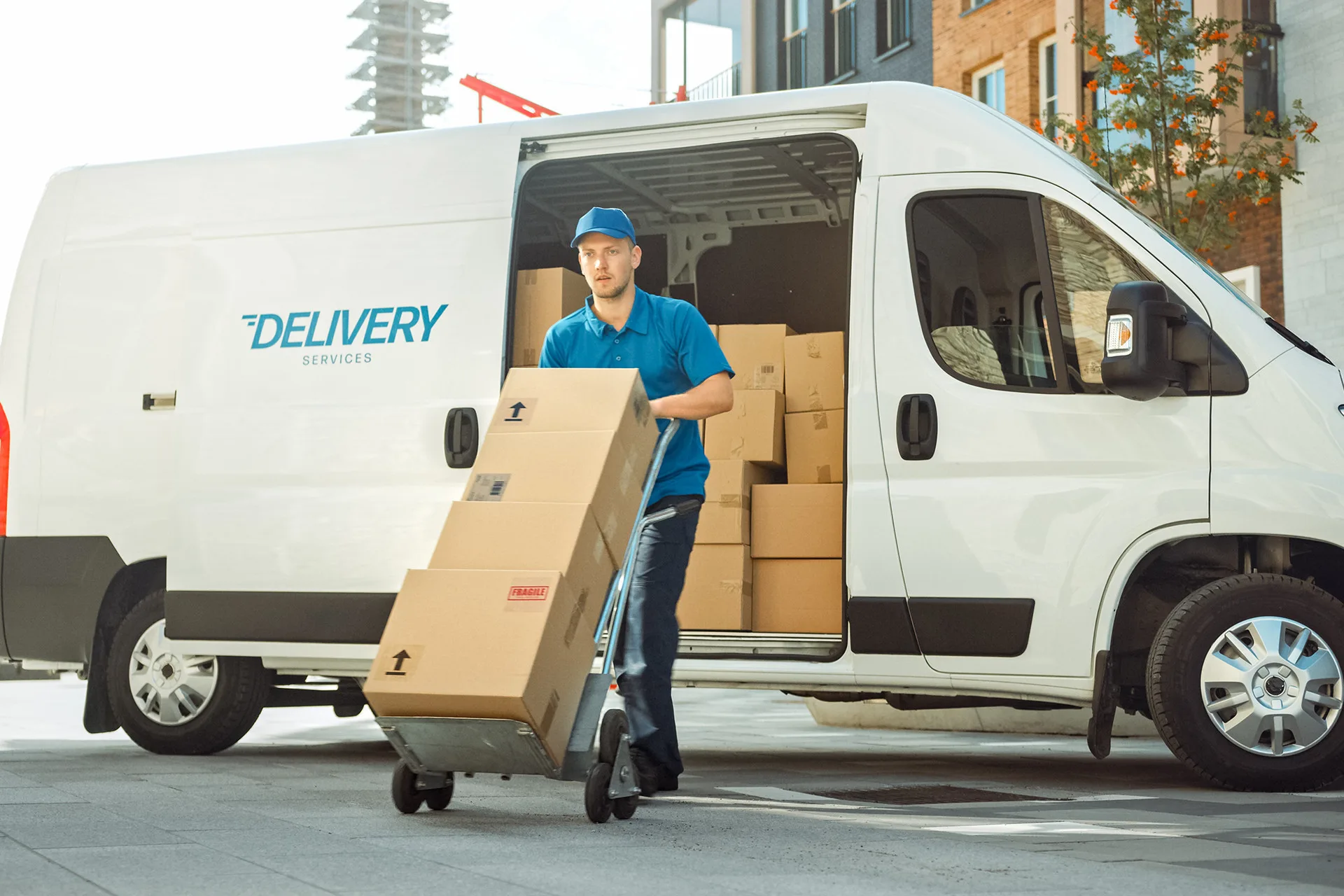
For delivery services, Teltonika links the DualCam camera to an FMC125 tracker so that recording starts on driving events: harsh acceleration and braking, speeding, prolonged idling, a crash. Online shopping grew so fast after 2020 that courier services could not hire people quickly enough. Inexperienced drivers ended up behind the wheel and the rest worked twelve-hour days. Hence the crashes, damaged parcels, fines, customer complaints and, worse, attacks on the couriers themselves. The case shows how video telematics helps a delivery service keep driving style and safety under control, and what to bear in mind if you are launching a system like this in Baku.
What this scenario solves
Demand for deliveries rose sharply, and the supply of experienced drivers did not.
Newcomers and tired couriers drive more aggressively, have more accidents and damage more goods.
The head of the service cannot see what happens inside the vehicle between the warehouse and the customer's door.
The couriers are taking risks too — threats and assaults against them are not rare.
Demand for deliveries rose sharply, and the supply of experienced drivers did not. Newcomers and tired couriers drive more aggressively, have more accidents and damage more goods. The head of the service cannot see what happens inside the vehicle between the warehouse and the customer's door. The couriers are taking risks too — threats and assaults against them are not rare.
Figures from the original case. In a survey for a report on e-commerce trends, 90% of companies in Europe and North America recorded at least a slight rise in online sales in 2020, and for half of them sales more than doubled. People were ordering food, clothes, medicines and subscriptions — and all of it had to be brought to the door.
At the same time the lockdowns hit the delivery services themselves: supply chain disruption, staff shortages, delays, expensive mistakes. The Financial Times reported that British recruiters rated delivery driver one of the most sought-after occupations of the pandemic. The picture was much the same in other countries.
Those who were hired worked themselves ragged: long shifts, stress, too little sleep. And a tired driver drives badly, with consequences that line up in a long chain. Fuel consumption goes up. Vehicles break down more often. More road traffic accidents and more fines. Damaged and lost parcels, rising insurance, medical costs, injuries. Downtime, late deliveries, customer complaints — and in the end fewer orders and lost market share.
Courier safety is a subject of its own. The BBC has reported on thousands of delivery drivers who face threats and serious injuries, and who are sometimes killed at work. A delivery service is answerable for its people, not only for its parcels.
What Teltonika offers
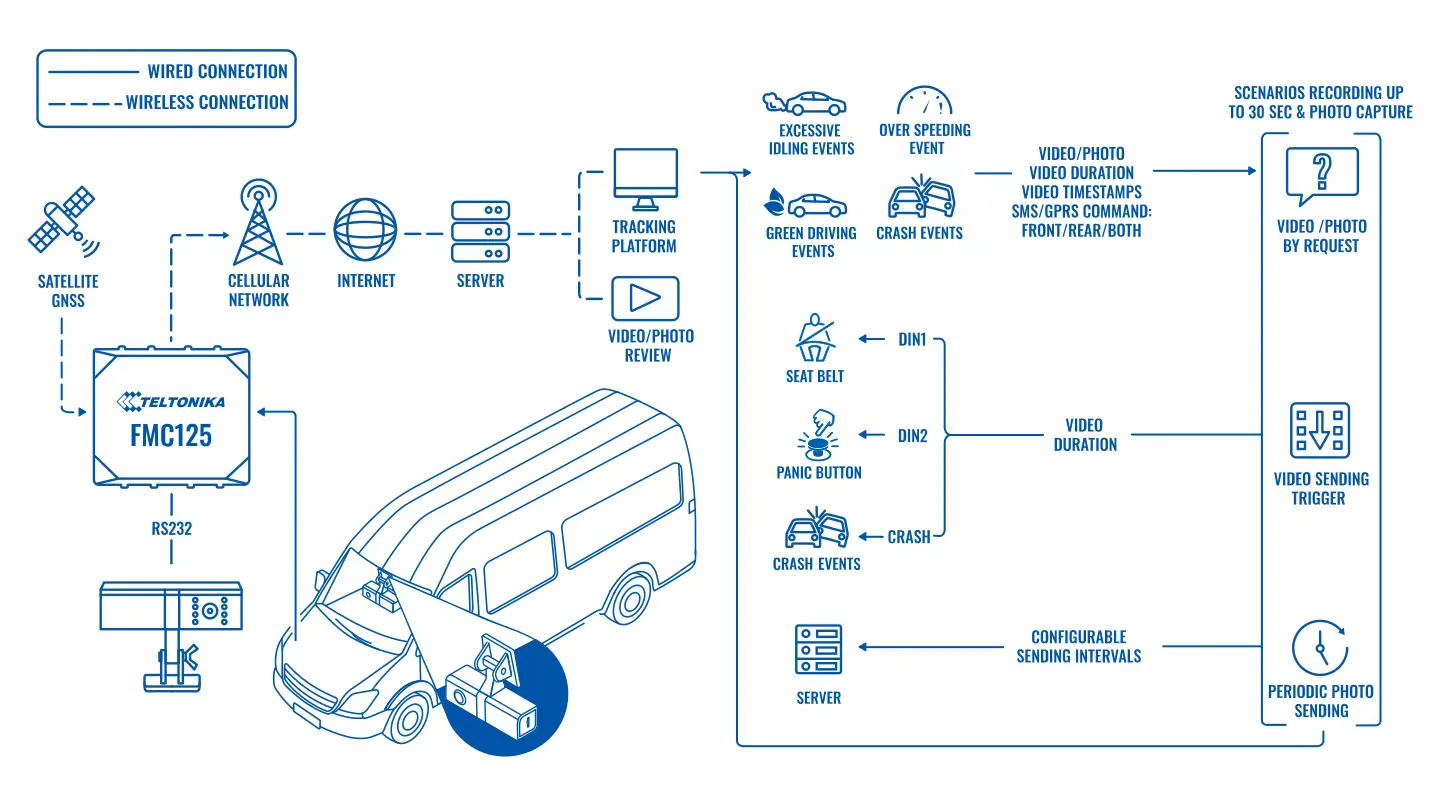
The Teltonika solution is a DualCam camera and an FMC125 tracker connected over RS232, where the tracker watches the driving and on an event tells the camera to record and send video by itself.
Installation and setup
Fitting the device and configuring it for the fleet scenario at hand.
Data transfer
The device collects data and sends it to the monitoring platform; how often depends on the model and its settings.
Analysis and control
The person in charge gets reports and alerts and looks into what stands out.
How this differs from an ordinary dash cam. A dash cam records everything and reports nothing. Here, recording is tied to events the tracker can already detect. The dispatcher gets not hours of video but short clips of exactly those moments when something went wrong.
Which tracker scenarios are used:
• Green Driving (also called Eco Driving) — logs harsh acceleration, harsh braking and harsh cornering;
• crash detection — from the characteristic accelerometer impact;
• speeding — above a set threshold, including in town and within specific zones;
• excessive idling — the vehicle standing for a long time with the engine running.
Every such event goes into the log and can trigger video from the DualCam: the camera films both the road and the driver. The manager sees not merely that a courier braked hard but why — a pedestrian stepped out, or the driver was looking at his phone.
What each scenario gives you in practice. Green Driving shows which couriers drive jerkily: those drivers wear out brakes and tyres faster and damage more parcels in the load space. Speeding usually comes from hurrying — the courier is behind schedule, which is a reason to review the route and not only to discipline him. Idling is a classic in delivery work: the courier has carried a parcel up to the fifth floor while the engine ran the whole time to keep the air conditioning going in the cab. Across a fleet of fifty vehicles that is a noticeable number of litres a day. A crash with video is ready-made material for the insurer and the police.
Courier safety. A camera facing the cab and the road reduces the risk of confrontation by itself: someone who can see a lens behaves differently. If an assault does happen, there is a recording, a position and a time.
Configuration and updates. The tracker and the camera are configured remotely through FOTA WEB, Teltonika's service for updating firmware and configuration over the air. To work with DualCam on the FMC125 and other supported trackers, firmware version 03.27.00.Rev.100 or newer is required; that too can be updated remotely, without gathering the vehicles at the depot.
The data is available from a computer, a tablet and a smartphone: a shift supervisor can watch the video from the warehouse without sitting down at a desk.
Points to consider. Event thresholds are matched to the real city. Set Green Driving too sensitively and the camera will trigger on every pothole, and the dispatcher will stop watching the video. For the first couple of weeks the thresholds are usually adjusted against actual data.
False triggers and calibration. In the first weeks some of the clips turn out to be empty: the camera fired on a speed bump, a pothole or braking that was hard but justified. That is a normal stage of setting up. The accelerometer threshold and Green Driving sensitivity are tuned against real clips, and after fitting the tracker must be firmly secured — otherwise vibration of the housing produces spurious events. The camera is set so that both the road and the driver's face are in frame, and the angle is checked against the first recordings.
What reaches the dispatcher. An event on the map with its time, speed and type (harsh braking, speeding, impact) and a video clip from both cameras, tied to that point on the track.
How to respond to an event. The dispatcher opens the clip and puts the event into one of four groups: false, justified (an obstruction on the road), a driver violation, or a road traffic accident. The false ones feed into threshold tuning, violations into a conversation with the driver, accidents into the insurance procedure. It is better to write this order down in an internal procedure before the launch, so that video does not turn into grounds for punishment without any assessment.
What you get
Video of the important moments only
The camera starts on a driving event, and the manager watches short clips rather than hours of recording.
Parcels arrive intact
Harsh acceleration and braking show up straight away, and drivers with a jerky style are identified and coached.
Protection for the courier and the company
Recordings of the road and the cab help with accidents, disputes with customers and assaults on the driver.
Fewer needless costs
Watching idling and speed brings down fuel consumption and fines.
Discipline without undue pressure
Paired with a sensible incentive scheme the data helps reward careful drivers rather than only penalise.
Configuration over the air
FOTA WEB updates firmware and configuration without the vehicle visiting the depot.
Why this solution
The main advantage of this pairing is that the video does not live apart from the telematics. Scenarios the Teltonika tracker has long been able to detect now come with a picture. A delivery service does not need a second system for its cameras — everything arrives in the same platform where the dispatcher sees vehicles and routes.
The FMC125 is a PROFESSIONAL series tracker with interfaces to spare. Besides the camera, it takes fuel sensors, a driver identification reader and Bluetooth temperature sensors for delivering food and medicines.
Remote servicing through FOTA WEB matters especially in delivery work, where vehicles are out all day and come back to the depot late in the evening, or not at all if the courier is using his own car.
How this works in Azerbaijan. The delivery market in Baku has grown a great deal in recent years: hot food, groceries, pharmacies, online shops, express services between Baku, Sumgait and Ganja. Most couriers work in cars and small vans in dense city traffic, where sharp manoeuvres and camera fines are everyday events. In summer, at +40 °C, couriers almost always leave the engine running for the air conditioning, and an idling report here shows real money. A windscreen camera is fitted in the area by the mirror, where it heats up less and does not obstruct the view. Before the launch we advise a pilot on 5–10 vehicles to tune the Green Driving thresholds to Baku roads. As Teltonika's GOLD partner in Azerbaijan, GPS.az fits DualCam with the FMC125, configures the driving scenarios and video delivery, and brings it all into Wialon with reports for each courier.
Related case studies
Related rollouts and equipment
Questions about the “DualCam for courier and delivery services” scenario
Request a call
A specialist will call back and match a solution to your fleet and your task.