
ADAS: lane departure warning
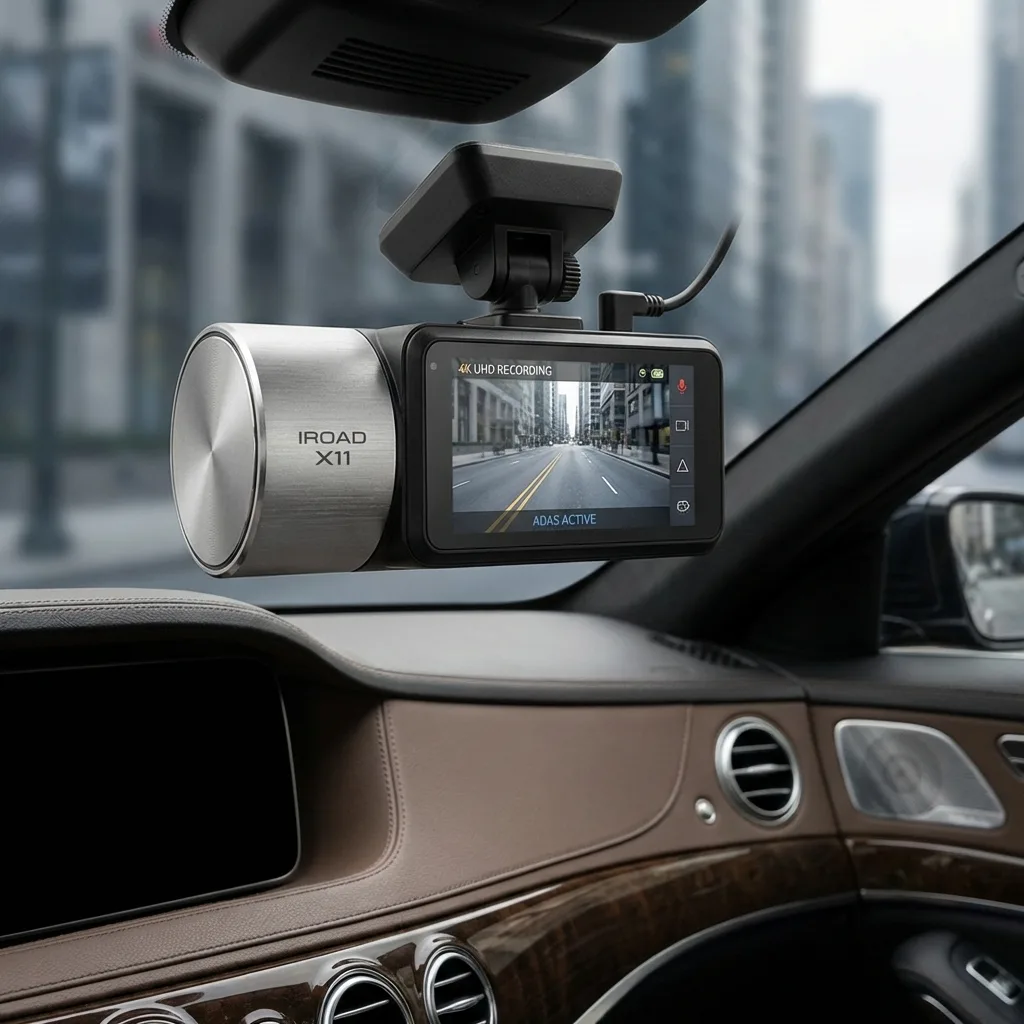
A Teltonika ADAS camera on the windscreen and an FMC125 tracker warn the driver when the vehicle drifts out of its lane without indicating, and pass the event on to the dispatcher.
A Teltonika ADAS camera on the windscreen and an FMC125 tracker warn the driver when the vehicle drifts out of its lane without indicating, and pass the event on to the dispatcher. A professional driver spends eight to ten hours behind the wheel, and sooner or later attention wanders: the phone, food, tiredness towards the end of a shift. Bans on using a phone at the wheel are in force almost everywhere, yet the number of crashes caused by inattention is not falling. The worst of them happen when the vehicle slides out of its lane into oncoming traffic or onto the verge without the driver noticing. In this case study Teltonika looks at how the LDW (Lane Departure Warning) function in the ADAS kit catches those moments, and why it is useful to a corporate fleet and not only to the driver.
What this scenario solves
Leaving your lane is one of the deadliest types of road traffic accident.
According to an estimate cited in an IATSS study, around 60% of fatal crashes worldwide involve an unintentional lane departure.
The main cause is a distracted driver who does not notice the vehicle wandering sideways.
A lorry that has crossed into oncoming traffic on a trunk road almost always means severe consequences.
Leaving your lane is one of the deadliest types of road traffic accident. According to an estimate cited in an IATSS study, around 60% of fatal crashes worldwide involve an unintentional lane departure. The main cause is a distracted driver who does not notice the vehicle wandering sideways. A lorry that has crossed into oncoming traffic on a trunk road almost always means severe consequences.
Figures from the United States show the scale. A lane departure warning system could prevent 6% of all road traffic accidents, 10% of injury crashes and 31% of fatal single-vehicle crashes. That amounts to roughly 297 thousand run-offs a year that could be avoided.
Almost everyone gets distracted. In a national survey of American drivers, 52.5% admitted to eating at the wheel, 23.6% to texting, 11.7% to taking photographs and 6.5% to putting on make-up. On average, at least 10% of time behind the wheel is spent with attention on the phone.
According to another survey quoted by ExxonMobil, more than 70% of drivers eat on the road and more than 83% drink beverages. While eating, reaction times slow by 44%; while drinking, by 22%. At 90 km/h those are extra metres that may be the ones you needed.
Fatigue adds its own share. A drowsy driver reacts more slowly, judges distance less well and can literally switch off for a couple of seconds. For a long-distance driver on a night leg this is not a theory.
The effect of LDW systems has been confirmed. In December 2020 the Insurance Institute for Highway Safety (IIHS) estimated that cars with such a system have 11% fewer single-vehicle, sideswipe and head-on crashes, and 21% fewer injury crashes of those same types.
Meanwhile the fleet manager has no tool for seeing the problem in advance. He finds out that a driver regularly wanders within the lane only after an accident. An ordinary tracker shows the route and the speed but cannot see where the vehicle sits inside its lane, and cannot tell a careful driver from one who spends half the journey steering one-handed.
For the company the consequences of such a crash go far beyond the repair bill. The vehicle stands idle, the load may not arrive on time, the insurer starts asking questions, and if anyone is injured the case drags on for months. Management spends a great deal of time investigating the incident, and often never manages to reconstruct what actually happened in the seconds before it.
What Teltonika offers
The ADAS camera watches the road, recognises the lane markings and, if the vehicle crosses a line with no indicator on, immediately gives the driver an audible and visual warning, while the FMC125 tracker sends the event to the server.
Installation and setup
Fitting the device and configuring it for the fleet scenario at hand.
Data transfer
The device collects data and sends it to the monitoring platform; how often depends on the model and its settings.
Analysis and control
The person in charge gets reports and alerts and looks into what stands out.
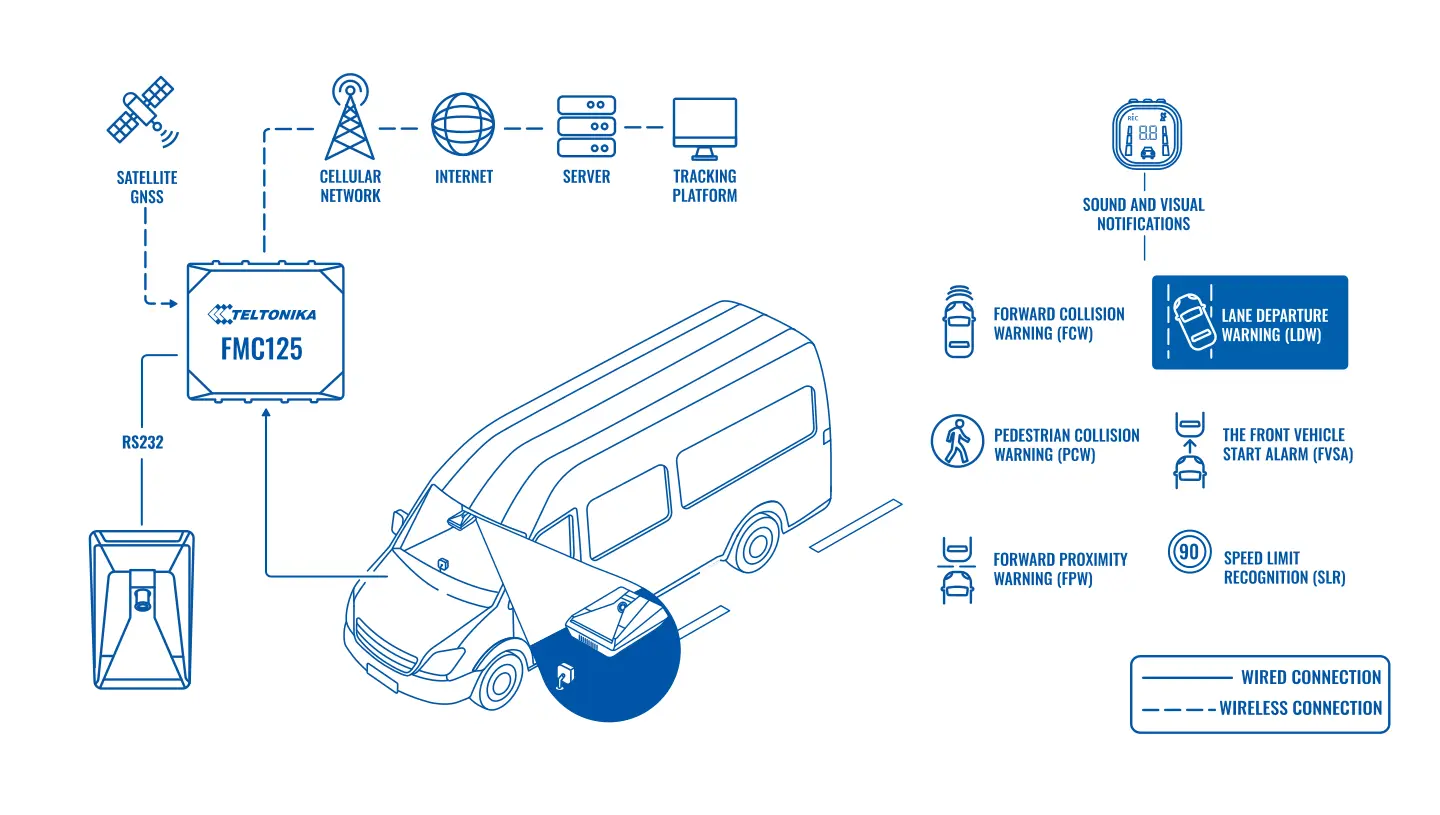
What the kit consists of. The Teltonika ADAS camera is mounted on the windscreen and connects to an FMC125 tracker from the professional range over an RS232 serial port. A small notification display goes on the dashboard; that is how the driver receives warnings. The tracker collects the events from the camera, adds coordinates, speed and time, and sends them to the server.
How LDW triggers. The camera keeps watch on the markings. If the vehicle begins to move into the adjacent lane and the indicator is not on, the system treats the manoeuvre as unintentional and warns the driver at once. If the indicator was on before the line was crossed, the event is ignored: the driver is changing lanes deliberately and there is no reason to nag him.
What else the camera can do. LDW is only one of the functions. The same kit includes forward collision warning, pedestrian warning, headway monitoring, a warning that the vehicle in front has moved off, and recognition of speed limit signs. It can be configured to suit the job: in some fleets everything is switched on, in others only LDW and headway.
Three typical situations LDW catches. The driver picks up the phone to answer a message and within a couple of seconds the vehicle has drifted towards the centre line — the display beeps and he steers back. The driver is eating on the move and gets distracted by the wrapper — the same warning. Towards the end of a long shift his eyes close for a second and the vehicle slides towards the verge — the warning wakes him.
What the dispatcher sees. Every trigger arrives at the server with a point on the map, a time and a speed. Out of that comes a picture for each driver: who leaves the lane once a week and who does it five times a run, on which sections and at what time of day. This is the basis for a conversation with the driver, for training or for changing the roster.
What working with the events looks like in practice. In the morning the manager opens the report for the previous day and sees, say, that one driver has twelve LDW triggers, all between two and four in the morning on the same leg. That is not grounds for a fine but a sign that the man is falling asleep at the wheel: the route should be rebuilt, a rest stop added or the shifts changed. Another driver's triggers are scattered through the day and coincide with moments when the vehicle is crawling through town. Most likely he is texting in traffic, and that calls for a different sort of conversation.
Setting the thresholds. LDW sensitivity depends on speed: at low speed in town, where vehicles constantly change lanes without indicating in dense traffic, the function is usually left off, while on the open road it works above a set minimum speed. That removes most false triggers and keeps the driver from being irritated.
Preparing the drivers. The system works best when the driver knows in advance what that display is and why it beeps. For the first few days the warnings feel like nit-picking, but after a couple of weeks most people start indicating automatically when changing lanes and keeping an eye on the lane, and the number of triggers drops noticeably.
A procedure for reacting to events. Nobody investigates a one-off LDW trigger. A sensible order of things is this: the system accumulates events, once a week the manager looks at the drivers with the highest number of triggers per 100 km, opens the specific episodes (time, place, speed) and decides what they are: fatigue on a night leg, a phone in traffic, or a badly calibrated camera. If a driver shows a spike immediately after installation, the first thing to check is the fitting, not the driver.
Servicing is remote. The firmware and configuration of the FMC125 can be updated through FOTA WEB without calling the vehicle in.
What you get
The driver learns about the departure straight away
The audible and visual warning on the display fires at the moment the marking is crossed, while there is still time to bring the vehicle calmly back into lane.
No false alarms when changing lanes
If the indicator is on, the system treats the manoeuvre as deliberate and stays quiet, so the driver does not get into the habit of ignoring warnings.
Risky drivers are visible in advance
Events accumulate in the reports, and the manager spots the problem from the frequency of triggers rather than from an accident report.
A basis for training and incentives
For each driver there are specific episodes with a place and a time, which can be discussed without arguments about whether it happened.
One camera for several jobs
Besides LDW, the same kit provides collision, pedestrian and headway warnings and speed sign recognition.
Fewer crashes and fewer associated costs
Every accident avoided saves on repairs, vehicle downtime, medical treatment and insurance.
Why this solution
The strength of this kit is that the camera and the tracker come from the same manufacturer and were designed to work together from the outset. The ADAS camera connects to the FMC125 over RS232, the tracker understands its events without additional gateways, and they reach the server together with ordinary telematics: coordinates, speed, ignition.
The FMC125 is a tracker from the Teltonika professional range with interfaces for external devices. Besides the camera, driver identification and sensors are connected to it, so one installation covers both monitoring and safety. Firmware and settings can be changed remotely through FOTA WEB.
The ADAS feature set is flexible. For long-distance lorries LDW and headway matter more; for city buses it is pedestrians and the vehicle in front moving off. Anything unnecessary is switched off so that the driver does not grow weary of warnings.
Data from the camera does not stay inside the vehicle. Every event, with coordinates and speed, reaches the server, where it can be set alongside the route, the shift times and other tracker data. That way you see not only the departure itself but what led up to it: how many hours the driver had already been at the wheel, what speed he was doing, whether there had been any stops.
An honest limitation: the camera needs visible markings. On roads where the lines are worn away or absent altogether, LDW works less well, and in heavy dust or a downpour recognition quality drops. The windscreen in front of the camera has to be kept clean.
One more point is the fitting. The camera has to be mounted exactly on the centre line and calibrated for the specific vehicle: the mounting height differs between a tractor unit, a van and a car, and that determines how accurately the camera judges the vehicle's position in the lane. A crookedly fitted camera produces both missed events and false alarms, so this is not the place to economise.
How this works in Azerbaijan. Lane departures happen most often on long monotonous legs: the M-2 from Baku via Ganja to Gazakh, the M-3 towards Astara, the M-1 to Guba and on to the Russian border. In summer there is heat of up to +40 °C on top of that, which leaves drivers badly tired by evening, while night runs by articulated lorries to Alat and back fall in the drowsiest hours. The markings on the main trunk roads are in good condition, so LDW works reliably there. On regional roads and in the mountains near Shamakhi and Guba the lines are worn away in places, and there the camera will be more useful for its headway and collision functions. When fitting the system we agree with the customer which warnings to enable, so that drivers do not switch the display off because of nagging beeps, and we explain to them in advance why the camera is there. GPS.az fits the FMC125 with the ADAS camera, configures the events and feeds them to the Wialon platform, where driver reports, alerts about frequent departures and a driving quality rating are built.
Related case studies
Related rollouts and equipment
Questions about the “ADAS: lane departure warning” scenario
Request a call
A specialist will call back and match a solution to your fleet and your task.