
Monitoring drivers' temperature with a wristband
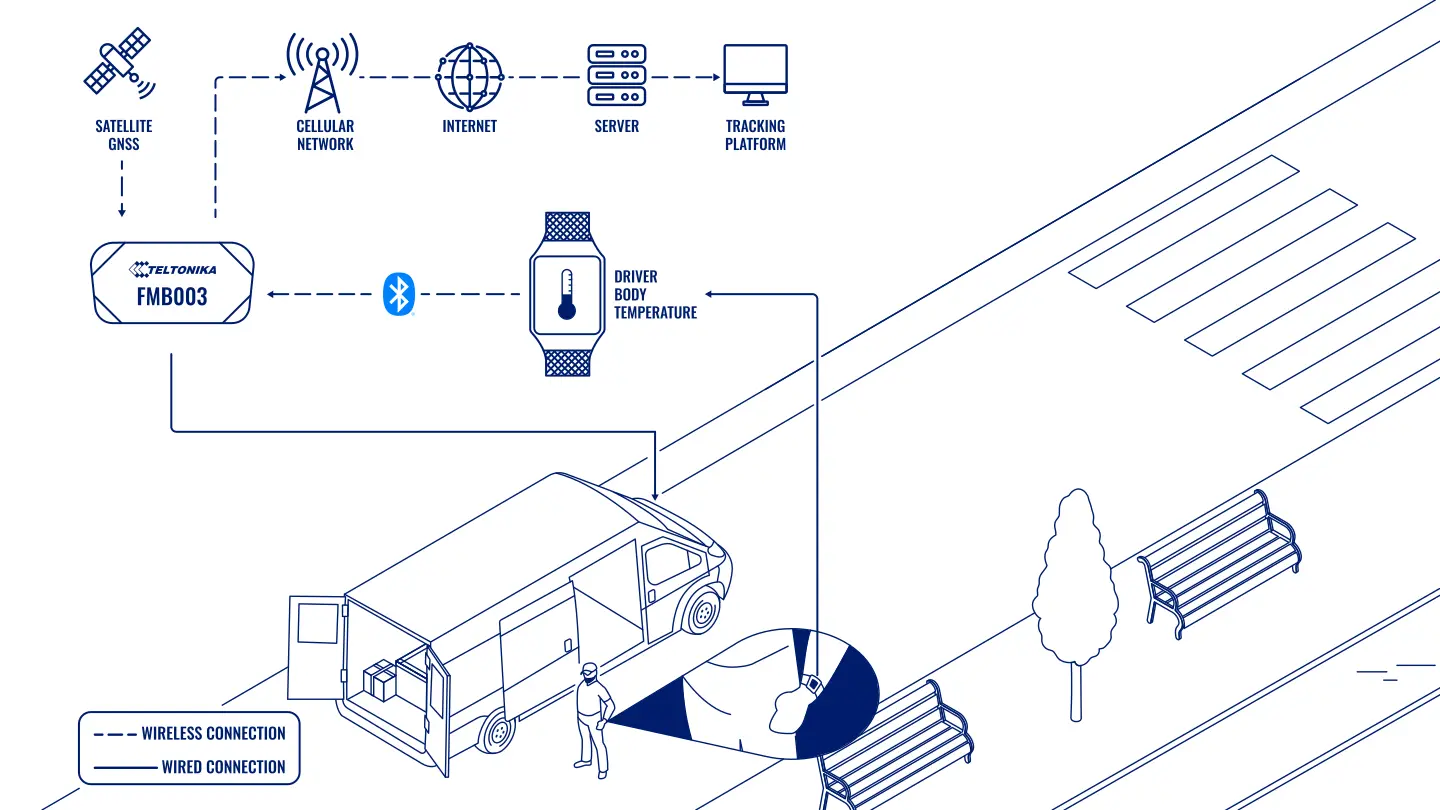
A smart watch or wristband with a temperature sensor connects over Bluetooth to the tracker in the vehicle (the FMB003 OBD tracker, in this case), and the driver's skin temperature goes to the server along with the journey data.
A smart watch or wristband with a temperature sensor connects over Bluetooth to the tracker in the vehicle (the FMB003 OBD tracker, in this case), and the driver's skin temperature goes to the server along with the journey data. The case dates from the COVID-19 pandemic, when many countries brought in compulsory daily temperature checks for staff, drivers included. For office staff a thermometer at the door settled it. For drivers who are out on runs for weeks at a time, it did not. Below is how Teltonika proposed to handle this with trackers already fitted and ordinary wearable electronics, and where the arrangement might still be useful today, now that pandemic restrictions have been lifted.
What this scenario solves
During the pandemic, employers had to check their staff's temperature every day.
Drivers at freight forwarding, courier and transport companies are hardly ever in the office.
Some of them work abroad for weeks, and checking them at the door is physically impossible.
What is needed is a way to get a temperature reading remotely, without a medic and without stopping work.
During the pandemic, employers had to check their staff's temperature every day. Drivers at freight forwarding, courier and transport companies are hardly ever in the office. Some of them work abroad for weeks, and checking them at the door is physically impossible. What is needed is a way to get a temperature reading remotely, without a medic and without stopping work.
The main COVID-19 symptoms were fever, a dry cough and shortness of breath. Temperature was the simplest sign by which illness could be spotted early, the person sent to a doctor, and passing the infection to colleagues, customers and passengers prevented.
In the office this was manageable: a contactless thermometer, protective equipment, a member of staff with no medical training after a short briefing, and an understanding of how such data should be stored. Doctors advised anyone with mild symptoms or after contact with a confirmed case to take their temperature at least twice a day.
With drivers it is harder. Freight forwarders, international hauliers, couriers, logistics operators, livestock carriers, taxis — all of them work on the road. Some do not call in at the depot for weeks, some are in another country. How do you check their temperature every day and at the same time respect the entry restrictions countries were introducing? Ringing up to ask how somebody feels is not a check.
What Teltonika offers
Teltonika proposed pairing ordinary wearable electronics with the tracker already fitted in the vehicle: the wristband measures skin temperature, passes it to the tracker over Bluetooth, and the tracker sends the data to the server along with GPS.
Installation and setup
Fitting the device and configuring it for the fleet scenario at hand.
Data transfer
The device collects data and sends it to the monitoring platform; how often depends on the model and its settings.
Analysis and control
The person in charge gets reports and alerts and looks into what stands out.
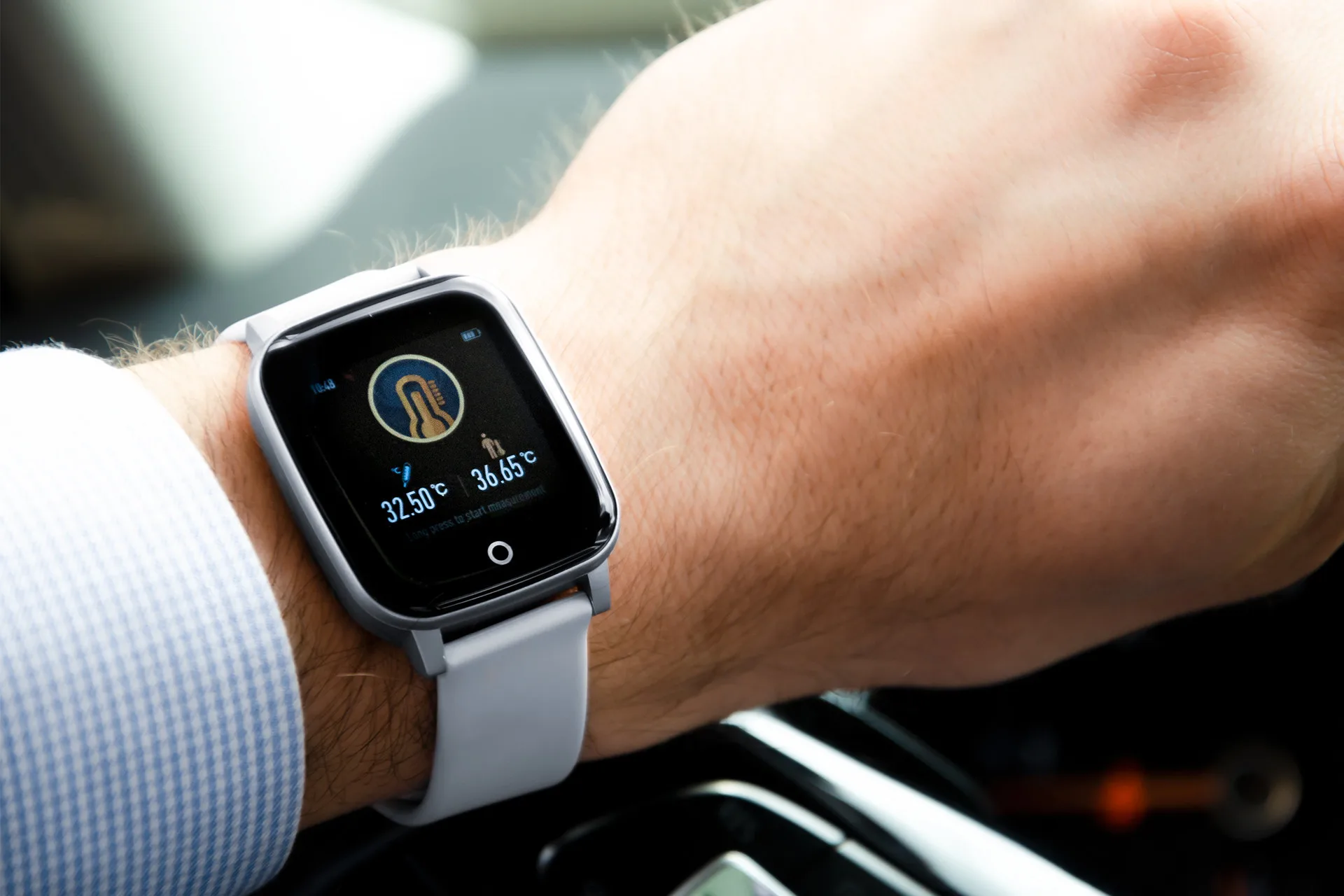
Where the wristband comes from. Fitness bands, smart watches and rings are made by plenty of manufacturers, and some models can measure skin temperature. Devices like these are designed to warn the wearer of a fever or another problem early and give them time to act. For a corporate fleet you need a model that can pass its readings on over Bluetooth Low Energy.
What it connects to. All Teltonika trackers support Bluetooth Low Energy, so practically any of them will do. The case uses the FMB003 as its example — a very compact tracker that plugs into the vehicle's OBD socket. Fitting takes a minute, with no wiring and no fitter.
How it works, step by step:
• the driver is issued a wristband or watch with a temperature sensor;
• the wristband is paired over Bluetooth with the tracker in his vehicle;
• at a set interval the wristband passes the skin temperature to the tracker — the interval depends on the model and its settings;
• the tracker sends the readings to the server over the mobile network along with position and journey data;
• the person responsible at the company sees each driver's temperature and gets an alert if it goes above a threshold.
What the company gets. Every driver's temperature is visible remotely and regularly, whether the person is in the next town or in another country. Nobody stops a run to take a reading. The company gets an early signal and can contact the driver in good time. A system like this does not replace a medical examination, nor does it establish compliance with medical-screening requirements.
An important qualification. The wristband measures skin temperature, not body temperature. It depends on the weather, on the cab air conditioning, on how snugly the strap sits. This is not a medical instrument and not a diagnosis, but a signal: if a driver's readings have been above his usual level for several hours, it is worth ringing him and sending him to a doctor.
Another point is personal data. Temperature is health information, and the driver has to know that it is being collected, why, and who sees it. The rules for storing such data and for access to it are written down in advance.
And a practical detail that often gets forgotten: the wristband needs charging. If the driver is out on a run for a week and the watch holds a charge for two or three days, there will be no data. So a model with a margin of battery life is chosen, and a charging cable is left in the cab. Loss of the Bluetooth link between wristband and tracker can also be made an event: the dispatcher sees that data has stopped arriving and reminds the driver.
What exactly is being measured, and how far to trust it. Accuracy and measurement frequency are set by the maker of the wristband, not by the tracker: the tracker only passes on what it received over Bluetooth. So the specifications are taken from the data sheet of the particular model rather than restated as properties of the system. The purpose of the measurement is an early signal for the person responsible, not a medical finding. No conclusions about health are drawn from a single reading: you look at a series of readings over several hours and compare them against that driver's usual values.
What the response looks like. Readings above the threshold come as an alert to the person responsible. He first checks whether it has to do with conditions in the cab or a badly fitting wristband, then rings the driver. If the driver confirms that he feels unwell, the decision on whether the run continues is taken by a manager together with a medic, not by the system.
Rules for employee data. Before the launch, put in writing: which readings are collected, who sees them (usually health and safety rather than the whole logistics department), how long they are kept and when they are deleted. The driver signs a consent form and knows how to switch the wristband off in his own time.
What you get
Checks without a trip to the depot
The temperature of drivers out on runs arrives at the server wherever they happen to be.
Works with trackers already fitted
If the vehicles have Teltonika trackers with Bluetooth, all you need to buy are the wristbands.
Suits any operator
Freight forwarders, couriers, international hauliers, taxis, livestock carriers.
The run is not interrupted
Readings are taken automatically and the driver spends no time on reports.
Free choice of wristband
Models from various manufacturers will do, as long as they pass temperature over Bluetooth Low Energy.
Less risk to the workforce
A driver falling ill is spotted sooner and sent to a doctor before he infects others.
Why this solution
Teltonika's strength here is Bluetooth Low Energy in every tracker. That means the solution needs no new hardware in the vehicle: it is enough to configure the tracker to accept data from the wristband. For a company with trackers already fitted, that is the cheapest route.
The FMB003 works well as an example because it plugs into the OBD socket with no wiring. But if a vehicle already has another Teltonika tracker, that will work too: cars, off-roaders, vans, lorries, buses, municipal and construction plant, taxis — the range covers almost every kind of vehicle.
Honestly, about today. Pandemic requirements were lifted long ago, and few operators are going to measure drivers' temperature on any scale now. But the underlying idea — a driver's wearable device passing data through the tracker — remains useful. The same channel is used for panic buttons, heart-rate bands for drivers on long runs, and sensors for lone workers.
How this works in Azerbaijan. Azerbaijan had quarantine restrictions during the pandemic too, and international hauliers carrying freight through Georgia, Russia, Iran and Turkey went through medical checks at the borders. Today the arrangement is mainly of interest for keeping an eye on how drivers are feeling on long runs: in summer a lorry cab on the M-2 or parked in the queue at the Red Bridge can get very hot, and a driver overheating is a real risk. When implementing this we check which wristband or watch can actually pass data over Bluetooth Low Energy — not all models allow it, and on many the data is only available in the manufacturer's phone app. GPS.az fits Teltonika trackers, configures them to receive data from Bluetooth sensors and feeds it into Wialon with alerts for the person responsible.
Related case studies
Related rollouts and equipment
Questions about the “Monitoring drivers' temperature with a wristband” scenario
Request a call
A specialist will call back and match a solution to your fleet and your task.