
Containers and site cabins on GPS: the TAT240 tracker
The self-contained TAT240 tracker goes onto site containers, cabins, waste bins and portable toilets on a magnet: once a day, or on every movement, it reports where the unit is, and it runs on its own battery for up to five years.
The self-contained TAT240 tracker goes onto site containers, cabins, waste bins and portable toilets on a magnet: once a day, or on every movement, it reports where the unit is, and it runs on its own battery for up to five years. Units like these stand unattended for months on sites, at customers' premises, on waste ground. They are moved from site to site, sometimes forgotten, sometimes taken away by other people. They have no mains supply, so an ordinary vehicle tracker is no use. Below is how Teltonika proposes to solve this, which settings strike the balance between how often data arrives and how long the battery lasts, and what to bear in mind in our conditions.
What this scenario solves
Containers and site cabins get stolen, and finding them afterwards is next to impossible.
There are often materials and tools inside, so the loss is made up of the value of the container and of its contents.
The units are constantly on the move, and paper records stop matching reality.
When a container is needed on a new site, people hunt for it by ringing round drivers and site managers.
Containers and site cabins get stolen, and finding them afterwards is next to impossible. There are often materials and tools inside, so the loss is made up of the value of the container and of its contents. The units are constantly on the move, and paper records stop matching reality. When a container is needed on a new site, people hunt for it by ringing round drivers and site managers.
The scale of the losses is considerable. In the USA alone, construction industry losses from theft are put at around 1 billion dollars a year. A missing container is not just the purchase of a new one but a wrecked schedule: the gang arrives on site and there is no cabin and no store for materials.
Companies that hire containers out or collect waste have a different but comparable problem. A bin was placed at a customer's premises, the customer moved out, the bin was shifted somewhere into a yard. A portable toilet was taken away from an event to the wrong place. Six months later the records show forty containers and only thirty-six can be found.
Manual checks do not work. On a large site a container can be moved without anyone noticing, and driving round every address once a week is expensive. What is needed is an arrangement in which each unit reports where it is by itself, requiring neither cables nor frequent battery changes.
What Teltonika offers
For this job Teltonika took the TAT240: a self-contained, battery-powered device that fixes with a magnet to the metal of the container and sends its location on a schedule, on movement or on command.
Installation and setup
Fitting the device and configuring it for the fleet scenario at hand.
Data transfer
The device collects data and sends it to the monitoring platform; how often depends on the model and its settings.
Analysis and control
The person in charge gets reports and alerts and looks into what stands out.
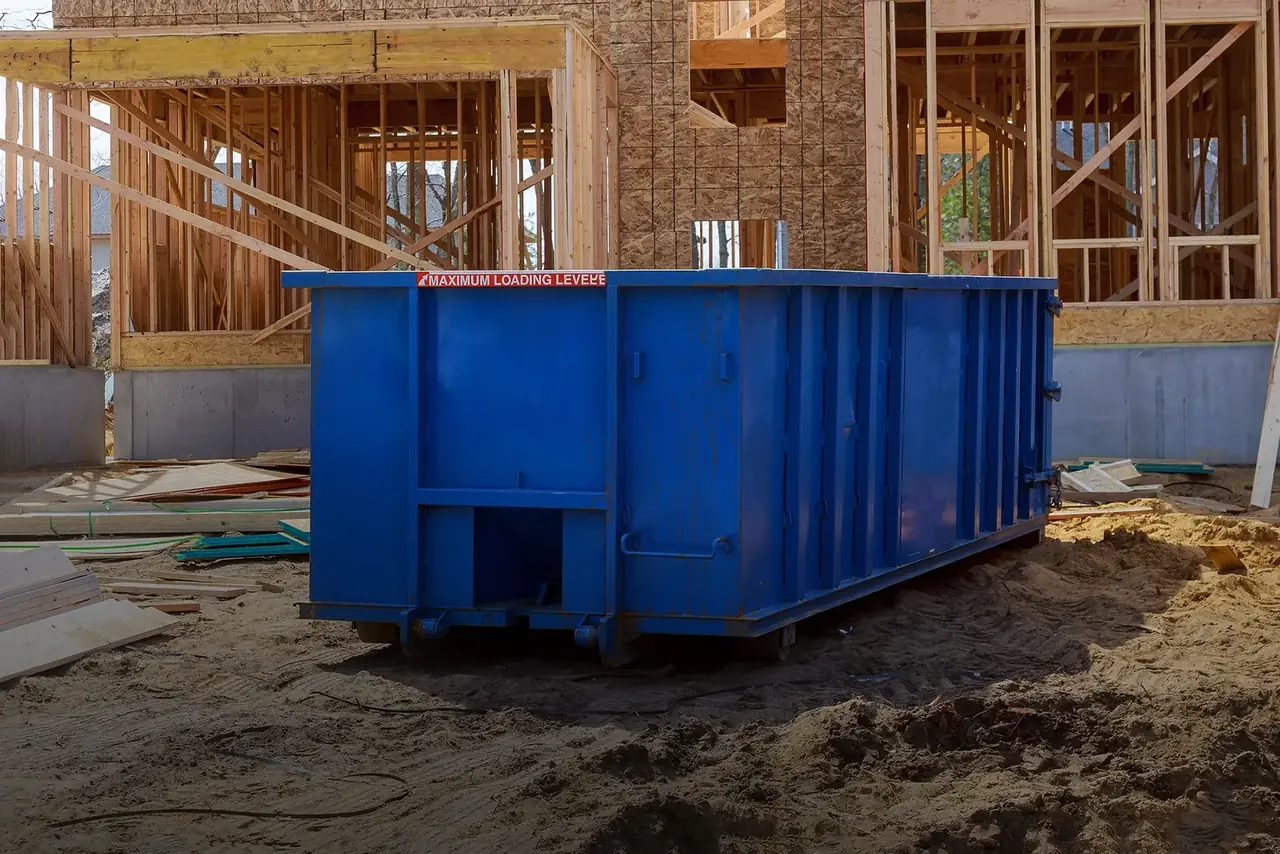
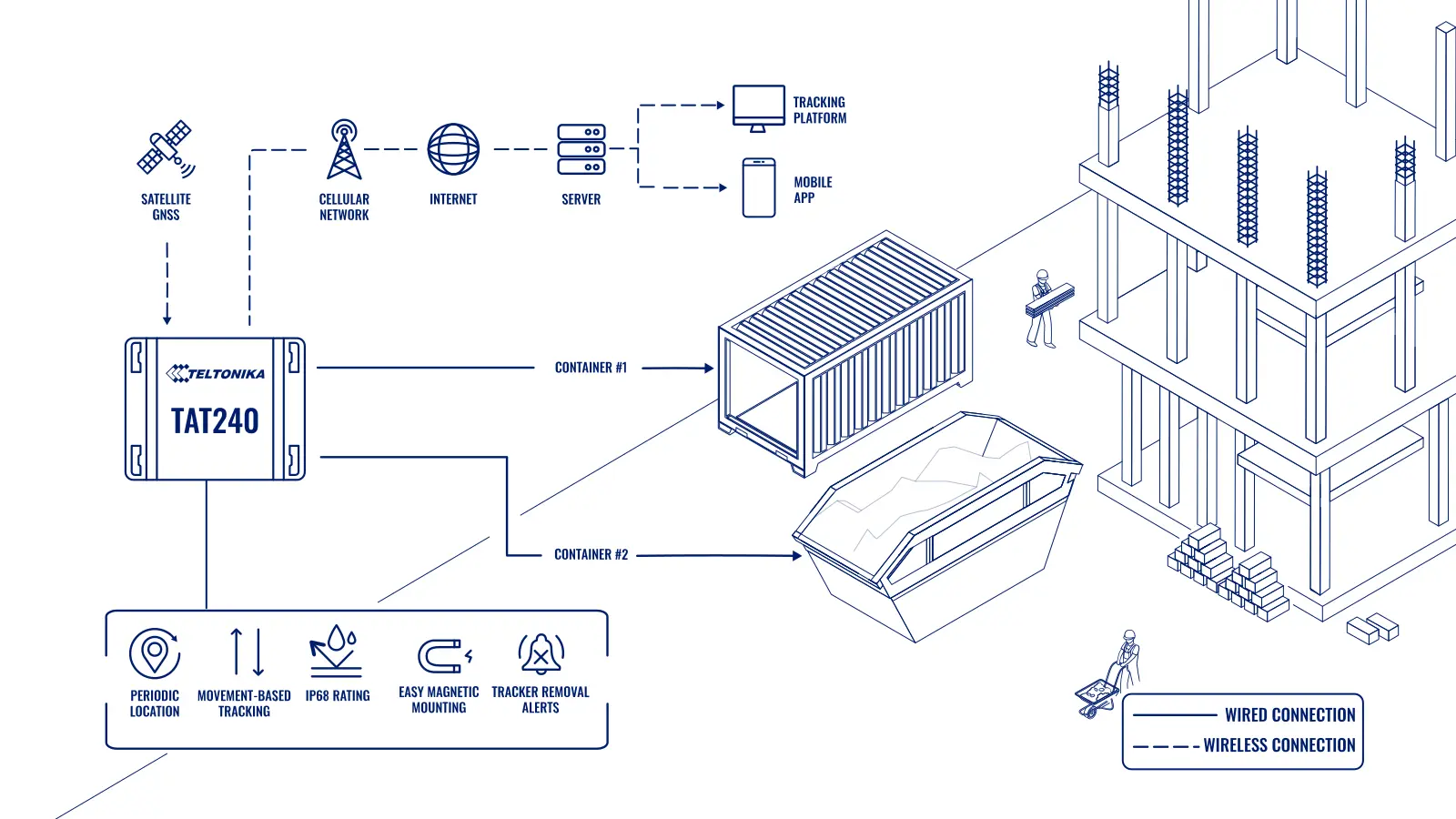
What can be configured. The TAT240 has several reporting modes, and they are combined to suit the particular unit:
• movement-based tracking — points come more often in transit, less often at a standstill;
• scheduled reporting — every working day at 17:00, for example;
• movement start and end events — the dispatcher knows at once that a container has been shifted and can react if that was not planned.
A tamper sensor guards against the tracker being removed: if the device is pulled off the container, a notification arrives. The magnetic mount comes in the box, so fitting takes a minute, and moving the tracker to another unit is just as easy.
The main question with self-contained trackers is how long the battery will last. Teltonika gives three typical scenarios.
Scenario 1: the container moves once a day for about ten minutes. Settings: movement events enabled, a point once an hour in transit (insurance against theft and a long haul), a point once a day at a standstill — at which the tracker also checks whether any commands are waiting for it, to switch on search mode for instance. Location by GNSS. Expected battery life — up to 3 years.
Scenario 2: the container moves once a week for about half an hour. Movement events and hourly reporting in transit stay, but reporting at a standstill is switched off. Instead, once a day the tracker checks in using the I am alive function and looks for commands. If necessary the dispatcher sends a command for an unscheduled position or for search mode with frequent points — the tracker will carry it out within a day at most. The battery lasts up to 4.5 years.
Scenario 3: movement once a month for an hour. The settings are the same as in the second case, and the life is up to 5 years.
An important caveat from the manufacturer: these are estimates for particular scenarios. The real life depends on how often the container actually travels, how good the GNSS and cellular signals are, what the ambient temperature is and how the tracker is fitted. Search mode after a theft is not allowed for in these figures — it uses the battery up faster.
How it looks to the dispatcher. Every container on the map, each with the time of its last report. A container moves at an odd hour — a notification. A container leaves the site geofence — likewise. The movement history shows where each unit stood and for how long, and that is already a basis for planning and for invoicing hire.
The cargo, not the vehicle. The tracker is attached to the container, so a change of carrier or a transfer to a train or a ferry makes no difference to it: the unit on the platform stays the same. But while the container is in a hold or in a tight stack, points may not come through, and the next one will appear when the tracker can see the sky and the network again.
A real-life example. A site cabin stands on a site out of town, the build is paused, nobody is there. In the early hours of Sunday the tracker registers the start of movement and sends the event. The dispatcher sees the notification in the morning, but there is already a position, and on command the tracker switches to search mode and starts reporting frequently. What follows is a matter for security and the police, but with an address to go to rather than an empty patch of ground on Monday.
And an ordinary, dull but useful case: the site manager asks for a cabin for a new site. The manager used to ring three sites to find out where there was a spare one. Now he opens the list, sees that one has stood on a completed site for a month without moving, and sends a lorry-mounted crane to fetch it.
What you get
Every unit reports where it is
Regular position reports with no driving round and no calls to site managers.
The site is not left waiting for a cabin
You can see which container is free and where it stands, and send it to the new site in good time.
Stolen property is easier to find
There is a last position, movement events and a search mode with frequent positions.
A battery that lasts years
Configuration to match the real movement pattern gives from 3 to 5 years of service without replacement.
Removing the tracker does not pass quietly
The tamper sensor sends a notification if the device is pulled off.
Fitting in a minute
The magnetic mount is in the box, and the tracker is easy to move to another unit.
Why this solution
The TAT240 is made for exactly these unpowered units: its own battery, a rugged housing, a magnetic mount, flexible reporting modes. Rather than simply promising years of service, the manufacturer gives specific configuration scenarios with an estimated life, and they make it easy to pick a mode for your own container fleet.
Teltonika's range of asset trackers is broad, so for a different scenario — more frequent reporting or a concealed installation, say — you can take a neighbouring model and work with it in the same Configurator.
What to bear in mind. A satellite signal will not pass through the inside of a metal container, so the tracker goes on the outside or in a spot with a clear view of the sky. On containers standing in stacks at a port the GNSS position will be worse than on open ground. The magnet holds firmly, but as protection against theft the tracker is better fixed where it is not visible at first glance.
How this works in Azerbaijan. Such trackers are needed most by construction contractors with site cabins and container stores on sites in Baku, Sumgait and the reconstruction projects in Karabakh, by companies that hire out modular buildings and toilets for events, and by municipal services with a fleet of waste containers. A topic in its own right is containers carried through the port of Alat and onwards by the BTK railway: there it matters at least to know the time of arrival and the last position. In summer a container in the sun gets very hot, and heat shortens battery life, so the tracker goes on the shaded side. In the mountains, where there is no cellular coverage, the report will go out at the next check-in. GPS.az chooses settings to match how your containers actually move and brings them into Wialon with site geofences and notifications about unauthorised movement.
Related case studies
Related rollouts and equipment


Questions about the “Containers and site cabins on GPS: the TAT240 tracker” scenario
Request a call
A specialist will call back and match a solution to your fleet and your task.